Tag: Stokowski

  • Khachaturian’s Symphony No 2 A Lost Chord Rediscovery

    Khachaturian’s Symphony No 2 A Lost Chord Rediscovery

    Anxious about current events?

    Join me on “The Lost Chord” for Leopold Stokowski’s rarely-heard recording of Aram Khachaturian’s Symphony No. 2.

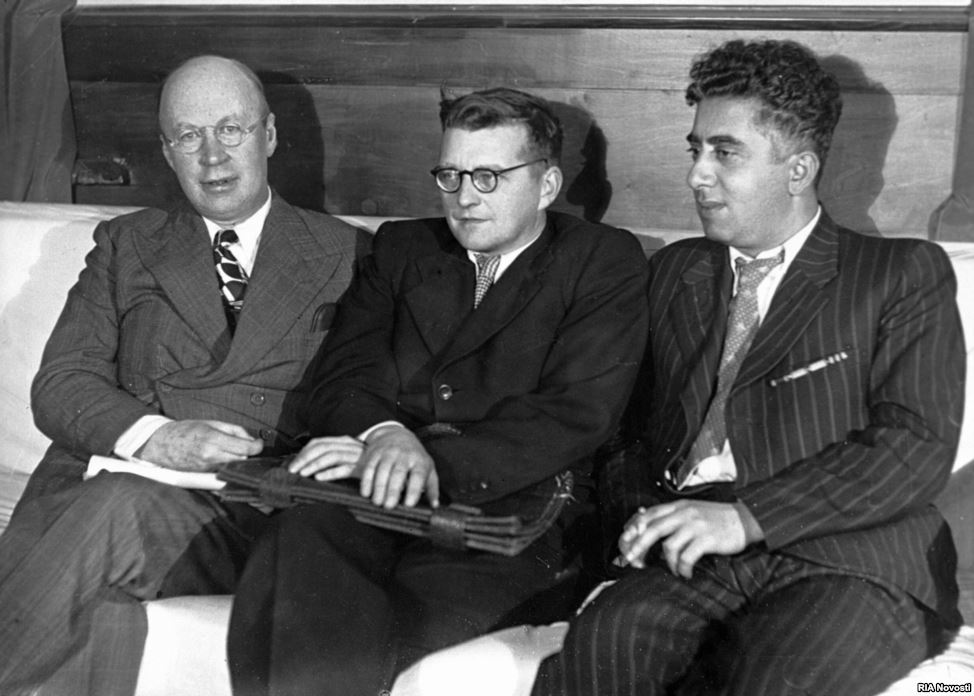
    Khachaturian composed the work in 1943, the height of World War II, while holed up at a Composers Union retreat with Shostakovich, Prokofiev, Miaskovsky, and Glière. He described the piece as “a requiem of protest against war and violence.” Its nickname, “The Bell,” alludes to a kind of alarm that opens and closes the work. Overall, the tone is one of unshakable resolve in the face of tragedy.

    Stokowski’s recording, long unavailable, was originally issued on United Artists Records in the late 1950s. It reappeared briefly on compact disc, on the EMI label, in 1994, and again in 2009, as part of a 10-disc box set of entrancing Stokowski performances.

    Alas, the master tapes have not weathered the years well, so there are moments of distortion, but the power of the work under Stokowski’s direction transcends any technical limitations.

    To round out the hour, we’ll hear Russian-born pianist Nadia Reisenberg in a selection from her 1947 Carnegie Hall recital, Khachaturian’s most famous piano piece, the “Toccata.” Reisenberg studied at Philadelphia’s Curtis Institute of Music under Josef Hoffman.

    I hope you’ll join me for music by Khachaturian other than the “Sabre Dance.” That’s “Khach as Catch Can,” on “The Lost Chord,” now in syndication on KWAX, the radio station of the University of Oregon.


    Clip and save the start times for all three of my recorded shows:

    PICTURE PERFECT, the movie music show – Friday at 8:00 PM EST/5:00 PM PST

    SWEETNESS AND LIGHT, the light music program – ALL NEW! – Saturday at 11:00 AM EST/8:00 AM PST

    THE LOST CHORD, unusual and neglected rep – Saturday at 7:00 PM EST/4:00 PM PST

    Stream them, wherever you are, at the link!

    https://kwax.uoregon.edu/


    “Sabre Dance” at the Bolshoi, with Khachaturian conducting:

    PHOTO: Troika! (Right to left) Khachaturian with Shostakovich and Prokofiev

  • Parsifal Good Friday Music from Wagner & Stokowski

    Parsifal Good Friday Music from Wagner & Stokowski

    For Good Friday, here’s my annual posting of Leopold Stokowski’s sublime Houston recording of the “Good Friday Spell” from Wagner’s “Parsifal.”

    As an added bonus, enjoy a fascinating 1927 recording of the Transformation Music and Grail Scene from Act I, set down at the Bayreuth Festspielhaus. The recording employs the original bells designed by Wagner, which were later melted down by the Nazis for ammunition during World War II. A rare opportunity to experience “Parsifal” as Wagner actually knew it. (The bells begin at 5:57.)

    Muck had been associated with the Bayreuth Festival since 1892. He became its principal conductor in 1903. Between 1901 and 1930, he conducted “Parsifal” at Bayreuth 14 times.


    IMAGE: Set design by Paul von Joukowsky for the 1882 Bayreuth debut of “Parsifal”

  • Stokowski Strauss Hindemith Marlboro School

    Stokowski Strauss Hindemith Marlboro School

    He shook hands with Mickey Mouse, married Gloria Vanderbilt, and signed a ten-year recording contract at the age of 90. Why, it’s LEOPOLD! Join me this afternoon at 4:00 on The Classical Network as we dip a toe into the recorded legacy of Leopold Stokowski, on his birthday.

    It’s also the anniversary of the birth of famed film composer Miklós Rózsa. Rózsa titled his autobiography “A Double Life.” Following his lead, we’ll hear examples of both his film and concert music. And I suppose – Franz von Suppé also having been born on this date – we’ll toss in one of Suppé’s frothy overtures, as well. Like Stokowski, Suppé got a fair amount of mileage out of being parodied in cartoons, so we should all be thankful for the movies, for having granted wide exposure to all three of today’s birthday celebrants.

    At 6:00, it’s another “Music from Marlboro.” This week, we’ll hear works by two composers of German origin, who travelled very different routes, Richard Strauss (1864-1949) and Paul Hindemith (1895-1963).

    Both men found much notoriety as nerve-shattering iconoclasts – Strauss with his operas “Salome” and “Elektra” and Hindemith with his raucous works of the 1920s. Then they settled into respectability, Strauss ageing into the elder statesman of Romantic opulence, and Hindemith becoming an influential teacher at Yale. The two men chose different paths during the Nazi Regime. Hindemith, denounced as an “atonal noisemaker” by Goebels, left for America, by way of Switzerland and Turkey, while Strauss, in his 70s with the outbreak of war, remained at home, hoping to preserve and promote German music and to protect his Jewish daughter-in-law and grandchildren. While understanding Strauss’ importance as a propaganda tool, Goebels wasn’t too fond of his music, either, referring to him privately as a “decadent neurotic.”

    But we’ll avoid all that, and instead listen to Strauss at the very beginning of his career, in 1883-84, and a Piano Quartet in C minor completed at the age of 20. Interestingly for this composer who became celebrated for the apotheosis of the lavish tone poem, Strauss here channels his admiration for Johannes Brahms, and in a genre not generally associated with a follower of the post-Wagnerian “New Music School.” Brahms was at the height of his fame while the young Strauss was living in Berlin. In fact, Strauss attended the premiere of Brahms’ Fourth Symphony. This performance of the Piano Quartet promises to be a very special one, with Walter Klien at the keyboard, heard at the 1972 Marlboro Music Festival, in his early 40s and at the peak of his powers.

    Hindemith was evidently feeling his oats when he launched into his series of Kammermusiken, 20th century analogues to the Bach Brandenburg Concertos, but with a little bit of an ironic edge. Hindemith was about 26 when he wrote his exuberant Kammermusik No. 1, in 1922, the piece sounding like a post-modern mash-up of “Petrushka,” the Rondo-Burleske from Mahler’s Ninth Symphony, and hot jazz. Watch out for that siren! The performance, from 2016, will feature an ensemble of 12 Marlboro musicians under the direction of another great pianist, Leon Fleisher.

    Two young composers show what they can do, one in reverence and the other evidently not, on “Music from Marlboro,” this Wednesday evening at 6:00 EDT, on WWFM – The Classical Network and wwfm.org.

    Marlboro School of Music and Festival: Official Page

  • Stokowski & Mozart on The Classical Network

    Stokowski & Mozart on The Classical Network

    Get ready to get Stoked!

    Today is the birthday of Leopold Stokowski (1882-1977), legendary music director of the Philadelphia Orchestra and the Houston Symphony, chief conductor of the NBC Symphony/the Symphony of the Air, chief guest conductor of the New York Philharmonic, and founder of the All-American Youth Orchestra, the New York City Symphony Orchestra, and the American Symphony Orchestra.

    A consummate showman, Stokowski was often dismissed as a charlatan. He could resort to a magic trunk full of tricks, ostentatiously tossing away sheet music to demonstrate that he didn’t need to conduct from a score, eschewing a baton to accentuate his expressive hand movements, and employing dramatic lighting effects to cast long shadows while he was on the podium.

    His theatricality may have raised a few eyebrows, and there is no doubt that his popularity was envied. But Stokowski might be said to have laughed all the way to the bank. How many conductors were well enough known by the general public to have been parodied by Bugs Bunny or to have enjoyed an onscreen handshake with Mickey Mouse?

    Say what you want about his sense of style, the man certainly knew his way around an orchestra, and he wasn’t afraid to try something new to achieve unique sonorities. He was also fascinated by recorded sound and remained at the cutting edge of developing technology, often pushing the frontier himself, throughout his long career. In addition, he gave the world and U.S. premieres of dozens of works that have gone on to become imperishable classics.

    This Tuesday afternoon on The Classical Network, following our Noontime Concert and until 4 p.m., we’ll enjoy a representative cross-section of recordings Stokowski made both in the studio and from live concert performances, including his own arrangement of Mussorgsky’s “Pictures at an Exhibition.”

    At 12:00, we’ll have the perfect counterbalance to Stokowski’s excess: a Harvard performance, captured in June of 2014, of Wolfgang Amadeus Mozart’s opera, “Il re pastore” (The Shepherd King). The period instrument ensemble Grand Harmonie will present this 1775 “serenata,” a setting of a libretto by Metastasio, which in turn was based on Tasso’s 1573 play, “Aminta.” The opera explores the conflict of the demands of love versus the demands of kingship. Mozart was 19 at the time of the work’s composition. In retrospect, some of the elements could be said to look ahead to “Idomeneo” and “La clemenza di Tito.”

    Grand Harmonie will take part in a recreation of the musical world of Philadelphia in 1776 with a concert at the Powel House, 244 S. 3rd St., in Philly, on Thursday at 7:30 p.m. Also participating in this all-Mozart affair will be The Franklin Quartet and mezzo-soprano Julia Mintzer.

    Other concerts of interest include Harvard performances of Haydn’s “The Creation” with the Harvard University Choir, on April 29, and Mendelssohn’s Symphony No. 2, “Lobegesang,” with the Harvard-Radcliffe Chorus, on May 5.

    Grand Harmonie will collaborate with On Site Opera for a production of Mozart’s “La finta giardiniera” (The Secret Gardener) at West Side Community Garden, 123 West 89th St., in New York City, May 11-13. For more information, visit the ensemble’s website at http://www.grandharmonie.org.

    It’s all Wolfgang and Leopold this afternoon, from noon to 4 EDT, on WWFM – The Classical Network and wwfm.org.

  • Rediscovering Loeffler’s Pagan Poem on WWFM

    Rediscovering Loeffler’s Pagan Poem on WWFM

    This afternoon on The Classical Network, you’ll have a chance to affirm your lofty love for Loeffler.

    What’s that? At best, you dimly recollect his music?

    Charles Martin Loeffler was born on this date in 1861; he died in 1935. Though he long claimed to be of Alsation birth, in actuality he was born outside Berlin. The composer turned against Germany after his father died in prison, where he had been sent for his subversive writings, when Loeffler was only 12 years-old.

    Loeffler was a fastidious artist, who cut his teeth in Berlin and Paris, and indeed he is frequently identified as French-American. He settled in Boston in 1881, where he shared the first desk with the concertmaster of the Boston Symphony Orchestra and became an important figure in the city’s musical life. A man of wide culture and refined taste, he founded the Boston Opera Company. In 1887, he left the Symphony to devote himself wholly to composition.

    I hope you’ll join me for Loeffler’s symphonic poem of 1906, titled “A Pagan Poem.” The work is inspired by the eighth Eclogue of Virgil, in which a maiden of Thessaly, abandoned by her lover, revives his ardor through the use of sorcery.

    The work was first performed by the Boston Symphony, under Karl Muck. It was later championed by Leopold Stokowski, who recorded it for EMI. The piano plays such a prominent role, the piece sounds at times as if it may be a piano concerto. We’ll hear pianist Robert Hunter, and also English hornist William Kosinski.

    You can enjoy it today, between 4 & 7:00 EST, on WWFM – The Classical Network or at wwfm.org.


    PHOTO: Loeffler (left) and Stokowski – who’s the true pagan here?

Tag Cloud

Aaron Copland (92) Beethoven (94) Composer (114) Conductor (84) Film Music (109) Film Score (143) Film Scores (255) Halloween (94) John Williams (184) KWAX (228) Leonard Bernstein (98) Marlboro Music Festival (125) Movie Music (124) Opera (196) Philadelphia Orchestra (85) Picture Perfect (174) Princeton Symphony Orchestra (106) Radio (86) Ross Amico (244) Roy's Tie-Dye Sci-Fi Corner (290) The Classical Network (101) The Lost Chord (268) Vaughan Williams (98) WPRB (396) WWFM (881)

DON’T MISS A BEAT

Receive a weekly digest every Sunday at noon by signing up here


RECENT POSTS