Tag: Picture Perfect

  • Film noir on “Picture Perfect”

    Film noir on “Picture Perfect”

    This week on “Picture Perfect,” as the shadows lengthen, we revisit the world of film noir, a genre notoriously slippery to define, but easy to know when you see it – with its long shadows and moral ambiguities; cock-eyed camera angles and snappy repartee; isolation and innuendo. It’s a genre wherein a pair of gams is an invitation to the gallows; wherein a man’s best friend – and sometimes his worst enemy – is his Colt .38, wherein only cigarettes and bourbon can ease the pain.

    The labyrinthine mystery at the heart of “The Big Sleep” (1946) is so disorienting, even the book’s author, Raymond Chandler, couldn’t tell whodunit. Who cares? Humphrey Bogart and Lauren Bacall get some more steamy dialogue to satisfy fans of “To Have and Have Not,” and there’s plenty of Bogie pounding the pavement and tossing off tart one-liners in pursuit of the truth. But my favorite scene involves Dorothy Malone, who runs the hottest bookstore in town.

    Whenever there are gallows to be built or gangsters to be beaten, Warner Bros. could be counted on to assign Max Steiner.

    “Touch of Evil” (1958) is often considered to be the last of the classic noirs. Yet another brilliant feature by Orson Welles, it was taken out of the master’s hands and re-edited by the studio. The film was restored only in 1998, to bring it closer to Welles’ original design.

    If you can get past Charlton Heston as a Mexican, “Touch of Evil” is one of the director’s best films. Welles himself is unforgettable as corrupt police captain Hank Quinlan. He’s joined by Janet Leigh, Joseph Calleia, Akim Tamiroff, and Marlene Dietrich, against a rogues’ gallery of memorable hoodlums and lowlifes.

    The film is celebrated, for, among things, a sustained and fluidly-executed tracking shot, which spans over three minutes – an eternity in film – documenting two threads of overlapping action. The score, by Henry Mancini, is equally arresting, as it often seems as if it’s diegetic – whatever music happens to be playing on a radio or in a nightclub – lending its own counterpoint to the seedy drama.

    “Chinatown” (1974) is one of the best of the neo-noirs of the 1970s. Jack Nicholson plays private dick J.J. Gittes, who takes on a seemingly routine case that begins to spiral out of control. When producer Robert Evans rejected Philip Lambro’s original score, Jerry Goldsmith stepped in as a last-minute replacement. The composer was hired with the understanding that he had only ten days to write and record new music. For his effort, Goldsmith received an Academy Award nomination.

    Finally, we’ll have music by the king of noir composers, Miklós Rózsa. Before he came to be stereotyped for his work on epic films like “Ben-Hur,” “King of Kings” and “El Cid,” Rózsa provided scores for genre classics such as “The Strange Love of Martha Ivers,” “The Killers, “Brute Force,” and “The Naked City.”

    We’ll hear an extended suite from “Double Indemnity” (1944). Sultry Barbara Stanwyck ensnares insurance salesman Fred MacMurray in a plot to bump off her husband for the insurance money, sparking an investigation by MacMurray’s boss, Edward G. Robinson. Director Billy Wilder shows how it should be done, in one of the high-water marks of the genre.

    Put on your rumpled linen suit, draw the Venetian blinds, and play the sap for nobody. We’ve got a nose for noir this week, on “Picture Perfect,” music for the movies, now in syndication on KWAX, the radio station of the University of Oregon!

    ——–

    Clip and save the start times for all three of my recorded shows:

    PICTURE PERFECT, the movie music show – Friday at 8:00 PM EST/5:00 PM PST

    SWEETNESS AND LIGHT, the light music program – Saturday at 11:00 AM EST/8:00 AM PST

    THE LOST CHORD, unusual and neglected rep – Saturday at 7:00 PM EST/4:00 PM PST

    Stream them, wherever you are, at the link!

    https://kwax.uoregon.edu

  • Herrmann’s Fantasy Film Scores for Halloween

    Herrmann’s Fantasy Film Scores for Halloween

    Hallowe’en is fast approaching. This week on “Picture Perfect,” it’s high time we get the pumpkin rolling, with an hour of fantasy film scores of Bernard Herrmann.

    Just about everyone has some awareness of Herrmann’s fruitful run with Alfred Hitchcock, a collaborative relationship which yielded scores to “Vertigo,” “North by Northwest” and “Psycho,” among others. Concurrently, Herrmann worked with producer Charles H. Schneer to create a series of classic films on fantastic subjects, featuring special effects by stop-motion maestro Ray Harryhausen. We’ll be listening to selections from two of these.

    Jules Vernes’ novel, “Mysterious Island,” was a sequel of sorts to “20,000 Leagues under the Sea.“ During the American Civil War, a ragtag band of Union soldiers escape from a Confederate prison by hot air balloon. A storm sweeps them off to the titular island, where they encounter pirates, a castaway, and an orangutan. Indeed Captain Nemo turns up late in the narrative, though no giant creatures, as in the film (made in 1961). Herrmann has a field day characterizing an enormous crab, bee, and especially bird, for which he employs a fugue!

    Harryhausen’s skeleton fight from Schneer’s “Jason and the Argonauts” (1963) stands as one of the all-time classic fantasy sequences, a dream marriage of visuals and music. Herrmann, who always provided his own orchestrations, was well known for putting together unique combinations of instruments, the better to illustrate the special character of a given film. In the case of “Jason,” he went in the opposite direction from what he had taken with “Psycho,” stripping away the strings and concentrating instead on winds, brass and percussion.

    On a somewhat gentler note, Herrmann scored the beautiful spectral romance, “The Ghost and Mrs. Muir” (1947), with Gene Tierney as a young widow who moves with her daughter to a seaside village, where she encounters the ghost of salty Captain Gregg (played by Rex Harrison). Of course, their banter leads to a hopeless attraction developing between them. Herrmann was a master at creating musical evocations of yearning, and his score for “The Ghost and Mrs. Muir” is full of romantic longing.

    Criminally, for a composer whose career spanned over four decades, from “Citizen Kane” to “Taxi Driver,” Herrmann received only a single Oscar, for “The Devil and Daniel Webster” (released in 1941 as “All That Money Can Buy”). Walter Huston makes a meal of his role as Mr. Scratch in Stephen Vincent Benét’s recasting of the Faust legend, transferred to the New England countryside. Director William Dieterle, who had his roots in German Expressionism, creates some truly eerie visuals, and Herrmann’s score barn-dances deftly back and forth between dread and whimsy.

    Join me for fantasy film scores of Bernard Herrmann this week on “Picture Perfect,” music for the movies, now in syndication on KWAX, the radio station of the University of Oregon!


    Clip and save the start times for all three of my recorded shows:

    PICTURE PERFECT, the movie music show – Friday at 8:00 PM EDT/5:00 PM PDT

    SWEETNESS AND LIGHT, the light music program – Saturday at 11:00 AM EDT/8:00 AM PDT

    THE LOST CHORD, unusual and neglected rep – Saturday at 7:00 PM EDT/4:00 PM PDT

    Stream them, wherever you are, at the link!

    https://kwax.uoregon.edu/

  • Tall Ships Movie Music Picture Perfect on KWAX

    Tall Ships Movie Music Picture Perfect on KWAX

    Summer vacation may be winding down, but it’s never too late to run away to sea. This week on “Picture Perfect,” we listen to music from movies featuring tall ships.

    Though Gregory Peck cuts a dashing figure as “Captain Horatio Hornblower” (1951), the movie itself is a bit episodic, adapted as it was from three of C.S. Forester’s Hornblower novels. Canadian-born master of British light music Robert Farnon wrote the music, lending another dimension to this nautical adventure.

    Alan Ladd and James Mason engage in a battle of wills in “Botany Bay” (1953). Ladd plays a doctor wrongly accused of a crime, being transported to a penal colony in New South Wales on a ship under the harsh command of Mason. In perhaps the film’s most memorable sequence, Mason has one of his charges keelhauled. Franz Waxman wrote the score.

    If it all sounds a mite familiar, it’s because the story was by Charles Nordhoff and James Norman Hall, authors of “Mutiny on the Bounty.” The classic film version dates from 1935, with Clark Gable butting up against Charles Laughton’s Captain Bligh. The 1962 version bears a certain notoriety, mostly for Marlon Brando’s eccentric performance, which turns Fletcher Christian into a fop, and the fact that he essentially directed all his own scenes himself. The film was colossal failure, earning back only $13 million of its $19 million budget. Nonetheless, it managed to inspire Bronislau Kaper to compose one of his most monumental scores.

    Finally, we’ll hear music from a release on Sepia Records of the soundtrack to “Windjammer” (1958), the only film shot using the Cinemiracle process. The film documents the round-trip, transatlantic journey of a Norwegian vessel from from Oslo to the Caribbean to New York to Portsmouth, New Hampshire, and then back home again. Morton Gould wrote the evocative score, which alternates dance rhythms and sea shanties with a recurring melody suggestive of the sweeping romance of the high seas.

    Join me as we recommission these tall ships on “Picture Perfect,” music for the movies, now in syndication on KWAX, the radio station of the University of Oregon!


    Clip and save the start times for all three of my recorded shows:

    PICTURE PERFECT, the movie music show – Friday at 8:00 PM EDT/5:00 PM PDT

    SWEETNESS AND LIGHT, the light music program – Saturday at 11:00 AM EDT/8:00 AM PDT

    THE LOST CHORD, unusual and neglected rep – Saturday at 7:00 PM EDT/4:00 PM PDT

    Stream them, wherever you are, at the link!

    https://kwax.uoregon.edu/

  • Gulliver’s Travels Movie Music & More on KWAX

    Gulliver’s Travels Movie Music & More on KWAX

    I haven’t had time to post today, because I had some deadlines to meet and then I had to hightail it up to the Bard Music Festival for the opening night of “Martinů and His World” — music of Bohuslav Martinů and friends at Bard College. So I’ll just interject briefly that today is the birthday of film composer Victor Young. Some of my favorite Young scores include those for “Scaramouche,” “The Quiet Man,” and “Around the World in 80 Days.”

    This week on “Picture Perfect,” however, we’ll enjoy selections from his score to the Fleischer Brothers’ production of “Gulliver’s Travels” (1939). Based on the novel by Jonathan Swift, the film was given the greenlight thanks to the success of Walt Disney’s “Snow White and the Seven Dwarfs.” The brothers, responsible for those classic “Popeye,” “Betty Boop,” and “Superman” cartoon shorts, here may have bitten off more than they could chew with this, their only animated feature.

    Victor Young’s music will be bookended by that of Bernard Herrmann for “The Three Worlds of Gulliver” (1960), a film also notable for its special effects by legendary stop-motion animator Ray Harryhausen, and John Addison’s riotous score for Tony Richardson’s picaresque romp “Tom Jones” (1963), based on the novel by Henry Fielding.

    You don’t have to be Lilliputian to find these big shoes to fill. It’s music from movies inspired by two beloved 18th century British literary classics, on “Picture Perfect,” music for the movies, now in syndication on KWAX, the radio station of the University of Oregon!


    Clip and save the start times for all three of my recorded shows:
    PICTURE PERFECT, the movie music show – Friday at 8:00 PM EDT/5:00 PM PDT

    SWEETNESS AND LIGHT, the light music program – Saturday at 11:00 AM EDT/8:00 AM PDT

    THE LOST CHORD, unusual and neglected rep – Saturday at 7:00 PM EDT/4:00 PM PDT

    Stream them, wherever you are, at the link!
    https://kwax.uoregon.edu/

  • Big Country Jerome Moross Picture Perfect

    Big Country Jerome Moross Picture Perfect

    August starts BIG this week, on “Picture Perfect,” as we hit the sundrenched plains and wide-open spaces, with music from outsized movies set in the American West.

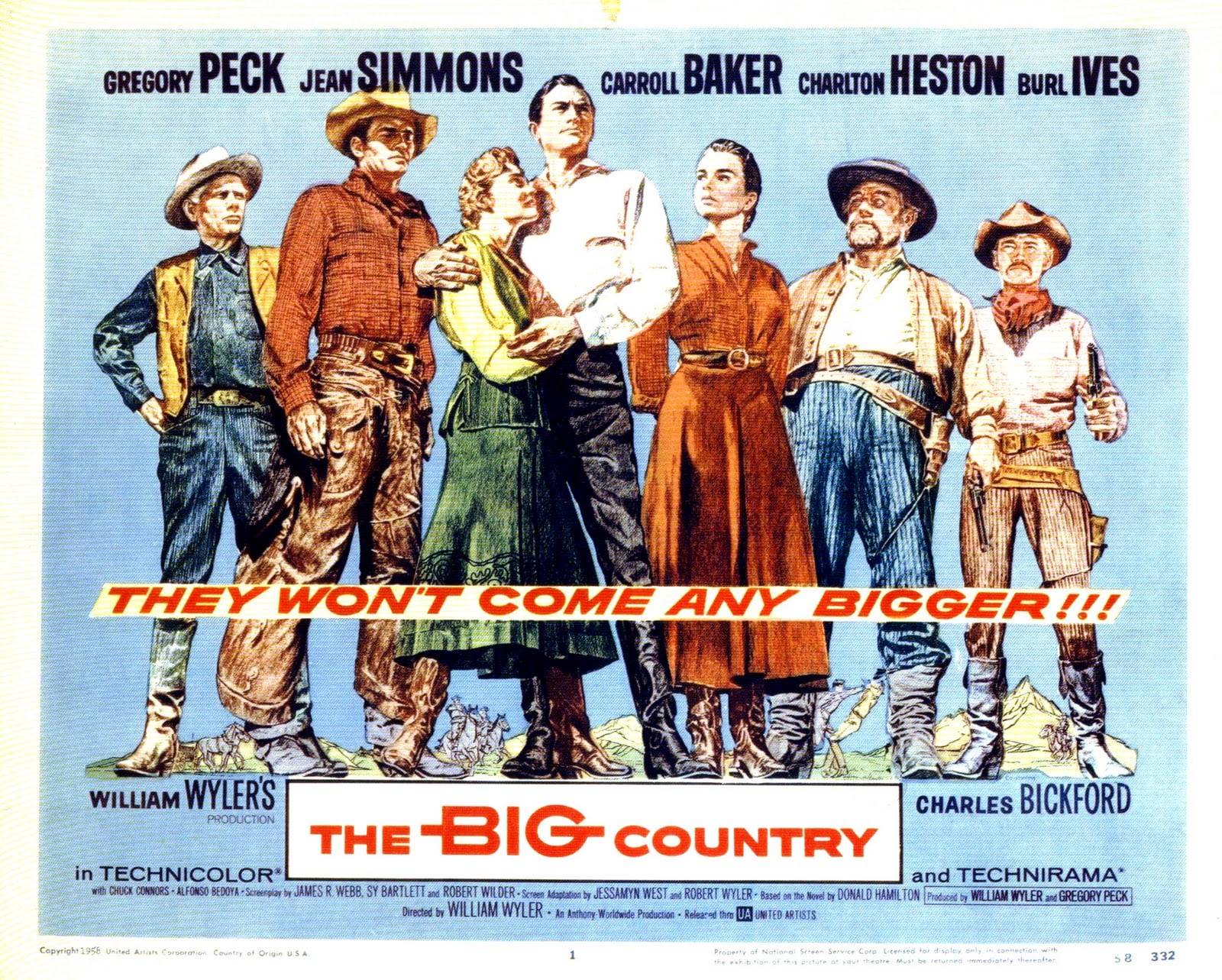
    On the birthday of Jerome Moross, we’ll begin with the composer’s most famous score, that for “The Big Country” (1958).

    Directed by William Wyler, the film’s cast includes Gregory Peck, Jean Simmons, Carroll Baker, Charlton Heston, Charles Bickford, Chuck Connors, and Burl Ives (who won an Oscar). Some big personalities! So it’s hardly surprising that not all the drama was limited to what we see on screen. The actors bristled against constant rewrites and Wyler’s ambiguous directing style. Some of them refused to talk about it, and a few of them refused to talk to each other. Ives, the exception, seemed to be above it all. He maintained he really enjoyed making the picture. In the end, Wyler had to delegate the film’s climax to his assistant, also the film’s editor, Robert Swink, as he had to leave for Rome to prepare for “Ben-Hur.”

    Fortunately, the entire technical crew was first-rate and brought its A-game. It’s a Hollywood miracle that all the pieces of “The Big Country” fit together as well as they do. It really says something that, alongside the awesome scenery, more than anything, it is the music that really solidified the film’s enduring popularity. Moross’ score is right up there, alongside Elmer Bernstein’s music for “The Magnificent Seven,” at the top of the genre.

    Though Moross was adept at writing music in many forms – including concert pieces (a symphony for Beecham), musical theater (the cult classic “The Golden Apple,” including the evergreen “Lazy Afternoon”), and opera (“Sorry, Wrong Number”) – unquestionably he is best known for his work in film. He spent much of his career ping-ponging back and forth between New York and Hollywood.

    When “Porgy and Bess” concluded its New York run in 1935, George Gershwin invited Moross to join the show, on tour, as a pianist. It was while on a bus trip to Los Angeles to participate in “Porgy’s” west coast premiere that the 23-year-old made a stop in Albuquerque.

    “[A]s we hit the Plains I got so excited,” Moross recollected. “. . . [T]he next day I got to the edge of town and then walked out onto the flat land with a marvelous feeling of being alone in the vastness, with the mountains cutting off the horizon. The whole thing was just too much for me . . . it was marvelous, and I just fell in love with it.”

    This communion with the American West stayed with him. It would be 23 years before he composed his big screen magnum opus. The vitality, invention, and lyricism of “The Big Country” was recognized with an Academy Award nomination. The “Western” sound would color Moross’ subsequent film and concert works, with the energetic syncopations of his native New York City bolstering an easy lyrical gift that could easily pass for genuine American folk music.

    Rounding out today’s program will be selections from “The Big Sky” (Dimitri Tiomkin), “Big Jake” (Elmer Bernstein), and “Silverado” (Bruce Broughton).

    It’s all BIG. Saddle up for music by Jerome Moross and friends on “Picture Perfect,” music for the movies, now in syndication on KWAX the radio station of the University of Oregon!


    Clip and save the start times for all three of my recorded shows:

    PICTURE PERFECT, the movie music show – Friday at 8:00 PM EDT/5:00 PM PDT

    SWEETNESS AND LIGHT, the light music program – Saturday at 11:00 AM EDT/8:00 AM PDT

    THE LOST CHORD, unusual and neglected rep – Saturday at 7:00 PM EDT/4:00 PM PDT

    Stream them, wherever you are, at the link!

    https://kwax.uoregon.edu/

Tag Cloud

Aaron Copland (92) Beethoven (94) Composer (114) Conductor (84) Film Music (105) Film Score (143) Film Scores (255) Halloween (94) John Williams (178) KWAX (227) Leonard Bernstein (98) Marlboro Music Festival (125) Movie Music (120) Opera (194) Picture Perfect (174) Princeton Symphony Orchestra (102) Radio (86) Ralph Vaughan Williams (83) Ross Amico (244) Roy's Tie-Dye Sci-Fi Corner (290) The Classical Network (101) The Lost Chord (268) Vaughan Williams (97) WPRB (396) WWFM (881)

DON’T MISS A BEAT

You’re always welcomed to read my daily dispatches here or on social media, where you can comment and we will be in conversation! But also, please subscribe here to receive direct e-mails either daily or weekly. Thank you always for reading and commenting!

Choose whether to receive one e-mail per day, or one per week:

RECENT POSTS