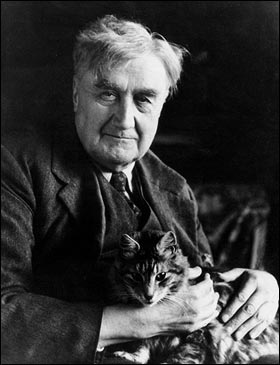
I’ve just tied the bow on another lovingly-wrapped gift for one of my favorite composers, Ralph Vaughan Williams. Vaughan Williams was born on October 12, 1872. I hope you’ll join me for my annual salute, on “Sweetness and Light.”
This year, I’ll be featuring one of his rarely-heard piano works, the Suite in G major, which he later arranged for strings as the “Charterhouse Suite,” some recordings issued on Albion Records – the record label of the Ralph Vaughan Williams Society – including an extensive orchestral rhapsody on tunes from the opera “The Poisoned Kiss,” and a delightful acoustical document of the composer himself conducting his overture to “The Wasps.”
I’ll provide the cake, but Vaughan Williams will provide the candles, on “Sweetness and Light.” Remember, the program is now repeated. So you’ll have two chances to enjoy it – this Saturday morning, at 11:00 EDT/8:00 PDT, and Sunday evening, at 9:00 EDT/6:00 PDT, exclusively on KWAX Classical Oregon.
Stream it, wherever you are, at kwax.com!
Tag: Ralph Vaughan Williams
-
Vaughan Williams Birthday Salute on KWAX
-
Vaughan Williams’ Vision of Hope and Shared Humanity
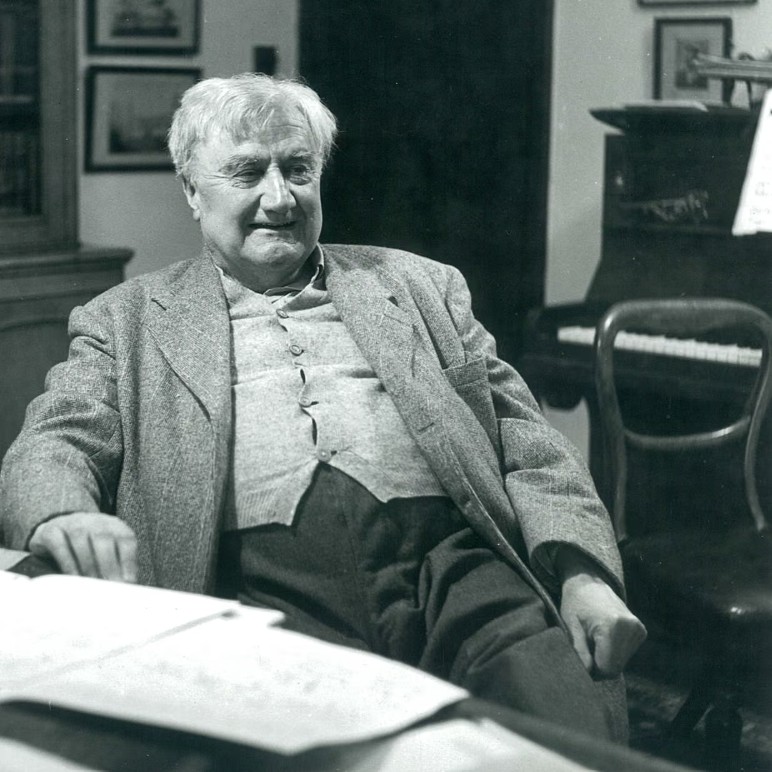
One of my favorite symphonies, the Symphony No. 5 by Ralph Vaughan Williams, makes today’s ”Composers Datebook.” As you’ll read (or hear) at the link below, the work was first performed on this date, at a time of great anxiety, in 1943. Vaughan Williams was 75-years-old.
In contrast to many wartime symphonies, there is no tub-thumping patriotism or gestures of defiance in RVW’s 5th. Instead, the composer takes the long view, sharing a larger vision of hope and serenity. The work surely resonated with listeners who lived through the Blitz, and even in 1943 continued to endure nightly air raids. The concert took place at Royal Albert Hall, because German bombings had gutted Queen’s Hall, the traditional venue of the summertime Proms. Also, it was held during the day, so that people could get back to their homes before London could be menaced after dark.
Reflected in the work is not only the soul of a nation, assimilating England’s proud sacred and secular musical traditions; it also exudes a unshakeable belief in our shared humanity. Contrast that with the anxiety, turbulence, and violence of the Symphony 4, completed in 1935, a time when the storm clouds were gathering – although the composer persistently denied any external influences. He always stood by his assertion that there was nothing at all programmatic about the work, and that he wrote what he wrote because he was compelled to write it. It was a wholly abstract piece of music.
The 5th symphony, on the other hand, shares themes with his long-gestating opera, “The Pilgrim’s Progress,” after John Bunyan’s popular Christian allegory; but again, there is no definitive extra-musical program. The composer himself stepped in for an indisposed Henry Wood to conduct the symphony’s premiere.
The work was dedicated to Jean Sibelius. Sibelius confided in a letter to Swedish composer Kurt Atterberg (who, in turn, was in touch with Vaughan Williams champion Adrian Boult), “This Symphony is a marvelous work… the dedication made me feel proud and grateful… I wonder if Dr. Williams has any idea of the pleasure he has given me?”
The music is transcendent in its luminosity. Why Vaughan Williams’ symphonies are not performed more often in the U.S. is a mystery. It’s probably just that people, even conductors, don’t really know the music. If it’s not “The Lark Ascending” or the “Fantasia on a Theme by Thomas Tallis,” they don’t even give it a second – or even a first – thought.
Which is a real shame, because the world can certainly use more reminders of the kind of positivity and reassurance expressed in the Symphony No. 5.
Listen to ”Composers Datebook” at the link.
https://www.yourclassical.org/episode/2026/06/24/composers-dateboo-ralph-vaughan-williams
Adrian Boult conducts the symphony here: -
Put Your Hands Up for Renaissance Dances on “Sweetness and Light”
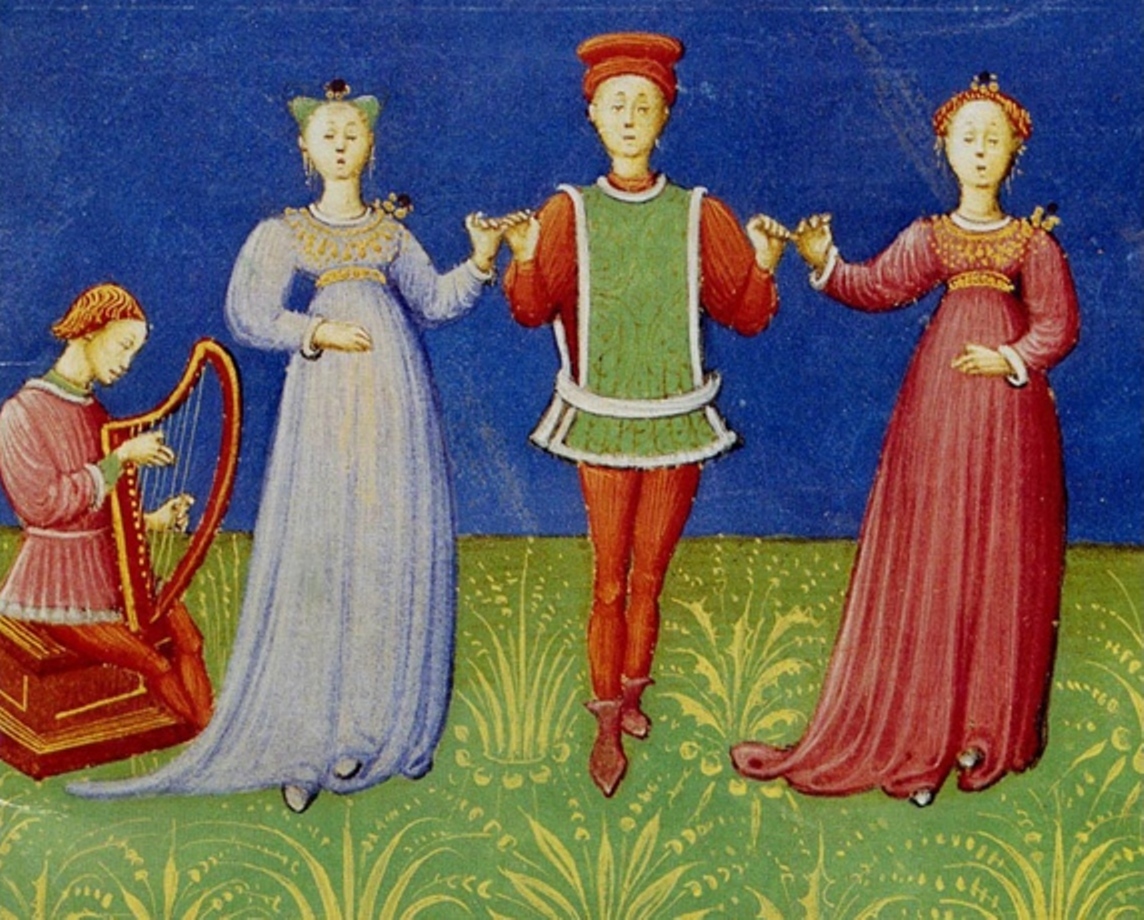
Spring is a time of rebirth – a renaissance, if you will – so I thought it might be fun this week on “Sweetness and Light” to round out Early Music Month with an hour of Renaissance dances.
Most of these will be reimagined by 20th century composers – though with a couple of notable exceptions – and in the case of Ralph Vaughan Williams, we’ll hear a wholly original work employing early instruments. (When’s the last time you heard RVW’s “Suite for Pipes?”)
It will be venison and peacock for breakfast. Put your hands up for a program of courtly and rustic dances on “Sweetness and Light,” this Saturday morning at 11:00 EDT/8:00 PDT, exclusively on KWAX Classical Oregon!
Stream it wherever you are at the link:
https://kwax.uoregon.edu/ -
Spring Into Documentary Music from England’s Green and Pleasant Land
This week on “Picture Perfect,” with the arrival of spring, we travel to “England’s green and pleasant land” for an hour of documentary music. The playlist will include scores by some of the country’s most respected composers.
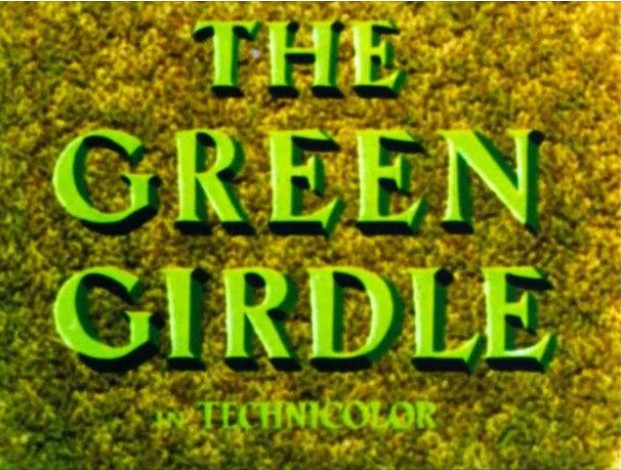
We’ll hear selections by Ralph Vaughan Williams, from “The People’s Land” (1941), Benjamin Britten, from “The King’s Stamp” (1935), William Alwyn, from “The Green Girdle” (1941), and Master of the Queen’s Music, Sir Arthur Bliss, from “The Royal Palaces of Britain” (1966). All four films are patriotic utterances on distinctly English themes.
Historically, in the United States, writing music for the movies has often been regarded as “hack work,” but overseas it has been accepted as just another aspect of what it means to be a working artist. There is no disgrace in a composer earning a living, and some of the nation’s greatest musicians – including those in the employ of the Royal Family – have contributed finely-crafted scores to its body of cinema.
You may not have seen any of these shorts, but the music sure is beautiful. I hope you’ll join me for music from English documentaries, on “The Lost Chord,” now in syndication on KWAX Classical Oregon!
——–
Clip and save the start times for all three of my recorded shows:
PICTURE PERFECT, the movie music show – Friday at 8:00 PM EDT/5:00 PM PDT
SWEETNESS AND LIGHT, the light music program – Saturday at 11:00 AM EDT/8:00 AM PDT
THE LOST CHORD, unusual and neglected rep – Saturday at 7:00 PM EDT/4:00 PM PDT
Stream them, wherever you are, at the link!
https://kwax.uoregon.edu
——–
In the meantime, if you’re having a slow day, why not get a taste of the films themselves?
“The People’s Land,” score by Vaughan Williams:
https://film.britishcouncil.org/resources/film-archive/the-peoples-land
“The King’s Stamp,” score by Benjamin Britten:
https://www.dailymotion.com/video/x21r04k
“The Green Girdle,” score by William Alwyn:
https://www.youtube.com/watch?v=YOlnnshTsvQ -

Vaughan Williams, Sibelius & The Letter That Got Away
Here’s a little something that springs to mind, on this, the birthday of Ralph Vaughan Williams.
I am the proud owner of two Sibelius signatures. One is at the end of a typed letter, of which admittedly many exist, in which the composer extends his thanks to a grateful fan for the gift of some “excellent cigars.” This I obtained from another dealer during my years in the book trade. The other is a signed photograph given to me by the composer’s grandson, with whom I had formed a friendship during his years in Philadelphia. Needless to say, I am beyond happy to have these.
But I might have had three, had I been able to make up my mind to commit to the considerable expense of a letter I found online a few years ago, which was written by Sibelius to Vaughan Williams on the occasion of the latter’s 80th birthday.
Sibelius and Vaughan Williams are my two favorite composers in the entire history of the world. The two inhabited a mutual admiration society, with Vaughan Williams dedicating his Symphony No. 5 to Sibelius, “without permission and with the sincerest flattery.” (For whatever reason, Sibelius exercised an incalculable influence over composers in the U.K. And thank goodness for it!) Fortunately, Sibelius very much enjoyed the piece. So clearly this letter would have had powerful associations for me.
Sadly, prudence prevailed. In my hesitation, someone else bought it, and a while later I found it on another site listed at a higher price. Eventually, it turned up at auction, where it sold for £2400.
It’s a decision that still tugs at my heart. It would have been an enormous expenditure for me, but it’s not like it would have put me on the streets. I just wouldn’t have paid any bills and not eaten very well and been stressed out for a while. It’s not like it hadn’t happened before. I’d have gotten by somehow.
Since then, I kind of wish I had just made the leap into the void. Now, I’m doomed to look back wistfully, as in the poem of Whittier:
For of all sad words of tongue and pen,
The saddest are these: “It might have been!”
PHOTOS: Vaughan Williams with Foxy; and the one that got away
Tag Cloud
Aaron Copland (94) Beethoven (95) Composer (114) Film Music (150) Film Score (143) Film Scores (255) Halloween (102) John Williams (198) KWAX (233) Leonard Bernstein (105) Marlboro Music Festival (125) Movie Music (165) Mozart (91) Opera (215) Philadelphia Orchestra (90) Picture Perfect (174) Princeton Symphony Orchestra (110) Radio (90) Ross Amico (244) Roy's Tie-Dye Sci-Fi Corner (290) The Classical Network (101) The Lost Chord (269) Vaughan Williams (107) WPRB (397) WWFM (881)