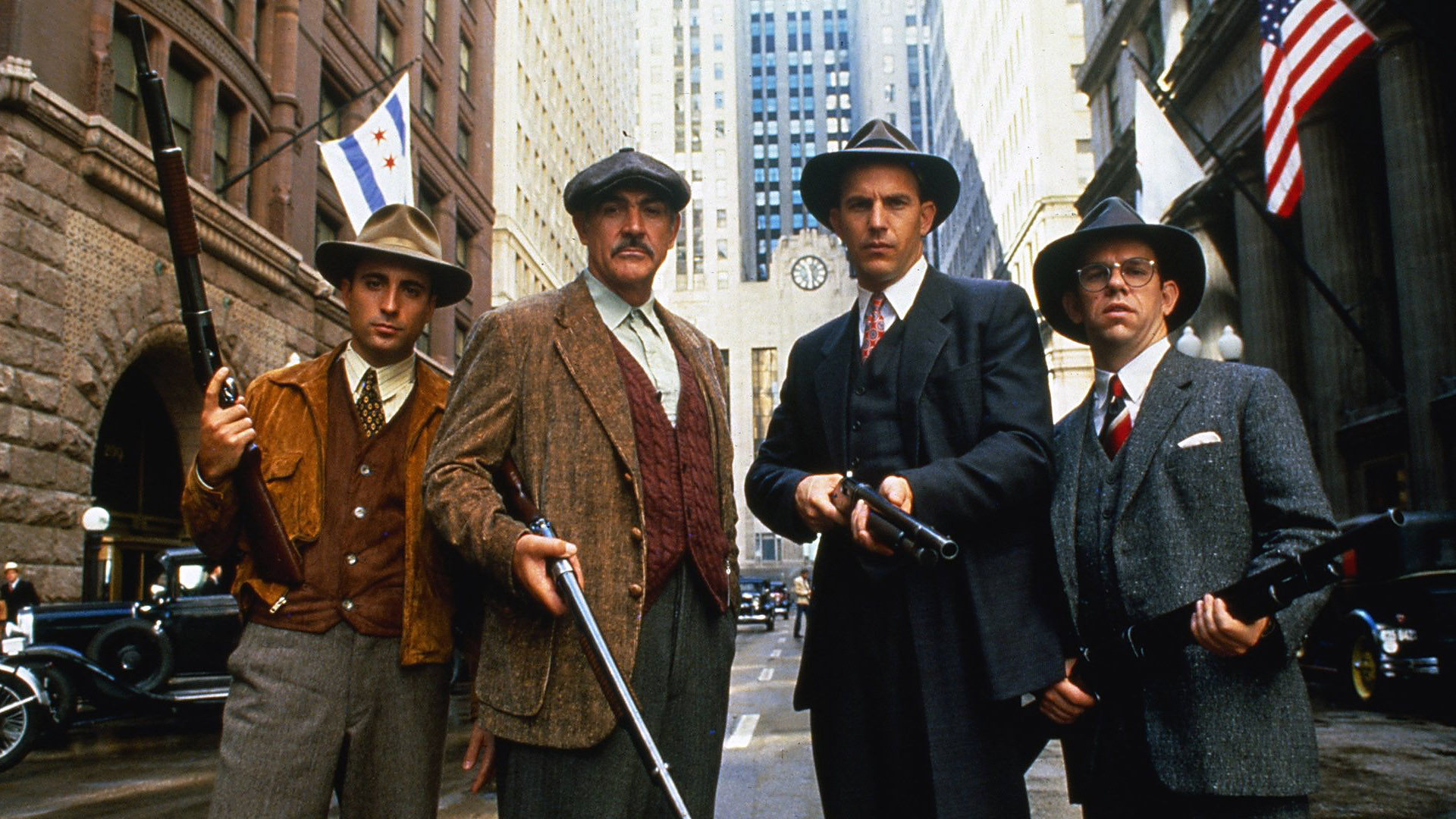
Brian De Palma is an extraordinarily adept filmmaker, who has been criticized for his adherence to “genre trash.” He has always been attracted to suspense and crime thrillers, usually of an especially violent nature, many of them tinged with horror.
This week on “Picture Perfect,” with Hallowe’en right around the corner, we’ll hear music from four of De Palma’s films.
It’s hardly surprising that such an admirer of Alfred Hitchcock would also hire Hitch’s signature composer. Bernard Herrmann scored two films for De Palma – “Sisters,” in 1973, and “Obsession,” in 1976.
“Obsession” is a spin on Hitchcock’s “Vertigo.” A botched rescue attempt results in the death of a businessman’s kidnapped wife. Years later, he encounters someone who could be her doppelganger. The film stars Genevieve Bujold, John Lithgow, and a very tan Cliff Robertson.
“The Fury,” from 1978, is a supernatural thriller based on a novel by John Farris. Two teenagers, endowed with powers of telekinesis and extra-sensory perception, are targeted by researchers who plan to harness them for their own nefarious ends. For a time, Kirk Douglas has fun as a former CIA agent, and John Cassavetes is a particularly slimy villain. Cassavetes’ comeuppance makes for one of the most memorable movie endings of its era – and we’ll leave it at that!
Critic Pauline Kael praised the music, which is by none other than John Williams – hot off his third Academy Award, for “Star Wars” – characterizing it as “as elegant and delicately varied a score as any horror film has ever had.”
Of course, “The Fury” was not the first De Palma film to deal with telekinesis. His adaptation of Stephen King’s “Carrie,” from 1976, became one the decade’s landmark horror films. It broadened King’s popularity and propelled De Palma into the A-list of Hollywood directors. It also essentially launched the careers of Amy Irving, John Travolta, and Nancy Allen, among others. Sissy Spacek was nominated for an Academy Award for her performance in the title role, as was Piper Laurie as Carrie’s overbearing, fundamentalist mother.
The music was by Pino Donaggio. The director had wanted to continue his collaboration with Herrmann, but the composer died before the film could be completed. Donaggio, though classically trained, made his fortune writing popular songs. His biggest hit was “You Don’t Have to Say You Love Me,” which was recorded by Dusty Springfield and treated to a well-known cover by Elvis Presley. Donnagio went on to become a regular De Palma collaborator, providing the music for seven of his films.
Finally, we’ll turn our back on horror, to listen to music from a successful period crime thriller, loosely based on the real-life exploits of Eliot Ness and his fellow prohibition agents – “The Untouchables,” from 1987. Kevin Costner plays the by-the-book federal agent who is given a valuable lesson in street smarts by an Irish beat cop played by an Academy Award winning Sean Connery. (“He pulls a knife, you pull a gun. He sends one of yours to the hospital, you send one of his to the morgue. That’s the Chicago way, and that’s how you get Capone.”) Capone is played, incidentally, by a baseball bat wielding Robert De Niro.
The score is by Ennio Morricone. Morricone, of course, was propelled to fame through his work on Sergio Leone’s spaghetti westerns. He applies some of that same mythmaking skill to this big screen adaptation, which had previously been published as a memoir and developed into a popular television series starring Robert Stack. The high point of the film must be the director’s nail-biting homage to Sergei Eisenstein, a slow motion shoot-out around a baby carriage as it teeters down the stairs of Chicago Union Station.
Start your weekend with a step in the right direction, with music from the films of Brian De Palma, on “Picture Perfect,” music for the movies, now in syndication on KWAX Classical Oregon!
———-
Clip and save the start times for all three of my recorded shows:
PICTURE PERFECT, the movie music show – Friday at 8:00 PM EDT/5:00 PM PDT
SWEETNESS AND LIGHT, the light music program – Saturday at 11:00 AM EDT/8:00 AM PDT (***now with a repeat Sunday at 9:00 PM EDT/6:00 PM PDT***)
THE LOST CHORD, unusual and neglected rep – Saturday at 7:00 PM EDT/4:00 PM PDT
Stream them, wherever you are, at the link!
https://kwax.uoregon.edu/
Tag: Halloween
-
Exhumed Vampire and Mummy Fiction for Halloween
I’ve been interested in vintage horror and “weird fiction” for nearly half a century, so I thought I knew a thing or two about vampires. Over and over again, I’ve encountered historical surveys or introductions that repeat that the first vampire story in English was a fragment by Lord Byron. This was undertaken to fulfill his part in a wager he proposed, while lounging with his bored Bohemian cohort on Lake Geneva, during the soggy summer of 1816, a contest to concoct the scariest ghost story that also yielded Mary Shelley’s “Frankenstein.” Byron’s fragment was picked up and completed by his physician (also part of the party), John Polidori, who gave us the transparently Byronic Lord Ruthven in “The Vampyre” (1819) – at first believed to have been written by Byron himself.
Then there’s a long gap until the penny dreadful “Varney the Vampire” (published weekly, in serialized form, from 1845-1847); and after that, another quarter century until Sheridan LeFanu’s proto-lesbian vampire novella “Carmilla” (1872); and at the far end of the century, the ne plus ultra of vampire novels, Bram Stoker’s “Dracula” (1897).
As you can see, I had it down. Or so I thought.
Now here I am, hanging onto middle age by my fingernails, only to discover this rich vein of vampire fiction in France. I suppose I failed to take into account that the surveys I was reading were concerned with vampire tales IN ENGLISH. But has it not traditionally been the case, everything being so Anglocentric here in the U.S.? In fact, the books I’m about to consider didn’t even exist in translation until fairly recently.
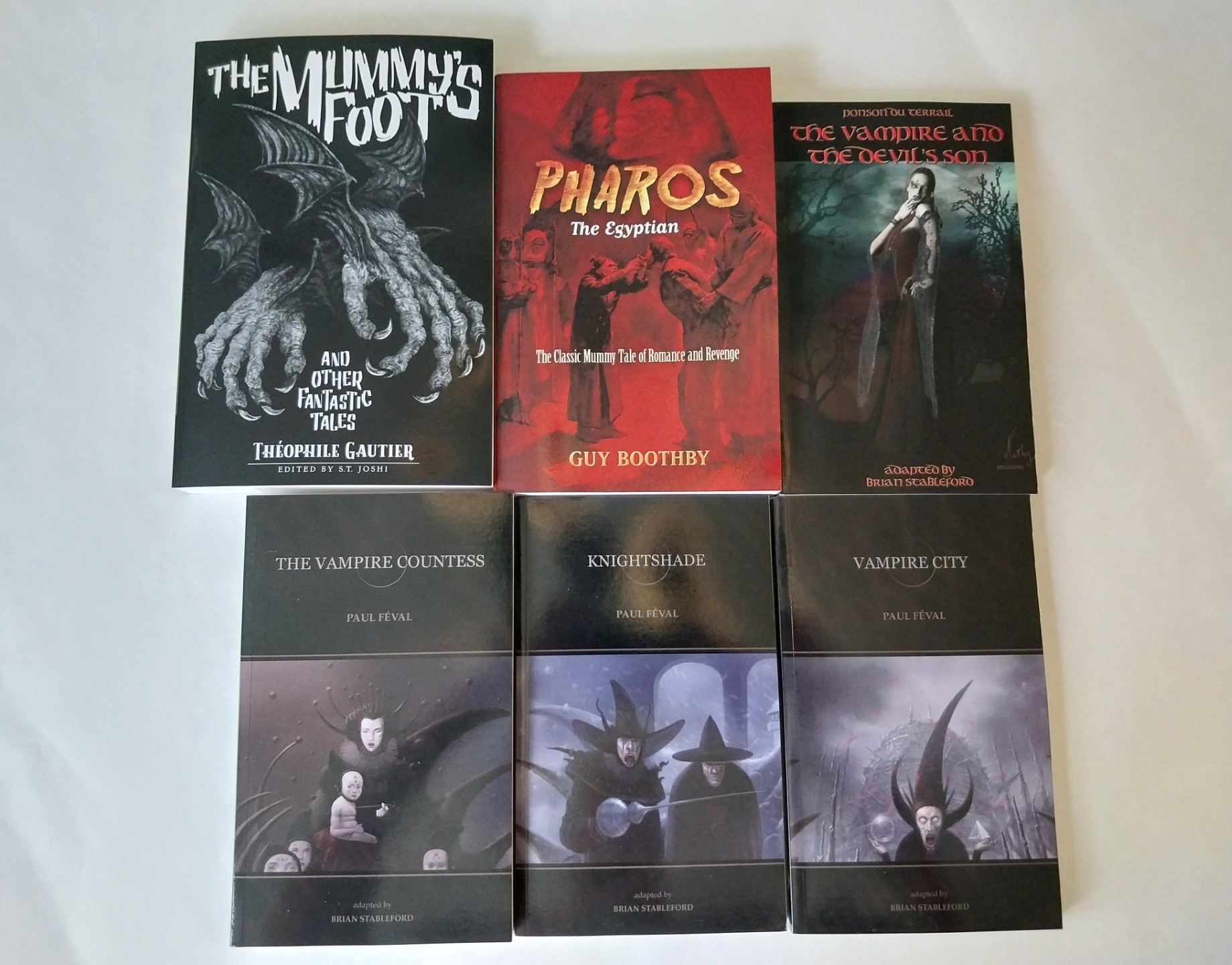
Imagine my surprise and delight to stumble across Paul Féval. Féval was known for his swashbuckling feuilletons (serialized adventure stories), most notably “Les Mystères de Londres” (itself cashing in on Eugène Sue’s “Les Mystères de Paris”), said to be a precursor of “The Count of Monte Cristo.” More to the point, he wrote three vampire novels, published after the same fashion, “Le Chevalier Ténèbre” (1860), “La Vampire” (1865), and “La Ville Vampire” (1874).
I’m going right to the top and starting with the third of his vampire feuilletons, “La Ville Vampire,” or “Vampire City.” From what I understand, this is the one in which the real-life Gothic novelist Ann Radcliffe faces off against the undead as a kind of proto-Buffy the Vampire Slayer.
Alas, Féval came to a bad end. First, he lost his incredible fortune – millions of dollars by today’s reckoning – in a financial scandal involving the Ottoman Empire. He staggered out of the ashes, hoping to reinvent himself by turning over a new leaf. He became the equivalent of a born-again Christian, gave up writing lurid novels, which he now regarded as sinful, and devoted himself to going back and touching up his earlier works in an attempt to smooth over all the objectionable bits. He also began writing novels on Christian themes.
When he was ruined a second time, by an embezzler, he suffered an attack of apoplexy that left him physically and creatively paralyzed. Two years later his wife died, which led to a second attack. He died in 1887 at the age of 70.
Another notable French contributor to the vampire genre was Pierre Alexis, Viscount of Ponson du Terrail (also, by the way, influenced by Radcliffe and Sue). Ponson du Terrail is said to be an important transitional figure in the evolution from old-fashioned Gothic novel to what we now recognize as the modern adventure story – especially in his “Rocambole” series, beginning with “L’Héritage Mystérieux, which features an heroic figure who rises above his apprenticeship to an evil genius to become a fearless champion of good.
The author certainly put his money where his mouth was. Following the surrender of Napoleon III to the Germans during the Franco-Prussian War, Ponson fled Paris to his estate near Orléans to engage in guerilla warfare against the enemy. In the end, he was forced to flee to Bordeaux after the Germans burned down his castle. He died in Bordeaux at 42, leaving his Rocambole saga incomplete.
I owe Brian Stableford and Black Coat Press a bottomless debt of thanks for exhuming a veritable catacomb of French vampire fiction. While I can’t yet vouch for Stableford’s talents as a translator, I am in awe of his drive and tenacity. When he realized so many of these novels were unavailable in English, he undertook to translate all of them himself. He published more than a hundred translations, on top of his hundred or so original novels and countless short stories. For the Black Coat publications, he also provides what promises to be, in light of the novels’ obscurity in the English-speaking world, a lot of helpful information in his introductions and afterwords.
In addition, I notice Stableford has translated and adapted (?) another, earlier Franco-vampire novel, “The Vampire Lord Ruthwen” (1820), spinning off from Polidori, also available from Black Coat Press. I’ll certainly keep it in mind, but I think I’m good with French vampire novels for this year.
https://www.blackcoatpress.com/catalog.html
In the process of boning up on French vampire fiction, I also learned of “La Morte Amoureuse” (1836) by Théophile Gautier, whose racy gender-bending swashbuckler, “Mademoiselle Maupin,” I happened to read in the past 15 years or so. So I picked up this collection, “The Mummy’s Foot and Other Fantastic Tales” – which looks like it’s basically a repackaging of “One of Cleopatra’s Nights and Other Fantastic Romances” (1882), with one or two substitutions of some of Gautier’s other weird fiction, translated by Lafcadio Hearn – now retitled, no doubt to appeal to a more luridly-inclined generation.
For classical music folk, Gautier cowrote the libretto for Adolphe Adam’s ballet “Giselle” and also rubbed shoulders with composers Georges Bizet, Giuseppe Verdi, and Hector Berlioz. Also, Charles Baudelaire dedicated his seminal volume of decadent poetry, “Les Fleurs de mal” (“The Flowers of Evil”) to him.
“The Mummy’s Foot” contains Gautier’s vampire story under its alternate title (after the vamp herself), “Clarimonde.” I just read it last night, and for anyone hankering for a 19th century vampire story on a level with “Carmilla,” it’s totally worth it. Is it a dream? An allegory? A manifestation of the narrator’s psychological state? Or did Clarimonde really exist and the story actually unfold as related? All I can say definitively is that it is one bizarre fever dream.
The book, a trade paperback edited by S.T. Joshi and published by Hippocampus Press, is very well produced, with a glossy cover, good paper, and a solid binding, none of which should be taken for granted in these days when so many independent “publishers” knock off inferior, on-demand reprints of public domain material in their basements. If you’re interested in this sort of fiction, definitely check out the titles in Hippocampus’ “Classics of Gothic Horror Collection.”
https://www.hippocampuspress.com/classics-of-gothic-horror
Of course the mummy story takes the cover, on the assumption that readers still know what mummies are and still associate them with supernatural goings-on. This prompted me to recollect Guy Boothby’s mummy potboiler “Pharos, the Egyptian” (1898), which is said to be closest in spirit to the Boris Karloff movie. It also features an over-the-top supervillain whose exotic cruelty and inexorable evil are said to have played on British imperial anxiety, in much the same way as “Dracula” and H.G. Wells’ “The War of the Worlds” (also 1898) did. There’s no way this fez-wearing stereotype is not going to be offensive to some modern readers, but you know I am going to lap it up, because I’m a grown-up, and I know right from wrong, and I understand historical context, and I know it’s just fantasy. I can’t wait to give it a whirl.
My copy was issued by Dover Publications, which has been making novels of this sort available more consistently than anyone else for more than 60 years, thanks to the editorial guidance of E.F. Bleiler. How I wish I could shake that man’s hand. (Bleiler died in 2010.) The company went bankrupt in 2020, but was purchased by Atlas Holdings, and the catalog remains available.
https://store.doverpublications.com/products/9780486803159?_pos=1&_sid=e34be0538&_ss=r
Who knows how many of these volumes of forgotten lore I’ll be able to wade through this month? Probably not many. There’s certainly plenty here to keep me entertained through November, and likely over the winter months, if not to be resurrected next year.
How about you? Reading anything to raise a shiver? As the days grow short, October, November, and December are prime ghost story season (if we’re to follow Dickens and M.R. James to Christmas). Hell, I’ll even throw January into the bargain. Why not?
Happy reading, everyone, and happy Halloween! -

Paul Dukas: The Composer Who Animated Mickey Mouse
Remember, without Paul Dukas, there would be no this:
https://video.disney.com/watch/sorcerer-s-apprentice-fantasia-4ea9ebc01a74ea59a5867853
How fortuitous that he would be born on October 1. What better way to start Halloween month than with the composer of “The Sorcerer’s Apprentice?”
Though Dukas left a comparatively small output – he was a notorious perfectionist who destroyed much – what survives of his music is of very high quality. Of that, he lends to his Halloween street cred with two other works of a fantastical, potentially horrific nature:
an opera about Bluebeard and his sixth wife, “Ariane et Barbe-Bleue”
and a so-called dance poem, “La Péri,” about a fatal encounter with a Persian fairy.
The music is fantastic in more ways than one.
Happy birthday, Paul Dukas! -

French Halloween Music the Lost Chord
On the whole the French don’t really celebrate Halloween (too American), but if you find one who does, don’t say “trick or treat.” Rather, demand “Des bonbons ou un sort!” – candy or a spell.
While France might not be down with the whole Halloween thing, many of the country’s great artists, writers, and composers could totally conjure a Halloween vibe. Think Odilon Redon’s “The Smiling Spider,” Charles Baudelaire’s “Les Fleurs du mal,” or Camille Saint-Saëns’ “Danse macabre.”
This week on “The Lost Chord,” we’ll have three pieces of French music totally suitable for the season.
Maurice Ravel’s “Gaspard de la Nuit” (“Gaspard of the Night”) – musical responses to the weird and sinister poetry of Aloysius Bertrand – is a suite of creepy impressions of (1) a flirtatious water spirit, (2) a hanged man at sunset against the backdrop of a tolling bell, and (3) a vampiric dwarf named Scarbo. Gina Bachauer will be the pianist, and Sir John Gielgud will preface each of the movements with recitations of the Bertrand poems.
Claude Debussy was enthralled by the writings of Edgar Allan Poe, which he knew through Baudelaire’s translations. At the time of his death, he left incomplete sketches for two operas after Poe stories – “The Fall of the House of Usher” and “The Devil in the Belfry.” We’ll hear fragments of the former, conducted by Georges Prêtre.
Finally, we’ll listen to the third of the “Etudes in Minor Keys,” subtitled “Scherzo Diabolico,” by Charles-Valentin Alkan. Alkan, a sometimes neighbor of Chopin and Georges Sand, shared a home with his illegitimate son, two apes, and a hundred cockatoos. Franz Liszt is alleged to have commented, “Alkan had the finest technique I had ever known, but preferred the life of a recluse.”
Best known is the story surrounding the circumstances of his death: while reaching for a copy of the Talmud, situated on a high shelf of a heavy bookcase, the case let go and crushed Alkan beneath it. It’s been suggested that the composer actually collapsed while in the kitchen – but when the legend becomes fact, print the legend. We’ll hear his etude in a recording by the late Michael Ponti.
I hope you’ll join me for “Jacques o’ Lanterns” – lurid music by French composers for Halloween on “The Lost Chord,” now in syndication on KWAX, the radio station of the University of Oregon!
Clip and save the start times for all three of my recorded shows:
PICTURE PERFECT, the movie music show – Friday at 8:00 PM EDT/5:00 PM PDT
SWEETNESS AND LIGHT, the light music program – Saturday at 11:00 AM EDT/8:00 AM PDT
THE LOST CHORD, unusual and neglected rep – Saturday at 7:00 PM EDT/4:00 PM PDT
Stream them, wherever you are, at the link!
-
Halloween Music on KWAX
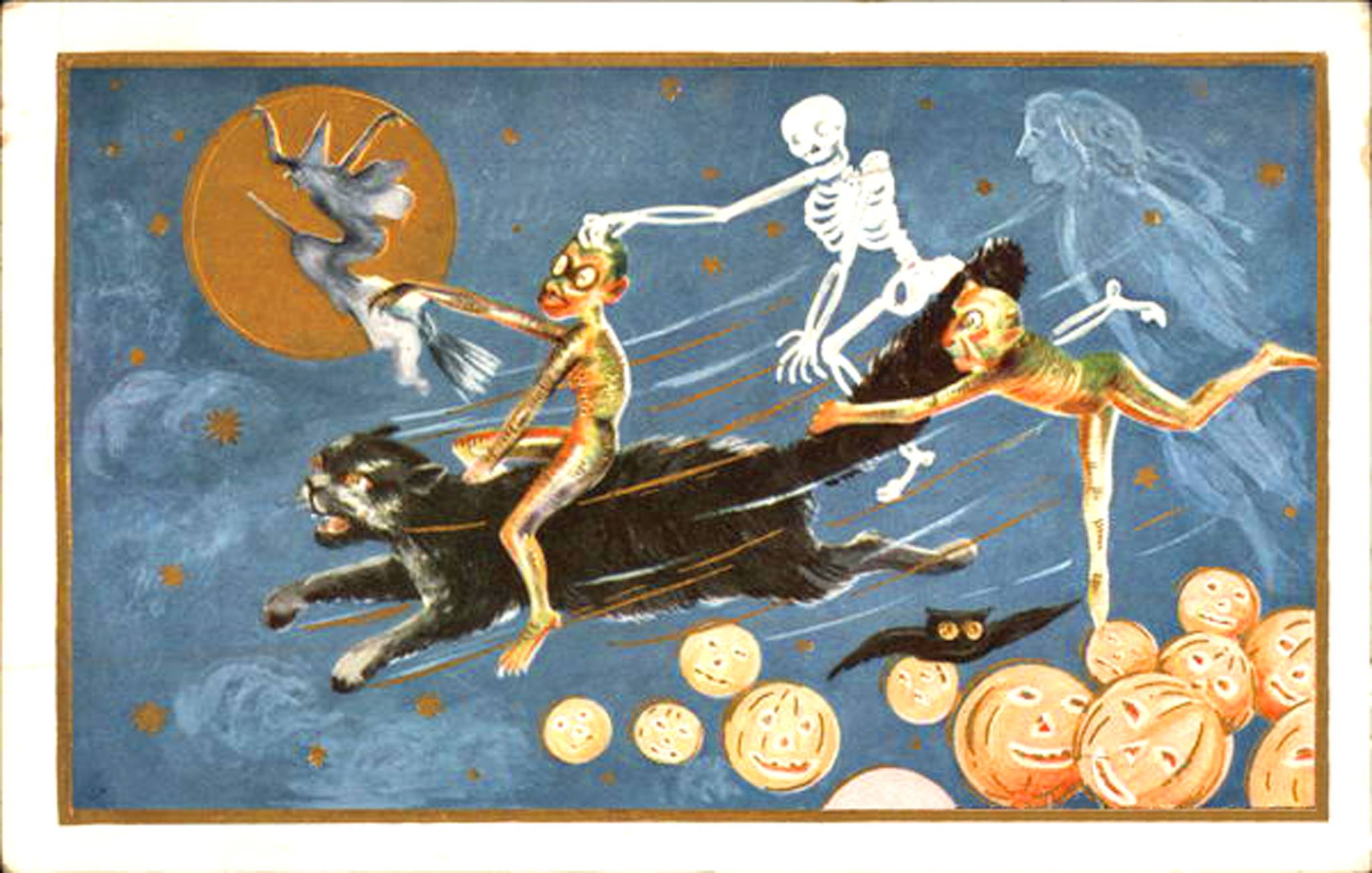
This week on “Sweetness and Light,” we’ll be cutting holes in Mom’s best sheets for a light music trick-or-treat. Join me for 13 ghostly premonitions of a holiday I am happy to say I never outgrew.
We’ll enjoy Halloween songs, selections from Halloween film scores, Halloween piano miniatures, and Halloween light music classics about a haunted ballroom, an ostracized imp, and a devil’s ride, all lovingly curated by you-know-who. Nothing too terribly terrible. It’s all in good fun. There will be no cowering before this disarming parade of spirits, reanimated corpses, witches, bogeymen, demons, and necromancers!
I’ve carefully examined all the candy for pins and razor blades, so you mustn’t hesitate to indulge. It will be Smarties® and peanut butter cups for breakfast, when you join me for “Sweetness and Light,” this Saturday morning at 11:00 EDT/8:00 PDT, exclusively on KWAX, the radio station of the University of Oregon!
Stream it wherever you are at the link:
Aaah-OOOOOO!
Tag Cloud
Aaron Copland (94) Beethoven (95) Composer (114) Film Music (148) Film Score (143) Film Scores (255) Halloween (97) John Williams (196) KWAX (232) Leonard Bernstein (105) Marlboro Music Festival (125) Movie Music (163) Mozart (91) Opera (215) Philadelphia Orchestra (90) Picture Perfect (174) Princeton Symphony Orchestra (110) Radio (90) Ross Amico (244) Roy's Tie-Dye Sci-Fi Corner (290) The Classical Network (101) The Lost Chord (269) Vaughan Williams (107) WPRB (397) WWFM (881)