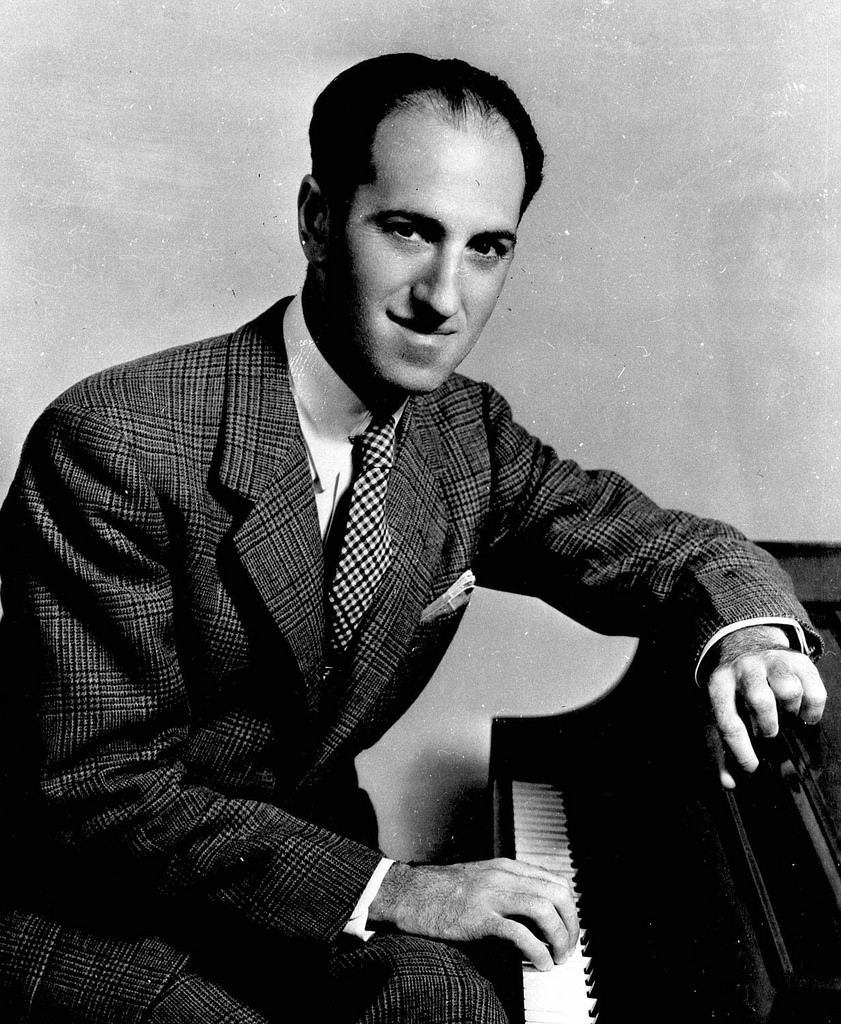
Why, it’s Gershwin’s birthday, by George! We’ll have two chances to celebrate today, on both my Saturday radio shows.
George Gershwin, of course, was one of our most versatile composers. He occupied a unique place in American music, rising from Tin Pan Alley scrapper to Broadway royalty. From there, he conquered the concert hall and even the opera house, with his blend of popular song, jazz, blues, spirituals, and European classical forms.
Like Franz Schubert a hundred years before, Gershwin managed to churn out an astonishing amount of music over a comparatively brief span. His songs, in particular, have been of enduring interest. His gift of lyricism and invention defied early critics as he bestrode the worlds of popular and classical music like an American colossus.
Sadly, at the peak of his success, he died of a brain tumor at the age of 38. But 89 years later, George, we’re still crazy for you.
This morning on “Sweetness and Light,” Gershwin will be one of four composers whose music we’ll enjoy in a salute to classic American musical theater. We’ll hear selections from Eubie Blake & Noble Sissle’s “Shuffle Along” (the 1921 all-Black musical that spawned the breakout hit “I’m Just Wild about Harry”), Leonard Bernstein’s “On the Town” (the ballet music, before it was distilled into the familiar “Three Dance Episodes,” with a 24-year-old Bernstein conducting), Gershwin’s “Porgy and Bess” (conceived by the composer as an opera, but produced on Broadway several times over the decades before finally being elevated to the pantheon), and Richard Rodgers & Lorenz Hart’s “On Your Toes” (the climactic “Slaughter on Tenth Avenue” sequence).
It’s guaranteed to get your toes tapping, for the most part, but I’ll also include a grand piano fantasy on themes from “Porgy” by Earl Wild. It’s showtime, this Saturday morning at 11:00 EDT/8:00 PDT!
Then later on today, on “The Lost Chord,” we’ll sample Gershwin’s artistry in recordings of his era, including several songs performed by Al Jolson, Fred Astaire, and Ella Logan. (So many excellent ones to choose from!)
We’ll also hear the world premiere recording of “An American in Paris” – performed by the Victor Symphony Orchestra (really members of the Philadelphia Orchestra), with the composer himself on the celesta – and the Concerto in F, performed as part of a Gershwin memorial concert at the Hollywood Bowl, with the composer’s friend, Oscar Levant, as soloist.
Three of these recordings date from 1937, the year of the composer’s death. All are from his era. I hope you’ll join me for “Vintage Gershwin,” this Saturday at 7:00 EDT/4:00 PDT.
It’s nice work if you can get it. Not that you need someone to watch over you, George. Our love is here to stay.
Strike up the band and let ‘em eat cake! Of thee I sing, on “Sweetness and Light” AND “The Lost Chord,” on KWAX Classical Oregon!
———-
Clip and save the start times for all three of my recorded shows:
PICTURE PERFECT, the movie music show – Friday at 8:00 PM EDT/5:00 PM PDT
SWEETNESS AND LIGHT, the light music program – Saturday at 11:00 AM EDT/8:00 AM PDT
THE LOST CHORD, unusual and neglected rep – Saturday at 7:00 PM EDT/4:00 PM PDT
Stream them, wherever you are, at the link.
https://kwax.uoregon.edu/
Tag: Leonard Bernstein
-
Our Love Is Here to Stay: Celebrating Gershwin on “Sweetness and Light” and “The Lost Chord”
-
The Sound and the Furry: Leonard Bernstein
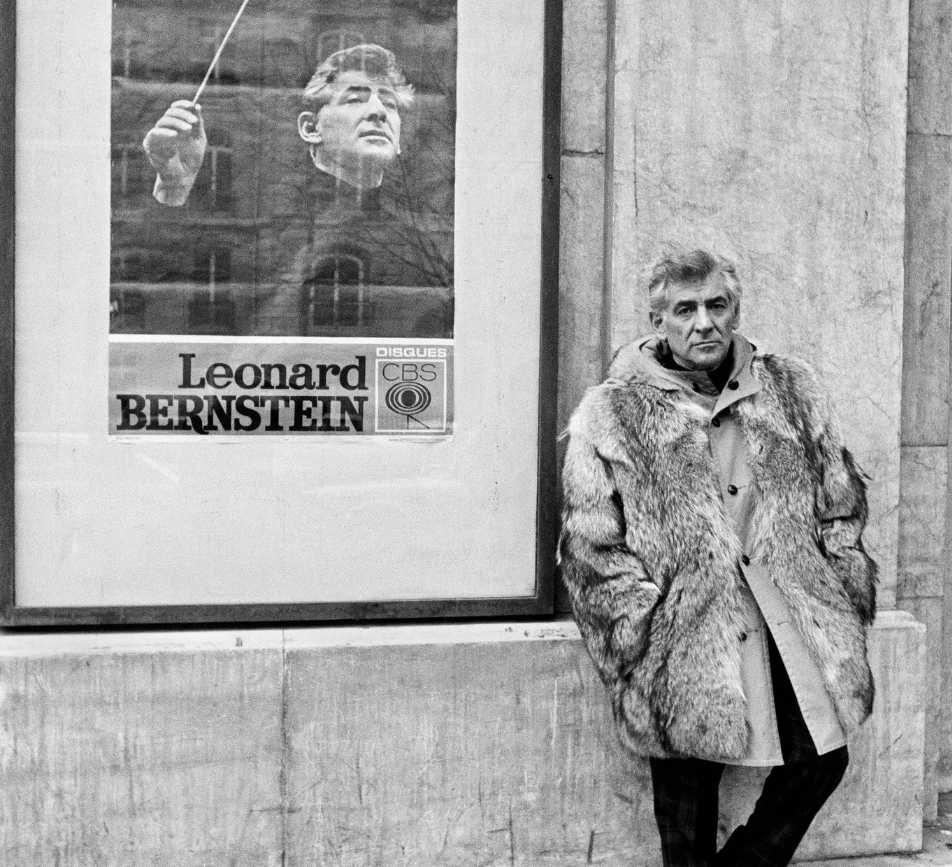
One of a kind. Happy birthday, Lenny!
The sound and the furry: Bernstein conducts Haydn’s “The Bear.” -
Before Mixed Martial Arts, Presidents Aimed for Stravinsky
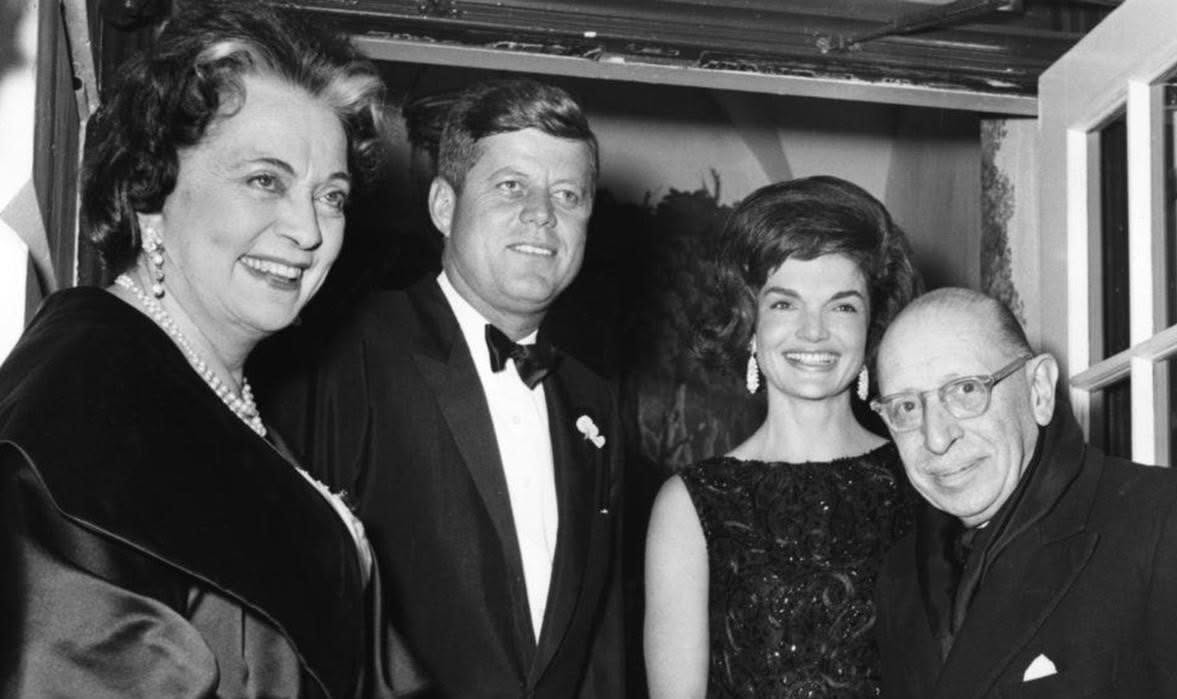
The new norm is to have steel-cage death matches on the South Lawn, but in 1962 an American president might invite Igor Stravinsky to the White House. On Stravinsky’s birthday, here’s an amusing account of the composer’s visit with the Kennedys:
https://www.whitehousehistory.org/igor-stravinsky-at-the-white-house
“Despite such criticism – which was entirely typical of Stravinsky’s unfiltered personality – he clearly remembered the visit with fondness and gratitude. In January, 1964 he commemorated John F. Kennedy – who had been assassinated on November 22, 1963 – by composing ‘Elegy for J.F.K.,’ a vocal piece with words by W.H. Auden. ‘I felt that the events of November were being too quickly forgotten,’ the composer told The New York Times, ‘and I wished to protest.’”
Leonard Bernstein was also in attendance at the dinner. Bernstein’s “Fanfare for JFK” was heard for the first time on the eve of Kennedy’s inauguration, also on this date, though one year earlier. It’s only 40 seconds long, so if you blink, you’ll miss it.
In 1978, Bernstein gave the opening speech at the first Kennedy Center Honors, at which the honorees included Marian Anderson, Richard Rodgers, George Balanchine, Fred Astaire, and Arthur Rubinstein.
I’ll spare you the entirety of Bernstein’s “Mass,” commissioned by Jacqueline Kennedy for the opening of the Kennedy Center in 1971, but here’s the piece’s hit tune, “A Simple Song.”
The questions, where are our Bernsteins and Stravinskys – or for that matter, our Marian Andersons, Richard Rodgerses, George Balanchines, Fred Astaires, and Arthur Rubinsteins – and why are they not honored at the White House, seem moot.
Stravinsky’s concern about the events of November 1963 being forgotten were echoed by many Americans in December 2025. Some presidents try to set an example by leading in a spirit of hope and aspiration. Others attempt to validate themselves by affixing their names to the Kennedy Center. -
Expanding My Horizons with Carl Nielsen
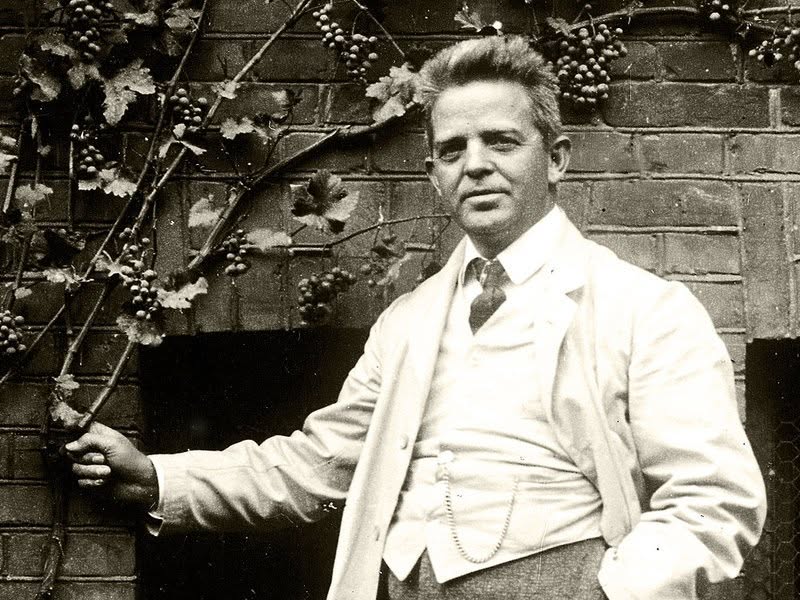
When I first heard Carl Nielsen’s Symphony No. 3, I was sweating it out in a one-room efficiency in West Philadelphia that I shared with two of my classmates, while making up a math course I had flubbed at Temple University.
It was the summer of ’85, there was no air conditioning, and I studied and slept in a netted hammock suspended from two bicycle hooks I had screwed into the door frames to prevent being surprised by mice. There was always movement in the lone trash bag that sat exposed on the linoleum in the corner of the kitchenette, and to prove a point once I lobbed a sneaker into it, from the safety of my resting place, so that the rodents poured out of it and scurried around the apartment, sending one of my roommates, the one whose name was on the lease, shrieking into his bunk. He had a job canvasing for a political organization, so he was gone all day and would stagger back every night after last-call to sketch with intensity under a bright, exposed lightbulb that shone down in my face. Somewhere along the way, he brought home a turtle, which he kept in the bathtub and fed raw hamburger, until I couldn’t take its imprisonment any longer and finally released it into Fairmount Park.
The other roommate had the good sense to get a girlfriend, so he was never there. His contribution was a makeshift bunk bed hastily assembled from planks he had plucked from the garbage. The top bunk was usually vacant, due to his absence, and the bottom bunk was where my politically-motivated, alcohol-fueled, musky, mulchy-footed friend slept between me and the sole window fan.
Occasionally, I’d glimpse a cockroach making its way down one of the ropes of my hammock, and I’d start rocking about, trying to dislodge it. More than once, one of the bike hooks let go. The roaches were everywhere. There were even roaches in the freezer.
It was under these circumstances, one boxed-in, sweltering afternoon, that I first experienced Carl Nielsen’s Symphony No. 3, subtitled “Sinfonia espansiva.” It was broadcast on WFLN, Philadelphia’s classical music station for nearly 50 years (sadly, now defunct). Nielsen’s aspirational music opened up horizons for me and offered glimpses of larger things.
The recording was conducted by Leonard Bernstein. For those of you who aren’t familiar with him, Carl Nielsen is Denmark’s most celebrated composer. Yet, internationally, his music has struggled to take root in the shadow of that other great bard of the North, Jean Sibelius. This is a shame, since, far from being a Sibelius knock-off, Nielsen forged his own, immediately-recognizable style. Bernstein believed Nielsen’s rightful place was as Sibelius’ equal.
“I think many people are in for pleasant surprises as they get to know Nielsen,” he said at a centennial celebration of the composer’s birth, “his rough charm, his swing, his drive, his rhythmic surprises, his strange power of harmonic and tonal relationships – and especially his constant unpredictability – all these are irresistible. I feel confident that Nielsen’s time has come.”
Hey, he was right about Mahler. But that was in 1965, and Lenny’s prophetic lightning failed to strike twice. Sixty-one years on, with many more recordings and performances to choose from, Nielsen’s music remains, stubbornly, an acquired taste, if a rewarding one. There really is nothing else quite like it – the puckish wit, the ambiguities, the quirky juxtaposition of seemingly disparate melodies, harmonies, and key signatures, all very often shot through with a sense of hope and optimism that rises above the chaos.
I only lived in that hell hole for about a month, one summer session, thankfully, just long enough to make-up my credits, and then it was off to the greenery of my hometown to detox. But I was in the process of selling my soul for a piece of parchment, a degree, so in the fall it was back to Philadelphia.
After the purchase of my first CD-player, in order to feed my habit, I took a part-time job as a clerk at Sam Goody, a record shop then located at 11th and Chestnut Streets, which at the time had the most extensive classical music section in the city. (This was before the arrival of Tower Records.) It was there that I acquired Neeme Järvi’s Prokofiev cycle, Bernard Haitink’s Shostakovich cycle, Adrian Boult’s Vaughan Williams cycle, and my first recording of Nielsen’s Symphony No. 3. Essentially, I signed my paycheck back over to the company in exchange for CDs. I remember my frustration that so much of the good stuff was still only on LP.
The Nielsen recording was not the classic Leonard Bernstein performance I had heard on the radio – which had yet to be transferred to compact disc – but a newer, digital recording with Myung-Whun Chung and the Gothenburg Symphony Orchestra, on the BIS label. And I have to say, giving all credit to Bernstein for his advocacy of Nielsen’s music, I believe Chung’s recording outshines his in every way. To this day, I find it to be one of the most satisfying Nielsen recordings. It must have been within my first ten CD purchases. I remember when I had so few, I could keep them all in a shoebox. Now I’ve got a library of a good 10,000. You might say it has gone “espansiva.”
What exactly did Nielsen mean by that choice of subtitle? Robert Simpson wrote that the use of “espansiva” suggests an “outward growth of the mind’s scope.” There is certainly a sensation of expanding horizons about the piece, which includes a pastoral slow movement complete with wordless solos for soprano and baritone. According to Nielsen, the symphony concludes with “a hymn to work and the healthy activity of living.” All I know is that it fills me with optimism and happiness.
A tip of the blond brush cut to Carl Nielsen on his birthday. Perhaps his time will come. For me, it arrived in a very different climate from that of Copenhagen, in tropical West Philadelphia, in the summer 1985.
——–
Leonard Bernstein conducts the Royal Danish Orchestra on its own turf
https://www.youtube.com/watch?v=VNNP_4TYnV4
Myung-Whun Chung and the Gothenburg Symphony
https://www.youtube.com/watch?v=IS_-K_w9wdM
“Espansiva: A Portrait of Carl Nielsen”
https://www.youtube.com/watch?v=r0a1CPcTDEA&t -
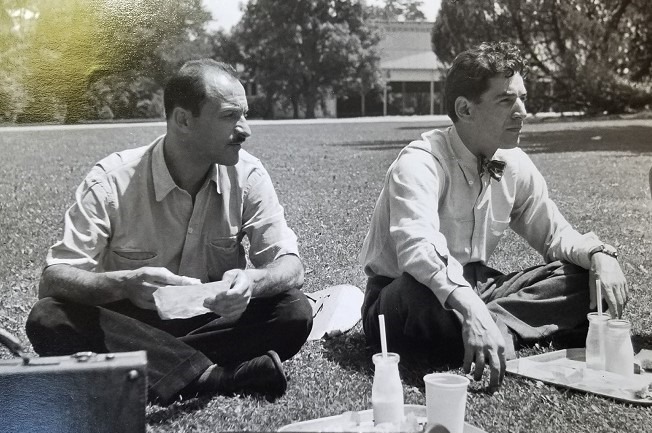
In the Open Air with Marc Blitzstein on “The Lost Chord”
This week on “The Lost Chord,” to coincide with Armed Forces Day, we’ll listen to Marc Blitzstein’s “Airborne Symphony.”
The programmatic work, a quasi-oratorio, was written on a commission from the U.S. Army, while the composer was serving in its Air Force. It traces the evolution of flight from its conception in theory to its use in modern warfare.
The piece was envisaged by Blitzstein as a big symphony on the theme of “the sacred struggle of airborne free men of the world… to crush the monstrous fascist obstructionist in their path.” Begun in 1943, at the height of World War II, it would not be completed until 1946, after the conflict had ended.
Leonard Bernstein, a lifelong admirer of the composer (he mounted a performance of Blitzstein’s pro-labor musical, “The Cradle Will Rock,” while still at student at Harvard, and dedicated his own opera, “Trouble in Tahiti,” to him), conducted the premiere virtually while the ink was still wet on the page.
He recorded the piece twice. We’ll hear the second of those recordings, from 1966, with Orson Welles the narrator, vocal soloists, the New York Philharmonic, and the men of the Choral Arts Society.
It may not be the most profound of Bernstein’s recordings, but it surely is one of the most unusual. I hope you’ll join me for “Flight of Fancy” on “The Lost Chord,” now in syndication on KWAX Classical Oregon!
——–
Clip and save the start times for all three of my recorded shows:
PICTURE PERFECT, the movie music show – Friday at 8:00 PM EDT/5:00 PM PDT
SWEETNESS AND LIGHT, the light music program – Saturday at 11:00 AM EDT/8:00 AM PDT
THE LOST CHORD, unusual and neglected rep – Saturday at 7:00 PM EDT/4:00 PM PDT
Stream them, wherever you are, at the link!
https://kwax.uoregon.edu
——–
PHOTO: Blitzstein and Bernstein, dining al fresco
Tag Cloud
Aaron Copland (94) Beethoven (95) Composer (114) Film Music (148) Film Score (143) Film Scores (255) Halloween (97) John Williams (196) KWAX (232) Leonard Bernstein (105) Marlboro Music Festival (125) Movie Music (163) Mozart (91) Opera (215) Philadelphia Orchestra (90) Picture Perfect (174) Princeton Symphony Orchestra (110) Radio (90) Ross Amico (244) Roy's Tie-Dye Sci-Fi Corner (290) The Classical Network (101) The Lost Chord (269) Vaughan Williams (107) WPRB (397) WWFM (881)