Tag: Leonard Bernstein

  • Bernstein, Liszt & the Devil’s Symphony

    Bernstein, Liszt & the Devil’s Symphony

    I don’t know about you, but if I were a kid I’d be all over my parents to be able to attend a program called “Liszt and the Devil.”

    In one of his celebrated “Young People’s Concerts,” from 1970, Leonard Bernstein makes the bold assertion that “A Faust Symphony” is Franz Liszt’s greatest work. I think “grandest” would be less controversial. I mean, Liszt was the composer of probably the most revolutionary piano sonata of the 19th century.

    Despite Bernstein’s effusion that “A Faust Symphony” is one of the monumental works of the whole Romantic Movement, it is hardly the most frequently programmed of his compositions. His piano concertos are heard much more frequently. So are some of his symphonic poems, at least on the radio. (When was the last time you heard “Les Preludes” in concert?) He wrote oratorios, masses, organ works, songs, and even an opera. His later works are on another plane entirely, as he hurled his lances into a future he would never live to see.

    As a pianist, he is frequently cited as a kind of proto-rock star, whipping his audiences into extravagant displays of emotion. Men wept and women fainted. Some fought over carelessly abandoned gloves or cigar butts or even his coffee dregs. Doctors seriously debated the causes and effects of “Lisztomania,” as it was described, and it remains a topic of speculation in academic and medical circles today.

    Liszt was a peculiar mix of prophet and showman. He could be flashy or profound, fiendishly difficult or insistently memorable, offputtingly vulgar or transcendentally beautiful. Interestingly, in his mid-30s, he retired from public life as a recitalist (recital, by the way, was a term he coined), shifting his focus instead to composition, conducting, teaching, and philanthropic efforts. In his mid-50s, he took the cloth. As the Abbé Liszt, he was, among other things, a licensed exorcist. Which takes us back to the matter at hand.

    I happen to share Bernstein’s enthusiasm for “A Faust Symphony.” It’s always been a great favorite of mine. Sadly, you don’t really see it programmed very often anymore – if it ever was. But back in the day, Bernstein and Solti and maybe a few others kept it alive. Bernstein recorded it twice: with the New York Philharmonic for Columbia Records in 1960 and with the Boston Symphony Orchestra for Deutsche Grammophon in 1976. Riccardo Muti conducted it in Philadelphia, back in 1982 – sadly two years before my arrival in the City of Brotherly Love – and recorded it for EMI. The recording is very good. Come to think of it, I don’t think I’ve ever heard “A Faust Symphony” live. This must be rectified!

    I love that Bernstein doesn’t talk down to the kids and lays some pretty heavy, adult concepts on them. Not only in the philosophical examination of the essential dichotomy of the human character, but also the nitty gritty of debauched adult behavior. I’m sure there are moments when the moms and dads in the audience are wondering whether maybe they should have taken the young ones to Radio City Music Hall instead. Around 28 minutes in, Bernstein delves into the Devil, the seduction of Gretchen, and “the wages of sin.”

    It’s fun that Bernstein can go to the piano to illustrate so many of his musical points and that he’s got so much Liszt under his fingers.

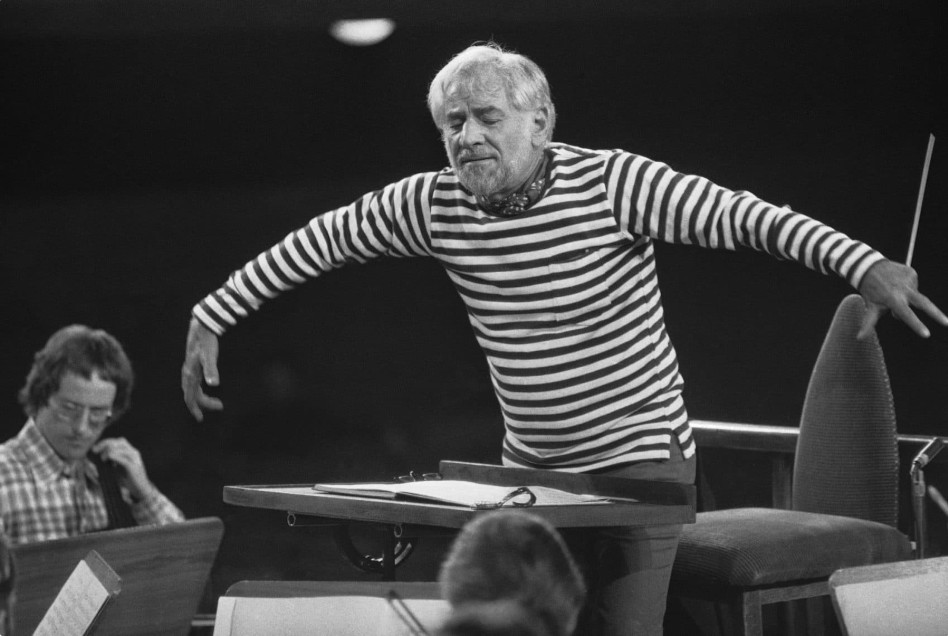
    This is the second “Young Person’s Concert” I’ve seen in which Bernstein gets so carried away conducting that he loses his baton (at 44 minutes in). The other was during a Sibelius program from 1965, in which he conducts the Symphony No. 2. In that instance, a moment after the baton takes flight, he reaches beneath the lectern and actually produces a spare! Here he rides it out with his bare hands, as Mephisto’s spirit of negation is itself negated by Gretchen’s innocence.

    This is Liszt’s original version, by the way. Three years later, he appended a coda for chorus and tenor. That’s the version Bernstein recorded.

    Bernstein knows a thing or two in comparing Liszt to Faust. He had a little bit of Faust in his own character, as well. But then, don’t we all?

    Happy birthday, Franz Liszt!


    “Young People’s Concert: Liszt and the Devil.” All in all, an intelligently presented, entertainingly delivered lecture and performance. I hope you enjoy it.

    Bernstein’s classic 1960 recording with the New York Philharmonic

    Also fun to hear “A Faust Symphony” turn up among the musical selections on the soundtrack to this restoration of the 1926 silent film “Masciste in Hell”

  • Yo-Yo Ma at 70 a Musical Legend

    Yo-Yo Ma at 70 a Musical Legend

    The years, they do fly by. How can Yo-Yo Ma be 70? It seems only yesterday we were celebrating his 60th birthday.

    Arguably the most visible and charismatic cellist of his generation, Ma was born on October 7, 1955. He’s recorded more than 90 albums and been recognized with 19 Grammy Awards. In addition, among innumerable other honors, he has been the recipient of the National Medal of the Arts and the Presidential Medal of Freedom. As recently as 2020, he was included in Time Magazine’s “100 Most Influential People.”

    Ma began playing cello at the age of 4. That’s when he “put away childish things” – that is to say, a juvenile pursuit of the violin, viola, and piano! At 5, he began performing in public, and at 7, played for Presidents Dwight D. Eisenhower and John F. Kennedy. At 8, he was introduced to American television audiences courtesy of Leonard Bernstein. The next year, Isaac Stern brought him along to “The Tonight Show with Johnny Carson.”

    This was all before Ma attended Juilliard, where he studied with Leonard Rose. He dropped out of Columbia – only to attend Harvard. He spent four summers at the Marlboro Music Festival, where he played under the direction of legendary cellist and conductor Pablo Casals. He’s been friends with Emanuel Ax, a regular chamber music partner, since their student days.

    Ma has long been acclaimed for his interpretations of the Bach Cello Suites, chamber music by Beethoven and Brahms, and most of the major concertos for cello and orchestra. However, his first commercial recording, believe it or not, was of the Cello Concerto by English composer Gerald Finzi. Ma recorded the piece while in his early 20s, with the Royal Philharmonic Orchestra conducted by Vernon Handley.

    Later, having conquered the classical concert hall and established his mastery of the standard repertoire, Ma proved increasingly restless and exploratory, with forays into Baroque music on period instruments, American bluegrass, Argentinean tango, improvisatory duets with Bobby McFerrin, and several musical journeys along the Silk Road.

    He’s also been active in film, contributing to the soundtracks of “Seven Years in Tibet” and “Memoirs of a Geisha” for John Williams and “Crouching Tiger, Hidden Dragon” (the recipient of an Academy Award for Best Original Score) for Tan Dun. And of course his album of arrangements of Ennio Morricone themes sold faster than a tray full of cannoli.

    Ma’s friendship with Williams also yielded a cello concerto, which they first recorded together in 1994. My most recent Ma acquisition is his recording of the concerto in its revised version, released on Sony Classical in 2022, and of course it’s wonderful. However, the earlier release has an alluring bonus in Williams’ “Elegy,” reworked from material originally conceived for “Seven Years in Tibet” – six transporting minutes of unalloyed loveliness.

    Ma is one of classical music’s last media celebrities, whether introducing kids to the cello on PBS’ “Arthur,” “Sesame Street,” or “Mr. Rogers’ Neighborhood,” or playing Bach in support of dancer Misty Copeland and sitting in with the band on “The Late Show with Stephen Colbert.”

    I’ve been privileged to see him in concert several times. Last season, he was in Princeton at McCarter Theatre for a conversation with PBS NewsHour correspondent Jeffrey Brown. His love for music is such that it is not unusual for him to return after intermission, following a star turn in a big concerto, to modestly sit in with the rest of the cello section and play as a rank-and-file musician on the concert’s second half.

    All in all, I suspect he’s a really good guy. In fact, I’m sure he is. Happy birthday, and thanks for everything, Yo-Yo Ma!


    John Williams’ “Elegy”

    On Colbert with Misty Copeland

    At the age of 7, presented by Leonard Bernstein

    “Crouching Tiger, Hidden Dragon”

    Ma with saxophonist Joshua Redman, playing “Crazy Bus” on “Arthur”

    On “Sesame Street”

    Gerald Finzi’s Cello Concerto

    Bach, Suite No. 1 for Unaccompanied Cello

  • Bernstein Salutes Shostakovich in Moscow

    Bernstein Salutes Shostakovich in Moscow

    On Dmitri Shostakovich’s birthday, here’s a wonderful document of Leonard Bernstein saluting the composer in Moscow in 1959, prior to a performance of the “Leningrad Symphony.” A modest man accustomed to stepping very carefully in a totalitarian state (also, he didn’t speak English), Shostakovich isn’t quite sure how to react, but ultimately approaches the stage to shake Bernstein’s hand. Stick around for the end of the video as Bernstein speaks the truth, and lament afresh those who devote their lives to undermining our potential as a species.

    Shostakovich composed the symphony, his seventh, as an emblem of hope and defiance during the Nazi siege of Leningrad in 1941. The work was given its premiere in Moscow, by the Bolshoi Theatre Orchestra. It was next performed in the West, in London (by Henry Wood) and New York City (by Toscanini), after the score was smuggled out of the Soviet Union on microfilm, by way of Tehran!

    The symphony was performed in Leningrad itself on August 9, 1942, with the concert blasted on loudspeakers into the enemy lines after three thousand high-caliber shells had been lobbed into the Germans. Furthermore, Shostakovich employed a grotesque quotation from Hitler’s favorite operetta, “The Merry Widow,” to mock the Nazi “invasion.”

    The “Leningrad Symphony” enjoyed tremendous popularity during the war years, but in the decades since, its musical merits have tended to be overshadowed by its propagandistic origins.

    One of Bernstein’s most shattering recordings of his later years was of this very work, taken from a live performance with the Chicago Symphony Orchestra in 1988 and issued on the Deutsche Grammophon label. The recording was recognized with a Grammy Award in 1990 – the year of Bernstein’s death at 72 – for Best Orchestral Performance. Shostakovich died in 1975 at the age of 68.

    In 1966, Bernstein paid tribute to Shostakovich for the composer’s 60th birthday, with another characteristically insightful introduction, for one of his televised “Young People’s Concerts,” which again featured a selection from the “Leningrad Symphony” and the complete Symphony No. 9.

    Happy birthday, Bernstein-style, Dmitri Shostakovich!


    PHOTO: Same tour, different concert: Shostakovich and Bernstein share an ovation after a performance of Shostakovich’s Symphony No. 5 at the Great Hall of the Moscow Conservatory on August 22, 1959

  • Nadia Boulanger Influential Teacher

    Nadia Boulanger Influential Teacher

    Nadia Boulanger (1887-1979) has been described as the most influential teacher since Socrates.

    Her students included everyone from Dinu Lipatti to Igor Markevitch, from Aaron Copland to Elliott Carter, from Astor Piazzolla to Philip Glass, from Michel Legrand to Quincy Jones, from Leonard Bernstein to “What Makes It Great?” creator Rob Kapilow.

    Her influence on American music, in particular, has been incalculable. Hopefuls flocked to her American Conservatory at Fontainebleau, where she accepted applicants from all backgrounds, provided they were determined to learn. It was Virgil Thomson who quipped, “She was a one-woman graduate school, so powerful and permeating that legend credits every United States town with two things: a five and dime and a Boulanger pupil.” The five and dimes may have faded, but not so the legacy of the “Boulangerie.”

    Beneath those grey hairs and pince-nez lurked an iron will that brooked no nonsense, yet Boulanger was surprisingly accepting, astonishingly objective, and generally dead-on in her assessments. When asked if a hierarchy could be established among composers – Beethoven being more important than Max Bruch, for instance – she suggests the pointlessness of such comparisons, stating it is like comparing the Himalayas to Montmartre.

    She accepted the philosophical breadth of her pupils as a matter of course: “It’s very different to confront a work you don’t know yet, or a work in which you have to recognize some worth, while secretly saying to yourself, ‘that’s a trend I would never follow.’ That’s a matter of personal taste. Cannot culture allow us to go beyond personal taste and see the beauty of an object? I may not want to buy it, but I can see that it’s beautiful.”

    We need more of that in our world. Happy birthday, Nadia Boulanger!


    Fascinating Boulanger documentary, with first-hand accounts, historical footage, and terrific insights. Leonard Bernstein is interviewed in French, beginning around the 7-minute mark.

    Boulanger conducts Fauré’s Requiem

    Her sister, Lili, was really the composer in the family. (Sadly short-lived, she died at the age of 24.) Even so, Nadia made some game attempts at composition. Here’s her own “Fantaisie variée” for piano and orchestra.

    Three Pieces for Cello and Piano

    Playing Brahms waltzes with Dinu Lipatti

  • Bernstein’s Waterfront A Hollywood Contender

    Bernstein’s Waterfront A Hollywood Contender

    “I coulda had class. I coulda been a contender. I coulda been somebody – instead of a bum, which is what I am.”

    We’ve all had those kinds of days, haven’t we?

    Yet Leonard Bernstein’s score for “On the Waterfront” (1954) was always a contender, even if at times the composer found himself on the ropes.

    “On the Waterfront” was the only original film score composed by Bernstein (the screen adaptations of his stage musicals were adapted by other hands). Narrative film, of course, is a collaborative effort, in which music is usually the last to the table and the first to go. Bernstein’s score was edited and dialed down to suit the overall needs of the film.

    Unused to such rough treatment, Bernstein found his brush with Hollywood to be dispiriting, to say the least. He arranged his music into a concert suite, over which he had complete control, and the work has gone on to become one of his better-known pieces. That said, what can be heard in the film remains a powerful statement, and one of the great film scores.

    The original recordings, as they appear in the film, were long believed to have been lost. However, in the course of restoration of “On the Waterfront” for release on BluRay, it was discovered that audio had been preserved on acetate discs used for playback during the original recording sessions. Material from these were issued for the first time in 2014, on the Intrada label.

    Bernstein’s music would be nominated for an Academy Award, one of twelve total nominations for the film. “On the Waterfront” would win in eight categories, including Best Picture, Best Actor (Marlon Brando), and Best Director (Elia Kazan). Bernstein may have lost out to Dimitri Tiomkin for his work on “The High and the Mighty.” However, like Brando’s Terry Malloy, his score to “On the Waterfront” proves itself a champion.

    We’ll hear selections, alongside some of Aaron Copland’s music for “The Red Pony” (1949), once again, from the film’s original elements; dances from the only film score ever to be awarded the Pulitzer Prize for Music, “Louisiana Story” (1948), by Virgil Thomson; and the music that lends “Picture Perfect” its signature tune, “They Came to Cordura” (1959), by Elie Siegmeister.

    It’s an hour of New York composers in Hollywood this week, on “Picture Perfect,” music for the movies, now in syndication on KWAX, the radio station of the University of Oregon!


    Clip and save the start times for all three of my recorded shows:

    PICTURE PERFECT, the movie music show – Friday at 8:00 PM EDT/5:00 PM PDT

    SWEETNESS AND LIGHT, the light music program – Saturday at 11:00 AM EDT/8:00 AM PDT

    THE LOST CHORD, unusual and neglected rep – Saturday at 7:00 PM EDT/4:00 PM PDT

    Stream them, wherever you are, at the link!

    https://kwax.uoregon.edu/

Tag Cloud

Aaron Copland (92) Beethoven (95) Composer (114) Film Music (123) Film Score (143) Film Scores (255) Halloween (94) John Williams (187) KWAX (229) Leonard Bernstein (101) Marlboro Music Festival (125) Movie Music (138) Opera (202) Philadelphia Orchestra (89) Picture Perfect (174) Princeton Symphony Orchestra (106) Radio (87) Ralph Vaughan Williams (85) Ross Amico (244) Roy's Tie-Dye Sci-Fi Corner (290) The Classical Network (101) The Lost Chord (268) Vaughan Williams (103) WPRB (396) WWFM (881)

DON’T MISS A BEAT

Receive a weekly digest every Sunday at noon by signing up here


RECENT POSTS