Tag: Leonard Bernstein

  • Chamber Orchestra Blooms Under Hayes’ Baton

    Chamber Orchestra Blooms Under Hayes’ Baton

    This was my kind of concert!

    Yesterday afternoon, at the Kimmel Center for the Performing Arts’ Perelman Theater, The Chamber Orchestra of Philadelphia was conducted by David Hayes in a program of 20th century classics.

    Aaron Jay Kernis’ “Musica Celestis” (1990-91) takes its inspiration from medieval mystic and composer Hildegard von Bingen – a work in the holy schmoly, “Fantasia on a Theme by Thomas Tallis”/Alan Hovhaness mode, with perhaps a little Barber’s “Adagio” tossed into the mix. Both Kernis’ and Barber’s works are arrangements of movements from their respective string quartets. This has always been my favorite Kernis piece, with perhaps his “Superstar Etude No. 1” (in the style of Jerry Lee Lewis) a guilty pleasure. Kernis himself was in attendance for yesterday’s performance. The program was a repeat of one previously presented on Friday night.

    Béla Bartók’s Divertimento for String Orchestra (1939) was next, the first movement, a game of Baroque solo-tutti table tennis; the second an atmospheric tiptoe through the dank corridors of Dracula’s castle (Hayes, in some spoken remarks, compared it to the scene in every horror movie where you think, “Don’t open that door!”); and the third, a frenzied village dance, more determined in character than in any way euphoric. This is not your standard 18th century entertainment or diversion! But you’ll have this, with Nazism swallowing Europe and the world teetering at the brink of war. (Germany invaded Poland only weeks after the work’s completion.)

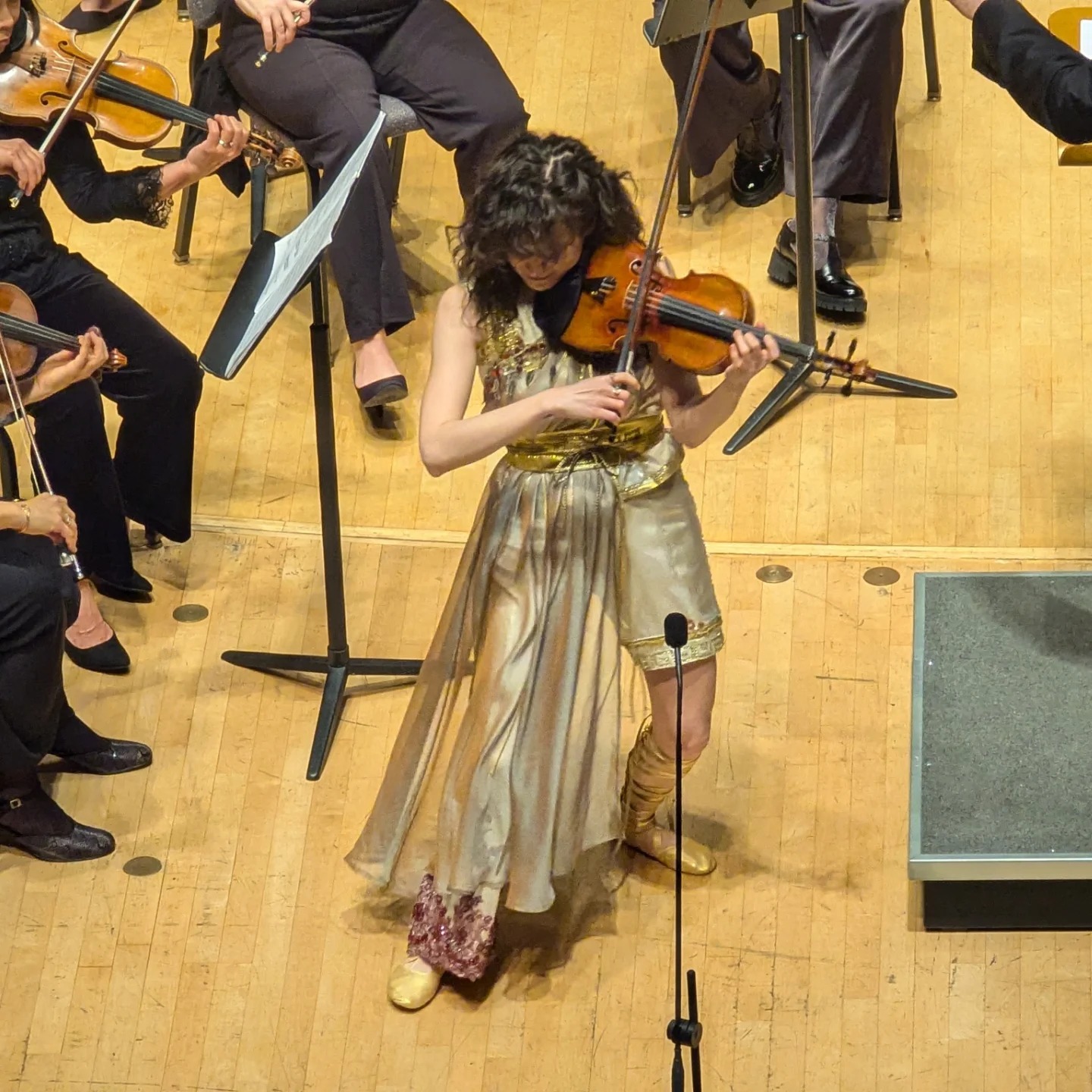
    The concert concluded with Leonard Bernstein’s “Serenade, after Plato’s ‘Symposium’” (1954) – scored for violin, harp, string orchestra, and percussion – essentially Bernstein’s violin concerto. Plato’s work is all about love, with dinner guests waxing philosophical on the multifarious aspects of Eros; but drink is involved, so things eventually devolve into a more worldly appreciation of the grape. Whether intentional or not, something of Bernstein’s character is reflected in the work’s debauched trajectory.

    Dionysian Sandy Cameron was the soloist, wearing a silver tunic, cross-laced “Demetrius and the Gladiators” boots, and diaphanous, ankle-length chlamys. It was her “Megalopolis” moment. Cameron moshed and swayed, contorted and smiled to the music, while meeting all the work’s technical and emotional challenges. Aristophanes never sounded so much like Korngold.

    I always thought this was Bernstein’s concert masterpiece, though of course there are moments when it is unmistakably the work of the guy who wrote “West Side Story” (already being formulated at the time). Hey, the work has six percussionists.

    I’ve been following Hayes on and off over the decades, since his days as a student at the Curtis Institute of Music. Apparently, I haven’t followed closely enough. I always considered him a choral conductor (for years, he was music director of the Philadelphia Singers; later, he directed the New York Choral Society), but his resume is much more diverse. I knew, but I guess must have willfully downplayed the significance of his service on the conducting staff of the Philadelphia Orchestra for a decade, from 2001-11. He kind of dropped of my radar when he moved to New York, and he’s racked up a whole lot of impressive credits since.

    Then a couple of years ago I saw him conduct the world premiere of Adolphus Hailstork’s Symphony No. 4 at Alice Tully Hall, on a program that also included works by Jennifer Higdon and Zhou Tian, with all three composers in attendance. Parenthetically, I was sorry to have to miss one of my favorite Hailstork works, the “Sonata da Chiesa,” on the Chamber Orchestra of Philadelphia’s October concert, with Michael Torke’s “December” and Beethoven’s “Emperor” Concerto, but unfortunately I had scheduling conflicts and was unable to attend.*

    At any rate, evidently I wasn’t really paying attention, as David Hayes is all growed-up!

    This is Hayes’ first season as music director of the chamber orchestra (succeeding Dirk Brossé). I hope the inclusion of so much worthwhile, wholly accessible 20th century and contemporary music works for the organization, because it really works for me. I could have very happily spent my Sunday afternoon at home (it was a whirlwind round-trip as I had another obligation on Sunday night), but this concert was like classical music shoo-fly pie. Bravo, and more please!


    *ERRATA: It was actually a more recent Hailstork work they performed, “Sagrada: Sonata da Chiesa No. 2.” All the more shameful for me to have missed it!


    Video excerpt from Bernstein’s “Serenade” from Friday night’s performance:

  • Copland’s Lincoln Portrait Still Inspires Today

    Copland’s Lincoln Portrait Still Inspires Today

    Suddenly the pride and optimism of “A Lincoln Portrait” has come to seem so quaint. But I will always carry its idealism in my heart.

    Incorporating texts from Lincoln’s speeches, most notably “The Gettysburg Address,” Aaron Copland’s work for speaker and orchestra has been embraced by narrators across the political spectrum, from William Warfield and Carl Sandburg to Margaret Thatcher and Charlton Heston.

    Regardless of one’s personal ideology, the work has the power to stir and inspire. When it was performed under the direction of the composer in Venezuela in 1957, in the presence of reigning dictator Marcos Pérez Jiménez, it was so passionately received by the audience that it may have contributed to Jiménez’ overthrow and exile only a few days later. So clearly, it can be heady, even incendiary stuff.

    Maybe it is, after all, the very thing we need at the present time. The message is one of unity, not division, in serving the greater good and honoring our responsibility to the nation and our fellow citizens in rising to the challenges of “the stormy present.” (“The fiery trial through which we pass will light us down in honor or dishonor to the latest generation.”) The elevating marriage of Lincoln’s words and Copland’s music humbles in its persuasive espousal of the American ideals of fairness and sacrifice. it’s not surprising that the work has appealed to people across the political spectrum. It’s not about partisanship. It’s about embracing the democratic ideals of the United States of America.

    This weekend will bring the opportunity to experience the work live, as Copland’s “A Lincoln Portrait” will be the centerpiece of a program on American and often patriotic themes, to be presented this Friday night at 8:00 by the Main Line Symphony Orchestra, at Valley Forge Middle School in Wayne, PA.

    Jamie Bernstein, Leonard Bernstein’s daughter, will be the narrator. Also on the program will be her father’s “Candide Overture,” Samuel Barber’s Violin Concerto (with Marc Rivetti, assistant concertmaster of the Philadelphia Orchestra, the soloist), William Schuman’s “New England Triptych” (based on melodies of Revolutionary Era composer William Billings), and selections from John Williams’ “Lincoln” and “The Patriot.”

    The conductor will be the orchestra’s music director, Don Liuzzi, whose day job is as principal timpani of the Philadelphia Orchestra.

    The program will be repeated at Reform Congregation Keneseth Israel in Elkins Park, PA, on Sunday at 2 p.m.

    On Aaron Copland’s birthday (today), it’s a timely reminder of the kind of thinking that really made this country great. For more information on these concerts and upcoming performances of the Main Line Symphony Orchestra, follow the link.

    https://www.mlso.org/concerts.htm

    Leonard Bernstein conducts “A Lincoln Portrait,” with William Warfield narrating. Watch for Gerard Schwarz as co-principal trumpet. Schwarz would go on to make his own recording of “A Lincoln Portrait,” as music director of the Seattle Symphony, with James Earl Jones as the speaker.

  • Bernstein Conducts Sibelius Birthday Tribute

    Bernstein Conducts Sibelius Birthday Tribute

    On his birthday anniversary, here’s Leonard Bernstein in 1966 to conduct probably my favorite symphony, the Symphony No. 5 by Jean Sibelius. I once heard him lead this glorious music at Carnegie Hall, around the time he made his Deutsche Grammophon recording with the Vienna Philharmonic. I’m happy to say, I never got over it. By 1987, Bernstein learned to really savor the nobility of the climactic “swan theme.”

    Later, I nearly heard him conduct the Sibelius 1st in Philadelphia, with the student orchestra of the Curtis Institute of Music, but it was toward the end of his life, and sadly he had to cancel due to illness.

    I’ve lost track of the Carnegie program, but I’m sure I’ve got it somewhere. Here’s a record of what else was on the concert.

    https://www.carnegiehall.org/about/history/performance-history-search?q=&dex=prod_PHS&page=2&event=7794&cmp=Jean%20Sibelius_&pf=Leonard%20Bernstein_

    Needless to say, the performance linked above, with the London Symphony Orchestra, is excellent.


    BONUS: Glimpse into a Bernstein masterclass on the Sibelius 5th:

  • Leonard Bernstein Genius Conductor and More

    Leonard Bernstein Genius Conductor and More

    Leonard Bernstein did so much so well.

    Even if we were to restrict ourselves to his achievements as a conductor, he was one of the very top interpreters of American music, Haydn, Schumann, Mahler, Nielsen, Shostakovich – on the evidence of his recordings, too many others to catalogue.

    Here’s just an example of his artistry: in London, from 1966, Lenny captured in his prime, conducting Stravinsky’s primal “Le Sacre du printemps” (“The Rite of Spring”) – without a score.

    At the end of the performance, the musicians refuse to rise, but only continue to applaud him from their seats.

    An appropriately orgiastic salute to Leonard Bernstein on his birthday!


    PHOTO: Bernstein’s magic elevator only goes in one direction: up!

  • Koussevitzky Champion of American Music

    Koussevitzky Champion of American Music

    Friday was the 150th anniversary of Serge Koussevitzky’s birth, but I had just finished recording one of my radio shows, and I couldn’t muster the energy and focus to post about it. Even a photo with a link to one of his recordings would have been something, albeit inadequate in proportion to his significance as one of the great champions of modern music and, more specifically, American music.

    It’s been calculated that, between 1924 and 1944, Koussevitzky presented 162 American works, 66 of which were world premieres. On his Concerts Koussevitzky, conducted in Paris in the 1920s, he also introduced Ravel’s enduring orchestration of Mussorgsky’s “Pictures at an Exhibition” and Honegger’s “Pacific 231.” As music director of the Boston Symphony Orchestra, he gave first performances of Bartók’s Concerto for Orchestra and Copland’s “Appalachian Spring” suite.

    “Kouss” was in on the ground floor at Tanglewood. He mentored Leonard Bernstein and others. When his wife, Nadia, died, he set up the Koussevitzky Music Foundation in her memory, to support and promote living composers. Early Foundation commissions yielded Britten’s “Peter Grimes” and Messiaen’s “Turangalîla-Symphonie.”

    Kouss began his career as a double-bassist and blossomed into one of the most important conductors of the 20th century. I was remiss in not acknowledging him on his birthday anniversary. Mea culpa, and happy 150, Serge Koussevitzky!


    First recording of “Pictures at an Exhibition”

    Broadcast premiere of Bartók’s Concerto for Orchestra (with the original wet-noodle ending, soon to be revised by the composer)

    Live performance of Sibelius’ Symphony No. 7

    Roy Harris’ Symphony No. 3

    Tchaikovsky’s Symphony No. 5

    Rehearsing the BSO in Rimsky-Korsakov’s “Scheherazade”

    Filmed performance of Randall Thompson’s “The Last Words of David”

    Playing the slow movement of his Double-Bass Concerto, with piano

    10-minute documentary, “The Story of Tanglewood” (1949)


    Serge Koussevitzky, holding hat, with (left to right) Olivier Messiaen, Aaron Copland, Leonard Bernstein (lighting up), and Lukas Foss at Tanglewood in 1949 (photo by Ruth Orkin)

Tag Cloud

Aaron Copland (92) Beethoven (95) Composer (114) Film Music (123) Film Score (143) Film Scores (255) Halloween (94) John Williams (187) KWAX (229) Leonard Bernstein (101) Marlboro Music Festival (125) Movie Music (138) Opera (202) Philadelphia Orchestra (89) Picture Perfect (174) Princeton Symphony Orchestra (106) Radio (87) Ralph Vaughan Williams (85) Ross Amico (244) Roy's Tie-Dye Sci-Fi Corner (290) The Classical Network (101) The Lost Chord (268) Vaughan Williams (103) WPRB (396) WWFM (881)

DON’T MISS A BEAT

Receive a weekly digest every Sunday at noon by signing up here


RECENT POSTS