This was my kind of concert!
Yesterday afternoon, at the Kimmel Center for the Performing Arts’ Perelman Theater, The Chamber Orchestra of Philadelphia was conducted by David Hayes in a program of 20th century classics.
Aaron Jay Kernis’ “Musica Celestis” (1990-91) takes its inspiration from medieval mystic and composer Hildegard von Bingen – a work in the holy schmoly, “Fantasia on a Theme by Thomas Tallis”/Alan Hovhaness mode, with perhaps a little Barber’s “Adagio” tossed into the mix. Both Kernis’ and Barber’s works are arrangements of movements from their respective string quartets. This has always been my favorite Kernis piece, with perhaps his “Superstar Etude No. 1” (in the style of Jerry Lee Lewis) a guilty pleasure. Kernis himself was in attendance for yesterday’s performance. The program was a repeat of one previously presented on Friday night.
Béla Bartók’s Divertimento for String Orchestra (1939) was next, the first movement, a game of Baroque solo-tutti table tennis; the second an atmospheric tiptoe through the dank corridors of Dracula’s castle (Hayes, in some spoken remarks, compared it to the scene in every horror movie where you think, “Don’t open that door!”); and the third, a frenzied village dance, more determined in character than in any way euphoric. This is not your standard 18th century entertainment or diversion! But you’ll have this, with Nazism swallowing Europe and the world teetering at the brink of war. (Germany invaded Poland only weeks after the work’s completion.)
The concert concluded with Leonard Bernstein’s “Serenade, after Plato’s ‘Symposium’” (1954) – scored for violin, harp, string orchestra, and percussion – essentially Bernstein’s violin concerto. Plato’s work is all about love, with dinner guests waxing philosophical on the multifarious aspects of Eros; but drink is involved, so things eventually devolve into a more worldly appreciation of the grape. Whether intentional or not, something of Bernstein’s character is reflected in the work’s debauched trajectory.
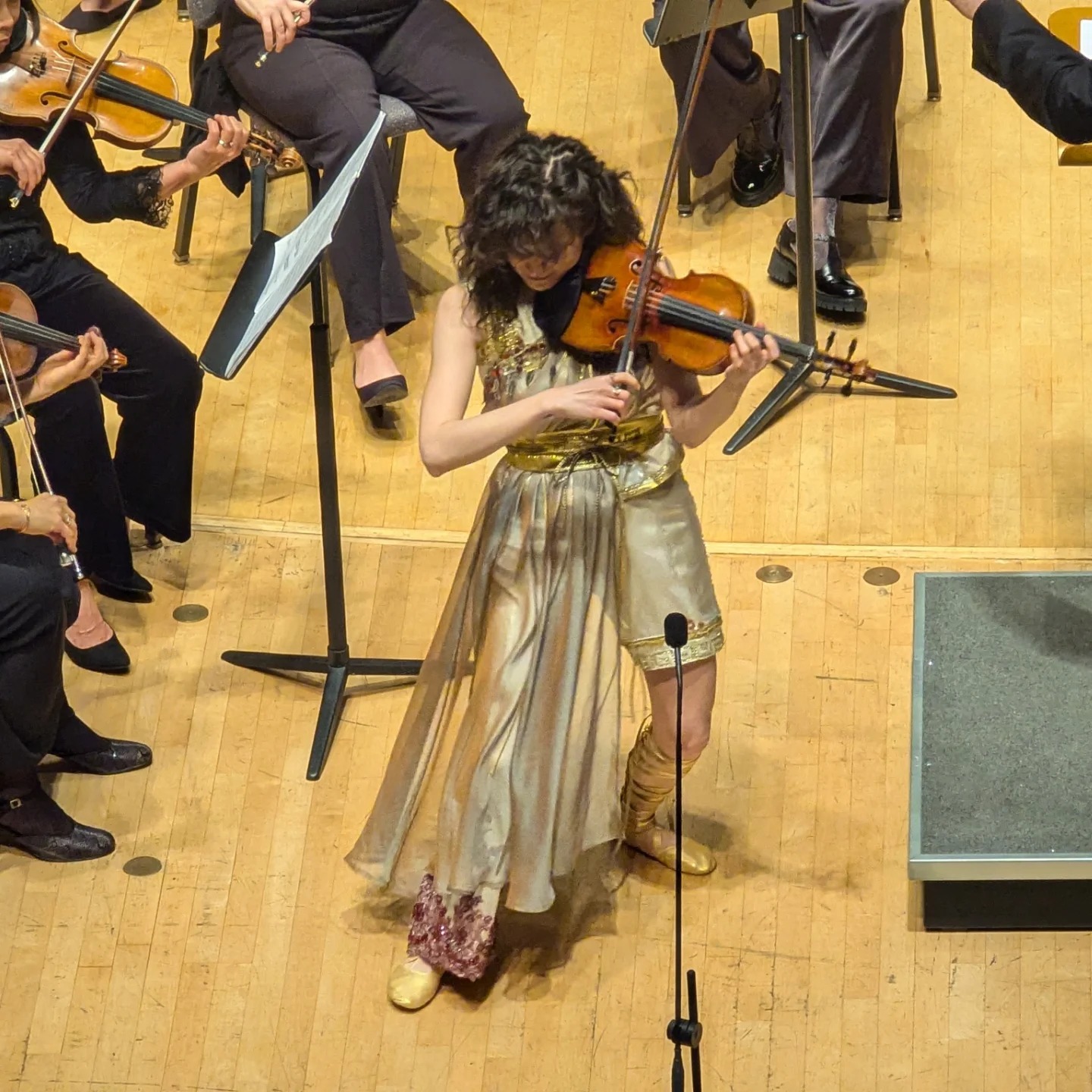
Dionysian Sandy Cameron was the soloist, wearing a silver tunic, cross-laced “Demetrius and the Gladiators” boots, and diaphanous, ankle-length chlamys. It was her “Megalopolis” moment. Cameron moshed and swayed, contorted and smiled to the music, while meeting all the work’s technical and emotional challenges. Aristophanes never sounded so much like Korngold.
I always thought this was Bernstein’s concert masterpiece, though of course there are moments when it is unmistakably the work of the guy who wrote “West Side Story” (already being formulated at the time). Hey, the work has six percussionists.
I’ve been following Hayes on and off over the decades, since his days as a student at the Curtis Institute of Music. Apparently, I haven’t followed closely enough. I always considered him a choral conductor (for years, he was music director of the Philadelphia Singers; later, he directed the New York Choral Society), but his resume is much more diverse. I knew, but I guess must have willfully downplayed the significance of his service on the conducting staff of the Philadelphia Orchestra for a decade, from 2001-11. He kind of dropped of my radar when he moved to New York, and he’s racked up a whole lot of impressive credits since.
Then a couple of years ago I saw him conduct the world premiere of Adolphus Hailstork’s Symphony No. 4 at Alice Tully Hall, on a program that also included works by Jennifer Higdon and Zhou Tian, with all three composers in attendance. Parenthetically, I was sorry to have to miss one of my favorite Hailstork works, the “Sonata da Chiesa,” on the Chamber Orchestra of Philadelphia’s October concert, with Michael Torke’s “December” and Beethoven’s “Emperor” Concerto, but unfortunately I had scheduling conflicts and was unable to attend.*
At any rate, evidently I wasn’t really paying attention, as David Hayes is all growed-up!
This is Hayes’ first season as music director of the chamber orchestra (succeeding Dirk Brossé). I hope the inclusion of so much worthwhile, wholly accessible 20th century and contemporary music works for the organization, because it really works for me. I could have very happily spent my Sunday afternoon at home (it was a whirlwind round-trip as I had another obligation on Sunday night), but this concert was like classical music shoo-fly pie. Bravo, and more please!
*ERRATA: It was actually a more recent Hailstork work they performed, “Sagrada: Sonata da Chiesa No. 2.” All the more shameful for me to have missed it!
Video excerpt from Bernstein’s “Serenade” from Friday night’s performance:
Leave a Reply