Tag: Kimmel Center

  • Steven Isserlis Live A Cello Revelation

    Steven Isserlis Live A Cello Revelation

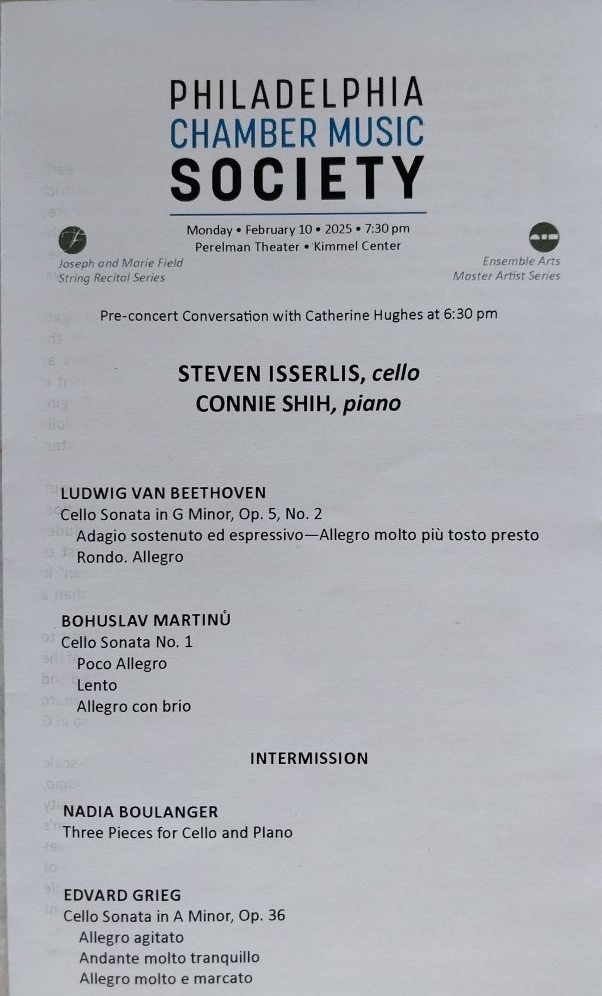
    When I noticed Steven Isserlis on the schedule of the Philadelphia Chamber Music Society – and on a Monday night, no less – I thought I’d very much like to see him. (Monday seems to be a low-traffic day whenever I want to zip into the city.) Unfortunately, I hadn’t seen the listing when I glanced over the brochure earlier in the season, so by the time I went to buy a ticket, it was one of those situations where there was only limited seating remaining and I’d have to contact the office to put my name in. I never like to do that. So I figured, oh well. Maybe I’ll have another opportunity to hear him sometime in the future. It was a pleasant surprise indeed, then, when I received PCMS’ weekly email on Sunday and, lo and behold, suddenly there were tickets available. So I pounced.

    In case you don’t know, Isserlis is an esteemed British cellist, now 66 years old, whose recordings I’ve played and collected for decades. Not religiously collected, but I have and have heard enough that I knew he would definitely be worth seeing.

    Also, the program consisted of works by, alongside the perhaps-not-quite-so-unexpected Beethoven, the much-more-rarely-encountered Bohuslav Martinu, Nadia Boulanger, and Edvard Grieg. Combined, they made for Classic Ross Amico catnip.

    This may have been the first time I would see Isserlis in person, but it was not the first time we interacted. Back in the 1990s, I ran a bookshop about three blocks from the Kimmel Center for the Performing Arts (which didn’t even exist then). Naturally, given my enthusiasm, I amassed an enviable collection of books on music, and I did a very good business with them online. One of the customers I attracted was, you guessed it, Steven Isserlis.

    I always did my best to try to rein it in and not go all fan-boy when interacting with the clientele, since some of the names I dealt with were famous artists with recording contracts with major labels, who were pretty much household names for anyone who listened to classical radio back then, when it was still a legitimate and widely-encountered mode of entertainment.

    Even so, when Isserlis reached out to inquire about a book I’d advertised about Martinu, I couldn’t very well just let it go. I had to, as coolly as I was able, let him know how much I enjoyed certain of his recordings. This went well enough – who doesn’t like to receive an informed compliment? – until I overplayed my hand and referenced a recording I thought he made featuring the music of Grieg and Frederick Delius. To which Isserlis responded, “I never recorded Delius.” He may have even said something disparaging about the composer. (I can’t seem to find the email right now.) I realized immediately I had him confused with Julian Lloyd Webber! Sometimes it pays just to sell the book. Anyway, he purchased it, and now, here we were, 30 years later, and he was playing Martinu at the Kimmel.

    It was nice to see at least one of us held on to our curls. With his shock of white hair, Isserlis increasingly resembles a mad scientist of the cello (either that, or the long-lost brother of Simon Rattle). But his wardrobe last night can best be described as Frankenstein chic – black t-shirt under black sport jacket (but without neck-bolts and elevator shoes). The impression was enhanced during his playing, as the jacket rode up on his arms and, without sleeves, wrists and forearms protruded.

    As for the sound he makes – playing on gut strings – it can sometimes take a while, still, for one to adjust to the discrepancy between a recording and a live performance. It often happens in concertos or in opera that a performer can be swamped in certain passages. But even in chamber music and in a hall as intimate as the Kimmel’s Perelman Theatre, Isserlis doesn’t necessarily have a big sound. Rather, he draws you in. On the whole, I found him most enchanting in more lyrical passages, which he played exquisitely. Of course, it’s also possible my ears just aren’t what they used to be.

    That’s not to say, he doesn’t have the firepower to deliver when necessary. The Martinu built to a good head of steam and when Isserlis rose to acknowledge our applause, I counted no less than four broken bowstrings wafting in the air. Likewise, he was in peak form for the third movement of Nadia Boulanger’s admittedly brief “Three Pieces for Cello and Piano.” On the whole, I think this was the most perfectly realized work on the entire program.

    But delights were many throughout the evening, and everything seemed to get better as it went along. In any case, with a musician of Isserlis’ experience, it’s silly to try to impose one’s views on how something should or should not go, or reflect on how he stacks up as an artist or technician to Lynn Harrell or Yo-Yo Ma. There’s a certain level at which, to approach a concert like that, is just foolish.

    Isserlis’ pianist Connie Shih had technique and temperament to burn. There were times when I felt the steel strings of the piano were too much of a match for the gut-strings of the cello. But these were passing instances, like wisps of cloud drifting across the sun. If I didn’t agree with a particular attack or phrase, again I was literally an armchair observer seated in the first balcony. These were soldiers in the field. Poets, more like it.

    Prior to the program, PCMS music director Miles Cohen took the stage, humorously donning an Eagles cap in acknowledgment of the team’s Super Bowl victory. The cap, which is about the most incongruous thing you could imagine Miles wearing, with his trademark three-piece suit, read, using the Philly colloquial, “IGGLES.” Ordinarily, his routine is to greet everyone, remind us of some upcoming concerts, encourage us to subscribe, and take out his cell phone and invite everyone in joining him in silencing theirs. (Even so, somebody’s phone went off last night.)

    Miles is always very personable, and never more so than when he’s able to share an anecdote. On this occasion, he asked the audience if they knew who Amor Towles is. Towles, who wrote “A Gentleman in Moscow,” released a collection of short stories, “Table for Two,” last year. I have it, having also enjoyed “A Gentleman in Moscow” and “The Lincoln Highway,” but I haven’t gotten around to reading it yet. But Miles has, and it turns out that one of the stories, “The Bootlegger,” features Steven Isserlis!

    Miles went on to say it occurred to him he should contact the author to see if he could get permission to run off copies so that he could distribute it to the audience, and was briefly on the fence about it, until he thought, what would his mother do? She would have emailed him immediately, of course, so sure enough Miles placed his electronic note in a bottle and tossed it out onto the internet, fully expecting never to get a response. Much to his surprise, a few days later, something appeared in his inbox. In the reply, Towles expressed his humility that Miles had thought of him, before tactfully informing him that he cannot distribute the story and that he should contact his publisher. Sure enough, Miles did just that, so that, in the end, everyone in the audience was able to collect a copy of “The Bootlegger.” What a lovely gesture on the part of Miles and PCMS!

    Later, after climbing into bed around midnight, I opened up the 37-page pamphlet to begin reading and I was astonished at how sloppy the writing was. One sentence states that “Mr. Isserlis took the stage accompanied by his accompanist.” Worse, some of the musical descriptions were evidently written by someone who really doesn’t know all that much about music. In defiance of Edgar Allan Poe’s philosophy that a short story should be read in a single sitting, I put it down at a break (there are several in the story) and turned out the light, intending to finish it in the morning.

    This morning came fast, and in the 6:00 hour I sat down with a cup of coffee to read by natural light that was barely strong enough that I could even make out the print. And you know what? I was astonished by how much better the story had gotten! A literary fairy must have visited in the night and swapped out the text, because suddenly what I had before me was a truly excellent story.

    In the first place, the narrative voice is in the first person, ostensibly told by a character who, by her own admission, was not present for some very important parts of the tale. Also, she admits she doesn’t know very much about music. So we have Towles ingeniously hiding behind an imperfect, if not exactly unreliable narrator. She possesses an innate wisdom, and though we are never told anything about her looks, she is beautiful to her core. This kind beauty, in fact, is present in all the characters. How well this writer, by which I mean Towles himself, understands our potential – our foibles and our better selves. In a revelatory passage toward the end, the narrator gives such a moving description of what music is, as Isserlis plays Bach, that it nearly brought me to tears. Here is someone who, while technically ignorant of music, understands it perfectly on its truest, most intuitive level.

    This is especially ironic, since her husband – who Towles also humanizes and allows us to understand – is all about doing everything by the book, about putting on a show about adhering to the rules and following protocol, which he realizes too late, under some circumstances, can be about the most foolish thing one can do. While he’s the one that gets them to Carnegie Hall, in the belief it’s something that a couple of their social standing should do, he is more concerned with the trappings of attending a concert there and its etiquette. Eventually, he is allowed the grace of his own conversion experience. While clearly he is who is, he is well-intentioned and he has a good heart, as do all of the characters, even the one who ultimately plays to the husband’s Achilles’ heel (she is, after all, only human) and, in doing so, instills a lifelong torment.

    I wish the world were the way Towles sees it. Who knows, maybe it really is?

    Anyway, the combined experience of the quality of the story and its message caused the scales to fall from my eyes. I found myself thinking back to my reflections in the car on my way home last night, when I was wondering if Isserlis needed time to warm up, or if it was actually I who needed the time to warm to him. Furthermore, is it fair to judge a short story that isn’t working, by an established writer, whose past books I’ve enjoyed, when the reader himself is tired? Is it possible the fault, dear Brutus, lies not so much in the artists as in myself?

    Food for thought. It was a lovely concert, and Isserlis gave us one final gift in an encore, the “Berceuse” from Gabriel Fauré’s “Dolly Suite,” which played to his lyrical strengths.

    I had another delightful bonus in encountering Kenneth Hutchins, a regular presence on this page, who surely attends every concert at the Kimmel Center.

    For a taste, here’s a video of Isserlis and Shih performing Fauré’s “Berceuse” at recital in London:

  • Barbara Hannigan: A Transformative Concert

    Barbara Hannigan: A Transformative Concert

    I’ve seen so many concerts recently, I would have neither the time nor the energy to write about all of them. But Tuesday night’s appearance by Barbara Hannigan, at the Kimmel Center for the Performing Arts’ Perelman Theater (courtesy of the Philadelphia Chamber Music Society), was extraordinary, astonishing, transformative. There really is no one else like her.

    The program, presented without intermission, was bookended by two song cycles. Olivier Messiaen’s “Chants de Terre et de Ciel” (“Songs of Earth and Heaven”) of 1938 is a 30-minute confessional on poetic texts offering insights into the composer’s domestic love and Catholic faith. As much a method actor as she is a vocal artist, Hannigan projected herself right into the heart of this intimate score, assimilating its hopes, doubts, and moments of ecstasy.

    In fact, she sang with such nuance and commitment, it had the paradoxical effect of lulling me into a kind of complacency, if such a thing is possible in the presence of artistry of this caliber, as I expected her usual high standards when she returned to perform John Zorn’s “Jumalattaret” of 2012. But she pulled the rug right out from under me, knocking me back on my heels, as she took things to a whole other, unanticipated level. I don’t know that I will witness a performance quite like it ever again.

    “Jumalattaret,” inspired by “The Kalevala” (the Finnish national epic that informs so much of Sibelius’ music), praises nine goddesses out of Sámi shamanism: Päivätär, goddess of the sun; Vedenemo, mother of waters; Akka, queen of the ancient magic; Louhi, hostess of the underworld; Mielikki, the huntress; Kuu, moon goddess; Tellervo, forest spirit; Ilmatar, virgin spirit of the air; and Vellamo, goddess of the sea.

    Hannigan delivered the opening invocation as almost a cooing sprechtstimme. As the cycle progressed, she also employed or engaged in birdlike vibrato, Queen of the Night scat-singing, diaphanous humming, and possessed laughter, all the while having to focus on clearing the work’s many polyrhythmic hurdles. I hasten to add, it was not all style over substance: with equal skill, she unfurled passages of ethereal beauty.

    Yes, she smacked her palms, thudded her chest, and enacted what I can only compare to the once common practice among children of clapping their hands against their mouths in Indian “woo-woo” fashion. But these gestures transcended gimmicky and reached to the primordial roots of the source material. You can always count on Hannigan to bend and blend technique and effect to the service of storytelling. A passage in which she begins with a hush, her voice blossoming unhurriedly, so that you can feel every petal unfold, will gently hairpin into a controlled decrescendo al niente that is as seamlessly executed as it is mesmerizing.

    In the program notes, she claims that the demands of the score initially stumped her. That’s saying something, for a singer who has seen and done it all. Not just done, mind you, but MASTERED. She reached out to Zorn to see if there might be some concessions they could make so that she might actually be able to perform his music. Somehow, he convinced her to just go for it. Hannigan shares some of their correspondence. Zorn wrote, “One cannot transcend anything by staying on safe ground. And it is in these intense moments that we can find deeper truths, bringing mind and heart together – and begin to understand the soul and its workings in that courageous moment of letting go and going for it, the music will become alive in a special way – a way that is beyond the notes on paper.”

    As astonishing as her performance was, I find it even more so that she would even have to be told this, as Hannigan always goes for broke. The score must have seemed beyond human capability. All the same, on Tuesday, she walked the tightrope between laser-focus and hurling-herself-into-the-void abandon.

    Certainly, Hannigan has had her forebears in avant-garde specialists like Cathy Berberian, Lucy Shelton, and Meredith Monk, all courageously exploring extended techniques, but I don’t know that any of them employed the entire tool kit with such facility. In uncanny precision and otherworldly beauty, Hannigan is like a human theremin.

    The last time I saw her live was as Gepopo in György Ligeti’s “Le Grand Macabre,” with the New York Philharmonic in 2010. She has lost none of her voice, and if anything her technique is even more astonishing.

    Zorn’s piano writing ranged wildly in its shifting time signatures from dissonant complexity to what I can only assume is meant to be folk-like simplicity. To me, it sounded like a cross between Vince Guaraldi and Mark Isham.

    He also employs an arsenal of inside-the-piano effects pioneered by composers like Henry Cowell (stroking and plucking the strings, banging on the wood, and inserting objects) and George Crumb (the soprano singing into the strings). Toward the end of the cycle, Hannigan produced a tiny suspended cymbal from inside the piano and struck it with a minute stick.

    Furthermore, Hannigan’s creative collaborator for the evening, Bertrand Chamayou, forwent the traditional music stand, preferring to read the scores from where he laid them open, also inside the piano, on the strings.

    The two song cycles were separated by a pair of piano pieces by Alexander Scriabin: “Poème-nocturne” (“Night Poem”), Op. 61, of 1912, and “Vers la flamme” (“Towards the flame”), Op. 72, of 1914. These were no mere palate-cleansers. Rather than divert, they maintained the keen interest aroused by the Messiaen, and they were absorbingly presented.

    Lights at the back of the stage emitted different colors during each of the pieces – red for Messiaen and blue for Zorn – not inappropriate for a program constructed on music by composers sensitive to the effects of synesthesia (a neurological phenomenon in which different tones trigger sensations of color).

    Granted, it was a rainy, foggy Tuesday night, with accidents and traffic jams everywhere, and new music can be a hard sell, but I was flabbergasted that the hall was not packed. The downstairs was near-full, and the first balcony respectably so, but the seats around the back of the stage were empty, save for I think one person. Where I sat, on the second balcony, with all the lonely old men in beards, we were all involuntarily social distancing.

    But it is still an intimate hall (of 650 seats), and Hannigan’s charisma, intensity, and daring sent electric shocks to the bleachers.


    PHOTOS: The blurrier ones at the bottom are mine; the one at the top is an authorized photo taken at the Teatro di San Carlo by Luciano Romano

  • Chamber Orchestra Blooms Under Hayes’ Baton

    Chamber Orchestra Blooms Under Hayes’ Baton

    This was my kind of concert!

    Yesterday afternoon, at the Kimmel Center for the Performing Arts’ Perelman Theater, The Chamber Orchestra of Philadelphia was conducted by David Hayes in a program of 20th century classics.

    Aaron Jay Kernis’ “Musica Celestis” (1990-91) takes its inspiration from medieval mystic and composer Hildegard von Bingen – a work in the holy schmoly, “Fantasia on a Theme by Thomas Tallis”/Alan Hovhaness mode, with perhaps a little Barber’s “Adagio” tossed into the mix. Both Kernis’ and Barber’s works are arrangements of movements from their respective string quartets. This has always been my favorite Kernis piece, with perhaps his “Superstar Etude No. 1” (in the style of Jerry Lee Lewis) a guilty pleasure. Kernis himself was in attendance for yesterday’s performance. The program was a repeat of one previously presented on Friday night.

    Béla Bartók’s Divertimento for String Orchestra (1939) was next, the first movement, a game of Baroque solo-tutti table tennis; the second an atmospheric tiptoe through the dank corridors of Dracula’s castle (Hayes, in some spoken remarks, compared it to the scene in every horror movie where you think, “Don’t open that door!”); and the third, a frenzied village dance, more determined in character than in any way euphoric. This is not your standard 18th century entertainment or diversion! But you’ll have this, with Nazism swallowing Europe and the world teetering at the brink of war. (Germany invaded Poland only weeks after the work’s completion.)

    The concert concluded with Leonard Bernstein’s “Serenade, after Plato’s ‘Symposium’” (1954) – scored for violin, harp, string orchestra, and percussion – essentially Bernstein’s violin concerto. Plato’s work is all about love, with dinner guests waxing philosophical on the multifarious aspects of Eros; but drink is involved, so things eventually devolve into a more worldly appreciation of the grape. Whether intentional or not, something of Bernstein’s character is reflected in the work’s debauched trajectory.

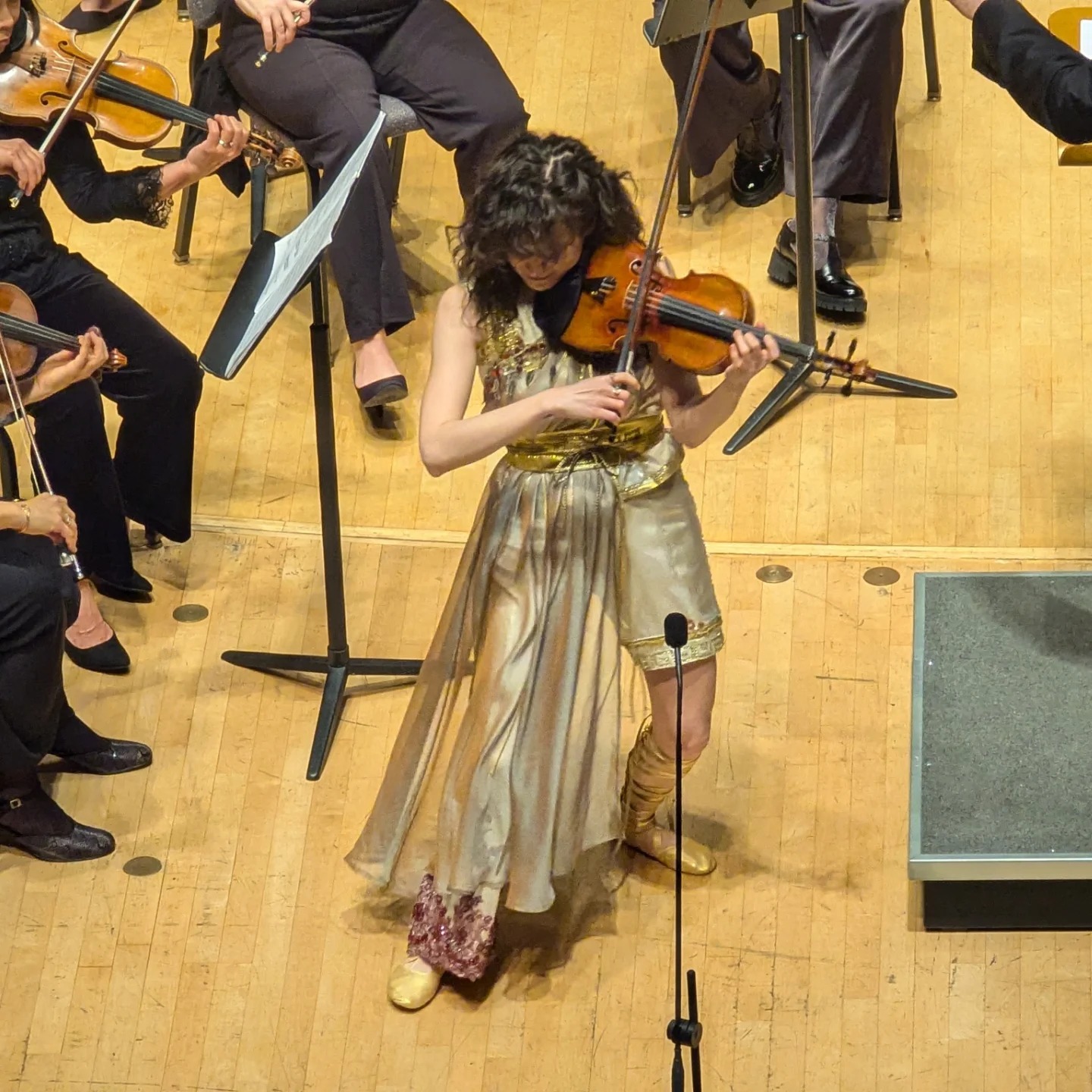
    Dionysian Sandy Cameron was the soloist, wearing a silver tunic, cross-laced “Demetrius and the Gladiators” boots, and diaphanous, ankle-length chlamys. It was her “Megalopolis” moment. Cameron moshed and swayed, contorted and smiled to the music, while meeting all the work’s technical and emotional challenges. Aristophanes never sounded so much like Korngold.

    I always thought this was Bernstein’s concert masterpiece, though of course there are moments when it is unmistakably the work of the guy who wrote “West Side Story” (already being formulated at the time). Hey, the work has six percussionists.

    I’ve been following Hayes on and off over the decades, since his days as a student at the Curtis Institute of Music. Apparently, I haven’t followed closely enough. I always considered him a choral conductor (for years, he was music director of the Philadelphia Singers; later, he directed the New York Choral Society), but his resume is much more diverse. I knew, but I guess must have willfully downplayed the significance of his service on the conducting staff of the Philadelphia Orchestra for a decade, from 2001-11. He kind of dropped of my radar when he moved to New York, and he’s racked up a whole lot of impressive credits since.

    Then a couple of years ago I saw him conduct the world premiere of Adolphus Hailstork’s Symphony No. 4 at Alice Tully Hall, on a program that also included works by Jennifer Higdon and Zhou Tian, with all three composers in attendance. Parenthetically, I was sorry to have to miss one of my favorite Hailstork works, the “Sonata da Chiesa,” on the Chamber Orchestra of Philadelphia’s October concert, with Michael Torke’s “December” and Beethoven’s “Emperor” Concerto, but unfortunately I had scheduling conflicts and was unable to attend.*

    At any rate, evidently I wasn’t really paying attention, as David Hayes is all growed-up!

    This is Hayes’ first season as music director of the chamber orchestra (succeeding Dirk Brossé). I hope the inclusion of so much worthwhile, wholly accessible 20th century and contemporary music works for the organization, because it really works for me. I could have very happily spent my Sunday afternoon at home (it was a whirlwind round-trip as I had another obligation on Sunday night), but this concert was like classical music shoo-fly pie. Bravo, and more please!


    *ERRATA: It was actually a more recent Hailstork work they performed, “Sagrada: Sonata da Chiesa No. 2.” All the more shameful for me to have missed it!


    Video excerpt from Bernstein’s “Serenade” from Friday night’s performance:

  • Philly Orch Blows Roof Off with Saint-Saëns, Martinu

    Philly Orch Blows Roof Off with Saint-Saëns, Martinu

    HOLY SH*T, WHAT A CONCERT!!! (I hope I didn’t steal that from Bernard Shaw.)

    I’m elated to report The Philadelphia Orchestra was in fine fettle on Friday afternoon, under the baton of guest conductor Roderick Cox.

    I venture to guess, the big draw for most was Camille Saint-Saëns’ “Organ” Symphony, but for me, what really ensured a fool and his money would soon be parted was the inclusion on the program of Bohuslav Martinu’s Rhapsody-Concerto for Viola and Orchestra, a work I had not heard in concert for 36 years. The last time, also in Philadelphia, was with Joseph de Pasquale, the soloist, and Riccardo Muti on the podium. Of course, now I own at least three recordings. Back then, De Pasquale was Philly’s principal violist. Today the work was played by the orchestra’s current principal, Choong-Jin Chang.

    If you don’t know anything about Martinu, and you’re at all squeamish about 20th century music, there is no better place to start. A few mildly anxious passages aside, the Rhapsody-Concerto is pure Dvořák in Iowa. Incidentally, this sleeping giant of Czech music will also be the focus of next summer’s Bard Music Festival. Fight me!

    I showed up with the expectation of the Saint-Saëns being mere icing on the cake. The “Organ” Symphony has always been a Philadelphia Orchestra specialty. The musicians could probably play it in their sleep. Today, they were a good deal more committed than that. Raphael Attila Vogl was at the console of the Fred J. Cooper Memorial Organ. The organ part of Saint-Saëns’ symphony is not a virtuosic one, but it sure does make an impression! There’s a reason certain pieces become warhorses. The last movement was one sustained goosebump – positively spinetingling! That Saint-Saëns really knew how to give an audience its money’s worth.

    The program opened with a suite from Béla Bartók’s feel-good ballet, “The Miraculous Mandarin.” The scenario is about a prostitute who lures unsuspecting men to her room so that three desperate characters can rough them up and steal their money. The most peculiar of her would-be clients is the titular mandarin, who the desperados attempt to murder, but he turns out to be more resilient than Rasputin.

    Unfortunately, I was stuck in traffic on I-95 South, so I can’t tell you anything about the performance. I blew into the Kimmel Center for the Performing Arts and took the elevator to the third tier with just enough time only to catch the last minute or two on a monitor. But having experienced the rest of the concert, I can say with confidence that, under the circumstances, it could well have been Bartók, and not Saint-Saëns, who wound up being the icing.

    The program will be repeated at the Kimmel on Sunday afternoon at 2:00. No concert tomorrow, presumably because of Yom Kippur.

    https://philorch.ensembleartsphilly.org/tickets-and-events/2024-25-season/saint-saenss-organ-symphony


    PHOTO: Love me some Martinu

  • Salonen’s Bad Hair Day:  Earthbound, Incoherent, Uninspiring Sibelius

    Salonen’s Bad Hair Day: Earthbound, Incoherent, Uninspiring Sibelius

    It was a dreary day last Thursday, but a great pleasure to finally meet up with sportswriter Brad Wilson for the first time at Philadelphia’s Kimmel Center for the Performing Arts. Brad’s beat is my old stomping grounds of the Lehigh Valley and across the river in Warren and Hunterdon Counties.

    I wish I could say I derived as much pleasure from Esa-Pekka Salonen’s performance of Sibelius’ Symphony No. 5 with the Philadelphia Orchestra.

    Sadly, as someone who loves this symphony very much and who has heard it performed many times, I thought Salonen really missed the ball on this one (I promise, my only sports analogy in this write-up). At no point did I feel moved or inspired, nor did I get any sense of the conductor’s understanding of the tectonic movement or spatial relationships in the piece. I didn’t think it possible not to be cheered by the opening “sunrise” of French horns and flutes, nor do I think I have ever heard the plangent woodwinds in the third movement (if we regard it as a four-movement symphony), like forlorn waterfowl, without them tugging at my heartstrings.

    There should be a sense of mounting suspense, dread even, as the ground begins to shift into the inexorable accelerando between the first two movements (which are connected). Ideally, it should carry all the thrill and terror of the sublime, but here I did not sense that it was undertaken with any great care. Rather, like most of the performance, it was simply tossed off, blithely and unconvincingly.

    Even in the magnificent last movement, it was like stuff just happened. In more satisfying performances (which is to say, probably just about every other performance I’ve ever heard), everything comes together in its rough-hewn way and conductors succeed in making it sound as if every component belongs, relates, and makes some kind of coherent sense. Despite his vast experience with this composer, Salonen did not – at least for me. Maybe it was just I who was having an off-night, but I did not like it, and nothing is as depressing as having a piece of music you love and know very well not take flight.

    I hasten to add, I realize the performance may not have impressed everyone the same way. At the end of the six monolithic chords that bring the symphony to a close, people around me burst into wild applause and the guy in front of me actually whooped, even as it took everything in my power to conjure a golf-clap. I didn’t want it to come across as if I don’t love the composer or don’t appreciate the orchestra’s efforts. But Salonen. Oy vey. I don’t know what people want from their Sibelius, but I expect more.

    I searched for some online reviews, to make sure I wasn’t taking crazy pills, and I came across this one in which every one of the reviewer’s impressions run counter to my own. The stuff he dismisses about the concert, I enjoyed, and the stuff I disliked, he lauded to Pohjola and back. Believe me, I would have settled for “majestic stateliness.”

    https://bachtrack.com/review-esa-pekka-salonen-philadelphia-orchestra-sibelius-stucky-may-2024

    If there was a Philadelphia Inquirer review, I could not find it and wouldn’t be able to read it anyway, unless forwarded to me, because it would be paywalled (and in any case probably mostly worthless).

    It’s unusual for Philadelphia to program the same piece two years in a row, but they did so with the Sibelius 5th. Frankly, I thought Dalia Stasevska’s performance last year was head and shoulders over what I heard Thursday night – nimble, thrilling, and intelligently judged. Even Don Liuzzi was more electrifying on the timpani. This is not a reflection on his playing on Thursday, but a musician has to work within the overall design of a conductor’s interpretation, such that it is. Salonen’s brass had some good moments with the big tune (Sibelius’ “swan theme”) in the last movement, but nothing seemed to fit together or flow organically – unusual for a conductor of his experience with this most organic of composers – or, at the very least, generate some tension and release.

    Salonen is often characterized as “a modernist.” I don’t care about that. The mature Sibelius is not exactly the most sentimental composer. I would be perfectly satisfied if he had allowed the architecture of the music to simply speak for itself. But it was as if he had no idea of its magnificent layout. Rather, it was like he was flipping through a magazine (Architectural Digest?) in the waiting room at the doctor’s office. The performance, to me, just felt uninvolved, and by extension uninvolving. Maybe he’s just conducted it too many times.

    Steven Stucky’s “Radical Light,” which opened the program, was also just kind of there. Salonen commissioned the work, back during his days as music director of the Los Angeles Philharmonic, to be included on a program between Sibelius’ 4th and 7th Symphonies. On Thursday, it just came off as a time-killer. Sure, it paid tribute to Sibelius by aping some of his mannerisms and textures, but I couldn’t help but think how much more satisfying it would have been had the concert just opened with the 7th Symphony or “Tapiola.”

    The highlight of the evening was Salonen’s own “kínēma” (all lower case) for clarinet and orchestra, which even at 30 minutes I found engaging and wonderfully played. Ricardo Morales, the orchestra’s charismatic principal clarinet, was the soloist. I confess I was pleasantly surprised, as I own a few recordings of Salonen’s own music, and while I find it agreeable enough to just go with it if I’m in the right mood, this piece was by far the most immediately ingratiating of anything of his I have ever heard.

    I want to make it clear that I don’t dislike Salonen, and I wish him all the best in conducting “Daphnis and Chloe” in Philadelphia this week. Even Pierre Boulez knew how to pull off a good performance of Ravel.

    Likewise, none of this is intended as a reflection on Brad, who was kind enough to secure our tickets. He and I have enjoyed a kind of radio and Facebook messaging friendship for a good number of years now. His musical knowledge is vast and his tastes are diverse (ranging from Bach to Elliot Carter), and his observations and recommendations are always valued. From his comments that night, I gather he liked the Sibelius. I don’t have the gift of diplomacy, so I was hesitant to start in, knowing that whatever I had to say would likely blossom into a rant.

    And what do I know? Salonen is Finnish (like the composer) and he has decades of experience interpreting this music. Me? I’m just a grouch. Maybe I should have eaten something closer to the start of the concert. But I love Sibelius and I love this symphony, and I have a pretty good idea of when somebody gets it right. Even Simon Rattle, with his bewildering obsession with whispered pianissimos, got it when he conducted it in Philly in 1999. Salonen was like Väinämöinen, the star-crossed wizard of the Kalevala, on one of his terrible, horrible, no good, very bad days.

    And dammit, the program notes were weak too!

    This amused me: Dave Hurwitz’s recollection of three terrible concerts. Hurwitz can be an acquired taste, but once you acquire it, he’s like an amusing, outspoken friend. I agree with him that live music concerts, even at their worst, can be wonderful. Also that there can be a certain satisfaction to be found in tearing the bad ones apart.

    I would have had this posted days ago, but I was interrupted by a phone call, like the poet Coleridge, distracted by a knock at the door in the middle of setting down the lines for “Kubla Khan,” which had come to him in a dream; and then when he returned, he found he couldn’t pick up the thread. However, unlike Coleridge, this humble review is unlikely to be included in anthologies of English literature in 200 years, even as society inevitably continues to deteriorate.

Tag Cloud

Aaron Copland (92) Beethoven (95) Composer (114) Film Music (119) Film Score (143) Film Scores (255) Halloween (94) John Williams (185) KWAX (229) Leonard Bernstein (99) Marlboro Music Festival (125) Movie Music (134) Opera (198) Philadelphia Orchestra (86) Picture Perfect (174) Princeton Symphony Orchestra (106) Radio (87) Ralph Vaughan Williams (85) Ross Amico (244) Roy's Tie-Dye Sci-Fi Corner (290) The Classical Network (101) The Lost Chord (268) Vaughan Williams (102) WPRB (396) WWFM (881)

DON’T MISS A BEAT

Receive a weekly digest every Sunday at noon by signing up here


RECENT POSTS