When I noticed Steven Isserlis on the schedule of the Philadelphia Chamber Music Society – and on a Monday night, no less – I thought I’d very much like to see him. (Monday seems to be a low-traffic day whenever I want to zip into the city.) Unfortunately, I hadn’t seen the listing when I glanced over the brochure earlier in the season, so by the time I went to buy a ticket, it was one of those situations where there was only limited seating remaining and I’d have to contact the office to put my name in. I never like to do that. So I figured, oh well. Maybe I’ll have another opportunity to hear him sometime in the future. It was a pleasant surprise indeed, then, when I received PCMS’ weekly email on Sunday and, lo and behold, suddenly there were tickets available. So I pounced.
In case you don’t know, Isserlis is an esteemed British cellist, now 66 years old, whose recordings I’ve played and collected for decades. Not religiously collected, but I have and have heard enough that I knew he would definitely be worth seeing.
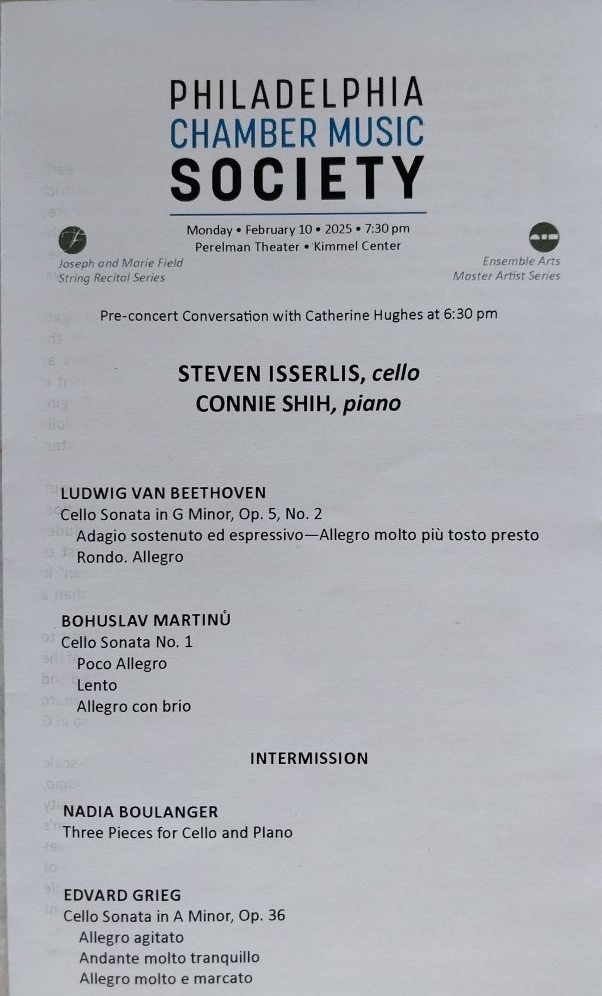
Also, the program consisted of works by, alongside the perhaps-not-quite-so-unexpected Beethoven, the much-more-rarely-encountered Bohuslav Martinu, Nadia Boulanger, and Edvard Grieg. Combined, they made for Classic Ross Amico catnip.
This may have been the first time I would see Isserlis in person, but it was not the first time we interacted. Back in the 1990s, I ran a bookshop about three blocks from the Kimmel Center for the Performing Arts (which didn’t even exist then). Naturally, given my enthusiasm, I amassed an enviable collection of books on music, and I did a very good business with them online. One of the customers I attracted was, you guessed it, Steven Isserlis.
I always did my best to try to rein it in and not go all fan-boy when interacting with the clientele, since some of the names I dealt with were famous artists with recording contracts with major labels, who were pretty much household names for anyone who listened to classical radio back then, when it was still a legitimate and widely-encountered mode of entertainment.
Even so, when Isserlis reached out to inquire about a book I’d advertised about Martinu, I couldn’t very well just let it go. I had to, as coolly as I was able, let him know how much I enjoyed certain of his recordings. This went well enough – who doesn’t like to receive an informed compliment? – until I overplayed my hand and referenced a recording I thought he made featuring the music of Grieg and Frederick Delius. To which Isserlis responded, “I never recorded Delius.” He may have even said something disparaging about the composer. (I can’t seem to find the email right now.) I realized immediately I had him confused with Julian Lloyd Webber! Sometimes it pays just to sell the book. Anyway, he purchased it, and now, here we were, 30 years later, and he was playing Martinu at the Kimmel.
It was nice to see at least one of us held on to our curls. With his shock of white hair, Isserlis increasingly resembles a mad scientist of the cello (either that, or the long-lost brother of Simon Rattle). But his wardrobe last night can best be described as Frankenstein chic – black t-shirt under black sport jacket (but without neck-bolts and elevator shoes). The impression was enhanced during his playing, as the jacket rode up on his arms and, without sleeves, wrists and forearms protruded.
As for the sound he makes – playing on gut strings – it can sometimes take a while, still, for one to adjust to the discrepancy between a recording and a live performance. It often happens in concertos or in opera that a performer can be swamped in certain passages. But even in chamber music and in a hall as intimate as the Kimmel’s Perelman Theatre, Isserlis doesn’t necessarily have a big sound. Rather, he draws you in. On the whole, I found him most enchanting in more lyrical passages, which he played exquisitely. Of course, it’s also possible my ears just aren’t what they used to be.
That’s not to say, he doesn’t have the firepower to deliver when necessary. The Martinu built to a good head of steam and when Isserlis rose to acknowledge our applause, I counted no less than four broken bowstrings wafting in the air. Likewise, he was in peak form for the third movement of Nadia Boulanger’s admittedly brief “Three Pieces for Cello and Piano.” On the whole, I think this was the most perfectly realized work on the entire program.
But delights were many throughout the evening, and everything seemed to get better as it went along. In any case, with a musician of Isserlis’ experience, it’s silly to try to impose one’s views on how something should or should not go, or reflect on how he stacks up as an artist or technician to Lynn Harrell or Yo-Yo Ma. There’s a certain level at which, to approach a concert like that, is just foolish.
Isserlis’ pianist Connie Shih had technique and temperament to burn. There were times when I felt the steel strings of the piano were too much of a match for the gut-strings of the cello. But these were passing instances, like wisps of cloud drifting across the sun. If I didn’t agree with a particular attack or phrase, again I was literally an armchair observer seated in the first balcony. These were soldiers in the field. Poets, more like it.
Prior to the program, PCMS music director Miles Cohen took the stage, humorously donning an Eagles cap in acknowledgment of the team’s Super Bowl victory. The cap, which is about the most incongruous thing you could imagine Miles wearing, with his trademark three-piece suit, read, using the Philly colloquial, “IGGLES.” Ordinarily, his routine is to greet everyone, remind us of some upcoming concerts, encourage us to subscribe, and take out his cell phone and invite everyone in joining him in silencing theirs. (Even so, somebody’s phone went off last night.)
Miles is always very personable, and never more so than when he’s able to share an anecdote. On this occasion, he asked the audience if they knew who Amor Towles is. Towles, who wrote “A Gentleman in Moscow,” released a collection of short stories, “Table for Two,” last year. I have it, having also enjoyed “A Gentleman in Moscow” and “The Lincoln Highway,” but I haven’t gotten around to reading it yet. But Miles has, and it turns out that one of the stories, “The Bootlegger,” features Steven Isserlis!
Miles went on to say it occurred to him he should contact the author to see if he could get permission to run off copies so that he could distribute it to the audience, and was briefly on the fence about it, until he thought, what would his mother do? She would have emailed him immediately, of course, so sure enough Miles placed his electronic note in a bottle and tossed it out onto the internet, fully expecting never to get a response. Much to his surprise, a few days later, something appeared in his inbox. In the reply, Towles expressed his humility that Miles had thought of him, before tactfully informing him that he cannot distribute the story and that he should contact his publisher. Sure enough, Miles did just that, so that, in the end, everyone in the audience was able to collect a copy of “The Bootlegger.” What a lovely gesture on the part of Miles and PCMS!
Later, after climbing into bed around midnight, I opened up the 37-page pamphlet to begin reading and I was astonished at how sloppy the writing was. One sentence states that “Mr. Isserlis took the stage accompanied by his accompanist.” Worse, some of the musical descriptions were evidently written by someone who really doesn’t know all that much about music. In defiance of Edgar Allan Poe’s philosophy that a short story should be read in a single sitting, I put it down at a break (there are several in the story) and turned out the light, intending to finish it in the morning.
This morning came fast, and in the 6:00 hour I sat down with a cup of coffee to read by natural light that was barely strong enough that I could even make out the print. And you know what? I was astonished by how much better the story had gotten! A literary fairy must have visited in the night and swapped out the text, because suddenly what I had before me was a truly excellent story.
In the first place, the narrative voice is in the first person, ostensibly told by a character who, by her own admission, was not present for some very important parts of the tale. Also, she admits she doesn’t know very much about music. So we have Towles ingeniously hiding behind an imperfect, if not exactly unreliable narrator. She possesses an innate wisdom, and though we are never told anything about her looks, she is beautiful to her core. This kind beauty, in fact, is present in all the characters. How well this writer, by which I mean Towles himself, understands our potential – our foibles and our better selves. In a revelatory passage toward the end, the narrator gives such a moving description of what music is, as Isserlis plays Bach, that it nearly brought me to tears. Here is someone who, while technically ignorant of music, understands it perfectly on its truest, most intuitive level.
This is especially ironic, since her husband – who Towles also humanizes and allows us to understand – is all about doing everything by the book, about putting on a show about adhering to the rules and following protocol, which he realizes too late, under some circumstances, can be about the most foolish thing one can do. While he’s the one that gets them to Carnegie Hall, in the belief it’s something that a couple of their social standing should do, he is more concerned with the trappings of attending a concert there and its etiquette. Eventually, he is allowed the grace of his own conversion experience. While clearly he is who is, he is well-intentioned and he has a good heart, as do all of the characters, even the one who ultimately plays to the husband’s Achilles’ heel (she is, after all, only human) and, in doing so, instills a lifelong torment.
I wish the world were the way Towles sees it. Who knows, maybe it really is?
Anyway, the combined experience of the quality of the story and its message caused the scales to fall from my eyes. I found myself thinking back to my reflections in the car on my way home last night, when I was wondering if Isserlis needed time to warm up, or if it was actually I who needed the time to warm to him. Furthermore, is it fair to judge a short story that isn’t working, by an established writer, whose past books I’ve enjoyed, when the reader himself is tired? Is it possible the fault, dear Brutus, lies not so much in the artists as in myself?
Food for thought. It was a lovely concert, and Isserlis gave us one final gift in an encore, the “Berceuse” from Gabriel Fauré’s “Dolly Suite,” which played to his lyrical strengths.
I had another delightful bonus in encountering Kenneth Hutchins, a regular presence on this page, who surely attends every concert at the Kimmel Center.
For a taste, here’s a video of Isserlis and Shih performing Fauré’s “Berceuse” at recital in London:
Leave a Reply