Brian De Palma is an extraordinarily adept filmmaker, who has been criticized for his adherence to “genre trash.” He has always been attracted to suspense and crime thrillers, usually of an especially violent nature, many of them tinged with horror.
This week on “Picture Perfect,” with Hallowe’en right around the corner, we’ll hear music from four of De Palma’s films.
It’s hardly surprising that such an admirer of Alfred Hitchcock would also hire Hitch’s signature composer. Bernard Herrmann scored two films for De Palma – “Sisters,” in 1973, and “Obsession,” in 1976.
“Obsession” is a spin on Hitchcock’s “Vertigo.” A botched rescue attempt results in the death of a businessman’s kidnapped wife. Years later, he encounters someone who could be her doppelganger. The film stars Genevieve Bujold, John Lithgow, and a very tan Cliff Robertson.
“The Fury,” from 1978, is a supernatural thriller based on a novel by John Farris. Two teenagers, endowed with powers of telekinesis and extra-sensory perception, are targeted by researchers who plan to harness them for their own nefarious ends. For a time, Kirk Douglas has fun as a former CIA agent, and John Cassavetes is a particularly slimy villain. Cassavetes’ comeuppance makes for one of the most memorable movie endings of its era – and we’ll leave it at that!
Critic Pauline Kael praised the music, which is by none other than John Williams – hot off his third Academy Award, for “Star Wars” – characterizing it as “as elegant and delicately varied a score as any horror film has ever had.”
Of course, “The Fury” was not the first De Palma film to deal with telekinesis. His adaptation of Stephen King’s “Carrie,” from 1976, became one the decade’s landmark horror films. It broadened King’s popularity and propelled De Palma into the A-list of Hollywood directors. It also essentially launched the careers of Amy Irving, John Travolta, and Nancy Allen, among others. Sissy Spacek was nominated for an Academy Award for her performance in the title role, as was Piper Laurie as Carrie’s overbearing, fundamentalist mother.
The music was by Pino Donaggio. The director had wanted to continue his collaboration with Herrmann, but the composer died before the film could be completed. Donaggio, though classically trained, made his fortune writing popular songs. His biggest hit was “You Don’t Have to Say You Love Me,” which was recorded by Dusty Springfield and treated to a well-known cover by Elvis Presley. Donnagio went on to become a regular De Palma collaborator, providing the music for seven of his films.
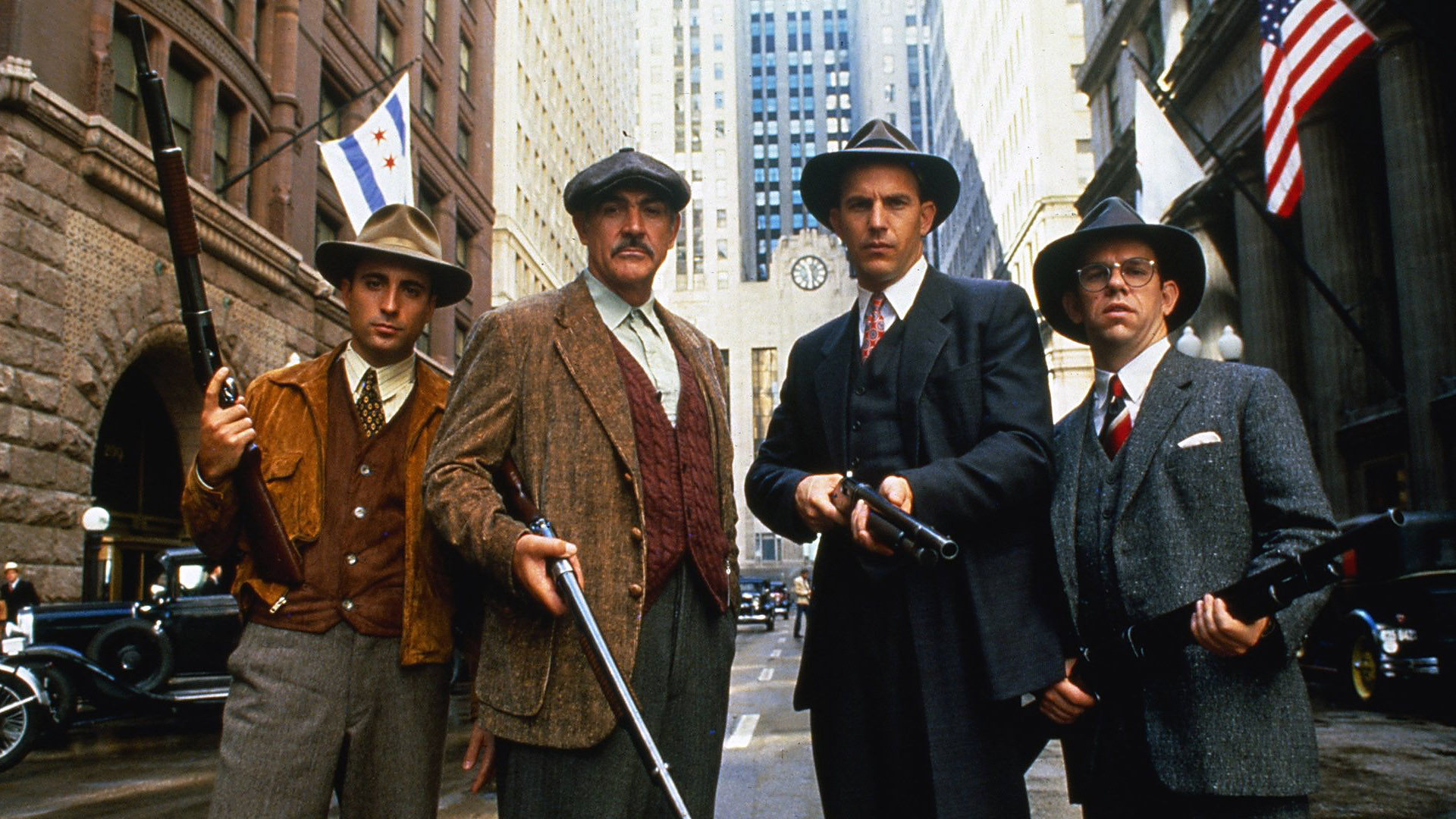
Finally, we’ll turn our back on horror, to listen to music from a successful period crime thriller, loosely based on the real-life exploits of Eliot Ness and his fellow prohibition agents – “The Untouchables,” from 1987. Kevin Costner plays the by-the-book federal agent who is given a valuable lesson in street smarts by an Irish beat cop played by an Academy Award winning Sean Connery. (“He pulls a knife, you pull a gun. He sends one of yours to the hospital, you send one of his to the morgue. That’s the Chicago way, and that’s how you get Capone.”) Capone is played, incidentally, by a baseball bat wielding Robert De Niro.
The score is by Ennio Morricone. Morricone, of course, was propelled to fame through his work on Sergio Leone’s spaghetti westerns. He applies some of that same mythmaking skill to this big screen adaptation, which had previously been published as a memoir and developed into a popular television series starring Robert Stack. The high point of the film must be the director’s nail-biting homage to Sergei Eisenstein, a slow motion shoot-out around a baby carriage as it teeters down the stairs of Chicago Union Station.
Start your weekend with a step in the right direction, with music from the films of Brian De Palma, on “Picture Perfect,” music for the movies, now in syndication on KWAX Classical Oregon!
———-
Clip and save the start times for all three of my recorded shows:
PICTURE PERFECT, the movie music show – Friday at 8:00 PM EDT/5:00 PM PDT
SWEETNESS AND LIGHT, the light music program – Saturday at 11:00 AM EDT/8:00 AM PDT (***now with a repeat Sunday at 9:00 PM EDT/6:00 PM PDT***)
THE LOST CHORD, unusual and neglected rep – Saturday at 7:00 PM EDT/4:00 PM PDT
Stream them, wherever you are, at the link!
https://kwax.uoregon.edu/
Tag: John Williams
-
Get Animated with “Picture Perfect”
“Music is a moral law,” wrote Plato. “It gives soul to the universe, wings to the mind, flight to the imagination… and life to everything.”
That includes computer-generated imagery.
While my distaste for the overkill of CGI in alleged “live action” movies is quite well known, I have to concede that, when shelling out the clams for a big-budget movie, one stands a better chance these days of getting a quality ride if one banks on the solely computer-animated feature. Put an action hero in a computer-animated landscape, and everything looks incredibly fake. But integrate the characters, by creating them in the computer as well, and the result is often much more absorbing, imaginative, and even wittier than your run-of-the-mill Hollywood blockbuster.
Furthermore, in a day when so many movies sport scores made up of droning electronics punctuated by colorless action cues, the computer-generated feature seems to attract composers who still understand how to write music.
This week on “Picture Perfect,” we’ll listen to enlivening scores from four computer-generated films.
We’ll hear selections from the first installment in the “Ice Age” franchise, by David Newman (son of Golden Age heavy-hitter Alfred Newman, brother of Thomas Newman, and cousin of Randy Newman).
We’ll also have some of John Williams’ music from “The Adventures of Tintin,” after the comic book adventurer created by Belgian artist and writer Hergé. Tintin’s popularity in Europe failed to translate into big domestic box office, comparatively speaking, but the score is Williams’ best of its kind – an exciting adventure piece full of leitmotifs and great action cues – since the first of the Harry Potter films.
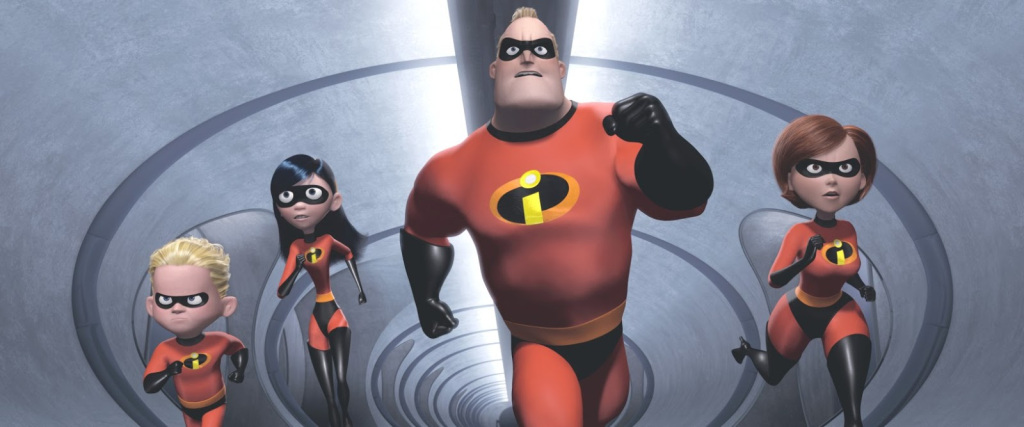
We’ll round out the hour with two projects scored by Michael Giacchino for Pixar Animation Studios. Giacchino’s break-out success was the sly superhero satire, “The Incredibles,” for which he composed in the swinging ‘60s espionage style popularized by John Barry when writing for the James Bond films.
We’ll also hear selections from Giacchino’s Academy Award-winning score to “Up.” “Up” was nominated for Best Picture at the 82nd Academy Awards, only the second animated feature ever to be included in the category.
I think we can all use a little animation, can’t we? I hope you’ll join me for an hour of selections from computer-animated adventures, on “Picture Perfect,” music for the movies, now in syndication on KWAX Classical Oregon!
——-
Clip and save the start times for all three of my recorded shows:
PICTURE PERFECT, the movie music show – Friday at 8:00 PM EDT/5:00 PM PDT
SWEETNESS AND LIGHT, the light music program – Saturday at 11:00 AM EDT/8:00 AM PDT
THE LOST CHORD, unusual and neglected rep – Saturday at 7:00 PM EDT/4:00 PM PDT
Stream them, wherever you are, at the link!
https://kwax.uoregon.edu See less -
Full Disclosure About “Disclosure Day”
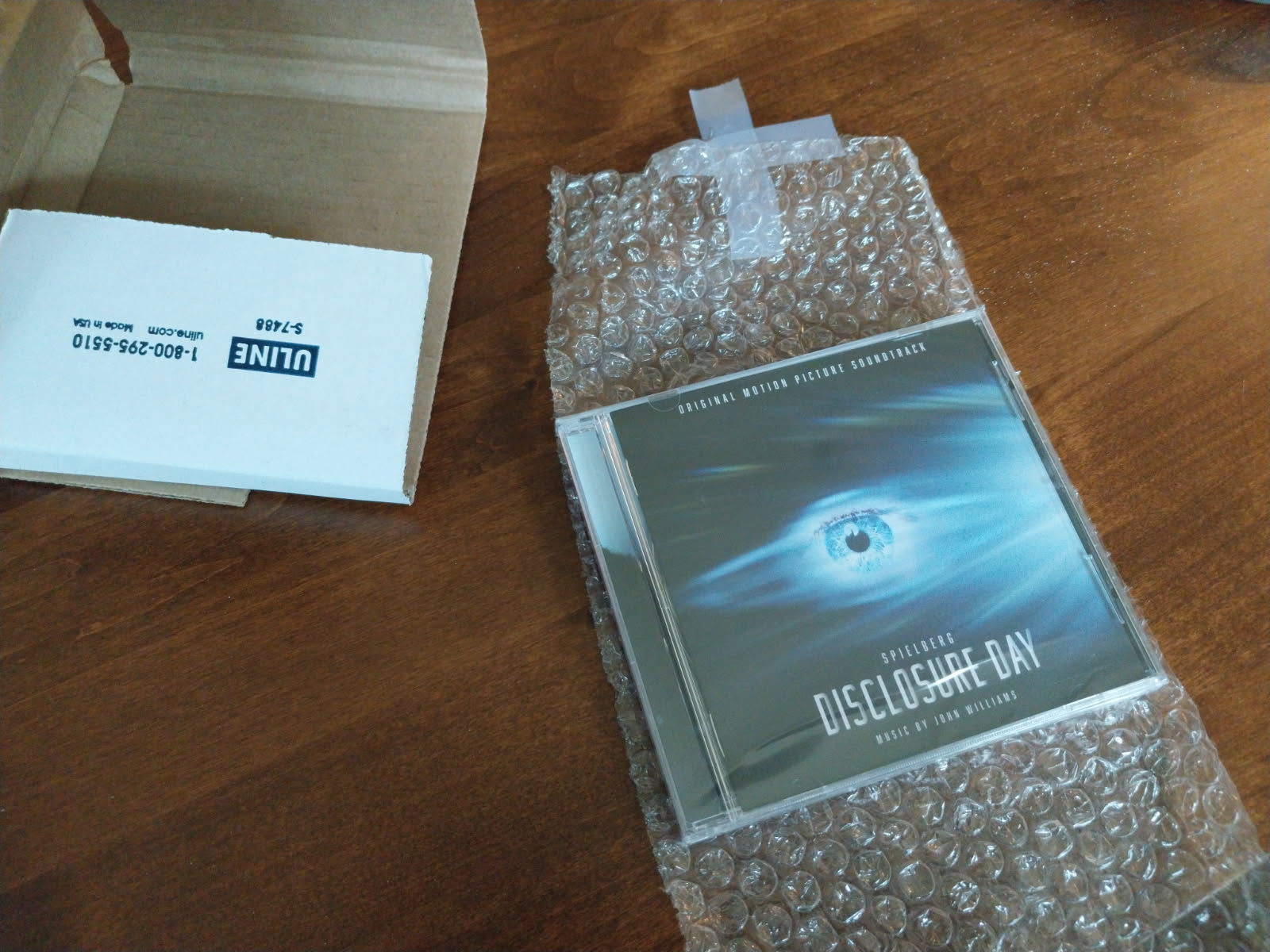
This finally arrived in the mail last week. Does anyone who’s seen the movie even remember it at this point? The quality of the film aside, I am always thankful for more John Williams, especially when he’s not squandering his talent on the diminishing returns of “Star Wars” or Indiana Jones.
What’s remarkable, Williams having written and recorded this at the ages of 93 and 94, is how good it is. This is not one of his scores in “heroic blockbuster” mode. The car chase cue is one of the least remarkable tracks on the album. The train scene everyone raves about, for some reason (it makes no sense), is presented in the film without music. Rather, it is the emotional moments and the moments of wonder (in the music, if not the film) that resonate and remind one of what the movie is so sorely lacking.
The film opened on June 12. I ordered the CD from Waxwork Records on June 18. The soundtrack was shipped exactly one month later. This should not be construed as a slam against Waxwork. It’s just the way things are now, and I can’t see how it helps sales. If the product is not available for purchase by your average, moderately-interested person on the street, either immediately in a brick-and-mortar shop or for two-day delivery from an online retailer, how can you expect more than a few thousand sales, mostly to hardcore John Williams fans and die-hard film score collectors? I guarantee Williams’ name alone would generate many times that amount, if only they would make it easier for people to buy it. As it is, it’s not even available on Amazon, save as a digital download.
Quality-wise, I have no qualms. This is a polished product of the sort that used to be put out by the major labels. The sound is immediate, without seeming to be right in your face; the choral contributions and electronic elements blend well with the acoustic instruments. I must say, the bass is quite striking, to a degree I haven’t really noticed in previous orchestral soundtrack releases – although I confess my consumption of newer movie music has diminished, most of my purchases tending toward music of decades past. Considerably past, in terms of most of the classical stuff. If you want to really feel the lower registers – the cellos, double basses, and percussion – “Disclosure Day” has a unique, appealing sound. More important is the content, and there’s plenty here, in terms of emotion and lyricism, for me to enjoy.
Alas, physical media are not the priority they once were. I miss the days of just being able to walk into a record store and buy a soundtrack when it arrived a week or two before a film’s release. Now, if you want the CD, you have to do your research, find out who is distributing it, and jump through the hoops of preorder and postal delivery. The digital downloads for “Disclosure Day” weren’t even available until the day of the film’s release. I really don’t understand this strategy. A successful soundtrack album has always been one more tool with which to sell a film. How many repeat viewings has Williams’ music inspired? But all that is peanuts, I suppose, in a world in which a movie has to make $300 million in order to turn a profit.
When I called Waxwork to request a few tracks to air on one of my radio shows in advance of the official soundtrack release, I was told it wouldn’t be possible; there would be a rights issues, and I would have to contact Universal directly. Everything has become such a corporate labyrinth over the past decades, it’s like trying to infiltrate the Illuminati to get permission from a studio. Don’t even get me started on Disney. At least at Waxwork someone actually answered the phone, and he was normal and pleasant, competent and human and real, the way people used to be. The prospect of having to deal with Universal was not appealing. In the end, I decided to wait the extra week and just air some tracks from the digital download. So yeah, I bought the soundtrack twice.
All this jealously-guarded secrecy surrounding every aspect of the film, and the final trailer basically gives away the entire movie…
My summation is spoiler-free: I can describe my viewing experience as one of anger, at the start, softening, by the end, to disappointment. At least Emily Blunt and John Williams were good, though I have to admit, in the scenes where Spielberg tries to be more contemporary and dystopian, the score does seem a bit out of place. As I say, Williams does emotion and wonder very well. Watching “Disclosure Day” was a reminder of how much those two qualities are lacking in movies today. Even Spielberg movies, apparently.
I can’t believe I am living in a world where you can’t get a CD of a John Williams soundtrack. The guy who broke all records for soundtrack sales and singlehandedly revived the orchestral film score with such verve that it carried into the 21st century. His appeal transcends the collectors’ market, or at least it did. But since everyone’s awareness about anything, beyond what they are fed on social media, seems to have diminished, you have to be 50 years old to remember a better world.
Disney has to be the biggest group of idiots, judging from its handling of Williams’ last soundtrack, for “Indiana Jones and the Dial of Destiny” – a far less interesting score, save for the delectable “Helen’s Theme,” which is pure golden age, though evidently not appreciated by everyone. As has been the case with the current score, clearly different people expect different things from John Williams. If it doesn’t possess “Jurassic Park” bombast, they’re incapable of recognizing or remembering a theme, apparently. At its best, the music for “Disclosure Day” is gorgeous. I’ve already commented on how the opening track, “Listen,” taps into the spiritual world of Vaughan Williams’ “Tallis Fantasia.” Already, right there, I am sold.
Others have pointed out a kinship between one of the tracks and Williams’ music for Spielberg’s “A.I.,” which, by the way, is easily my most-hated Spielberg film. And while I’m at it, he really missed the boat on creating a prescient sci-fi classic about honest-to-goodness, now-in-the-headlines, anxiety-provoking A.I.! While “Disclosure Day” doesn’t make me violently angry the way “A.I.” did, both movies make me question why I ever liked Spielberg to begin with. But then I remember “Jaws,” “Raiders,” “CE3K,” “E.T.,” and a few others.
“Disclosure Day” is no “Close Encounters,” for as much as it wants to be, and it is certainly no “E.T.” Say what you want about Spielberg’s remake of “War of the Worlds,” at least it was coherent. In 2 ½ hours, “Disclosure Day” has plenty of time to tell its story. But the ideas the screenplay seems to think are the most profound don’t cut very deep, at least in the way they are handled, and plot holes so glaring a ten-year-old child would recognize them are brushed off with a single line of dialogue, if that.
Despite some nice visual touches and some potentially interesting, sadly underdeveloped ideas, there’s more talk than show in what is, after all, a visual medium, and one this director has always exploited better than just about everyone else.
“Disclosure Day” often doesn’t make sense, and I couldn’t understand what any of the critics saw in it, until I realized we have very few actual critics who understand movies anymore, or even basic storytelling. The film proves that, if Spielberg wants to speak to the heart, if he wants empathy and wants us to “listen,” then John Williams is indispensable.
This soundtrack gives me a lot of pleasure, and moves me in a way the movie most definitely did not. -
Picaresque Adventures on “Picture Perfect”
Calling all rapscallions and scapegraces! This week on “Picture Perfect,” get ready to revel in some freewheeling lack of judgment, with an hour of films based on picaresque novels.
For those of you who weren’t English majors, the picaresque novel is a literary genre often characterized by the presence of rogues or anti-heroes as protagonists, episodic, wayward structures, and, not infrequently, low humor.
We’ll hear music from “The Reivers,” after William Faulkner’s Pulitzer Prize-winning novel, a coming-of-age story about a boy swept into automobile theft and illicit horseracing in the American South. Mark Rydell directed the 1969 film, which stars Steve McQueen as the rakish Boon Hogganbeck and features narration by Burgess Meredith. John Williams wrote the breezy Americana score.
Mark Twain’s “The Adventures of Huckleberry Finn” is frequently categorized as an American picaresque. It’s certainly one of the funniest of “serious” books. A middling film adaptation was made in 1960, directed by Michael Curtiz, with Tony Randall given top billing, shifting the focus of the story to the con artistry of the King and the Duke. It features an evocative score by Jerome Moross.
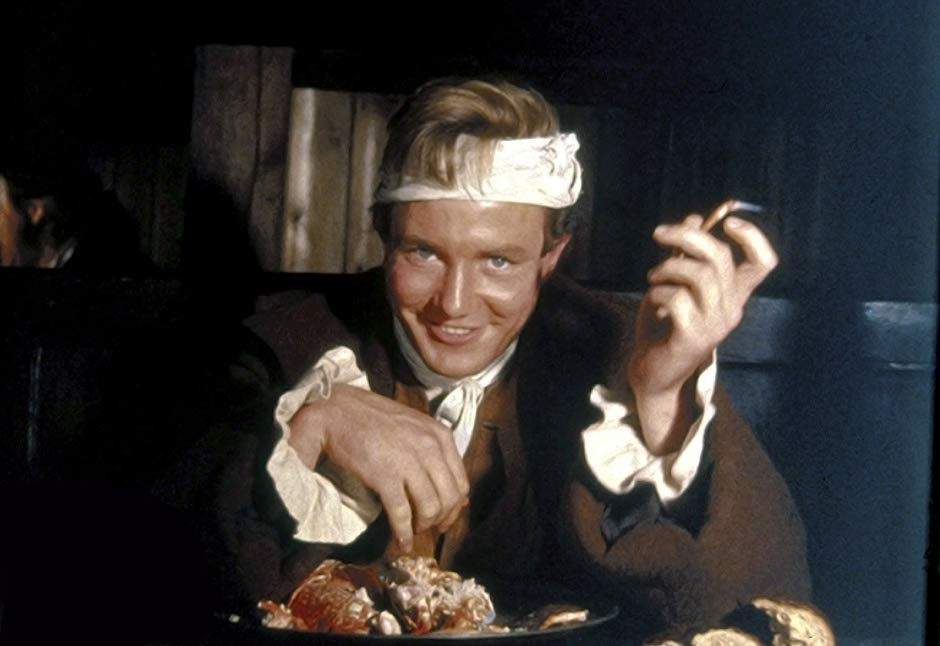
If Hervey Allen’s “Anthony Adverse” had any humor to begin with, it was definitely lost in translation. (Too bad the novel was written in English.) However, the 1936 screen adaptation certainly does sprawl. One could say it’s picaresque in the worst way. It just doesn’t go anywhere. It does, however, feature a top-notch cast (Frederic March, Olivia De Havilland, Claude Rains, etc.) and an Academy Award-winning score by Erich Wolfgang Korngold.
While the modern picaresque novel has its roots in the Renaissance, the genre really seemed to hit its stride in the 18th century, with comic novelists such as Henry Fielding. Fielding’s “Tom Jones,” perhaps the quintessential picaresque, was made into a film in 1963. It went on to win Academy Awards for Best Picture, Best Director (Tony Richardson), Best Adapted Screenplay (John Osborne), and Best Original Score (John Addison). Addison’s music suits Richardson’s quirky virtuosity like an off-kilter powdered wig.
We’re up to no good, with an hour of picaresque adventures, on “Picture Perfect,” music for the movies, now in syndication on KWAX Classical Oregon!
———
Clip and save the start times for all three of my recorded shows:
PICTURE PERFECT, the movie music show – Friday at 8:00 PM EDT/5:00 PM PDT
SWEETNESS AND LIGHT, the light music program – Saturday at 11:00 AM EDT/8:00 AM PDT
THE LOST CHORD, unusual and neglected rep – Saturday at 7:00 PM EDT/4:00 PM PDT
Stream them, wherever you are, at the link!
https://kwax.uoregon.edu -
250 Years of Independence, and All I Got Was “Picture Perfect”
Tomorrow is Independence Day, so it seems appropriate this week on “Picture Perfect” to treat the subject of music from movies related to the birth of our nation.
We’ll hear selections from the 2000 Mel Gibson film, “The Patriot,” in which slow-burning pacifist Mel is pushed too far by ruthless British officer Jason Isaacs and reverts to his bloody French and Indian War ways. By the end of the film, he is literally waving the flag to John Williams’ triumphant score.
Then we’ll hear a suite from the 1942 Jack Benny-Ann Sheridan fixer-up comedy, “George Washington Slept Here,” based on the play by Moss Hart and George S. Kaufman – not really about the Revolution, beyond the fact that the ramshackle Pennsylvania farm house purchased by a transplanted New York couple is alleged to have been a resting place for the Continental Army’s most famous general. The music is by Adolph Deutsch.
The 1985 film, “Revolution,” seemed to have everything going for it. The director was Hugh Hudson, whose “Chariots of Fire” was the big winner at the 1981 Academy Awards; its star was Al Pacino; and its composer was John Corigliano, who went on to win the Pulitzer Prize for Music for his Symphony No. 2 and an Academy Award for “The Red Violin.” Yet “Revolution” bombed horribly – so horribly that Pacino gave up making movies for the next four years. James Galway plays the flute and pennywhistle on the film’s soundtrack.
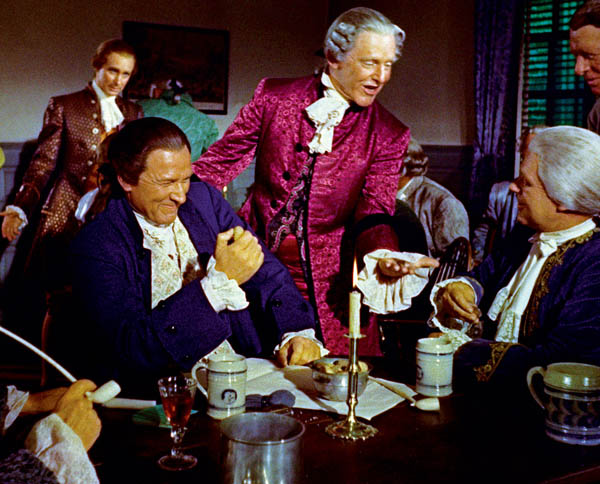
Finally, we’ll hear music from the longest continuously-shown film in cinematic history, “Williamsburg: The Story of a Patriot,” created exclusively for the tourist attraction of Colonial Williamsburg. The film features future “Hawaii Five-O” star Jack Lord, and the score is by none other than Bernard Herrmann. Peppered with recognizable patriotic tunes from the Revolutionary era, the charming suite includes quotations from “Yankee Doodle” and the William Billings hymn “Chester.”
Stick a feather in your hat and call it macaroni. Then join me for “Picture Perfect,” music for the movies, now in syndication on KWAX!
——-
Clip and save the start times for all three of my recorded shows:
PICTURE PERFECT, the movie music show – Friday at 8:00 PM EDT/5:00 PM PDT
SWEETNESS AND LIGHT, the light music program – Saturday at 11:00 AM EDT/8:00 AM PDT
THE LOST CHORD, unusual and neglected rep – Saturday at 7:00 PM EDT/4:00 PM PDT
Stream them, wherever you are, at the link!
https://kwax.uoregon.edu
——-
PHOTO: George Washington wagers he can crack a walnut with his bare hand in “Williamsburg: The Story of a Patriot”
Tag Cloud
Aaron Copland (94) Beethoven (95) Composer (114) Film Music (148) Film Score (143) Film Scores (255) Halloween (97) John Williams (196) KWAX (232) Leonard Bernstein (105) Marlboro Music Festival (125) Movie Music (163) Mozart (91) Opera (215) Philadelphia Orchestra (90) Picture Perfect (174) Princeton Symphony Orchestra (110) Radio (90) Ross Amico (244) Roy's Tie-Dye Sci-Fi Corner (290) The Classical Network (101) The Lost Chord (269) Vaughan Williams (107) WPRB (397) WWFM (881)