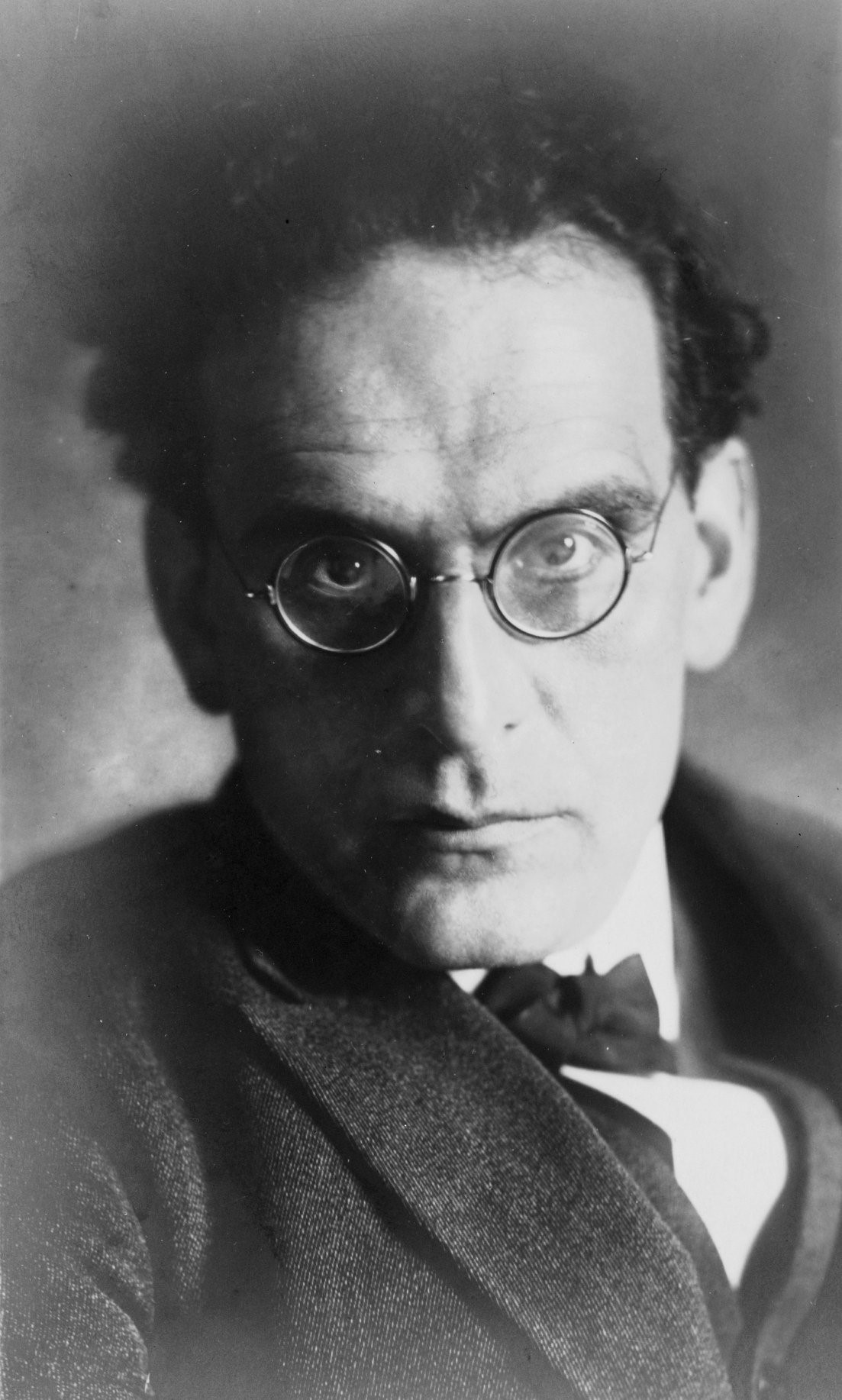
Otto Klemperer was as monumental as his music-making. At 6-foot-6, he wore a look of granitic intensity. Seat him in front of a camera, and he assumed the gaze of a raptor staring down a field mouse.
An associate, friend, and disciple of Gustav Mahler, Klemperer championed new works by Schoenberg, Stravinsky, and Hindemith. He tolerated no coughing or sneezing from his audience. When the New York Philharmonic failed to offer him a music directorship after 14 weeks as guest conductor, he fired off a scathing missive: “That the society did not reengage me is the strongest offense, the sharpest insult to me as artist, which I can imagine… This non-reengagement will have very bad results not only… in New York but in the whole world.” He settled in London, where a new orchestra, the Philharmonia, was created specifically for him.
Klemperer’s power of indestructibility is legendary. No one and nothing could stop him. Not Hitler. Not the U.S. State Department (that refused to renew his visa). Not even a brain tumor. He made Rasputin look like a mayfly.
His catalogue of misfortunes would have destroyed a lesser man. He suffered from severe cyclothymic bipolar disorder. He underwent surgery to remove a brain tumor, a meningioma “the size of a small orange.” When placed in an institution, he escaped. (He was characterized by the police as “dangerous and insane.”) Later, he took a severe spill, requiring him to conduct from a chair. When he set himself on fire – while smoking in bed – he tried to douse the flames with spirits of camphor.
I’m not sure what kind of a woman would have the courage to get anywhere near him, but there’s no explaining charisma. Somehow he managed to sire actor Werner Klemperer (a.k.a. Colonel Klink). A daughter, Lotte, became his assistant and caretaker. Once, Georg Solti knocked at the door of his dressing room, and when Otto Klemperer answered, he was in his boxers and covered in lipstick.
In 1912, he was horsewhipped at the Hamburg Opera following a performance of Wagner’s “Lohengrin.” The perpetrator was the husband of soprano Elisabeth Schumann, who was apoplectic after his wife had run off with the conductor. Klemperer was taken off guard, but quickly recovered. According to soprano Lotte Lehmann, he clambered out of the pit “like a huge black spider.” When the two men were finally pried apart, Klemperer collected himself and turned to address the audience. “This man has attacked me because his wife loves me,” he said. “Good evening!”
Klemperer’s career was capped by a glorious Indian summer that spanned some 20 years (roughly 1952 to 1972). Half-paralyzed, he maintained control of his players with piercing eyes and a baton sometimes held in his left hand. It’s rumored that he actually fell asleep during the recording sessions for Schumann’s “Rhenish” Symphony, and rather than rouse an angry god, the orchestra just kept on playing. This juggernaut of the podium finally ground to a halt at the age 88. Like the man, his recordings are built to last.
Happy birthday, Otto Klemperer.
———–
Klemperer in Philadelphia
Live Bruckner from 1947, quite at variance with the glacial recordings of the elder Klemperer
Klemp conducting Beethoven’s 7th at 85
“Klemperer the Immoralist”
Leave a Reply