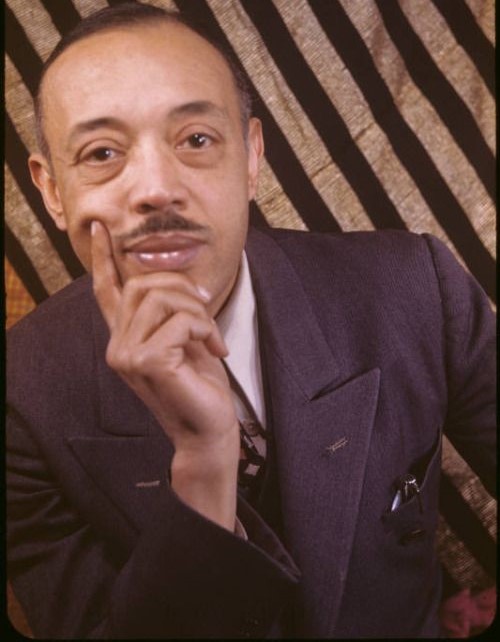
I am proud to say I was a William Grant Still advocate before it was cool to be so. When I first encountered his “Afro-American Symphony” in the early 1980s, it was love at first sound. It remains one of my favorite symphonies by an American composer.
Perhaps it’s not “The Great American Symphony,” self-consciously aspirational, oratorical, or grandiose in the manner the third symphonies of Roy Harris, William Schuman, or Aaron Copland; but it does go straight to the heart, which is something none of the composers of that great American triumvirate do, at least in those particular works.
Still’s symphony is poetic, it’s genuinely reflective, it’s beautiful, and it brims with great tunes. It’s congenial, and in the end quite moving. When I want “big statements” made on an Olympian scale, I will turn to those Lincoln Center composers, who would have us believe they are eating out of lunch pails in their spare time and riveting skyscrapers or busting sod in denim overalls. But let’s face it, they are mostly hobnobbing in suits, jostling to get their music conducted by “Lenny.”
Still is a composer in the mold, if not the manner, of Charles Ives. He’s a perpetual outsider, and always true to himself. His music grows directly out of his autobiographical experience, the blues, ballads, and spirituals of his childhood, in Woodville, Mississippi, and Little Rock, Arkansas, and later his experience playing in pit bands during the Harlem Renaissance.
He also studied at the Oberlin Conservatory and privately with George Whitefield Chadwick and Edgard Varèse, of all people. There is no Varèse to be found in Still’s music.
He composes with the directness of a Virgil Thomson, but with none of Thomson’s affected naiveté. He shares with George Gershwin a refreshing lack of pretention – or at any rate his music does (he did, after all, subtitle one of his symphonies “Autochthonous”) – and a wonderful facility with melody.
Of course, any discussion of Still must come with a litany of “firsts.” His “Afro-American Symphony” was the first written by a black composer to be performed by a major orchestra (the New York Philharmonic at Carnegie Hall). He was the first to be given the opportunity to conduct a major orchestra (the Los Angeles Philharmonic at the Hollywood Bowl). His opera, “Troubled Island,” became the first to be produced by a major company (the New York City Opera). Another of his operas, “A Bayou Legend,” was the first to be performed on national television (as late as 1981). His works were performed internationally by the Berlin Philharmonic, the London Symphony Orchestra, the BBC Symphony, and the Tokyo Philharmonic.
For years, all I could find was the “Afro-American Symphony,” and that only in two out-of-print, albeit very fine recordings (with Karl Krueger and the Royal Philharmonic, and Paul Freeman and the London Symphony Orchestra). It wasn’t until the digital era that the other four symphonies gradually – very gradually – became available. Thankfully, all of them now have been recorded and are available for purchase.
I think we have to thank the revival of the fortunes of Florence Price for the boost in exposure brought to so many other Black composers recently. Who would have thought that Price, Still, and William Levi Dawson would not only be performed, but recorded by the Philadelphia Orchestra – for the Deutsche Grammophon label, no less?
Of course, it would nice if DG didn’t change horses midstream and issue the final installment of their Price cycle exclusively as a digital download. I don’t do downloads, at least for the purposes of collecting. I would snap up the rest of their Price, Still, Dawson, and Margaret Bonds recordings if they actually existed on physical media (even if I was less than impressed with Yannick’s Dawson in concert). It’s exciting that a world-class band would take up the cause of these composers. I don’t need any more Philadelphia Orchestra Rachmaninoff!
Be that as it may, whether or not DG eventually grants him the respect of some compact disc releases, for me, William Grant Still is still the one.
Happy birthday, WGS (1895-1978).
—–
“Afro-American Symphony”
https://www.youtube.com/watch?v=9S-g-qYnqQQ
William Grant Still: Still the One
by
34 responses
Comments
34 responses to “William Grant Still: Still the One”
-
VT’s “affected naiveté”: bravo!
-
Kile Smith That’s not to say I do not enjoy Virgil Thomson’s music! I think his “Symphony on a Hymn Tune” is tops.
-
I don’t. I think that piece, in particular, misses the point. His facility was his greatest enemy.
-
Kile Smith I’m guessing you’re coming at it from the spiritual side and that you would have liked more “sincerity” in the handling of the hymns. Me, arch-pagan that I am, I think it’s a satisfying piece of Americana, like a piece of folk art needlepoint, albeit a slightly arch one. However, I’m not sure it’s rendered entirely without affection.
-
“Arch” is exactly the word I’ve associated with him—here & there, not all of his music, but yes, in that symphony. I am sensitive to its being a hymn tune, and I revere hymn tunes, no doubt about it. I had the same reaction to another composer’s symphony from recent years that also mishandled a hymn tune. It isn’t even a cultural appropriation argument, as the perpetrator may come from within the culture itself. It is archness, however, the sense that the thing you’re handling isn’t really that important, therefore that you’re above it all. I put up with that in ephemeral conversation—have been guilty of it myself, of course, usually in an attempt to be humorous. But I despise it in an artist. I don’t doubt his affection, which you’ve picked up on (because you’re a good man). But affection is merely the beginning of the path. An artist must love the materials to their depth, even simple ones, even mediocre ones, especially mediocre ones. If you can’t, stay far away from them.
-
Kile Smith I figured that might be it. But if I recall correctly, Thomson actually began the piece in Paris when he was feeling a little nostalgic for his Kansas City boyhood. So I don’t think he was actually mocking the hymns. And for the 1920s (predating Copland’s folkloric period that began in the late ’30s), I think this is a pretty solid piece of Americana. But perhaps Thomson fancied himself too much of a sophisticate, even at such a comparatively young age, to go all in. I can’t claim to know everything he wrote, but I think I’m familiar with a pretty representative cross-section of his work, and the one thing I can offer is that while there are always moments in Copland’s “populist” pieces that seem to exude genuine warmth, I never get that same sense of sincere identification from Thomson. In the case of “Symphony on a Hymn Tune,” keep in mind he was strolling the same boulevards and no doubt occupying the same cafes as Satie and Les Six. So a little cheeky, French modernism (as when there’s that ludicrous doubling of the piccolo and tuba at the end of the first movement, alternating with a “fiddling” violin) was perhaps unavoidable. Anyway, I have no wish to cloud your morning with unpleasant associations, so please, let’s put Thomson back in the linen drawer and go in peace!
-
No, I’m enjoying this, as you help me clarify my thoughts. I actually wrote about the VT Sym on Fleisher Discoveries: https://kilesmith.com/2021/06/30/fleisher-discoveries-virgil-thomsons-music-of-america-via-paris/ In it I opine that he was using the hymn tune to make sense of Dada. I also allowed that he loved the tune. But he didn’t, as you put it, go all the way in. He wasn’t a believer, but neither was Copland, whose “Shall We Gather at the River” stunningly gets it. (Still, you have to believe, I think, to reach deeper still. Ives does, in his crazy-quilt quoting, but which is at a different spiritual level from VT. Bruckner is the most brilliant example to me of a believer whose sacred music is so sacred it hurts. Not that belief alone gets you there. Believers can write some of the most awful sacred music.) VT simply doesn’t have the chops to overcome unbelief—and it must be overcome—as Copland does. He’s content with being cheeky, another of your apt observations. But in the handling of sacred things, one should never be content with cheek.
-
Kile Smith I remember listening to this show. I look forward to revisiting your thoughts (and the concert performance).
-
Thanks! By the way, I love William Grant Still (the whole reason for your post!), anything I’ve ever heard of his. The more of him, the better. And yes, he had sincerity.
-
-
-
Long ago, I listened to his music on a flight to California, as he had a channel all to himself. I can’t say I loved the music.
-
Zlat Zlat I’m sorry for you. You don’t have to love everything, but I never understand the compulsion to comment that one doesn’t love something at the end of a laudatory post. It’s like that person who insists on jumping on a memorial thread, after somebody notable dies, and everyone is in mourning and posting their affectionate reminiscences. There’s always that one guy who has to write, “Never much cared for him.” Everyone’s entitled to their opinion, of course, but in the context, it comes across as kind of tone-deaf!
-
I’m sorry you don’t have higher standards.
-
Zlat Zlat Don’t ever change, Zlat
-
-
Zlat Zlat Lest that came across as a little harsh, I would be curious to know what you make of Still’s “Ennanga.” It’s a piece for harp, so I expect it would be right in your wheelhouse. I’ve heard it performed by harp and orchestra and also as a sextet. I am neither endorsing nor dismissing this particular performance, which I am linking because it’s the orchestral version, it’s live, and it’s complete. Maybe you won’t like it. Nothing wrong with that, but I happen to enjoy the music. https://www.youtube.com/watch?v=5HlQiD5Y0VI&t
-
-
Always played the humor movement for classes. It was in their textbook.
-
I enjoyed this post while respectfully disagreeing with you about Copland’s Third Symphony, which for me also goes straight to the heart as Still’s Afro-American Symphony does. True, Copland wasn’t a “lunch pail guy”, but he captured some kind of American lightning in a bottle there. For me, it remains the greatest American symphony, though opinions can vary. I also agree that Still’s rediscovery is long overdue and that it’s good to have all his symphonies recorded now. I assume you know about the connection between the Humor movement of the Afro-American Symphony and Gershwin’s “I Got Rhythm”?: https://www.wqxr.org/story/did-gershwin-get-his-rhythm-african-american-composer-william-grant-still/
-
Mather Pfeiffenberger You know I love Copland — he’s got to be in my top three or four favorite composers — but I don’t think he’s at his best in the 3rd Symphony. I gave it another shot a couple of weeks ago, when it was performed in Philadelphia (unfortunately, unknown to me at the time, I was just getting sick), and it did nothing to change my opinion. It’s a rousing piece, and an at times beautiful one, but it doesn’t “touch” me. And I’m sorry, I still think those restored measures at the end are just too much! Still, I concede from a “Great American Symphony” standpoint, it’s probably the best we’ve got. I’d place Still’s “Afro-American” around the level of Hanson’s “Romantic” and Randall Thompson’s 2nd — unpretentious symphonies that often score higher in my estimation than the heavy hitters. But… you know, that’s just like, uh, my opinion, man. Yes, I knew about the “I Got Rhythm” theory.
-
Classic Ross Amico I get it, man. 😊 The Third does touch me and has for a long time. In fact, it’s my favorite Copland work, more than Appalachian Spring. But different strokes for different folks. And as we have discussed, I love having the measures restored to the last movement, but you obviously agree with Lenny. Not bad company to be in.
-
Mather Pfeiffenberger More than Appalachian Spring?????????????????????????????????????????????????????????????????????????????????????????????????????????????????????????????????????????????????????????????????????????????????????????????????????????????????????????????????????????????????????????????????????????????????????????
-
Classic Ross Amico Absolutely. I like AS as much at the next person, but it’s done way too often. In a way, I think Billy the Kid is a more interesting ballet, both musically and thematically. The Third remains my favorite Copland work. But as you know, I like all his works, so this is almost like quibbling about favorite ice cream flavors. 😊
-
Mather PfeiffenbergerMedia: https://www.facebook.com/photo.php?fbid=1845273359725052&set=p.1845273359725052&type=3
-
Classic Ross Amico Yes, I know that photo! Copland at Interlochen.
-
Classic Ross Amico “Top three or four favorite composers”? Americans or altogether??
-
Yoël L. Arbeitman Altogether! Yes, it’s so…
-
-
-
BTW, I agree with you about DG releasing the Price, Still, Dawson, and Bonds in digital format only. Bummer! More and more companies are doing that. Yesterday, I was at a concert by Brooklyn Rider in DC and they made a few of their CDs available free to the audience, “for those of you who still have a CD player.” Naturally, I picked them both up.
-
Mather Pfeiffenberger I don’t know who these people are without CD players. We’re classical music people! We skew older, so of course we hang on to our playback equipment like grim death. The last time I was in the market for a car, I wouldn’t even consider one unless it had a CD player. It was the same deal when I saw The Gesualdo Six. They sheepishly announced the fact that they were offering CDs, “for those of you who still have a CD player,” but sure enough, after the concert, the audience picked the sales table clean.
-
Classic Ross Amico John Middleton, heir to Middleton tobacco fortune, lead owner of the Phillies, major supporter of the Phil Orch and other organizations has proudly announced he doesn’t own a CD player.
-
Kenneth Hutchins Good for him. I’m glad he’s got something to be proud of. 🙄
-
Classic Ross Amico Yeah, Phillies still suck and he can’t listen to better audio sources!
-
-
-
Well, technically, they were recorded for archival and broadcasting over WRTI and SiriusXM Symphony Hall. When it suits DG they will take the recordings and either issue digital or CD releases. There have only been a few vinyl releases. To be honest, they push the Spotify play list strategy.
-
Ah. So they’re not even made under “studio” conditions. Doesn’t surprise me. A lot of recordings are made live these days. I hope they’re of professional quality, that they clean them up so they’re not full of coughs, like a real Kimmel concert. So Rachmaninoff and Gershwin get CD releases, and the Black folk get sent to Spotify.
-
Classic Ross Amico They record rehearsals, all of the performances, and when necessary patch sessions. Sometimes they leave in the post concert applause.
When Marin Alsop recorded selections from Porgy and Bess with the Philadelphia Orchestra, just before the pandemic shutdown, she pleaded for the audience to hold the applause for a moment for recording purposes. That recording was not released on DG. A few years ago, I talked with a producer from DG about recordings, what makes for a record release, and where is the focus. When I look at most current releases, it is Andrew Mellor listed as producer, the same guy who produces the POA broadcasts recordings.
-
Kenneth Hutchins Many of Bernstein’s late recordings were made under concert conditions also. I don’t mind, as long as there are no glaring extraneous noises that become more irksome the more you relisten to it. The whole DG “CD-versus-streaming” division puzzles me. As I commented elsewhere (maybe not in this thread?), classical music people skew older, so most of us likely hang onto our audio equipment. If there is a genre of music that should be made available on compact disc, it’s classical. I’m betting the last genre to fall will be the film music collectors’ market. The classic scores keep getting remastered, expanded, and given ever-more-lavish treatments, though often issued in limited editions of a few thousand copies. I wonder if it’s a market that will dry up once people my age start to die off. I’m not sure how many younger people are going to be interested in film composers who flourished from the 1930s through the 1980s, but right now the market seems to be booming (probably sustained by the John Williams-Jerry Goldsmith-John Barry fanatics).
-
-
Tag Cloud
Aaron Copland (94) Beethoven (95) Composer (114) Film Music (149) Film Score (143) Film Scores (255) Halloween (98) John Williams (197) KWAX (232) Leonard Bernstein (105) Marlboro Music Festival (125) Movie Music (164) Mozart (91) Opera (215) Philadelphia Orchestra (90) Picture Perfect (174) Princeton Symphony Orchestra (110) Radio (90) Ross Amico (244) Roy's Tie-Dye Sci-Fi Corner (290) The Classical Network (101) The Lost Chord (269) Vaughan Williams (107) WPRB (397) WWFM (881)
Leave a Reply