Tag: African American

  • A Still Presence Behind the Stooges

    A Still Presence Behind the Stooges

    For his many achievements – as the first Black American composer to write a symphony, the first to conduct a major U.S. orchestra, and the first to compose an opera, among other things – William Grant Still would be recognized as the “Dean of Afro-American Composers.” But face it, even under the best of circumstances, a full-time composer has to scramble to make ends meet. Still was not alone in seeking employment in Hollywood, which could always be counted on, once you were in, for a decent paycheck.

    However, unlike some of his peers, he was employed mostly as an orchestrator and a composer of “additional music.” One of the films he worked on was Dimitri Tiomkin’s “Lost Horizon” in 1937. John Williams did the same kind of work for Tiomkin on “The Guns of Navarone” in 1961, and we all know how that worked out for him. Still was never given his shot to break into the upper echelon, the way so many white composers who did the same kind of grunt work were. To my knowledge, he never even received a screen credit, but if you know differently, please correct me!

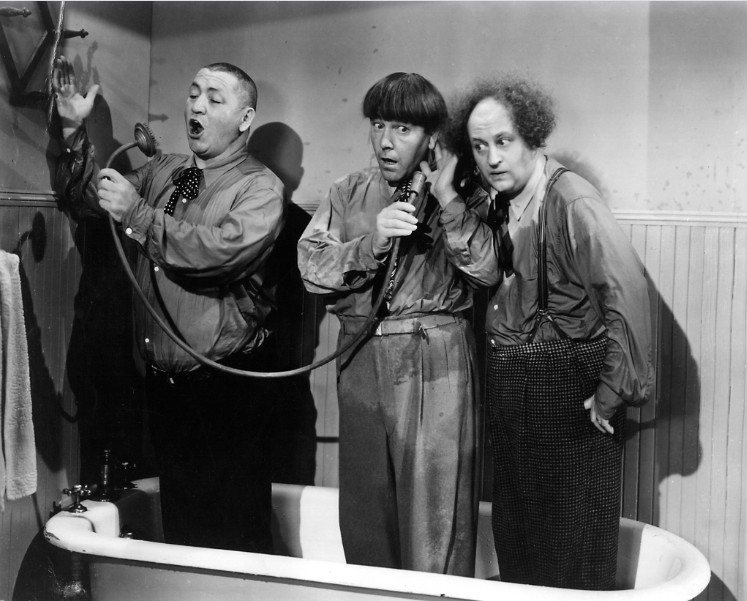
    A number of his cues were recycled as “library music” to fill out scores for B-movies and television shows. I was reminded of this yesterday by my friend (and former editor) Dan Aubrey, who will be accompanying me tonight to The Three Stooges Film Festival at the Princeton Garden Theatre, when he made a quip about Still’s music accompanying “eye gauging and cranium pounding.” Allegedly, Still’s work was indeed used in some of the Stooges’ shorts. I’m not sure which ones, and IMDB is no help in this regard, but I will listen more carefully, whenever I go back and watch them.

    In the 1950s, he compiled his “Laredo Suite” for use in television westerns, such as “Gunsmoke,” “Have Gun, Will Travel,” and “Rawhide.” (He had written music for a number of film westerns starring Charles Starrett.) Still was far from the only composer to do this. Bernard Herrmann put together some suites of mood music and action cues to be dropped into CBS westerns. The difference is that, even if he wasn’t always credited on the shows, Herrmann was a headliner at the movies.

    Still’s involvement with the Stooges is funny and sad at the same time. During the 1930s and ‘40s, Aaron Copland (the “Dean of American Composers”) was scoring prestige pictures such as “Our Town” and “Of Mice and Men.” He was even recognized with an Academy Award for his work on “The Heiress.”

    Of course, Still wasn’t alone among talented composers who toiled on the Hollywood production line, but as a Black musician, it’s doubtful he would have been able to rise much higher in mainstream movies until at least the 1960s, after Otto Preminger hired Duke Ellington to score “Anatomy of a Murder,” in 1959, and Quincy Jones made his mark with “The Pawnbroker,” in 1964. And even then, would he have been accepted if the music he wrote wasn’t “jazz”?

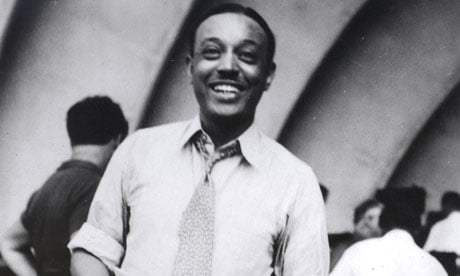
    While laboring anonymously in motion pictures of the 1930s, Still conducted a concert at the Hollywood Bowl with the Los Angeles Philharmonic. On July 23, 1936, he presented his “Afro-American Symphony.” It was the first time a Black man would conduct a major American orchestra. The next year, in August 1937, the work would be repeated on the first Hollywood Bowl program ever to be devoted exclusively to works by American composers.

    Still’s “Afro-American” remains one of my favorite American symphonies.

    https://www.youtube.com/watch?v=b9iGFLpO5Nk

    Fascinating reconstruction of Still’s “Laredo Suite,” library music for westerns, although I suspect the cuts have been posted out of sequence:

    https://www.youtube.com/watch?v=CpJQK1miHV4&list=PLgK8FIC-dBq-qGKj5r3vXlGSP3nd9jfq-

    Information on The Three Stooges Film Festival, tonight at the Princeton Garden Theatre:

    https://www.princetongardentheatre.org/films/three-stooges-garden
    ———-

    PHOTO: William Grant Still at the Hollywood Bowl
  • William Grant Still:  Still the One

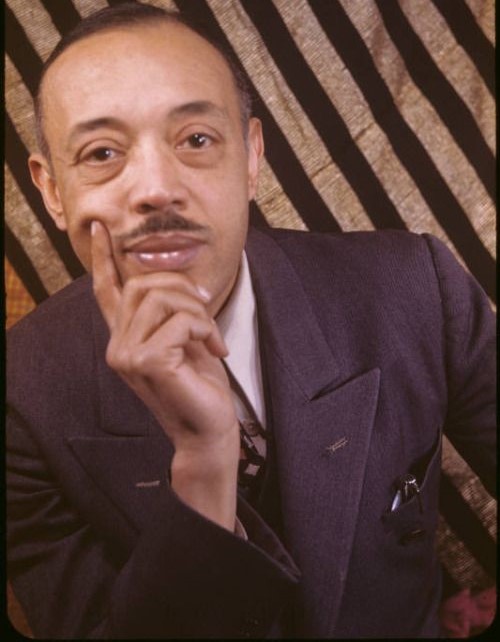
    William Grant Still: Still the One

    I am proud to say I was a William Grant Still advocate before it was cool to be so. When I first encountered his “Afro-American Symphony” in the early 1980s, it was love at first sound. It remains one of my favorite symphonies by an American composer.

    Perhaps it’s not “The Great American Symphony,” self-consciously aspirational, oratorical, or grandiose in the manner the third symphonies of Roy Harris, William Schuman, or Aaron Copland; but it does go straight to the heart, which is something none of the composers of that great American triumvirate do, at least in those particular works.

    Still’s symphony is poetic, it’s genuinely reflective, it’s beautiful, and it brims with great tunes. It’s congenial, and in the end quite moving. When I want “big statements” made on an Olympian scale, I will turn to those Lincoln Center composers, who would have us believe they are eating out of lunch pails in their spare time and riveting skyscrapers or busting sod in denim overalls. But let’s face it, they are mostly hobnobbing in suits, jostling to get their music conducted by “Lenny.”

    Still is a composer in the mold, if not the manner, of Charles Ives. He’s a perpetual outsider, and always true to himself. His music grows directly out of his autobiographical experience, the blues, ballads, and spirituals of his childhood, in Woodville, Mississippi, and Little Rock, Arkansas, and later his experience playing in pit bands during the Harlem Renaissance.

    He also studied at the Oberlin Conservatory and privately with George Whitefield Chadwick and Edgard Varèse, of all people. There is no Varèse to be found in Still’s music.

    He composes with the directness of a Virgil Thomson, but with none of Thomson’s affected naiveté. He shares with George Gershwin a refreshing lack of pretention – or at any rate his music does (he did, after all, subtitle one of his symphonies “Autochthonous”) – and a wonderful facility with melody.

    Of course, any discussion of Still must come with a litany of “firsts.” His “Afro-American Symphony” was the first written by a black composer to be performed by a major orchestra (the New York Philharmonic at Carnegie Hall). He was the first to be given the opportunity to conduct a major orchestra (the Los Angeles Philharmonic at the Hollywood Bowl). His opera, “Troubled Island,” became the first to be produced by a major company (the New York City Opera). Another of his operas, “A Bayou Legend,” was the first to be performed on national television (as late as 1981). His works were performed internationally by the Berlin Philharmonic, the London Symphony Orchestra, the BBC Symphony, and the Tokyo Philharmonic.

    For years, all I could find was the “Afro-American Symphony,” and that only in two out-of-print, albeit very fine recordings (with Karl Krueger and the Royal Philharmonic, and Paul Freeman and the London Symphony Orchestra). It wasn’t until the digital era that the other four symphonies gradually – very gradually – became available. Thankfully, all of them now have been recorded and are available for purchase.

    I think we have to thank the revival of the fortunes of Florence Price for the boost in exposure brought to so many other Black composers recently. Who would have thought that Price, Still, and William Levi Dawson would not only be performed, but recorded by the Philadelphia Orchestra – for the Deutsche Grammophon label, no less?

    Of course, it would nice if DG didn’t change horses midstream and issue the final installment of their Price cycle exclusively as a digital download. I don’t do downloads, at least for the purposes of collecting. I would snap up the rest of their Price, Still, Dawson, and Margaret Bonds recordings if they actually existed on physical media (even if I was less than impressed with Yannick’s Dawson in concert). It’s exciting that a world-class band would take up the cause of these composers. I don’t need any more Philadelphia Orchestra Rachmaninoff!

    Be that as it may, whether or not DG eventually grants him the respect of some compact disc releases, for me, William Grant Still is still the one.

    Happy birthday, WGS (1895-1978).

    —–

    “Afro-American Symphony”

    https://www.youtube.com/watch?v=9S-g-qYnqQQ

Tag Cloud

Aaron Copland (93) Beethoven (95) Composer (114) Film Music (141) Film Score (143) Film Scores (255) Halloween (94) John Williams (195) KWAX (229) Leonard Bernstein (103) Marlboro Music Festival (125) Movie Music (156) Mozart (89) Opera (212) Philadelphia Orchestra (89) Picture Perfect (174) Princeton Symphony Orchestra (108) Radio (88) Ross Amico (244) Roy's Tie-Dye Sci-Fi Corner (290) The Classical Network (101) The Lost Chord (269) Vaughan Williams (103) WPRB (397) WWFM (881)

DON’T MISS A BEAT

Receive a weekly digest every Sunday at noon by signing up here


RECENT POSTS