There’s a longer, 6400-word version of this review, which I don’t know if I’ll ever be able to completely wrangle into shape. I’ve been trying now for four days, and seriously, I would like to get on to something else. At times it is positively brutal, not so much because of my tone, which I tried my best to moderate, but because of my honest, detailed, factual reporting, with ample evidence of the sheer number of mistakes, the poor writing, and the shameful quality of the editing.
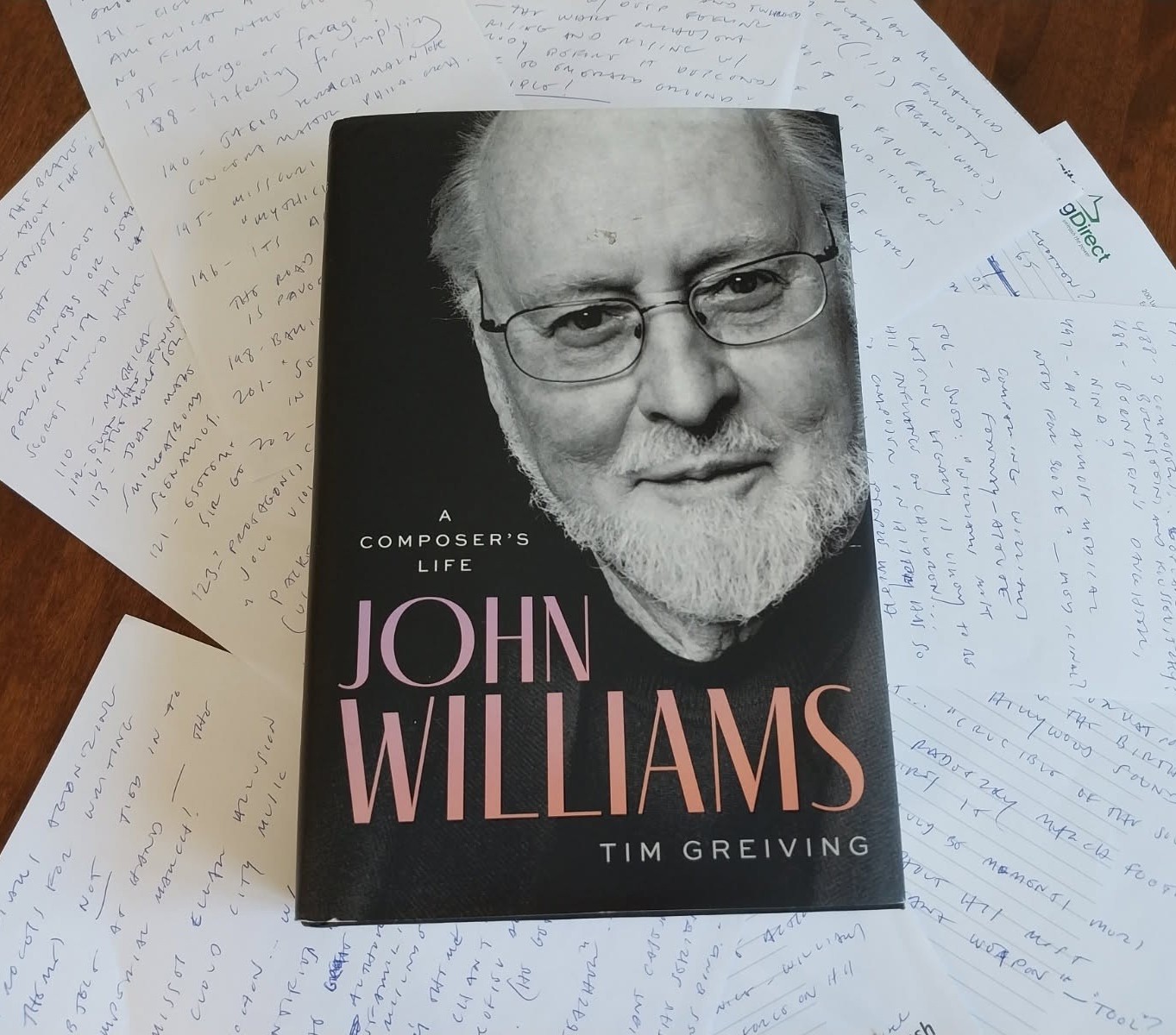
The source of my agony has been Tim Greiving’s epic biography of John Williams (“John Williams: A Composer’s Life”), released by Oxford University Press in September. I was overjoyed to receive it for Christmas. Little did I realize I’d unwrapped 630 pages of quicksand.
I compiled the bulk of my report over two days this month, separated by a couple of weeks. My mood evidently shifted, as the two halves do not flow together. Here, I do my best to restore the paragraphs I set down on Day 1, which are much kinder, if more broadly argued.
*****
The author is at his worst when he goes purple or wades into simile and metaphor. He’s simply too imprecise, random, and just plain sloppy. The book reads like a first draft, and I am shocked that Oxford University Press would allow anything like this to go to print. And yet it has turned up on holiday gift lists and year’s top recommendations from many reputable sources. Am I taking crazy pills? Or are people simply not equipped to recognize good prose anymore?
The internet has had the effect of tearing down the old guard of gatekeepers and leveled the playing field, but I’ve been around long enough – and I’m not THAT old – to remember when, if you were going to be published, you had to be able to write well enough that a reader isn’t made to stop every few sentences to think about what’s wrong with what he or she just read. When I read a published book, I expect polished prose, not a high school essay that keeps shifting tones and tenses, repeats itself, mixes metaphors, and commits any number of actual malaprops.
I do a lot of reading in bed. Since I knew I wanted to post my observations on this book, I kept a tablet and pen on my nightstand. Little did I expect that I would be having to put down the book and pick up the pen so often, frequently multiple times per page. Some nights, if I felt I just wanted to enjoy reading for a change, I had to stifle the impulse. But on those nights, I could feel the perspiration beading on my brow. By no means did I chronicle every error in the book, but even in my sporadic effort I managed to accumulate eight double-sided pages.
There are the bones of a good book here, and the author obviously loves his subject. There are times when he’s so confessional, as in the acknowledgments section at the end, that he actually moves me. But he needed a genuine editor, not to get the length down – I think the world deserves a 600-page John Williams biography – but rather to tame the prose, to whack the weeds and bring some order and to get everything looking professional and consistent, to lend it the feel of authoritativeness it deserves. Because for as shoddily-written as it is, it will remain an important resource for anyone who truly cares about the composer, beyond the casual fan’s ten favorite soundtracks.
I hasten to add, the book as an object is beyond reproach, very handsomely produced, with an attractive dustjacket, a glossy photo section, and quality paper that, under reasonable conditions, is not likely to yellow within a few years, unlike so many books these days. Perhaps the font could have been a little larger and the margins a little more generous, but these things didn’t really bother me once I got used to them. The alternatives probably would have added another hundred pages. Perhaps more? How many more pages would Oxford University Press allow, anyway?
I strongly suspect that Greiving, in common with many film music “scholars,” possesses a very limited knowledge of classical music (from which, as he himself astutely observes, the language of Hollywood film music evolved). I’d even go further to speculate that he doesn’t know all that much about music in general, at least in terms of how it is ordinarily written about and discussed, and not only in the academic literature. I am by no means a pointy-headed, jargon-bandying university type. I am speaking of the proper application of terms like “orchestrations,” for instance, which the author seems to use often as a synonym for “works” or “compositions.”
I don’t doubt he has an extensive knowledge of film music and composers, as I always have, but I’m afraid it may all come down to the enthusiastic absorption and retention of trivia, statistics, and history. I am not denigrating those things in themselves. I am merely pointing out that there is an awkwardness to some of the music writing that would not exist had the author more experience reading about orchestral music in periodicals or books that deal with the subject. This shortcoming does not wreck Greiving’s book, but it does unfortunately draw attention to itself. Repeatedly.
There are times when the author pulls himself together and the writing becomes less turgid or juvenile and he makes some very astute points. And at those moments, I say to myself, “Yes!” But my god, man, I wish that someone with some experience reading actual books had sat down and proofread this thing. Such a handsomely produced volume and such an ambitious undertaking, with a major artistic and pop cultural figure as its subject, should have been one of the year’s best books.
Astonishingly, it was included on many such lists – which makes me a little sad for the world, that our editing and publishing would be in the hands of such amateurs. There were many times in the course of my reading that I really, really hoped my own writing doesn’t come across like this to older readers of more experience, who lived through an era of higher standards.
*****
Anyway, this is not complete or polished, but it’s something, a fragment that touches on some of the issues I had with the book, so that I can get this off my desk and get back to posting again. What a logjam!
Maybe I’ll share the longer version, or fragments of it, next week. That’s the one with all the actual, painful examples, but it’s also full of specifics about Williams himself and what I found commendable about the book, alongside what I found so very frustrating. The last thing I want is for it to come across as a public flogging. One of the reasons I hesitate is that I’m afraid if I post it as it is, there’s going to be a lot of painful stripes.
Grieving deserves all respect for undertaking such a project, and clearly it was a labor of love. Frankly, the book should never have gone to print in the condition it’s in. And that’s all on Oxford University Press. A good editor could have worked miracles on it and ensured the book and its author looked their very best.
If there’s ever a second edition, Tim, I am here for you. Don’t hesitate to message me.
Caught in My Own Web: Tangled Up in Indignation Over Tim Greiving’s John Williams Bio
by
15 responses
Comments
15 responses to “Caught in My Own Web: Tangled Up in Indignation Over Tim Greiving’s John Williams Bio”
-
A book like this deserves both the Amazon style review as well as the NY Review of Books. We should see your longer version, even if it’s a link to a blog on a web site.
A Tale of Two Reviews
Doublemint Review – it’s two, two reviews in one.
The Ying and Yang Biography of John(ny) Williams.
-
Kenneth Hutchins Do you honestly believe anyone would be interested to read my 6400-word assessment of the new John Williams biography? I can’t even look at it myself long enough to make the last third of what I wrote flow cohesively. How’s it going to look, me ridiculing Oxford University Press, when I can’t even edit my own post?
-
Classic Ross Amico here is your prologue:
Following the approach of the John Williams biography, I humbly submit my Miscellaneous Ramblings review of this book.
NB Miscellaneous Ramblings was the monthly column of the editor of Road & Track magazine.
-
-
-
This reminds me of how I went in to the movie Bohemian Rhapsody. I’m not egotistical enough to say I know all of Queen and Freddy Mercury……but a lot of that film was just plain wrong. And most of the wrongness came from Brian May deciding he had to make Freddy appear to be a saint when oh good God he was the farthest thing from that!!! Why can’t peeps just write the truth??
-
Jon Haag Yeah, but that’s the movies. They’re always twisting things for dramatic license. It’s been the case since the invention of moving pictures. Even before. Playwrights, novelists, poets. What a bunch of liars! 😉
-
Classic Ross Amico As Gregory House would say “Everybody lies!”
-
-
-
No, John Williams deserves a “brief life” and examination not to exceed 450 pages at most. That book should deal with his extensive “borrowings” from other composers. Mr. Williams is a kindly man and a complete professional. However, biographies of living subjects are problematical at best.
-
Byron Adams Have you read the book? It doesn’t sound like it. Otherwise, you wouldn’t fixate on Williams’ “borrowings.” Greiving may not possess the knowledge of the classical repertoire to be able to identify what all these are, exactly, but the book does a respectable job of conveying why such reductive criticism totally misses the point. Frankly, in light of some of the compliments you’ve paid Williams in your talks at Bard, I thought you would be one of the ones who got it. Anyway, I address it in my longer review, which I really don’t feel like revisiting, but you might be forcing my hand.
I don’t doubt that the book could be shorter — the length is extended by the author’s insistence on writing about every one of Williams’ scores (which he does in often unmusical fashion), coupled with often awkward critiques of the films — but there is nothing problematic in anything he writes about the composer himself. If anything, there needs to be more about the man, as he drops out of the narrative entirely for great expanses of the book. Musical analysis is important, if the writer has the tools (Greiving does not). But the glimpses we get are illuminating. Even if someone thinks he knows a lot about John Williams, there’s plenty here to intrigue. First biographies, whatever their perceived flaws, are valuable, and we’re not going to get that many more first-hand accounts about a 94-year-old composer.
If you don’t want to read 600 pages about John Williams, don’t. Me, I’d eagerly read 600 pages about any subject I’m interested in, provided the writing and the editor can make it worth my while! However, as I say, this should have been a much better book.
-
-
Quite the report. Wow. OUP shocker. University presses are usually reliable. Yikes.
-
R Bradley Wilson It is, in all honesty, a trainwreck. I don’t know if the manuscript was submitted too close to deadline, if OUP is severely understaffed, or if the project was overseen by someone who usually edits graphic novels.
-
R Bradley Wilson maybe the editor was Claude AI?
-
Kenneth Hutchins I hadn’t even thought about that. If it’s really the case, and this is what we can expect going forward, it is beyond depressing. Roll over, Maxwell Perkins!
-
Classic Ross Amico At least the revolution won’t be televised.
-
-
-
Wow, very straightforward! I had tough English teachers, one of which would slay me for using the word, “very”, so I appreciate your standards. I have yet to relate to you my impressions of the Legrand, autobio, as told to. The English translation, coincidentally, is published by Oxford.
-
Bill Zeltman Oh Bill, I can’t even tell you. I was so fried trying to organize my notes. It’s a good thing I didn’t jot down everything that leaped out at me. I was this far from not posting about it at all. As it is, these are just a few random observations. I should eventually post it all, just so readers can see what I’m talking about and know that I’m not exaggerating. But if I do, at 6400 words, it’s bound to be a disjointed mess!
-
Tag Cloud
Aaron Copland (94) Beethoven (95) Composer (114) Film Music (150) Film Score (143) Film Scores (255) Halloween (102) John Williams (198) KWAX (233) Leonard Bernstein (105) Marlboro Music Festival (125) Movie Music (165) Mozart (91) Opera (215) Philadelphia Orchestra (90) Picture Perfect (174) Princeton Symphony Orchestra (110) Radio (90) Ross Amico (244) Roy's Tie-Dye Sci-Fi Corner (290) The Classical Network (101) The Lost Chord (269) Vaughan Williams (107) WPRB (397) WWFM (881)
Leave a Reply