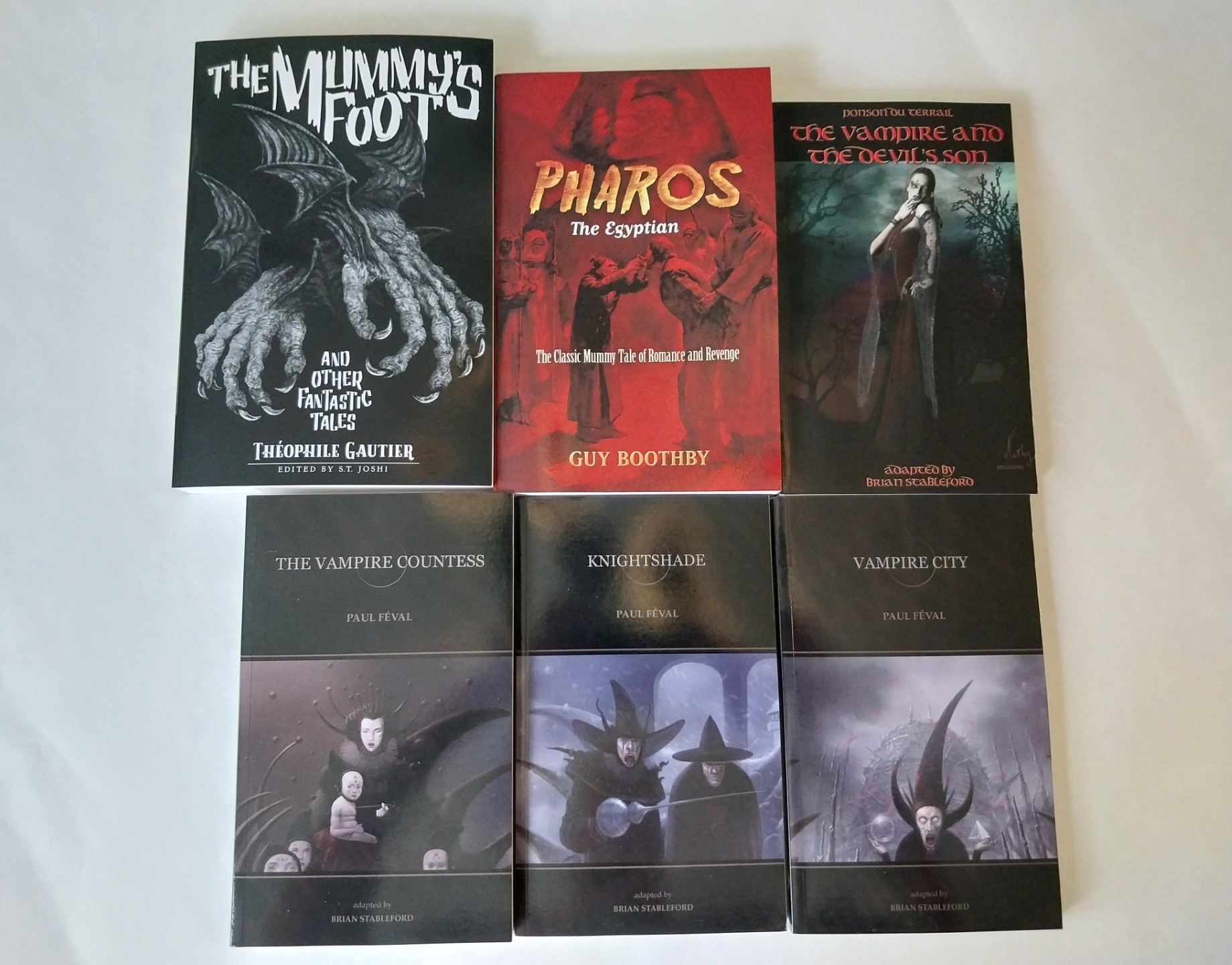
I’ve been interested in vintage horror and “weird fiction” for nearly half a century, so I thought I knew a thing or two about vampires. Over and over again, I’ve encountered historical surveys or introductions that repeat that the first vampire story in English was a fragment by Lord Byron. This was undertaken to fulfill his part in a wager he proposed, while lounging with his bored Bohemian cohort on Lake Geneva, during the soggy summer of 1816, a contest to concoct the scariest ghost story that also yielded Mary Shelley’s “Frankenstein.” Byron’s fragment was picked up and completed by his physician (also part of the party), John Polidori, who gave us the transparently Byronic Lord Ruthven in “The Vampyre” (1819) – at first believed to have been written by Byron himself.
Then there’s a long gap until the penny dreadful “Varney the Vampire” (published weekly, in serialized form, from 1845-1847); and after that, another quarter century until Sheridan LeFanu’s proto-lesbian vampire novella “Carmilla” (1872); and at the far end of the century, the ne plus ultra of vampire novels, Bram Stoker’s “Dracula” (1897).
As you can see, I had it down. Or so I thought.
Now here I am, hanging onto middle age by my fingernails, only to discover this rich vein of vampire fiction in France. I suppose I failed to take into account that the surveys I was reading were concerned with vampire tales IN ENGLISH. But has it not traditionally been the case, everything being so Anglocentric here in the U.S.? In fact, the books I’m about to consider didn’t even exist in translation until fairly recently.
Imagine my surprise and delight to stumble across Paul Féval. Féval was known for his swashbuckling feuilletons (serialized adventure stories), most notably “Les Mystères de Londres” (itself cashing in on Eugène Sue’s “Les Mystères de Paris”), said to be a precursor of “The Count of Monte Cristo.” More to the point, he wrote three vampire novels, published after the same fashion, “Le Chevalier Ténèbre” (1860), “La Vampire” (1865), and “La Ville Vampire” (1874).
I’m going right to the top and starting with the third of his vampire feuilletons, “La Ville Vampire,” or “Vampire City.” From what I understand, this is the one in which the real-life Gothic novelist Ann Radcliffe faces off against the undead as a kind of proto-Buffy the Vampire Slayer.
Alas, Féval came to a bad end. First, he lost his incredible fortune – millions of dollars by today’s reckoning – in a financial scandal involving the Ottoman Empire. He staggered out of the ashes, hoping to reinvent himself by turning over a new leaf. He became the equivalent of a born-again Christian, gave up writing lurid novels, which he now regarded as sinful, and devoted himself to going back and touching up his earlier works in an attempt to smooth over all the objectionable bits. He also began writing novels on Christian themes.
When he was ruined a second time, by an embezzler, he suffered an attack of apoplexy that left him physically and creatively paralyzed. Two years later his wife died, which led to a second attack. He died in 1887 at the age of 70.
Another notable French contributor to the vampire genre was Pierre Alexis, Viscount of Ponson du Terrail (also, by the way, influenced by Radcliffe and Sue). Ponson du Terrail is said to be an important transitional figure in the evolution from old-fashioned Gothic novel to what we now recognize as the modern adventure story – especially in his “Rocambole” series, beginning with “L’Héritage Mystérieux, which features an heroic figure who rises above his apprenticeship to an evil genius to become a fearless champion of good.
The author certainly put his money where his mouth was. Following the surrender of Napoleon III to the Germans during the Franco-Prussian War, Ponson fled Paris to his estate near Orléans to engage in guerilla warfare against the enemy. In the end, he was forced to flee to Bordeaux after the Germans burned down his castle. He died in Bordeaux at 42, leaving his Rocambole saga incomplete.
I owe Brian Stableford and Black Coat Press a bottomless debt of thanks for exhuming a veritable catacomb of French vampire fiction. While I can’t yet vouch for Stableford’s talents as a translator, I am in awe of his drive and tenacity. When he realized so many of these novels were unavailable in English, he undertook to translate all of them himself. He published more than a hundred translations, on top of his hundred or so original novels and countless short stories. For the Black Coat publications, he also provides what promises to be, in light of the novels’ obscurity in the English-speaking world, a lot of helpful information in his introductions and afterwords.
In addition, I notice Stableford has translated and adapted (?) another, earlier Franco-vampire novel, “The Vampire Lord Ruthwen” (1820), spinning off from Polidori, also available from Black Coat Press. I’ll certainly keep it in mind, but I think I’m good with French vampire novels for this year.
https://www.blackcoatpress.com/catalog.html
In the process of boning up on French vampire fiction, I also learned of “La Morte Amoureuse” (1836) by Théophile Gautier, whose racy gender-bending swashbuckler, “Mademoiselle Maupin,” I happened to read in the past 15 years or so. So I picked up this collection, “The Mummy’s Foot and Other Fantastic Tales” – which looks like it’s basically a repackaging of “One of Cleopatra’s Nights and Other Fantastic Romances” (1882), with one or two substitutions of some of Gautier’s other weird fiction, translated by Lafcadio Hearn – now retitled, no doubt to appeal to a more luridly-inclined generation.
For classical music folk, Gautier cowrote the libretto for Adolphe Adam’s ballet “Giselle” and also rubbed shoulders with composers Georges Bizet, Giuseppe Verdi, and Hector Berlioz. Also, Charles Baudelaire dedicated his seminal volume of decadent poetry, “Les Fleurs de mal” (“The Flowers of Evil”) to him.
“The Mummy’s Foot” contains Gautier’s vampire story under its alternate title (after the vamp herself), “Clarimonde.” I just read it last night, and for anyone hankering for a 19th century vampire story on a level with “Carmilla,” it’s totally worth it. Is it a dream? An allegory? A manifestation of the narrator’s psychological state? Or did Clarimonde really exist and the story actually unfold as related? All I can say definitively is that it is one bizarre fever dream.
The book, a trade paperback edited by S.T. Joshi and published by Hippocampus Press, is very well produced, with a glossy cover, good paper, and a solid binding, none of which should be taken for granted in these days when so many independent “publishers” knock off inferior, on-demand reprints of public domain material in their basements. If you’re interested in this sort of fiction, definitely check out the titles in Hippocampus’ “Classics of Gothic Horror Collection.”
https://www.hippocampuspress.com/classics-of-gothic-horror
Of course the mummy story takes the cover, on the assumption that readers still know what mummies are and still associate them with supernatural goings-on. This prompted me to recollect Guy Boothby’s mummy potboiler “Pharos, the Egyptian” (1898), which is said to be closest in spirit to the Boris Karloff movie. It also features an over-the-top supervillain whose exotic cruelty and inexorable evil are said to have played on British imperial anxiety, in much the same way as “Dracula” and H.G. Wells’ “The War of the Worlds” (also 1898) did. There’s no way this fez-wearing stereotype is not going to be offensive to some modern readers, but you know I am going to lap it up, because I’m a grown-up, and I know right from wrong, and I understand historical context, and I know it’s just fantasy. I can’t wait to give it a whirl.
My copy was issued by Dover Publications, which has been making novels of this sort available more consistently than anyone else for more than 60 years, thanks to the editorial guidance of E.F. Bleiler. How I wish I could shake that man’s hand. (Bleiler died in 2010.) The company went bankrupt in 2020, but was purchased by Atlas Holdings, and the catalog remains available.
https://store.doverpublications.com/products/9780486803159?_pos=1&_sid=e34be0538&_ss=r
Who knows how many of these volumes of forgotten lore I’ll be able to wade through this month? Probably not many. There’s certainly plenty here to keep me entertained through November, and likely over the winter months, if not to be resurrected next year.
How about you? Reading anything to raise a shiver? As the days grow short, October, November, and December are prime ghost story season (if we’re to follow Dickens and M.R. James to Christmas). Hell, I’ll even throw January into the bargain. Why not?
Happy reading, everyone, and happy Halloween!
Category: Book Reviews
-
Quaker Notes: S. Weir Mitchell’s “Hugh Wynne”
I’d been meaning to read “Hugh Wynne, Free Quaker” for a good 25 years. Introduced to me by a fellow bibliophile who added much to my knowledge and education in the book trade, “Hugh” was the second best-selling novel of 1898, behind Francis Hopkinson Smith’s “Caleb West, Master Diver,” about the dangerous underwater construction of a lighthouse off the coast of New England. Smith, a descendent of the Declaration signer whose name he shares, was an engineer who built New York’s Race Rock Lighthouse, as well as the foundation to the Statue of Liberty.
Essentially, “Hugh Wynne” is a bildungsroman set during the American Revolution and the years preceding, about a young Quaker of Welsh ancestry, who is raised in colonial Philadelphia by a severe father (the author’s preface to the book’s nineteenth edition indicates that this character was the source of some controversy in the Friends community) and a vivacious, indulgent French mother, while also receiving instruction on the side in the ways of society and the wider world by an independent, free-thinking, well-to-do aunt (his father’s sister). In my ideal film adaptation, I imagine Edna May Oliver or perhaps Dame Edith Evans in the role.
Interestingly, Hugh’s best friend is Jack Warder, who is noted throughout for his effeminacy – I mean, nearly every time he appears, in person or in conversation, to the point where how could the reader not wonder if there was something coded going on there. But Mitchell also has him hopelessly in love with a capricious coquette who entrances seemingly every male in the novel, and sets up an interesting rivalry with Hugh, which is never fully exploited.
It’s not the only aspect of the drama Mitchell fails to leverage. The novel’s last act should have been screwed to a fever pitch. Within moments of finishing the book, I thought of at least three elements that, had the author squeezed the tube, would have really heightened the drama. And it’s a great shame that he didn’t, as the book could have been as fondly remembered as any of the historical fiction of James Fennimore Cooper.
Instead, he deflates tension by having Hugh reveal things such as, “On the last occasion I saw so-and-so,” negating all suspense as to whether or not a certain villain is going to come back later to make trouble for the protagonists. At the beginning, he remembers his late friend Jack – the story is told in the first-person, with selections from Jack’s diary filling in details or offering perspectives at the time unknown to Hugh – which, as the novel progresses, makes the reader anticipate Jack’s untimely end – which never comes! And there is the wasted potential of heightened tension between two friends in their love for the same woman. Astonishing, that Mitchell could squander such opportunities! In their place, he settles for drawing room kerfuffle and romantic coda.
That said, the book does have its points, particularly for those familiar with Center City Philadelphia, especially Society Hill and Old City, but also Germantown and Chestnut Hill. It’s interesting to imagine this colonial town of woodlots, woodland from 8th Street to the Schuylkill, and wilderness north of Fairmount Avenue, which, when occupied, is dotted with English forts.
The book is also successful in illustrating just how divided the colonials were in their beliefs and allegiances, even as they were united in their social lives. Tories and Patriots frequently occupy the same drawing rooms, sharing gossip, tea, and cards, united in all, it seems, except politics. In fact, Hugh forms a number of allegiances and friendships with Loyalists and even British soldiers that show that, in some respects, the American Revolution was actually a precursor of the Civil War, in terms of pitting brother against brother. This is something historical fiction can often address more effectively than the bald statistics of straight history.
Naturally, as a Quaker – a member of the Religious Society of Friends – Hugh also struggles to reconcile his pacifist upbringing with a moral duty to fight for American independence. At home, there is further tension in his conflicted relationship with his domineering, disapproving father, who, as the story progresses, also becomes a figure of concern, as he begins to show signs of cognitive decline.
Hugh is less guarded in his emotions when he attempts to save a friend condemned to death for spying. Earlier, another, newfound friend looks out for him while they are incarcerated in a makeshift British prison on what is now Washington Square, of a type, in its squalor and brutality, Alexandre Dumas and Victor Hugo would have recognized.
Hugh’s Philadelphia is a port town of merchants and blacksmiths, taverns and churches, redcoats and Continental Congressmen. In peacetime, mornings are passed in abundant private gardens, lazy afternoons in boating on (and bathing in) the Delaware and Schuylkill Rivers, and free days on horseback excursions to Germantown and Chestnut Hill.
However, there are ominous undercurrents even in Hugh’s largely untroubled youth, as the colonies begin to bristle under English taxation and corruption. The spirit of revolution is intensifying, and Hugh will be a part of the action. Historical figures such as Alexander Hamilton, Benjamin Franklin, Benedict Arnold, and especially George Washington, play supporting, though obviously important, parts in the narrative.
The author, S. Weir Mitchell (1829-1914), was a prominent Philadelphia doctor and Civil War surgeon. His observations of nerve trauma and “phantom limb” syndrome launched him on a career as a pioneer in the field of neurology.
Some of his theories and treatments were not uncontroversial. Charlotte Perkins Gilman claimed to have written her famous short story, “The Yellow Wallpaper,” as a repost to Mitchell’s “rest cure” – which prescribed bed rest, seclusion, electrotherapy, and overfeeding on a protein diet (including a lot of milk), primarily for “nervous” women, who were also instructed not to engage in intellectual activity, such as study, writing, or any kind of creative work. Anxious men were sent West to rope, hunt, and roughride.
Mitchell wrote broadly on science and medical matters, but at midlife, he was also took an interest in literary fiction. “Hugh Wynne” proved to be his greatest success. It’s an absorbing read, I would even say a page-turner, by my standards, but I understand I am a peculiar person, often older than my years, perhaps even born too late. I always kept a selection of Mitchell’s novels in my Philadelphia bookshops, and they invariably sold. So there are still other people out there who know their local history – or perhaps medical history – and are interested in reading him.
Of his other titles, Mitchell’s “The Red City” is also set in Philadelphia, during the time of Washington’s second administration and the Yellow Fever epidemic of 1793 (during which many were buried in Washington Square – then Southeast Square – since 1706 a potter’s field and final resting place of African Americans, Native Americans, and Revolutionary War soldiers).
It’s also mindblowing to contemplate a time when the City of Brotherly Love really was an extension of Penn’s Woods, with abundant tree cover and even forest over most of Center City. My thoughts travel to a print I once saw of a view from the old Fairmount Prison (also instituted by Quakers), with Penn’s “green country town” so seemingly distant. From as recently as the 1920s and ‘30s, there are black and white photographs of livestock being driven down Broad Street. How quickly it all changed, how Penn’s vision devolved into a modern urban nightmare. I am reminded of Wilde’s quip, “Nowadays people know the price of everything and the value of nothing.”
Attentive Philadelphians will still find evidence of Weir’s life and accomplishments around town. There’s an historical marker, a frieze with his likeness, on a building at 1528 Walnut Street (the site of his former residence), not far from Rittenhouse Square. There’s Mitchell Elementary School in southwest Philly. There’s Mitchell Hall in the College of Physicians on 22nd Street (in the same structure that houses the notorious Mütter Museum of medical oddities). And of course there’s his final resting place in Woodlands Cemetery. Interestingly, I only just learned of a contemporary actor and producer, Silas Weir Mitchell – a distant relative – born in Philadelphia in 1969.
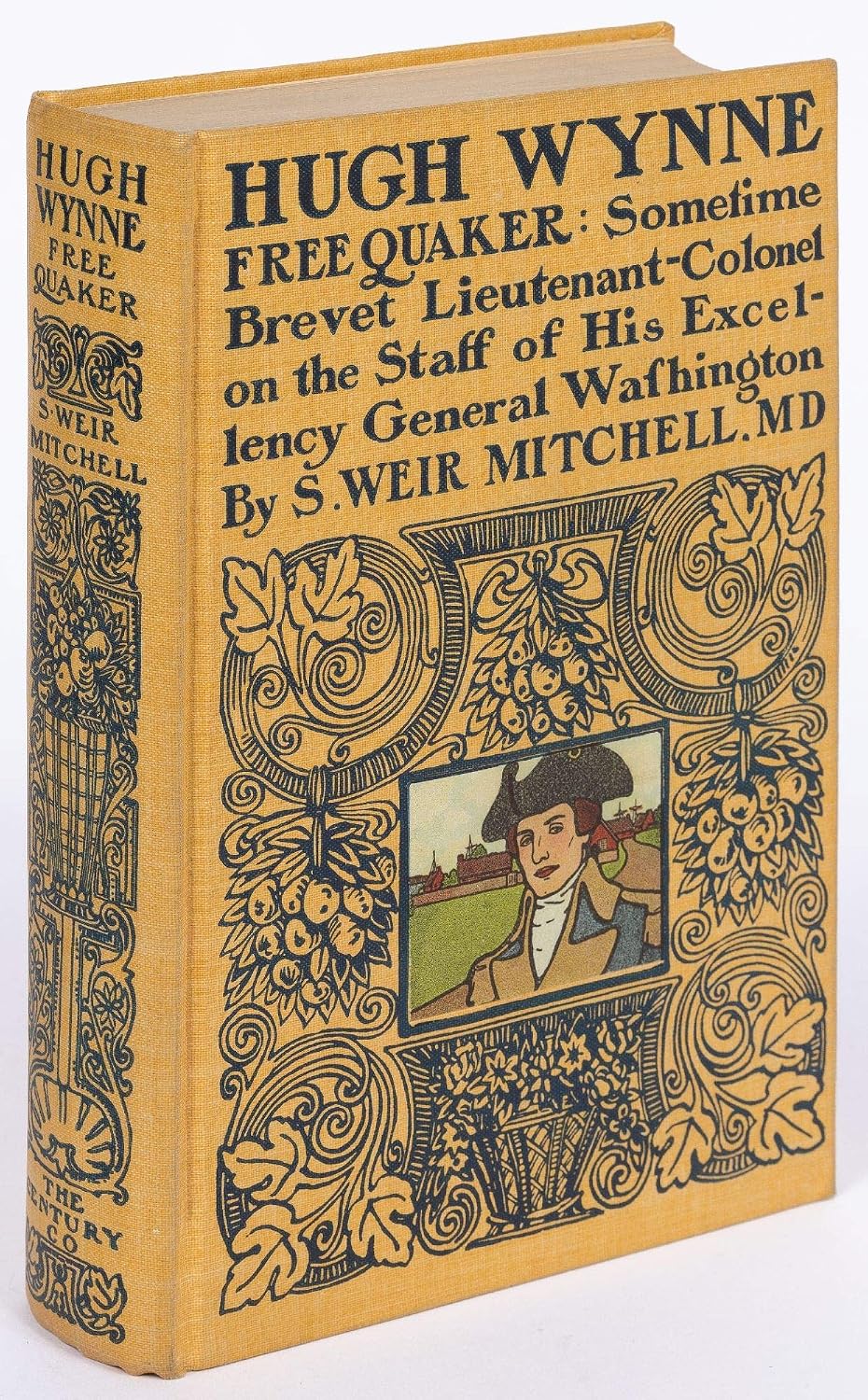
Early editions of “Hugh Wynne” (including my copy) contain black and white plates by Howard Pyle, which, to be honest, lack the dynamism of his famous pirate illustrations and are actually kind of blah. The cover is great, though, with gold cloth embossed with black lettering and ornate design, and a color paste-down plate of Hugh in a tricorn.
It’s fascinating to consider that at the time “Hugh” was written, it would be the equivalent of someone today writing an historical novel about the turn of last century – the time when ”Hugh” was actually written! The novel is equidistant between us and the events of the nation’s founding. Mitchell might very well have encountered veterans of the Revolution. (It’s thought that the last of these, Daniel Frederick Bakeman, died in 1869 at the age of 109.) He certainly grew up surrounded by the living memory of the Revolutionary generation. It is yet another example of what we all take for granted as the comparative youth of the United States, but being made to focus on it, its brevity still boggles the mind.
———-
A fairly thorough overview of Mitchell
https://www.med.upenn.edu/neurology/silas-weir-mitchell.html
His “Rest” and “West” cures
https://www.apa.org/monitor/2012/01/go-rest
Charlotte Perkins Gilman, “The Yellow Wallpaper”
https://www.nlm.nih.gov/exhibition/theliteratureofprescription/exhibitionAssets/digitalDocs/The-Yellow-Wall-Paper.pdf
Gilman, “Why I Wrote ‘The Yellow Wallpaper’”
https://www.americanyawp.com/reader/18-industrial-america/charlotte-perkins-gilman-why-i-wrote-the-yellow-wallpaper-1913/
S. Weir Mitchell historical marker
https://www.hmdb.org/m.asp?m=232078 -
Caught in My Own Web: Tangled Up in Indignation Over Tim Greiving’s John Williams Bio
There’s a longer, 6400-word version of this review, which I don’t know if I’ll ever be able to completely wrangle into shape. I’ve been trying now for four days, and seriously, I would like to get on to something else. At times it is positively brutal, not so much because of my tone, which I tried my best to moderate, but because of my honest, detailed, factual reporting, with ample evidence of the sheer number of mistakes, the poor writing, and the shameful quality of the editing.
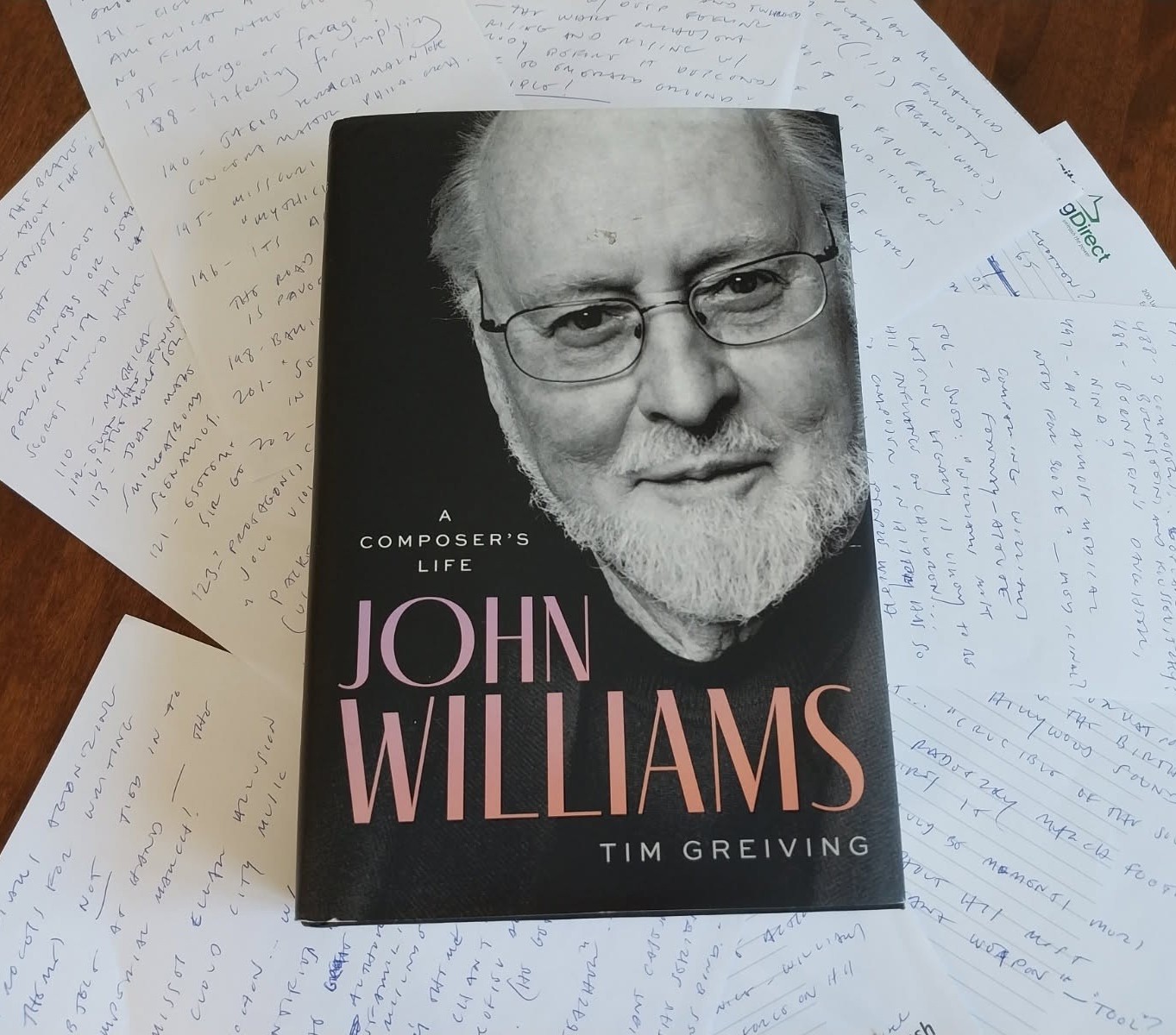
The source of my agony has been Tim Greiving’s epic biography of John Williams (“John Williams: A Composer’s Life”), released by Oxford University Press in September. I was overjoyed to receive it for Christmas. Little did I realize I’d unwrapped 630 pages of quicksand.
I compiled the bulk of my report over two days this month, separated by a couple of weeks. My mood evidently shifted, as the two halves do not flow together. Here, I do my best to restore the paragraphs I set down on Day 1, which are much kinder, if more broadly argued.
*****
The author is at his worst when he goes purple or wades into simile and metaphor. He’s simply too imprecise, random, and just plain sloppy. The book reads like a first draft, and I am shocked that Oxford University Press would allow anything like this to go to print. And yet it has turned up on holiday gift lists and year’s top recommendations from many reputable sources. Am I taking crazy pills? Or are people simply not equipped to recognize good prose anymore?
The internet has had the effect of tearing down the old guard of gatekeepers and leveled the playing field, but I’ve been around long enough – and I’m not THAT old – to remember when, if you were going to be published, you had to be able to write well enough that a reader isn’t made to stop every few sentences to think about what’s wrong with what he or she just read. When I read a published book, I expect polished prose, not a high school essay that keeps shifting tones and tenses, repeats itself, mixes metaphors, and commits any number of actual malaprops.
I do a lot of reading in bed. Since I knew I wanted to post my observations on this book, I kept a tablet and pen on my nightstand. Little did I expect that I would be having to put down the book and pick up the pen so often, frequently multiple times per page. Some nights, if I felt I just wanted to enjoy reading for a change, I had to stifle the impulse. But on those nights, I could feel the perspiration beading on my brow. By no means did I chronicle every error in the book, but even in my sporadic effort I managed to accumulate eight double-sided pages.
There are the bones of a good book here, and the author obviously loves his subject. There are times when he’s so confessional, as in the acknowledgments section at the end, that he actually moves me. But he needed a genuine editor, not to get the length down – I think the world deserves a 600-page John Williams biography – but rather to tame the prose, to whack the weeds and bring some order and to get everything looking professional and consistent, to lend it the feel of authoritativeness it deserves. Because for as shoddily-written as it is, it will remain an important resource for anyone who truly cares about the composer, beyond the casual fan’s ten favorite soundtracks.
I hasten to add, the book as an object is beyond reproach, very handsomely produced, with an attractive dustjacket, a glossy photo section, and quality paper that, under reasonable conditions, is not likely to yellow within a few years, unlike so many books these days. Perhaps the font could have been a little larger and the margins a little more generous, but these things didn’t really bother me once I got used to them. The alternatives probably would have added another hundred pages. Perhaps more? How many more pages would Oxford University Press allow, anyway?
I strongly suspect that Greiving, in common with many film music “scholars,” possesses a very limited knowledge of classical music (from which, as he himself astutely observes, the language of Hollywood film music evolved). I’d even go further to speculate that he doesn’t know all that much about music in general, at least in terms of how it is ordinarily written about and discussed, and not only in the academic literature. I am by no means a pointy-headed, jargon-bandying university type. I am speaking of the proper application of terms like “orchestrations,” for instance, which the author seems to use often as a synonym for “works” or “compositions.”
I don’t doubt he has an extensive knowledge of film music and composers, as I always have, but I’m afraid it may all come down to the enthusiastic absorption and retention of trivia, statistics, and history. I am not denigrating those things in themselves. I am merely pointing out that there is an awkwardness to some of the music writing that would not exist had the author more experience reading about orchestral music in periodicals or books that deal with the subject. This shortcoming does not wreck Greiving’s book, but it does unfortunately draw attention to itself. Repeatedly.
There are times when the author pulls himself together and the writing becomes less turgid or juvenile and he makes some very astute points. And at those moments, I say to myself, “Yes!” But my god, man, I wish that someone with some experience reading actual books had sat down and proofread this thing. Such a handsomely produced volume and such an ambitious undertaking, with a major artistic and pop cultural figure as its subject, should have been one of the year’s best books.
Astonishingly, it was included on many such lists – which makes me a little sad for the world, that our editing and publishing would be in the hands of such amateurs. There were many times in the course of my reading that I really, really hoped my own writing doesn’t come across like this to older readers of more experience, who lived through an era of higher standards.
*****
Anyway, this is not complete or polished, but it’s something, a fragment that touches on some of the issues I had with the book, so that I can get this off my desk and get back to posting again. What a logjam!
Maybe I’ll share the longer version, or fragments of it, next week. That’s the one with all the actual, painful examples, but it’s also full of specifics about Williams himself and what I found commendable about the book, alongside what I found so very frustrating. The last thing I want is for it to come across as a public flogging. One of the reasons I hesitate is that I’m afraid if I post it as it is, there’s going to be a lot of painful stripes.
Grieving deserves all respect for undertaking such a project, and clearly it was a labor of love. Frankly, the book should never have gone to print in the condition it’s in. And that’s all on Oxford University Press. A good editor could have worked miracles on it and ensured the book and its author looked their very best.
If there’s ever a second edition, Tim, I am here for you. Don’t hesitate to message me. -

William Saroyan and Jean Sibelius
I’d forgotten what a terrific writer William Saroyan is. As someone who has haunted, worked in, and owned bookstores throughout his life, of course I had encountered Saroyan’s name and gleaned from some of his titles that he was proud of his Armenian heritage.
But what drove me finally to seek out his work was a viewing on TCM some years ago of a moving wartime drama called “The Human Comedy,” in which Mickey Rooney, surely giving one of his best performances, plays a high school student who moonlights as a telegraph delivery boy, helping to support his family after the death of his father, while his brother is away at war.
The cast also includes Frank Morgan (a.k.a. The Wizard of Oz), Donna Reed in one of her early roles, and Van Johnson, who for once doesn’t annoy the hell out of me. It’s a heartwarming film that delivers. A really beautiful slice of Americana. Sentimental? At times, but I think its tears are well earned. There’s an awful lot of “aw shucks” wholesomeness, but I’m not against that. I don’t know if I’d put it on the same shelf as “The Best Years of Our Lives” or “It’s a Wonderful Life,” but it definitely exudes that same quasi-mythic sense of community and basic American decency.
Saroyan himself didn’t like what Hollywood did with the film, but he was, after all, the writer and understandably proprietary. Also, he had been nudged out of the director’s chair by Louis B. Mayer, after it was found Saroyan’s original screenplay would have pushed the running time to 4 hours. In response, Saroyan went home and immediately adapted his treatment into a novel, which was rushed into publication before the film could be completed and became a runaway bestseller.
It’s always been a bit of a mindbender for me to realize that so many of these figures who attained success during the 1930s and ‘40 were still basically middle-aged by the time they reached the 1970s. It’s crazy, for instance, to think that my grandfather, who served in World War II, turned 60 in 1975. So it was that I always thought of Saroyan as the outlandlishly mustachioed celebrity he was at the time he appeared on “The Dick Cavett Show” (with Veronica Lake and Leonard Maltin) in 1971. It’s hard to reconcile it with the handsome, dark-eyed, alternately exuberant and melancholy, earthy and unwaveringly independent writer of the 1930s and ‘40s.
Once upon a time, Saroyan was taken very seriously as a major voice in American fiction. He wrote acclaimed novels, plays, and short stories. And the power and personality of his individual voice never aged. It is still potent in the story collections he tossed off late in life, if perhaps tempered by accrued wisdom (but not always). At times, he can be positively Vonnegutesque, so I suppose it should have come as no surprise to learn that Vonnegut wrote a tribute to Saroyan that was delivered at the American Academy and Institute of Arts and Letters the year after Saroyan’s death in 1981. Vonnegut, who had never met the man but clearly admired his work, characterized Saroyan as “the first and still the greatest of all the American minimalists.”
On the last day of a Princeton Public Library book sale in October, I returned to run my eye over the picked-over inventory to see what I might have missed and maybe pick up a few deals from among the orphans during the half-price closeout. Imagine my delight, when I espied a crisp, leather-bound Franklin Library edition of Saroyan’s “Sons Come and Go, Mother’s Hang in Forever” from 1976, with illustrations by Al Hirschfeld, marked $10 – $5 half-price. This was especially exciting as it happened to contain Saroyan’s account of his meeting with Jean Sibelius. Sibelius, of course, is one of my favorite composers. He was born on this date in 1865.

Somehow, at some point, I had learned about this literary anecdote and have had my eyes open for “Jean Sibelius at Home in Jaarvenpaa” [sic] ever since. Basically, the writer at 27 pops into a record shop in Helsinki in 1935 and requests a recording of “Finlandia,” a piece of music with which he had come to strongly identify for personal, as opposed to nationalistic, reasons. The clerk pulls a performance and puts it on a turntable, and the two listen transfixed. Reading his enthusiasm, the clerk insists on calling up the composer to ask if it would be okay for Saroyan to drop by. The account is especially interesting in that it offers a bit of a counterpoint to the usual portraits of Sibelius as a solemn recluse.
Here, he’s hospitable and good-humored. Saroyan is surprised by the composer’s “boyish and boisterous courtesy” and whisky is consumed. (Saroyan, however, declines the offer of a fine cigar.) But it isn’t long before he detects a sorrowful undercurrent in his host’s character that he recognizes from another of his personal favorite pieces by the composer, the “Elegie” from “King Christian II,” which the writer references in at least two other stories in the collection.
The meeting grows awkward as Saroyan mentions “Valse triste,” one of Sibelius’ most successful works, but one for which the composer was screwed out of enormous royalties, thanks to an early agreement with his publisher. In the silence that follows, Saroyan is glad to have retained a taxi, which is waiting for him outside. Still, he is so buoyed by the experience of meeting Jean Sibelius that he decides to write a story about it as soon as he gets back to his room. This he also calls “Finlandia.”
It was only in reading “Sons Come and Go, Mother’s Hang in Forever” last week that I learned of the existence of this earlier Sibelius-related short story. This I have been unsuccessful in obtaining prior to the writing of this post. It appeared in Saroyan’s book “Inhale and Exhale” and was subsequently collected in “The William Saroyan Reader.” Sadly, I could find neither on the shelves of Princeton’s Labyrinth Books or Barnes & Noble (no Saroyan represented at either store, as a matter of fact), and the Princeton Public Library only had “The Human Comedy” and “My Name is Aram.” So I have a copy of “The William Saroyan Reader” on order from a seller on eBay.
(Parenthetically, at some point within the last few years I also picked up a good used copy of “My Name is Aram,” which I had passed over many times, even when I had it on the shelf in one of my own shops, not realizing how very interested I would be to read it until my conversion experience with “The Human Comedy.” That said, I have yet to get around to it. It’s in one of the stacks on my desk.)
“Sons Come and Go, Mother’s Hang in Forever” is a like a collection of vignettes, entertaining free-associations spanning some three or four pages recollecting some aspect of Saroyan’s world, whether it be his boyhood in Fresno, his experiences in Hollywood in the 1930s, or the sights and sounds of New York City’s 57th Street. Some of the other artists and celebrities of whom Saroyan records his impressions include Jack Benny, Paul Bowles, Marc Chagall, Charlie Chaplin, Greta Garbo, Lillian Gish, Ernest Hemingway, Miriam Hopkins, Walter Huston, Gypsy Rose Lee, H.L. Mencken, Marilyn Monroe, George Jean Nathan, Diego Rivera and Frida Kahlo, George Bernard Shaw, George Stevens, Gloria Swanson, and Darryl Zanuck (with a cameo by Humphrey Bogart). And he doesn’t pull any punches. If he finds someone lacking, he lets you know. He really didn’t like Will Rogers or Harold Clurman or Louis B. Mayer. Mostly, though, he’s pretty genial and matter-of-fact, often with a touch of empathy, or at any rate, humanity glowing beneath the surface.
I have since discovered that Sibelius is not the only classical composer with whom Saroyan had associated. He also collaborated with American composer Alan Hovhaness, who shared his Armenian ancestry. (Hovhaness was also an ardent Sibelius enthusiast, who kept up a correspondence with the Finnish master.) Together, they wrote the song “Bari, Bari” and Hovhaness composed incidental music for Saroyan’s play “Jim Dandy.” After Saroyan’s death in 1981, half his ashes were interred in the Komitas Pantheon in Armenia near the grave of Aram Khachaturian, whose artistry Saroyan had also lauded. Komitas himself is celebrated as the founder of an Armenian national school of music.
Clearly, Saroyan possessed a fierce ethnic pride, but the United States, after all, was the country of his birth, and despite early hardship (his mother was so poor that after his father died he lived in an orphanage for five years), he loved America, and he wrote warmly about the people of different ethnicities and backgrounds he grew up with.
For reasons he perhaps never fully understood, he felt a close affinity with Sibelius, living in the remote north, “a giant in the world, and not just the world of music, a giant in the world of mystery, of legend, of universal human meanings.”
A roundabout salute, then, to Jean Sibelius on the 160th anniversary of his birth!
——–
Sibelius, “Elegy” from incidental music to “King Christian II”
Alan Hovhaness, “Bari, Bari”
Selection from Hovhaness’ incidental music to Saroyan’s “Jim Dandy”
Veronica Lake and William Saroyan on Dick Cavett
“Finlandia”
-

Evenings with Hector Berlioz: Music, Scorn, and Genius
“Music makes herself beautiful and charming for those who love and respect her; she has nothing but scorn and contempt for those who sell her.” Only one of the many quotable observations in Hector Berlioz’s “Evenings with the Orchestra.”
I’ve been reluctant to try to encapsulate this book, which I finished weeks ago, in preparation for this year’s Bard Music Festival. “Hector Berlioz and His World” will begin on Friday at Bard College in Annandale-on-Hudson, NY. (For more information, see the link below.)
Oscar Wilde’s Lord Henry memorably observed, “To define is to limit,” and there is something about this book – like Berlioz himself – that defies limitation. It’s every bit as much of a chimera as the composer’s most ambitious music. Satire, autobiography, music criticism, sociology, aesthetic philosophy, slapstick comedy, parable, historical romance, science fiction, and grand guignol form a curious menagerie, startling as the wonders of Dr. Lao’s circus parade.
The tales and framing device provide glimpses into the composer’s life, his encounters with musicians great and poor, his intense love affairs raising him on wings to heaven, only to dash him in the other place, his observations on a beleaguered art in a hopelessly flawed and vulgar world, and his impressions of what he perceives as our very greatest and worst music.
At times, these take on a fantastical element. The composer projects his criticisms of the current state of the art, circa 1850, five hundred years into the future, to an authoritarian, Gluck-worshipping society, complete with air ships like something out of Edgar Rice Burroughs. I kept expecting Raymond Massey to show up in his massive “Things to Come” helmet. In one of the interludes, things turn unexpectedly gruesome, rivaling the most horrifying episode in Edgar Allan Poe. In another, we learn of composer William Vincent Wallace’s erotic adventures among the cannibals of New Zealand.
We are introduced to the microcosm of the opera house, with its vainglorious tenors, who treat music scores like so many hangers on which to display their gaudy clothes; impresarios who know little about, and care nothing for, the integrity of the works they present; and the routine rough handling, arbitrary cuts, and clumsy alterations to which even the greatest operas are routinely subjected.
Furthermore, Berlioz seldom allows an opportunity to pass with which he can use to illustrate what a bunch of idiots the wider public are. Yes, even back then.
The overarching conceit has the narrator (Berlioz or an alter ego) visit the pit of a foreign opera house, where most of the musicians are shown to quickly lose interest in whatever jejune trifle they’re given to perform, dismiss whatever imbecilities transpire onstage, and pass the time gossiping and exchanging the anecdotes and stories that become the bases of the various chapters of the book.
There are notable exceptions. Whenever the works of Gluck or Weber find their way onto the music stands, they play as if they are handing down Holy Scripture.
A recurring target is the overzealous bass drummer. Berlioz makes no secret of his disgust with the vulgarity of most Italian opera, especially Rossini; but he is no easier on the French, at one point offering an ostensible – albeit extensive – review of a new opera by Adolphe Adam that, beyond a few sentences at the end, is really mostly an account of Berlioz’s weekend in the country. This review originally appeared in a Paris newspaper. As you can imagine, there was no love lost between the two composers.
We also learn about the political maneuverings of the claques, factions paid off by impresarios and singers to applaud and cheer, with the aim of bolstering the reputations of performers and the successes of new productions.
Also, about “tacks,” when conductors take to rapping their batons on nearby objects to attract the attention of musicians. According to Berlioz, or the narrator, in one case, the maddening repetition of the act against a resonant box at the foot of the stage, night after night, drove the prompter who worked inside finally to commit suicide.
Episodes like these excite with their lurid interest. However, they are interleaved with panegyrics to Berlioz’s favored musicians (Spontini, Gluck, Weber, Paganini), and some of these, I have to admit, can go on for quite some time. They provide their own sort of interest, but after a while, they can get to be a little challenging for a reader burning the midnight oil. When Berlioz warms to a subject, he can waffle on about it for a good 30 pages. For great stretches, he can be amusing, occasionally even laugh-out-loud funny, but I must say, for me personally, “Evenings with the Orchestra” is not bedtime reading. I made much surer progress when I picked it up during the day. If you want a good Berlioz bedtime book, stick with the “Memoirs.” Its shorter chapters lend it a brisker pace.
Whatever the composer writes, it is invariably full of personality. This book, more than most, really conveys quite vividly that nothing in human nature ever really changes – even without the author projecting 500 years in the future. I can totally relate to the types and personalities involved, and the composer’s frustrations, but also, thankfully, his sense of the ridiculous.
I conclude by reminding you that the Bard Music Festival, “Berlioz and His World,” will take place at Bard College from August 9-18. You’ll find a complete schedule of concerts and more information at the link.
https://fishercenter.bard.edu/whats-on/programs/bard-music-festival/
Fisher Center at Bard
Tag Cloud
Aaron Copland (94) Beethoven (95) Composer (114) Film Music (148) Film Score (143) Film Scores (255) Halloween (97) John Williams (196) KWAX (232) Leonard Bernstein (105) Marlboro Music Festival (125) Movie Music (163) Mozart (91) Opera (215) Philadelphia Orchestra (90) Picture Perfect (174) Princeton Symphony Orchestra (110) Radio (90) Ross Amico (244) Roy's Tie-Dye Sci-Fi Corner (290) The Classical Network (101) The Lost Chord (269) Vaughan Williams (107) WPRB (397) WWFM (881)