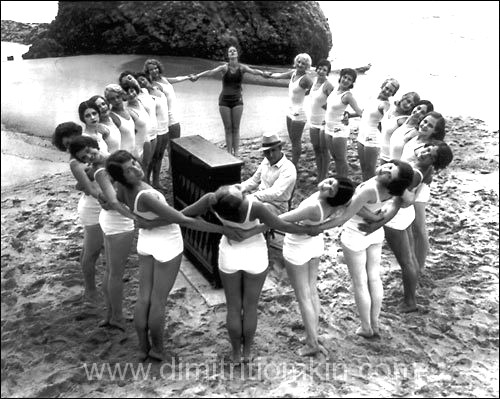
It’s summer, and for some, life’s a beach. Here’s a fun photo of future film legend Dimitri Tiomkin, the man who kicked off the craze for title songs in the seemingly incongruous genre of the movie western, when his score and song for “High Noon” earned wide acclaim, double Oscars, and enormous financial dividends. In fact, “Do Not Forsake Me, Oh My Darlin’” has been credited by some with having saved the picture from box office failure and cementing its status as an American classic.
From then on, Tiomkin was always sure to include a title song in his westerns – “Gunfight at the O.K. Corral,” “The Alamo,” “The War Wagon,” “Rio Bravo,” and, for television, “Rawhide,” among them – and for films in other genres, as well (“Friendly Persuasion,” “The Guns of Navarone,” “Wild Is the Wind”).
Interestingly, Tiomkin was born in Ukraine and studied at the St. Petersburg Conservatory with Alexander Glazunov. When asked the secret to his exceptional success writing music for westerns, Tiomkin replied with a shrug, “A steppe is a steppe is a steppe.”
Early on, it had been his mother’s dream that he become a concert pianist. To this end, he studied with Felix Blumenfeld, teacher of Horowitz, and Isabelle Vengerova. Also with Ferruccio Busoni and Egon Petri. He made his debut with the Berlin Philharmonic in Liszt’s Piano Concerto No. 2. At Carnegie Hall, he played Ravel, Scriabin, Poulenc, and Alexandre Tansman. He also gave the European premiere, in Paris, of Gershwin’s Concerto in F, with the composer in attendance.
Predating his Hollywood years, Tiomkin accompanied and wrote music for a ballet company run by his wife, Austrian dancer and choreographer Albertina Rasch, with whom he had first teamed on the American vaudeville circuit. After the stock market crash of 1929, opportunities in New York dwindled, but Rasch was hired to supervise dance numbers in MGM musicals. It was during this time that the beach photo was taken.
Tiomkin made mostly undistinguished, often uncredited contributions to motion pictures in the 1930s. The best known of these was a misbegotten all-star adaptation of “Alice in Wonderland” in 1933. But it was with Frank Capra’s “Lost Horizon,” in 1937, that he was really able to show his stuff. The opulent score was conducted by the vastly more experienced Max Steiner. Recognition came just in time, as Tiomkin broke his arm, effectively ending his career as a concert pianist.
He needn’t have worried. He found success composing more than 100 film scores, earning 22 Academy Award nominations. He won four, and numerous Golden Globes. Enough of the title songs were covered by major artists and turned into popular hits that he made a very comfortable living.
You can learn more about Tiomkin and Rasch at Castle Rock Beach and the then-provocative photo (which, as we would say today, “went viral”) at the link.
Some of his ballet music for Rasch was recorded in 2020 for the album “Paris Under the Stars,” released on the Intrada label.
Leave a Reply