Serge Diaghilev, impresario of the Ballets Russes, commissioned some of the most enduring ballet scores of the 20th century, from such composers as Claude Debussy (“Jeux”), Maurice Ravel (“Daphnis and Chloe”), Manuel de Falla (“The Three-Cornered Hat”), and Igor Stravinsky (“The Firebird,” “Petrushka” and “The Rite of Spring”).
Less well known is the fact that two Englishmen were also approached.
This week on “The Lost Chord,” we’ll listen to works by Constant Lambert and Lord Berners – both men so diverse in their interests, and possessing such outsized personalities, it isn’t really possible to do justice to either in the time allotted.
Lambert was a brilliant polymath. In addition to his considerable talents as a composer, he was a conductor, arranger, and writer, as well as the lover of Margot Fonteyn. Alas, alcoholism and workaholism conspired with undiagnosed diabetes to hasten his demise at the age of 45.
His ballet, “Romeo and Juliet,” presented as a play-within-a-play, turns Shakespeare’s tragedy of star-crossed lovers on its head, with the leads falling hard in a backstage romance with happier results. Lambert would go on to greater things, but the ballet is undeniably an impressive piece of work for a 20 year-old.
Similarly, Lord Berners’ interests lie all over the place, but his was a much more relaxed character. Unfailingly productive as a composer, a painter, and a writer, nonetheless he never lost sight of the fact that life would be his magnum opus. And Berners lived well.
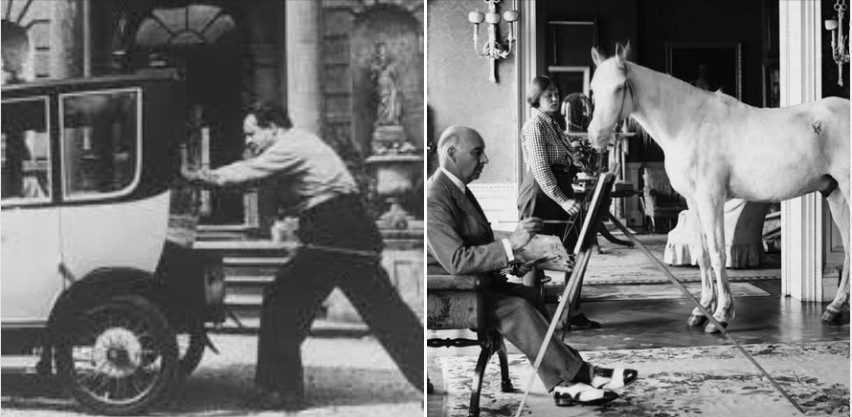
Furthermore, his fortune ensured that he would never be taken to task for any of his whimsical behavior. This included having a 140-foot folly tower constructed on his estate (partly to annoy the neighbors) and keeping a horse and a giraffe to invite to his indoor and outdoor tea parties.
Berners wrote novels, painted portraits (always sure to include a moustache, whether the sitter had one or not), and composed a respectable amount of music, especially for the ballet.
For the Ballets Russes, he wrote “The Triumph of Neptune,” which became a great favorite of Sir Thomas Beecham. Sacheverell Sitwell provided the scenario, which concerns a sailor who is shipwrecked en route to Fairyland, and George Balanchine supplied the choreography.
That’s a heady mix of hornpipes and pas de deux. I hope you’ll join me for “England à la Russe,” on “The Lost Chord,” now in syndication on KWAX Classical Oregon!
——-
Clip and save the start times for all three of my recorded shows:
PICTURE PERFECT, the movie music show – Friday at 8:00 PM EDT/5:00 PM PDT
SWEETNESS AND LIGHT, the light music program – Saturday at 11:00 AM EDT/8:00 AM PDT
THE LOST CHORD, unusual and neglected rep – Saturday at 7:00 PM EDT/4:00 PM PDT
Stream them, wherever you are, at the link!
https://kwax.uoregon.edu
——-
PHOTOS: Berners, no doubt contemplating the placement of a moustache (right); and Lambert pushing Berners car
Tag: Ballet
-
“England à la Russe” on “The Lost Chord”
-
Dimitri Tiomkin and Ballet on the Beach
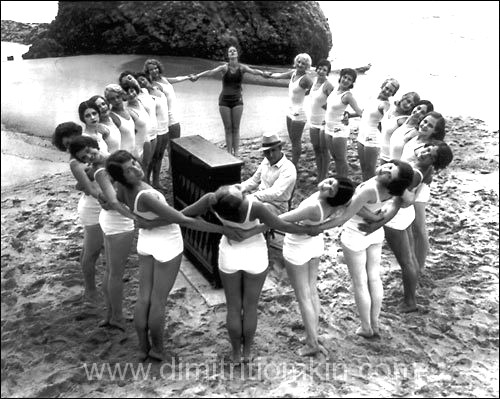
It’s summer, and for some, life’s a beach. Here’s a fun photo of future film legend Dimitri Tiomkin, the man who kicked off the craze for title songs in the seemingly incongruous genre of the movie western, when his score and song for “High Noon” earned wide acclaim, double Oscars, and enormous financial dividends. In fact, “Do Not Forsake Me, Oh My Darlin’” has been credited by some with having saved the picture from box office failure and cementing its status as an American classic.
From then on, Tiomkin was always sure to include a title song in his westerns – “Gunfight at the O.K. Corral,” “The Alamo,” “The War Wagon,” “Rio Bravo,” and, for television, “Rawhide,” among them – and for films in other genres, as well (“Friendly Persuasion,” “The Guns of Navarone,” “Wild Is the Wind”).
Interestingly, Tiomkin was born in Ukraine and studied at the St. Petersburg Conservatory with Alexander Glazunov. When asked the secret to his exceptional success writing music for westerns, Tiomkin replied with a shrug, “A steppe is a steppe is a steppe.”
Early on, it had been his mother’s dream that he become a concert pianist. To this end, he studied with Felix Blumenfeld, teacher of Horowitz, and Isabelle Vengerova. Also with Ferruccio Busoni and Egon Petri. He made his debut with the Berlin Philharmonic in Liszt’s Piano Concerto No. 2. At Carnegie Hall, he played Ravel, Scriabin, Poulenc, and Alexandre Tansman. He also gave the European premiere, in Paris, of Gershwin’s Concerto in F, with the composer in attendance.
Predating his Hollywood years, Tiomkin accompanied and wrote music for a ballet company run by his wife, Austrian dancer and choreographer Albertina Rasch, with whom he had first teamed on the American vaudeville circuit. After the stock market crash of 1929, opportunities in New York dwindled, but Rasch was hired to supervise dance numbers in MGM musicals. It was during this time that the beach photo was taken.
Tiomkin made mostly undistinguished, often uncredited contributions to motion pictures in the 1930s. The best known of these was a misbegotten all-star adaptation of “Alice in Wonderland” in 1933. But it was with Frank Capra’s “Lost Horizon,” in 1937, that he was really able to show his stuff. The opulent score was conducted by the vastly more experienced Max Steiner. Recognition came just in time, as Tiomkin broke his arm, effectively ending his career as a concert pianist.
He needn’t have worried. He found success composing more than 100 film scores, earning 22 Academy Award nominations. He won four, and numerous Golden Globes. Enough of the title songs were covered by major artists and turned into popular hits that he made a very comfortable living.
You can learn more about Tiomkin and Rasch at Castle Rock Beach and the then-provocative photo (which, as we would say today, “went viral”) at the link.Some of his ballet music for Rasch was recorded in 2020 for the album “Paris Under the Stars,” released on the Intrada label.
-
Romeo and Juliet Ends in Cat-astrophe
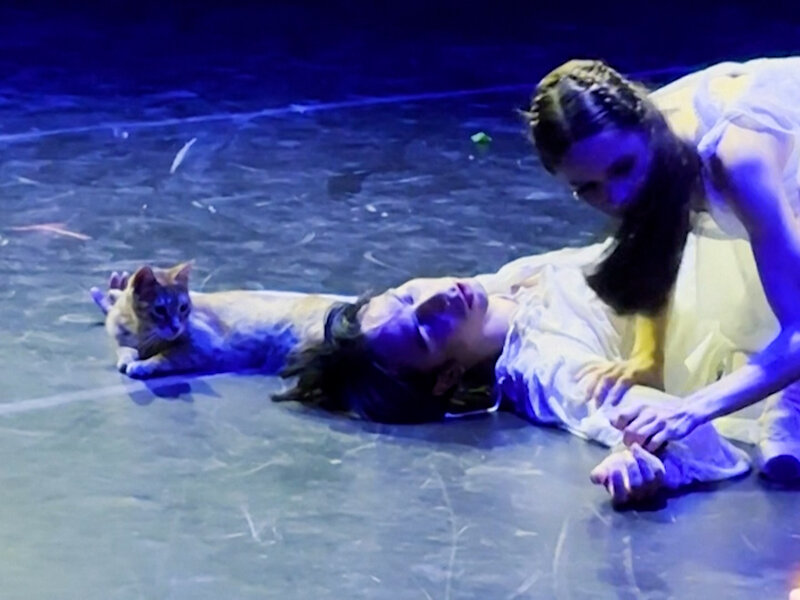
I guess Tybalt wasn’t the only rat-catcher in this production of “Romeo and Juliet.”
A stray cat brought unexpected levity to Prokofiev’s “Romeo and Juliet” during a performance by the Imperial Russian Ballet in Izmir, Turkey. Far from being upset by the four-legged interloper, the dancers evidently took to the feline balletomane, as he or she was brought out a few minutes later to share in the final bow. Later, it was shown that the ginger started turning up at rehearsals.
Scroll down to watch all three videos at the link.
https://slippedisc.com/2026/06/cat-steals-the-scene-in-ro-meouw-and-juliet-ballet/
Isn’t the Imperial Russian Ballet now properly identified as the Mariinsky?
Or hereafter, the Meow-riinsky? -
Timothée Chalamet and the Performing Arts: No Such Thing as Bad Publicity?
Trolling Timothée Chalamet for his blithe dismissal of opera and ballet as no longer relevant is so last month. But the media is not done with it. This morning a friend texted me a link to an article from the BBC in which Sir Alex Beard, chief executive of the Royal Ballet and Opera, thanks Chalamet for actually boosting ticket sales. Of course he did! Because this tempest in a teapot actually put opera and ballet in the news. And there’s no such thing as bad publicity.
In case, like most of the world, you’ve already moved on, Chalamet’s misstep occurred during an exchange with Matthew McConaughey about the preservation of cinema, which took place at the University of Texas before a live audience. “I don’t want to be working in ballet or opera, or you know, things where it’s like, ‘Hey, keep this thing alive,” Chalamet let drop, presumably to underline the comparative vitality and relevance of film. Carried away by his own eloquence, he continued, “‘… even though, like, no one cares about this anymore.’”
In all likelihood immediately sensing the remark was a little extreme (his own family includes three generations of ballet dancers), he quickly added, “All respect to the ballet and opera people out there.” Then he actually made it worse with an aside: “I just lost 14 cents in viewership.” Ouch.
Not the end of the world, of course, but in the age of social media, where sharpened knives are no further away than a cell phone or a computer keyboard and everyone is looking for a chance to be offended, Chalamet’s attempts to come across as a regular, relatable dude were received as fightin’ words.
It’s not hard to understand why they would get a rise out of anyone in the arts – who wants to be told that their life’s passion is meaningless? – but the wider backlash irrupted into a dogpile. Yeah, he’s an ignorant jackass, but so what? That’s democracy.
Widespread indignation, naturally, brings out the vultures, carpetbaggers, and trolls, so that following the initial salvo of outrage came all the reactionary posts, articles, and cartoons lampooning everyone for pearl-clutching by asking the rhetorical question, when was the last time any of you have been to an opera or a ballet?
For myself, I can say truthfully that I’ve been to more performing arts events in the past few years than I ever have. But I realize I am not widely representative of John Q. Public.
Actually, some of the arts organizations themselves did some of the best trolling. I’m not sure that any of them outdid Seattle Opera, which immediately responded with a 14-percent discount on tickets when using the promotional code TIMOTHEE. That was savage
.
From a certain point of view, perhaps counterintuitively, the Chalamet kerfuffle is proof that the arts are still powerful. The problem is not relevance, as art will always be relevant; it’s lack of exposure.
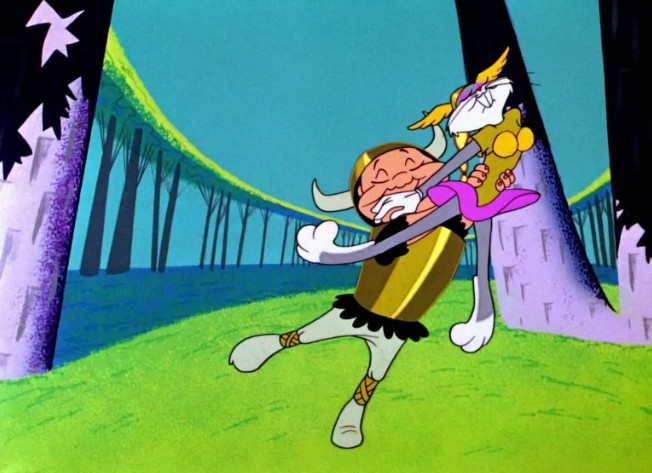
Time was when kids were exposed to the arts at school. At home, they encountered Arthur Fiedler, Yo-Yo Ma, and the Metropolitan Opera on PBS. Pavarotti and Virgil Fox were on talk shows. Rudolf Firkušný and Manuel Barrueco did television commercials. Samuel Ramey was on “Sesame Street,” singing about the letter “L.” Bugs Bunny cross-dressed to Wagner. Danny Kaye, in front of an orchestra, and Victor Borge, at the piano, made our parents laugh, and us too. Classical music was still a part of the conversation.
But somewhere along the way, some fat cats in a boardroom somewhere began to wonder why in the world the media was wasting valuable resources on all this long-hair stuff, when it could be maximizing profits by dumbing down and squeezing juice from the wallets of the lowest common denominator.
In the meantime, there was a longstanding tradition among populist entertainers of mocking the arts. So you have The Three Stooges flipping grapes and bananas into opera singers’ mouths. Not that I don’t love that stuff. Anything with staid traditions and certain protocols is easy to ridicule. Comedy mocks the establishment. It punches up, seldom down. To really enjoy music, you have to sit still and pay attention and actually listen to it. That’s just the way music and theater work. But I admit, it can seem ridiculous to an outsider, especially to one with no experience of it.
That said, the arts are no more “elitist” than rock concerts or sporting events, and they are often a lot less expensive. What’s more, they lend just as much to the economy, as people who attend concerts have to park, they have to eat, they like to shop, and since concerts frequently take place in cities, ticket-holders often come to town early and take in other attractions. A lot of businesses benefit. Also, nobody drinks too much and there’s comparatively little property damage afterward.
I find, once the novelty wears off, that the average sporting event has stretches more boring than anything I’ve ever endured in an opera house. Presumably the fans hang in there for the high points – the adrenaline rush of a touchdown or a homerun, the thrill of a close contest as the clock runs down, the euphoria of victory, the camaraderie of a roaring crowd.
We experience similar sensations in the performing arts: the emotional impact of an acrobatic aria, the grace and physicality of ballet, the spinetingling climax of a grand romantic symphony. Just like with a ballgame, not every experience is a world-beater, but when it’s at its best, there are moments you will carry with you for the rest of your life.
Moreover, it reminds us of the necessity of beauty and keeps us in touch with our shared humanity. That somebody born 150 years ago and lived their life in a foreign land without what we take for modern conveniences can continue to communicate with us, and even move us, in a language that transcends discernible words is miraculous.
If an orchestra plays and no one is there to hear it, does it still make music? Whether or not Chalamet really meant what he said, the performing arts endure for those of us who will have them. The public just needs to be reminded that they’re there. So yes, thank you, Timothée Chalamet. -

Léon Minkus: A Gentleman in Moscow (and St. Petersburg)
Who’s excited to celebrate Léon Minkus’ bicentennial? As I suspected, exactly no one.
Before you double-check to see if this post was written by Timothée Chalamet, I hasten to add that in his day, Minkus was a much sought-after, quite successful composer for the ballet. Among his most celebrated works are “La Source” (co-composed with Léo Delibes), “Don Quixote,” and “La Bayadère.” He also wrote insert numbers for older ballets by other composers.
Born in Austria (where he was known as Ludwig), Minkus briefly served as principal violinist at the Vienna State Opera before emigrating to Russia. There he became concertmaster and conductor of Italian opera at the Imperial Bolshoi Theatre. With a few years, he was promoted to the prestigious position of Inspector of Orchestras to the Moscow Imperial Theaters. He also taught violin at the newly-established Moscow Conservatory. In addition, he enjoyed a long association with St. Petersburg through his work with choreographers Arthur Saint-Léon and Marius Petipa.
At 65, Minkus returned with his wife to Vienna to live in semi-retirement on a modest pension from the Tsar’s treasury. One of his later works was rejected by Gustav Mahler, then director of the Vienna Court Opera, for being too old-fashioned. He came to a sad end, as his wife predeceased him and the events of World War I cut off support from Russia. He died, childless, in poverty, having developed pneumonia during the bitter winter of 1917, at the age of 91. O Fortuna!
While his music has not been embraced with the same level of affection as that of his colleagues Tchaikovsky and Delibes, whose ballets are frequently recorded and revived, in his day, Minkus enjoyed considerable success and will forever remain a notable figure in the history of Russian dance.Remembering him on the 200th anniversary of his birth!
———-
To be fair, his ballets have never completely fallen out of the repertoire, and some balletomanes, I’m sure, love his stuff. Perhaps you will too. At the link is a Mariinsky production of “Don Quixote.”Apparently, until the 1930s, there was a dream sequence in which Quixote fights a giant spider. Contemporaneously, a notorious spider pit sequence was dropped from the film “King Kong.” People must really have been creeped out by giant spiders during the Great Depression.

Tag Cloud
Aaron Copland (94) Beethoven (95) Composer (114) Film Music (148) Film Score (143) Film Scores (255) Halloween (97) John Williams (196) KWAX (232) Leonard Bernstein (105) Marlboro Music Festival (125) Movie Music (163) Mozart (91) Opera (215) Philadelphia Orchestra (90) Picture Perfect (174) Princeton Symphony Orchestra (110) Radio (90) Ross Amico (244) Roy's Tie-Dye Sci-Fi Corner (290) The Classical Network (101) The Lost Chord (269) Vaughan Williams (107) WPRB (397) WWFM (881)