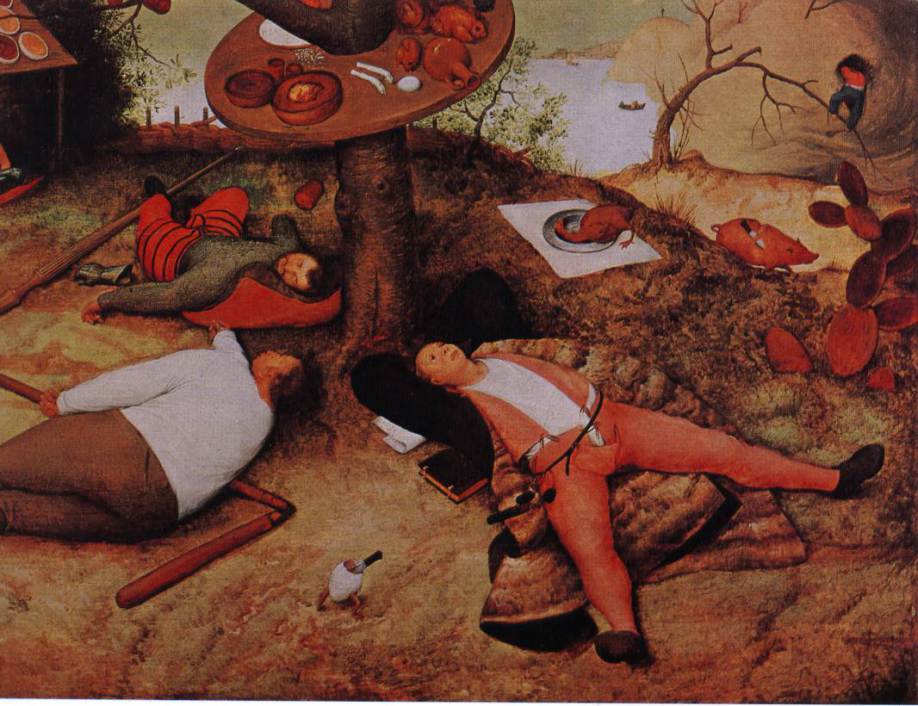
This Sunday night on “The Lost Chord,” we conclude the long, gluttonous holiday weekend with Knudage Riisager’s ballet “Slaraffenland” (usually translated as “Fool’s Paradise”).
Inspired by Bruegel’s painting “The Land of Cockaigne,” the scenario imagines a Promised Land “where roasted pigeons fly around in the air with knives and forks in their backs, and the streets are paved with marzipan and chocolate.” The plot concerns a silly boy who wanders into the country of King Sauce and becomes ill from overindulgence. Along the way, he encounters Robin Hood, the Three Musketeers, Captain Fear, Fountains of Liqueur, Cigarettes, and the Candy Princess.
Riisager was born in 1897 to Danish parents living in Estonia. He studied music at Copenhagen University and then in Paris with Albert Roussel. Though he was a prolific composer, with some 400 works to his name, including symphonies, concertos, chamber music and songs, he is probably best known, if at all, for his ballet works.
Rouse yourself for a dose of musical tryptophan. Join me for “Fool’s Paradise” – Knudage Riisager’s “Slaraffenland” – this Sunday night at 10:00 EST, on WWFM – The Classical Network and wwfm.org.
As related in the Gospel of Luke, a young wastrel burns through his family fortune, then returns home to the arms of his forgiving father. The son’s more responsible, elder brother is none too happy, but the father explains that since the younger son has repented and returned, as if from the dead – in essence, was lost, and is now found – there is cause for celebration.
This Sunday night on “The Lost Chord,” it’s an off-center Father’s Day tribute, as we listen to ballet music inspired by the Parable of the Prodigal Son.
We’ll hear a late, folk-inspired score by the Swedish composer Hugo Alfvén, staged in honor of his 85th birthday in 1957, and Sergei Prokofiev’s alternately pungent and transcendentally lyrical opus, written for the Ballets Russes in 1928. The latter was developed simultaneously with Prokofiev’s Symphony No. 4 and shares much of the same thematic material.
Father knows best. I hope you’ll join me for “Son Dance,” ballet music inspired by the Prodigal Son for Father’s Day, this Sunday night at 10:00 EDT, on WWFM – The Classical Network and wwfm.org.
In the WPRB studio this morning with Douglas Martin, artistic director of American Repertory Ballet, and Marc Uys, executive director of the Princeton Symphony Orchestra. They dropped by to talk about their collaboration on “Pride and Prejudice,” a new ballet to be presented at McCarter Theatre Center on April 21 & 22. That guy on the left looks like he could really use a cup of coffee. (Photo by Dan Bauer)
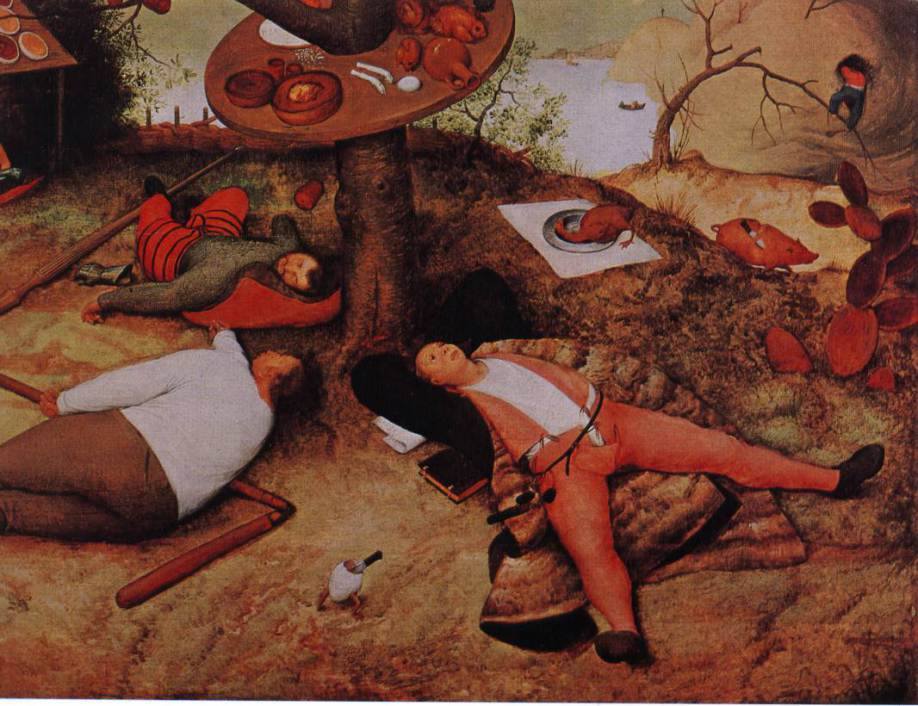
This Sunday night on “The Lost Chord,” we wrap up the long, gluttonous holiday weekend with Knudage Riisager’s ballet “Slaraffenland” (usually translated as “Fool’s Paradise”).
Inspired by Bruegel’s painting “The Land of Cockaigne,” the scenario imagines a Promised Land “where roasted pigeons fly around in the air with knives and forks in their backs, and the streets are paved with marzipan and chocolate.” The plot concerns a silly boy who wanders into the country of King Sauce and becomes ill from overindulgence. Along the way, he encounters Robin Hood, the Three Musketeers, Captain Fear, Fountains of Liqueur, Cigarettes, and the Candy Princess.
Riisager was born in 1897 to Danish parents living in Estonia. He studied music at Copenhagen University and then in Paris with Albert Roussel. Though he was a prolific composer, with some 400 works to his name, including symphonies, concertos, chamber music and songs, he is probably best known, if at all, for his ballet works.
I hope you’ll join me, even as you’re zoning under the influence of tryptophan, for “Fool’s Paradise” – Knudage Riisager’s “Slaraffenland” – this Sunday night at 10 EST, on WWFM – The Classical Network and at wwfm.org.
Today is the birthday of two notable Philadelphians.
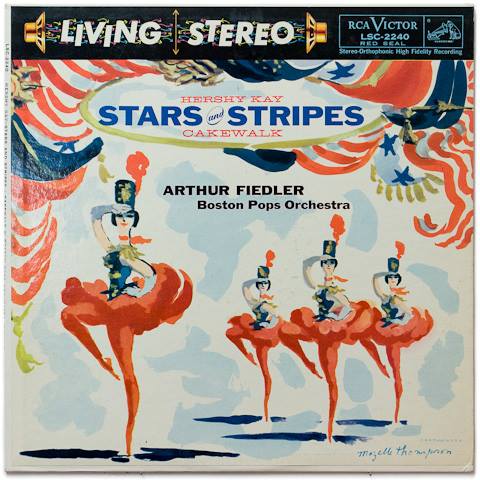
Hershy Kay (1919-1981) is known mainly for his arrangements for George Balanchine’s New York City Ballet and for his work on Broadway. He studied at the Curtis Institute of Music, where Randall Thompson was his composition teacher and Leonard Bernstein a classmate. He started making arrangements to get out of playing the cello in pit bands. Along the way, he taught himself how to orchestrate.
The success of Kay’s orchestrations for Bernstein’s “On the Town” put him much in demand. He would later collaborate with Bernstein on “Peter Pan” and “Candide.” His work as an orchestrator can also be heard in such varied projects as Marc Blitzstein’s “Juno,” Cy Coleman’s “Barnum” and Andrew Lloyd Webber’s “Evita.”
For Balanchine he wrote the sub-Copland “Western Symphony” and the splashy “Stars and Stripes Ballet,” after Sousa. He also reconstructed and orchestrated works of Louis Moreau Gottschalk, resulting in the “Grande Tarantelle,” for piano and orchestra, and the ballet “Cakewalk.”
David Amram (b. 1930) has always been equally at home in classical music, jazz, folk and world music. He’s composed over 100 orchestral and chamber works, music for Broadway and film (including scores for “Splendor in the Grass” and “The Manchurian Candidate”), and two operas. He’s also written three books, with a fourth in the works.
He was raised on a farm in Bucks County, where he was introduced to classical, jazz and cantorial music by his father and uncle. He took piano lessons and experimented with instruments of the brass family, finally settling on the French horn. Following a year at Oberlin, he lit out for George Washington University, where he studied history. While there, he performed as an extra hornist with the National Symphony. He also studied privately with two musicians in the orchestra.
Amram became a pioneer of the jazz French horn, as well as the New York Philharmonic’s first composer-in-residence (named in 1966). He’s worked with artists ranging from Dizzy Gillespie to Bob Dylan, from Jack Kerouac to Arthur Miller, from Christopher Plummer to Johnny Depp. He’s a musician without boundaries, who has always been open to new experiences.
Happy Birthday, Hershy Kay and David Amram!
Kay’s arrangement of the “Grande Tarantelle”:
Some of Amram’s music for “The Manchurian Candidate”: