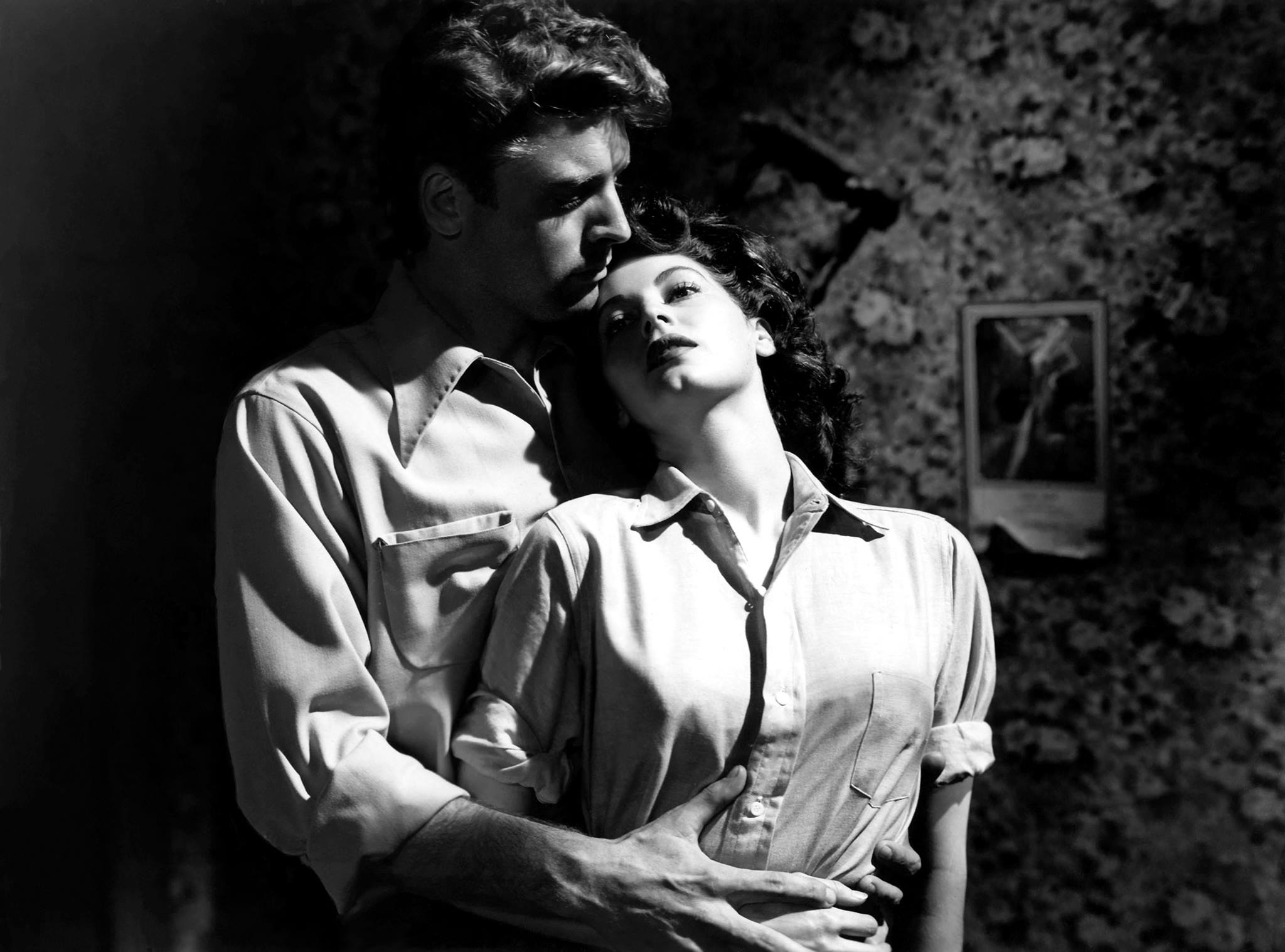
Nick sat down against the charred stump and smoked a cigarette. He lit a match and watched it burn and as it burned he thought of boxers and marlins and the Spanish Civil War. The stories were brave and strong and good. He ordered a mojito and prepared to face the music.
This week on “Picture Perfect,” the focus is on Ernest Hemingway.
Seemingly at odds with Hemingway’s minimalist, “iceberg” style, big screen adaptations of the writer’s work show what the stories don’t tell. In the case of 1946’s “The Killers,” the screenwriters unapologetically just made stuff up, an entire back story explaining the motivations for the hit of boxer “Swede” Anderson. Fortunately, those screenwriters happened to include an uncredited John Huston, who virtually codified noir with “The Maltese Falcon.”
“The Killers” provided Burt Lancaster with his break-out role. It also features a knock-out score by Miklós Rózsa, in which he uses the dum-dee-dum-dum motto later made famous by the television series “Dragnet.”
In 1977, George C. Scott reunited with his “Patton” director, Franklin J. Schaffner, for an adaptation of Hemingway’s posthumously published novel, “Islands in the Stream.” Scott gives one of his best performances as a Hemingway-like figure living on a Caribbean island. “Patton” composer Jerry Goldsmith wrote the music. Goldsmith spoke of it often as his favorite score.
Hemingway himself handpicked the leads for the 1943 adaptation of “For Whom the Bell Tolls,” with Gary Cooper and Ingrid Bergman falling in love against the backdrop of the Spanish Civil War. The music was by the prolific and versatile Victor Young.
And finally, Spencer Tracy is the whole show, as he faces off against a large marlin, in the 1958 version of “The Old Man and the Sea.” Dimitri Tiomkin’s music earned him his fourth Academy Award.
Join me for an hour of laconic grace and stoic manliness on “Picture Perfect,” music for the movies, now in syndication on KWAX Classical Oregon!
———-
Clip and save the start times for all three of my recorded shows:
PICTURE PERFECT, the movie music show – Friday at 8:00 PM EDT/5:00 PM PDT
SWEETNESS AND LIGHT, the light music program – Saturday at 11:00 AM EDT/8:00 AM PDT
THE LOST CHORD, unusual and neglected rep – Saturday at 7:00 PM EDT/4:00 PM PDT
Stream them, wherever you are, at the link!
https://kwax.uoregon.edu/
Tag: Dimitri Tiomkin
-
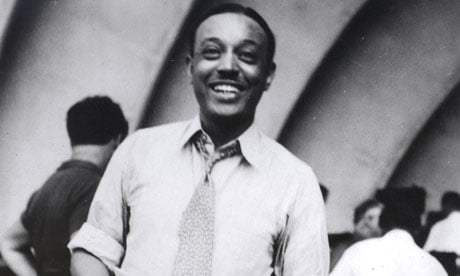
A Still Presence Behind the Stooges
For his many achievements – as the first Black American composer to write a symphony, the first to conduct a major U.S. orchestra, and the first to compose an opera, among other things – William Grant Still would be recognized as the “Dean of Afro-American Composers.” But face it, even under the best of circumstances, a full-time composer has to scramble to make ends meet. Still was not alone in seeking employment in Hollywood, which could always be counted on, once you were in, for a decent paycheck.
However, unlike some of his peers, he was employed mostly as an orchestrator and a composer of “additional music.” One of the films he worked on was Dimitri Tiomkin’s “Lost Horizon” in 1937. John Williams did the same kind of work for Tiomkin on “The Guns of Navarone” in 1961, and we all know how that worked out for him. Still was never given his shot to break into the upper echelon, the way so many white composers who did the same kind of grunt work were. To my knowledge, he never even received a screen credit, but if you know differently, please correct me!
A number of his cues were recycled as “library music” to fill out scores for B-movies and television shows. I was reminded of this yesterday by my friend (and former editor) Dan Aubrey, who will be accompanying me tonight to The Three Stooges Film Festival at the Princeton Garden Theatre, when he made a quip about Still’s music accompanying “eye gauging and cranium pounding.” Allegedly, Still’s work was indeed used in some of the Stooges’ shorts. I’m not sure which ones, and IMDB is no help in this regard, but I will listen more carefully, whenever I go back and watch them.
In the 1950s, he compiled his “Laredo Suite” for use in television westerns, such as “Gunsmoke,” “Have Gun, Will Travel,” and “Rawhide.” (He had written music for a number of film westerns starring Charles Starrett.) Still was far from the only composer to do this. Bernard Herrmann put together some suites of mood music and action cues to be dropped into CBS westerns. The difference is that, even if he wasn’t always credited on the shows, Herrmann was a headliner at the movies.
Still’s involvement with the Stooges is funny and sad at the same time. During the 1930s and ‘40s, Aaron Copland (the “Dean of American Composers”) was scoring prestige pictures such as “Our Town” and “Of Mice and Men.” He was even recognized with an Academy Award for his work on “The Heiress.”
Of course, Still wasn’t alone among talented composers who toiled on the Hollywood production line, but as a Black musician, it’s doubtful he would have been able to rise much higher in mainstream movies until at least the 1960s, after Otto Preminger hired Duke Ellington to score “Anatomy of a Murder,” in 1959, and Quincy Jones made his mark with “The Pawnbroker,” in 1964. And even then, would he have been accepted if the music he wrote wasn’t “jazz”?
While laboring anonymously in motion pictures of the 1930s, Still conducted a concert at the Hollywood Bowl with the Los Angeles Philharmonic. On July 23, 1936, he presented his “Afro-American Symphony.” It was the first time a Black man would conduct a major American orchestra. The next year, in August 1937, the work would be repeated on the first Hollywood Bowl program ever to be devoted exclusively to works by American composers.Still’s “Afro-American” remains one of my favorite American symphonies.
https://www.youtube.com/watch?v=b9iGFLpO5Nk
Fascinating reconstruction of Still’s “Laredo Suite,” library music for westerns, although I suspect the cuts have been posted out of sequence:
https://www.youtube.com/watch?v=CpJQK1miHV4&list=PLgK8FIC-dBq-qGKj5r3vXlGSP3nd9jfq-
Information on The Three Stooges Film Festival, tonight at the Princeton Garden Theatre:
https://www.princetongardentheatre.org/films/three-stooges-garden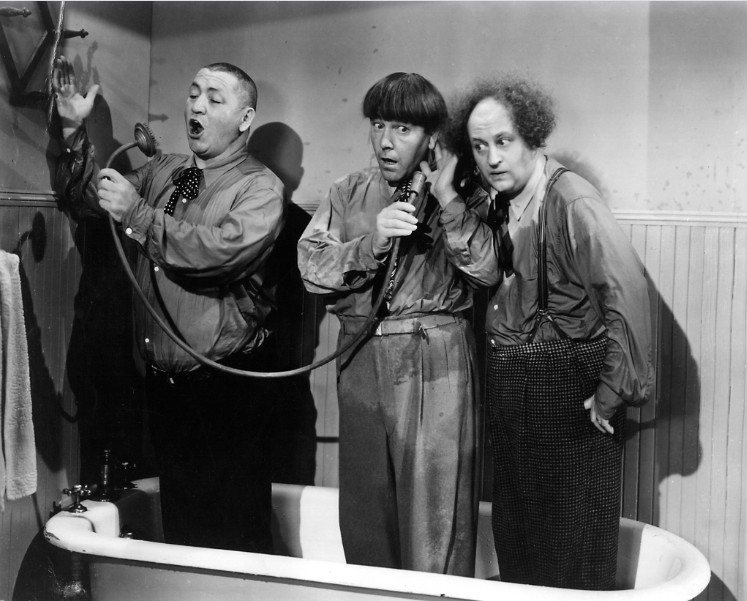
———-
PHOTO: William Grant Still at the Hollywood Bowl -
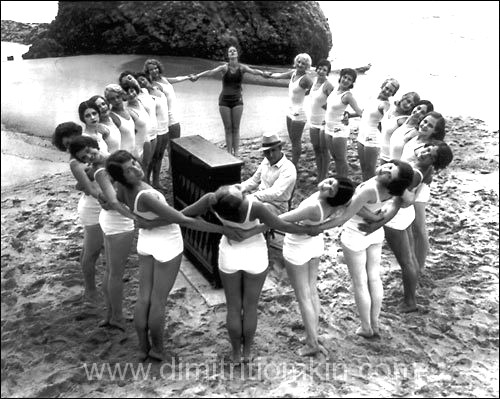
Dimitri Tiomkin and Ballet on the Beach
It’s summer, and for some, life’s a beach. Here’s a fun photo of future film legend Dimitri Tiomkin, the man who kicked off the craze for title songs in the seemingly incongruous genre of the movie western, when his score and song for “High Noon” earned wide acclaim, double Oscars, and enormous financial dividends. In fact, “Do Not Forsake Me, Oh My Darlin’” has been credited by some with having saved the picture from box office failure and cementing its status as an American classic.
From then on, Tiomkin was always sure to include a title song in his westerns – “Gunfight at the O.K. Corral,” “The Alamo,” “The War Wagon,” “Rio Bravo,” and, for television, “Rawhide,” among them – and for films in other genres, as well (“Friendly Persuasion,” “The Guns of Navarone,” “Wild Is the Wind”).
Interestingly, Tiomkin was born in Ukraine and studied at the St. Petersburg Conservatory with Alexander Glazunov. When asked the secret to his exceptional success writing music for westerns, Tiomkin replied with a shrug, “A steppe is a steppe is a steppe.”
Early on, it had been his mother’s dream that he become a concert pianist. To this end, he studied with Felix Blumenfeld, teacher of Horowitz, and Isabelle Vengerova. Also with Ferruccio Busoni and Egon Petri. He made his debut with the Berlin Philharmonic in Liszt’s Piano Concerto No. 2. At Carnegie Hall, he played Ravel, Scriabin, Poulenc, and Alexandre Tansman. He also gave the European premiere, in Paris, of Gershwin’s Concerto in F, with the composer in attendance.
Predating his Hollywood years, Tiomkin accompanied and wrote music for a ballet company run by his wife, Austrian dancer and choreographer Albertina Rasch, with whom he had first teamed on the American vaudeville circuit. After the stock market crash of 1929, opportunities in New York dwindled, but Rasch was hired to supervise dance numbers in MGM musicals. It was during this time that the beach photo was taken.
Tiomkin made mostly undistinguished, often uncredited contributions to motion pictures in the 1930s. The best known of these was a misbegotten all-star adaptation of “Alice in Wonderland” in 1933. But it was with Frank Capra’s “Lost Horizon,” in 1937, that he was really able to show his stuff. The opulent score was conducted by the vastly more experienced Max Steiner. Recognition came just in time, as Tiomkin broke his arm, effectively ending his career as a concert pianist.
He needn’t have worried. He found success composing more than 100 film scores, earning 22 Academy Award nominations. He won four, and numerous Golden Globes. Enough of the title songs were covered by major artists and turned into popular hits that he made a very comfortable living.
You can learn more about Tiomkin and Rasch at Castle Rock Beach and the then-provocative photo (which, as we would say today, “went viral”) at the link.Some of his ballet music for Rasch was recorded in 2020 for the album “Paris Under the Stars,” released on the Intrada label.
-
Get Lost on “Picture Perfect”
This week on “Picture Perfect,” I invite you to get lost! It’s all music from movies about lost worlds and forgotten civilizations.
While the concept of the “Lost World” dates at least as far back as Plato’s Atlantis, it wasn’t until the Victorian Era that the idea really blossomed in the public consciousness. At the time, of course, lost civilizations were genuinely being discovered – which might help explain, in part, the incredible success of “King Solomon’s Mines.” The author, H. Rider Haggard, wrote the book on a bet that he could churn out an adventure story half as good as Robert Louis Stevenson’s “Treasure Island,” which had been published two years earlier.
“King Solomon’s Mines” became the literary sensation of 1885. Its protagonist, Allan Quatermain, is a direct ancestor of Indiana Jones. The book inspired reams of sequels and at least five film adaptations.
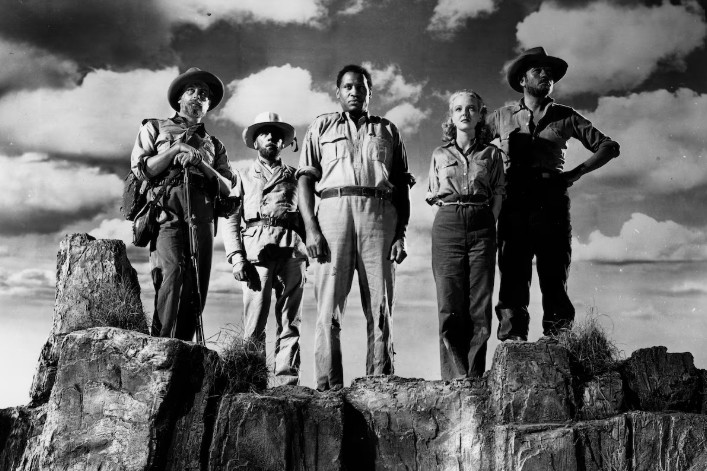
The two best known starred Stewart Granger, in 1950, and Paul Robeson, in 1937. Robeson, who played Umbopa, a king in disguise, received top billing. The score was by Mischa Spoliansky.
Haggard achieved another “Lost World” hit with “She,” first issued in book form in 1887 – another adventure about Europeans in Africa, who meet a seemingly immortal white queen known as the all-powerful She, or She-Who-Must-Be-Obeyed.
“She” has been adapted to film six times. The 1965 version starred Ursula Andress, Peter Cushing, and Christopher Lee. The music was by Hammer Studios house composer, James Bernard. It’s nice to hear Bernard, who mostly wrote horror scores for the likes of Dracula and Frankenstein, provide something a little more nuanced for a change.
Rudyard Kipling’s “The Man Who Would Be King,” published in 1888, was clearly influenced by the writings of Haggard. In this case, two British adventurers in India strike out for a remote corner of Afghanistan to set themselves up as kings. The story was made into one of the great adventure films of the 1970s, directed by John Huston, and starring Sean Connery and Michael Caine. That Christopher Plummer appears as Kipling himself is only icing on the cake. Maurice Jarre wrote the rousing score.
Finally, James Hilton’s “Lost Horizon,” published in 1933, imagines Shangri-La, a Utopian society nestled in a sheltered valley somewhere in the mountains of Tibet. A British diplomat is one of a handful of passengers who survives a plane crash to be taken into the lamasery.
“Lost Horizon” was made into a film twice. The less said about the 1973 version, a musical with songs by Burt Bacharach, the better. Frank Capra directed the classic 1937 version, which starred Ronald Colman, Jane Wyatt, and outstanding character actors of the day, people like Edward Everett Horton, Thomas Mitchell, Sam Jaffe, and H.B. Warner.
The score, Dimitri Tiomkin’s first major contribution, was also one of his most ambitious. Seldom was it so obvious that he had studied at the St. Petersburg Conservatory under Alexander Glazunov.
I hope you’ll lose yourself in music for lost civilizations this week, on “Picture Perfect,” music for the movies, now in syndication on KWAX Classical Oregon!
——-
Clip and save the start times for all three of my recorded shows:
PICTURE PERFECT, the movie music show – Friday at 8:00 PM EDT/5:00 PM PDT
SWEETNESS AND LIGHT, the light music program – Saturday at 11:00 AM EDT/8:00 AM PDT
THE LOST CHORD, unusual and neglected rep – Saturday at 7:00 PM EDT/4:00 PM PDT
Stream them, wherever you are, at the link!
https://kwax.uoregon.edu
——-
PHOTO: Paul Robeson headlines “King Solomon’s Mines” -
Old World Composers Go West on “Picture Perfect”
Before American composers like Jerome Moross and Elmer Bernstein made the western distinctly their own, the task of scoring the genre fell largely to European émigrés. This week on “Picture Perfect,” we’ll take a look at some outside perspectives on how the West was won.
Literally the godson of Richard Strauss, Max Steiner came from Vienna, where he studied with Johannes Brahms and Robert Fuchs. In Hollywood, he wound up scoring such classics as “King Kong,” “Gone with the Wind” and “Casablanca.”
Among his over 300 film projects were a number of westerns. One of these was “They Died with Their Boots On” (1941), which starred Errol Flynn as George Armstrong Custer and Olivia de Havilland as Libby, the woman who becomes his wife. Steiner’s score features familiar folk material, some old-fashioned faux “Indian” music, and one of his characteristically lush love themes.
Born in Ukraine in 1894, Dimitri Tiomkin was a pupil of Alexander Glazunov. He came to revolutionize the sound of the American West, when he wrote the music for “High Noon,” the first of his “ballad” scores. Advance word, based on an early screening for the press, was that the picture would be a failure. However, Tiomkin had such faith in the theme song, sung in the film by Tex Ritter, that he hired Frankie Laine to record it, and the record became a world-wide hit. In fact, his score is largely credited with having saved the film.
Tiomkin was recognized with two Academy Awards: one for Best Original Song, and one for the score itself. It was the first time a composer won two Oscars for his work on the same movie. It also changed the way western scores were done. In the 1950s, Tiomkin became THE western composer of choice. He produced a number of subsequent ballad scores, including that for “Gunfight at the O.K. Corral” (1957). Asked how it was that a composer from Ukraine could write so convincingly for the American West, Tiomkin quipped, “A steppe is a steppe is a steppe.”
Another unexpected source of classic western music, Franz Waxman was born in Upper Silesia. He arrived in the U.S. by way of Germany. Nonetheless, as part of the composer’s varied and prolific output, he did indeed score a number of films in the genre, including “The Furies” (1950), a peculiar noir-western hybrid. Walter Huston, in his final film, plays a cattle baron who remarries and throws his empire into jeopardy. Barbara Stanwyck is his strong-willed daughter.
Hungarian-born composer Miklós Rózsa scored many films with historical settings – “Quo Vadis,” “Ben-Hur,” and “King of Kings,” among them. However, to my knowledge, his only western was “Tribute to a Bad Man” (1956). James Cagney stars as a rancher who doles out some frontier justice.
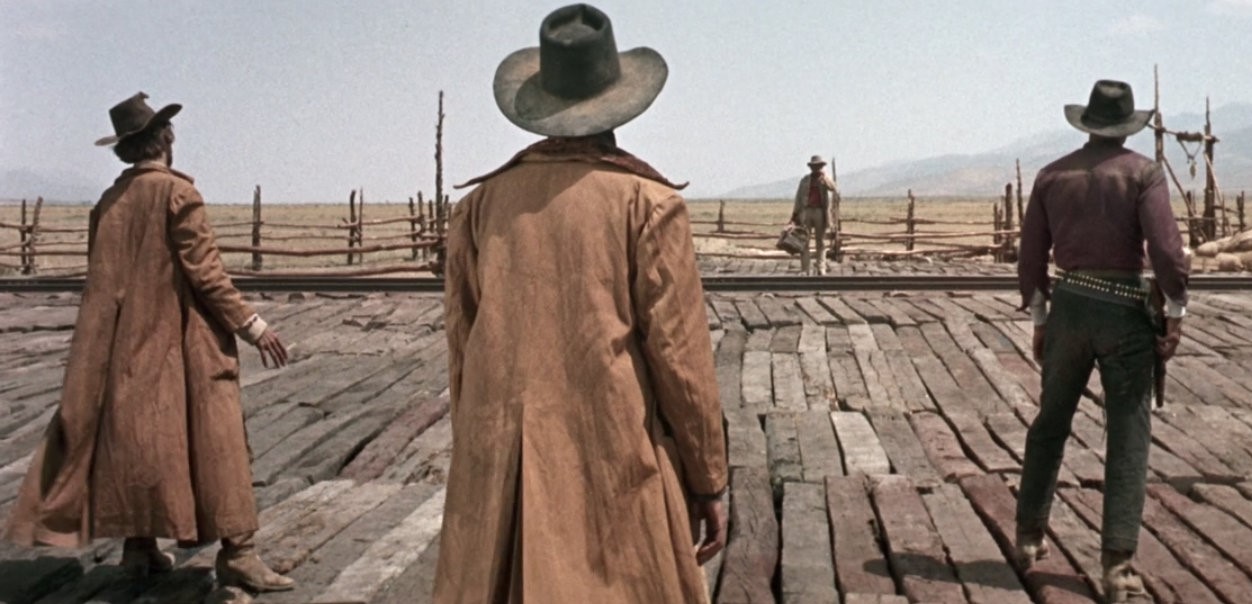
Finally, we’ll hear music by Ennio Morricone, from arguably the most operatic of all spaghetti westerns, “Once Upon a Time in the West” (1968). As a reaction to Tiomkin’s ballad scores and the neo-Coplandisms of Elmer Bernstein and the rest, Morricone brings his own quirky sensibility to bear on the classic western iconography. Get ready for indelible motifs for harmonica and banjo, but also an unexpectedly moving elegiac arioso, underscoring the close of the American West with the arrival of the railroad.
Doublecheck your train tables and wind your pocket watches. Old World composers go west this week on “Picture Perfect,” music for the movies, now in syndication on KWAX Classical Oregon!
——-
Clip and save the start times for all three of my recorded shows:
PICTURE PERFECT, the movie music show – Friday at 8:00 PM EDT/5:00 PM PDT
SWEETNESS AND LIGHT, the light music program – Saturday at 11:00 AM EDT/8:00 AM PDT
THE LOST CHORD, unusual and neglected rep – Saturday at 7:00 PM EDT/4:00 PM PDT
Stream them, wherever you are, at the link!
https://kwax.uoregon.edu
Tag Cloud
Aaron Copland (94) Beethoven (95) Composer (114) Film Music (150) Film Score (143) Film Scores (255) Halloween (102) John Williams (198) KWAX (233) Leonard Bernstein (105) Marlboro Music Festival (125) Movie Music (165) Mozart (91) Opera (215) Philadelphia Orchestra (90) Picture Perfect (174) Princeton Symphony Orchestra (110) Radio (90) Ross Amico (244) Roy's Tie-Dye Sci-Fi Corner (290) The Classical Network (101) The Lost Chord (269) Vaughan Williams (107) WPRB (397) WWFM (881)