Tag: Dimitri Tiomkin

  • Walpurgis Night Devils Cabaret Pre-Code Film

    Walpurgis Night Devils Cabaret Pre-Code Film

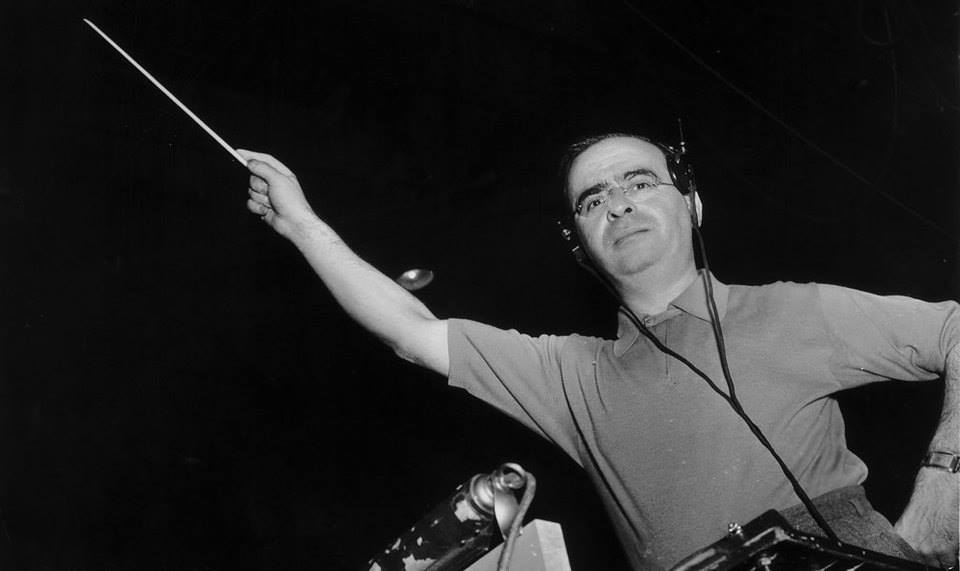
    For Walpurgis Night, here’s “The Devil’s Cabaret” (1930). The pre-Code short climaxes with “The Hades Ballet,” reminding us that Dimitri Tiomkin once studied with Alexander Glazunov.

    Part 1 https://www.youtube.com/watch?v=Ij2AsmQ_6ZE
    Part 2 https://www.youtube.com/watch?v=xOgHueVqyyU

    BTW – Satan is played by Charles Middleton, perhaps better known as Ming the Merciless in the Flash Gordon serials.

  • Theremin Sounds in Sci-Fi Film Scores

    Theremin Sounds in Sci-Fi Film Scores

    You all know the sound. That crazy, trilled electronic whistle that dips into a whoop. Or it starts in a trough and shoots up into the super stratosphere. It’s the sound of UFOs and mad science. It’s the sound of the theremin.

    The electronic instrument, invented by Leon Theremin in 1928, is played without physical contact. The proximity of the hands to two antennae determines volume and pitch.

    This week on “Picture Perfect,” we’ll hear music from four films which feature the instrument’s distinctive, extraterrestrial timbre.

    “The Thing from Another World” was one of two seminal science fiction scores written in 1951. (The other was Bernard Herrmann’s “The Day the Earth Stood Still.”) On the soundtrack, the theremin acts as a musical counterpart to James Arness’ rampaging humanoid carrot. This was unquestionably composer Dimitri Tiomkin’s wildest hour; he never wrote anything like it again.

    “The Thing” and “The Day the Earth Stood Still” may have been the most influential, but “Rocketship X-M” was the first. The film was rushed into production in 1950 to beat George Pal’s “Destination Moon” to theaters. It was shot in just 18 days! The unlikely plot has the crew of a moon expedition blown off course to Mars. Interestingly, the composer was none other than Ferde Grofé – he of the “Grand Canyon Suite” fame.

    Far more reputable, but still not wholly comfortable with its science, is Alfred Hitchcock’s “Spellbound,” from 1945. Gregory Peck plays an amnesiac, who may or may not have committed murder, and Ingrid Bergman plays the psychoanalyst who falls in love with him. The film is of greatest interest for its production design, which features dream sequences conceived by Salvador Dali, and for its music, by Miklós Rózsa.

    Hitchcock disliked the score – he thought it got in the way of his direction – but the Academy disagreed, and the music earned Rózsa the first of his three Academy Awards.

    Closer to our own time, Howard Shore incorporated the theremin into his Mancini-esque score to “Ed Wood,” released in 1991, Tim Burton’s love letter to the grade-Z director of “Plan 9 from Outer Space,” which is widely regarded as the worst movie ever made (worse even than “Rocketship X-M”).

    Join me for an hour of theremins for Hallowe’en this week, on “Picture Perfect,” music for the movies – this Friday evening at 6 ET, with a repeat Saturday morning at 6; or listen to it later as a webcast at http://www.wwfm.org.

    FUN FACT: On three of the four movies from which scores we’ll be sampling (“Spellbound,” “Rocketship X-M,” and “The Thing”), the original thereminist was Samuel Hoffman. Hoffman played in dozens of Hollywood films in the 1940s and ‘50s. By day, he worked as a podiatrist!

    PHOTO: Hoffman (right) looks on as Cary Grant tries his hand at the theremin

  • WWII Film Scores Memorial Day Special

    WWII Film Scores Memorial Day Special

    Today is Richard Wagner’s birthday. Perhaps in his honor, I am going to go his megalomania one better by completely ignoring the fact and using the space for shameless self-promotion!

    This week on “Picture Perfect,” as we near Memorial Day, the focus will be on music from World War II classics.

    Among the selections will be a new release – and a very fine one – on the Intrada label of music by Miklós Rózsa. The album is called “The Man in Half Moon Street,” and includes re-recordings of some of his underrepresented though certainly deserving scores, among them, “Valley of the Kings,” “The Strange Love of Martha Ivers,” and “Sahara.”

    In “Sahara,” Humphrey Bogart plays a WWII tank commander who holes up at a desert well and uses his apparent position of power to delay a parched German battalion from participating in the First Battle of El Alamein. Allan Wilson conducts the Royal Scottish National Orchestra, in what is truly the best project of its kind I have encountered in quite some time. Re-recordings so often lack the punch of the originals, but here is Rózsa is all his glory, sounding wholly idiomatic and presented in vivid digital splendor.

    Jerry Goldsmith’s music for “Patton” should require no introduction. The film is a bona fide classic, a winner of seven Academy Awards, including Best Picture. Unfortunately for Goldsmith, at that stage of his career, he was always a bridesmaid but never a bride. George C. Scott notoriously rejected his Oscar for Best Actor; he should have given it to Goldsmith.

    Errol Flynn may seem an unlikely choice to play a U.S. Army captain, but he does just that in “Objective, Burma!” Flynn received criticism for remaining in Hollywood during the war, but the Warner Brothers publicity machine did what it could to hush up the fact that the world’s most famous swashbuckler had tried to enlist but was rejected on medical grounds. “Objective, Burma!” infuriated Churchill, and the film was actually banned in Britain for what was perceived as the Americanization of a largely British, Indian and Commonwealth conflict. The rousing score, also nominated for an Oscar, was by Franz Waxman.

    “The Guns of Navarone,” adapted from the novel of Alistair MacLean, is one of the all-time great adventure films. A team of Allied military specialists – played by Gregory Peck, David Niven and Anthony Quinn, among others – undertake a mission to blow up some very big Nazi guns trained over the Aegean Sea. Dimitri Tiomkin pulled out all the stops for his Oscar-nominated music. The recording features a spoken introduction by James Robertson Justice, who plays Commodore Jensen in the film.

    Join me for these scores from World War II classics on “Picture Perfect,” music for the movies, this Friday evening at 6:00 ET, or listen to it as a webcast, at http://www.wwfm.org.

Tag Cloud

Aaron Copland (92) Beethoven (95) Composer (114) Film Music (119) Film Score (143) Film Scores (255) Halloween (94) John Williams (185) KWAX (229) Leonard Bernstein (99) Marlboro Music Festival (125) Movie Music (134) Opera (198) Philadelphia Orchestra (87) Picture Perfect (174) Princeton Symphony Orchestra (106) Radio (87) Ralph Vaughan Williams (85) Ross Amico (244) Roy's Tie-Dye Sci-Fi Corner (290) The Classical Network (101) The Lost Chord (268) Vaughan Williams (102) WPRB (396) WWFM (881)

DON’T MISS A BEAT

Receive a weekly digest every Sunday at noon by signing up here


RECENT POSTS