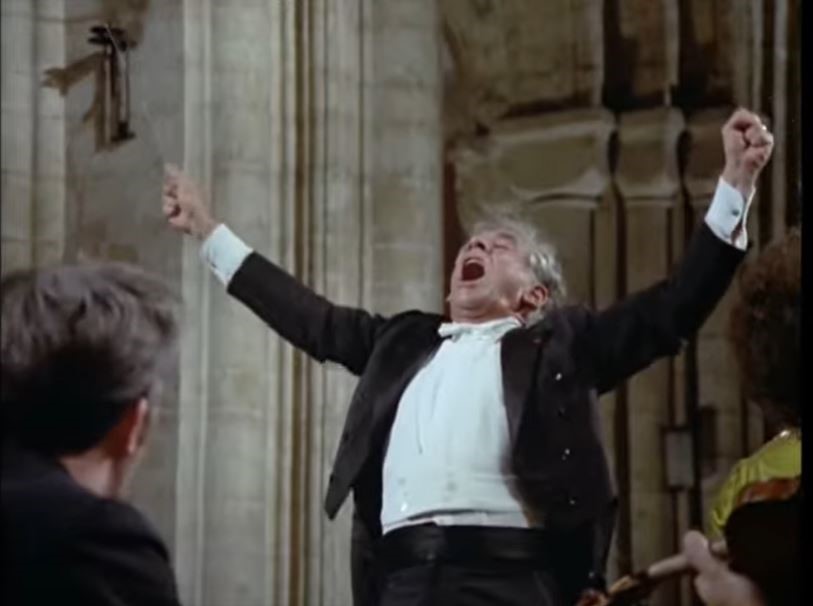
The finale of Gustav Mahler’s spinetingling “Resurrection” Symphony, conducted by Leonard Bernstein. Of course, the piece is so much more powerful – ecstatic and exhausting – when you take the full, 90-minute pilgrimage, but even excerpted, as here, it still puts my hair on end. Eat your heart out, Bradley Cooper. And happy birthday, Gustav Mahler!
The whole thing, probably riddled with YouTube ads:
The most widely-recognized of American classics? Perhaps. Next to “Fanfare for the Common Man” and “The Stars and Stripes Forever,” I can think of few others. George Gershwin’s “Rhapsody in Blue” is 100 today.
I once heard it performed on a New Year’s Day concert in Milan. As late as the mid ‘90s, it seemed European musicians still hadn’t acquired that innate ability to swing. But the world’s a lot smaller place now, and they seem to have gotten it.
Here’s the first recording, with Gershwin at the piano and Paul Whiteman conducting. The work is abridged and played a little faster than we’re accustomed to hearing today, in large part to be able to fit it onto two sides of a 12-inch 78 rpm record.
The first recording I acquired, on LP, was with Leonard Bernstein as conductor and pianist with the New York Philharmonic, made for Columbia Records in 1964. The performance really is more expansive than most. As the years went by, I enjoyed hearing different takes on the piece, some of them attempting to recreate its original jazz band debut.
The work has been dismissed by cognoscenti as corny. In 1934, composer Constant Lambert derided it as “neither good jazz nor good Liszt.” As recently as two weeks ago, the New York Times ran an article under the title “The Worst Masterpiece,” with pianist Ethan Iverson making a straw man argument that Duke Ellington was a more important composer. Of course the “Rhapsody” is not true jazz, any more than Brahms’ Hungarian riffs could be construed as authentic Hungarian music. But it is 100 percent American.
“Rhapsody in Blue” is one of those rare pieces of classical music whose appeal transcends genre. I have an uncle, who is by no means a classical music person, who is obsessed with the work. It’s a crowd-pleaser, and deservedly so. If anything, its winning combination of optimism, energy, and naiveté reminds us of America’s “better angels” (a phrase I borrow from Lincoln on his birthday). The work is as refreshing now as it ever was, even if, one hundred years on, it seems more and more like a distant dream. It’s still a dream to be celebrated.
Bernstein, 1964
Bernstein live, 1976
Michael Tilson Thomas’ quite different conception
Incorporating Gershwin’s 1925 piano roll
Peter Nero and the Philly Pops at Independence Hall
In Woody Allen’s “Manhattan”
Paul Whiteman, who conducted the premiere of “Rhapsody in Blue,” introduces and leads it here, beginning at the 51-minute mark (with interlude for “voodoo drums???”) in the insane, pre-Code curio, “King of Jazz” (1930). Just don’t watch it too close to bed!
Live footage of Gershwin playing “I Got Rhythm” in 1931
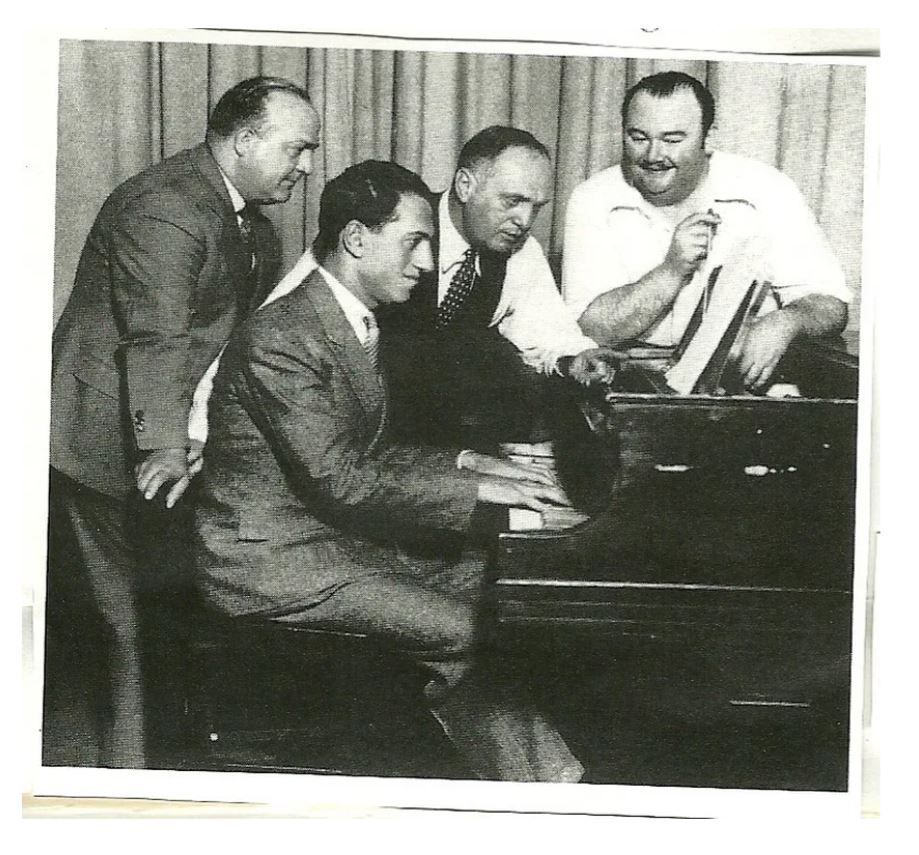
PHOTO: (left to right) Ferde Grofé, Whiteman’s orchestrator and later composer of the “Grand Canyon Suite;” Gershwin at the piano; theatrical impresario Samuel “Roxy” Rothafel; and Whiteman, with his baton
In his prime, Seiji Ozawa was like a breath of counterculture fresh air, assuming the podium in mop top, turtleneck, and love beads. Later, perhaps, he overextended himself, raising a family in Japan while putting the Boston Symphony Orchestra through its paces.
But routine performances cannot take away from a lifetime of achievements.
Ozawa was the first and most prominent Japanese conductor to wow the West with his mastery of the European classics.
As a young man, his talent and tenacity carried him to France (he arrived on a cargo ship, with a scooter and a guitar), where he attracted the attention of then-BSO music director Charles Munch. Munch invited him to study at the Berkshire Music Center at Tanglewood, the orchestra’s summer home. Ozawa then studied with Herbert von Karajan in Berlin and was taken under the wing of Leonard Bernstein, who appointed him assistant conductor of the New York Philharmonic in 1961.
Ozawa’s breakout post was with the Toronto Symphony Orchestra, where he was installed, on Bernstein’s recommendation, in 1965. He served as music director of the San Francisco Symphony from 1970 to 1976.
For decades – 29 years, in fact, beginning in 1973 – he was Boston’s music director and enjoyed many successes, both on the orchestra’s home turf and elsewhere. However, the consensus among players, critics, and audiences is that he stayed too long.
During his time in Boston, he remained active on the other side of the globe. He became honorary music director of the Japan Philharmonic (now the New Japan Philharmonic). He also helped found the Saito Kinen Orchestra, named for cellist and conductor Hideo Saito, a principal mentor during Ozawa’s youth.
Other posts included an early appointment as artistic director of the Ravinia Festival, summer home of the Chicago Symphony Orchestra, co-artistic director (with Gunther Schuller) of the Berkshire Music Center, and much later, artistic director of JapanNYC.
Ozawa left Boston for the Vienna State Opera, where he served until 2010. Alas, the spirit was willing, but the flesh was weak. Health issues predominated for the rest of his life. He was diagnosed with esophageal cancer in 2010. More recently, he was hospitalized with heart valve disease. His convalescence was complicated by sciatica. It was painful to see such an energetic presence diminished in his later years.
In some respects, he remains underrated. His legacy was marred, no doubt, by his extended tenure in Boston, which lent him high visibility, even as he ruffled feathers and outstayed his welcome. Back in Japan, he received scorn from older players for being too Westernized.
But he excelled especially in contemporary music (including that of his compatriot Toru Takemitsu), the Russian classics, and in opulent orchestral showpieces. He could be extraordinarily adept at managing the large forces required of monumental works such as Benjamin Britten’s “War Requiem,” Arthur Honegger’s “Jeanne d’Arc au bûcher,” and Arnold Schoenberg’s “Gurrelieder.” He led the world premiere of Olivier Messiaen’s “Saint François d’Assise” at the Paris Opera and concert performances of Richard Strauss’ “Elektra” in Boston.
Ozawa died at his home in Tokyo on Tuesday. The cause of death was reported as heart failure. He was 88 years old. R.I.P.
Ozawa conducts gorgeous Gabriel Fauré
Mendelssohn’s “A Midsummer Night’s Dream” incidental music, with Judi Dench
Introduced by Bernstein on one of his “Young People’s Concerts”
In 1963, as a contestant on “What’s My Line?” – on the same episode with Woody Allen and Peter, Paul and Mary
Conducting the Muppets (with Placido Flamingo)
At Bernstein’s 70th birthday
I was just listening to this yesterday, for John Williams’ birthday – “Tributes! For Seiji”
Takemitsu, with violinist Anne-Sophie Mutter
Ozawa as I’ll always remember him, with the love beads, in a live performance of Arnold Schoenberg’s late Romantic masterpiece, “Gurrelieder”
PHOTO: Ozawa rehearsing the BSO with Jessye Norman in Frankfurt in 1988
I finally got around to watching “Tár” the other night, and I have to say, the minute or two of Leonard Bernstein footage (from one of his “Young People’s Concerts”) that Lydia discovers on an old VHS tape in the closet of her childhood bedroom conveys more about the significance of the man and the artist than most anything on display in Bradley Cooper’s “Maestro.” Not that I disliked “Maestro.” I warmed to it the more it progressed, and it gets better once Bernstein hits middle age.
Interestingly, both “Tár” and “Maestro” – but especially “Tár” – toss off a lot of musical allusions and in-jokes very few viewers in the broader audience are going to get. (Tar even makes a crack about Jerry Goldsmith!) Not that anyone needs to understand these things in order to grasp the larger points.
But “Maestro” in particular drops “Easter eggs” all over the place. I can’t believe Cooper bothered to incorporate whatever piece of Bernstein arcana he may have happened across on the internet. Unsurprisingly, there’s the performance of Mahler 2 in Ely Cathedral, but there’s also a recreation of the “Fancy Free” demo recorded for Jerome Robbins (complete with Copland interjections), and Bernstein showing up for a performance looking all the world like a stereotypical French wharf rat. I’m surprised he drew the line at the hilarious video of Bernstein conducting the Vienna Philharmonic with his eyebrows.
I understand that these are merely backdrop to a story about Bernstein’s complicated marriage to Felicia Montealegre, but it would have been nice to have seen a broader cultural understanding of what Bernstein signified as an artist. WHY was he so important? It all whirls by in such a blur that none of it has any resonance.
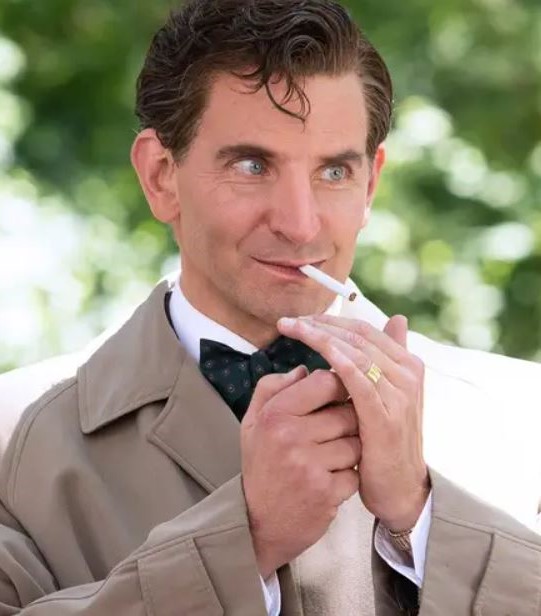
Much has been made of Kazu Hiro’s Academy Award nominated make-up, applied to suggest Bernstein at different stages of his life. I can’t say it necessarily makes Cooper look any more like Bernstein, particularly when young. It just looks like make-up. In fact, what it truly reminded me of was the kind of uncanny valley I used to experience when watching many of Martin Short’s impressions on SCTV. And all the make-up in the world is not going to distract a viewer from Cooper’s piercing blue eyes. All those hours in the make-up chair, and nobody thought to give him some contact lenses?
A few Baz Luhrmann-style excesses aside (as with the transparently computer-manipulated, vertiginous segue from Bernstein’s bedroom to the podium of Carnegie Hall, or the fantastic superimposition of the composer dancing around in a sailor’s outfit during a rehearsal of “Fancy Free”), “Maestro” works well enough. I just hope there’s another Bernstein movie down the line. There WAS one already in the pipeline – that would have starred Jake Gyllenhaal – but that got bumped when the Bernstein estate threw its weight behind “Maestro.” (I guess Gyllenhaal then thought it was a good idea to remake Patrick Swayze’s “Roadhouse?”) Or better yet, a Ken Burns-style documentary. Of course, a documentary probably wouldn’t attract the same crowd as Bradley Cooper.
One final disappointment – and it’s a big one: “Maestro” doesn’t use any of Bernstein’s actual recordings on the soundtrack!
I had my issues with “Tár,” too. Although both films are competently executed, and “Tár” aims higher than “Maestro,” there’s almost always something “off” about movies that purport to be about music or musicians. I get that the music is not really what either film is “about.” It’s just that film, by its very nature, is limited in its ability to convey the essence of music.
Of course, that applies to any other medium. A piece of music can no more depict a painting than a painting can depict a piece of music. Such translations may lend to our understanding, and even offer insights of their own, but they can never be more than approximations, interpretations of the original.
Too often filmmakers ramp up the external drama – of which, of course, there is often plenty – but they can’t put their fingers on the ineffable: what makes music count, why certain gifted interpreters are more successful than others at capturing our imaginations, and why any of it is important.
50 years ago today: Leonard Bernstein delivers the first of six lectures, collectively titled “The Unanswered Question,” while serving as Charles Eliot Norton Professor of Poetry at Harvard University.