Tag: Leonard Bernstein

  • Leonard Bernstein A Life with Not Enough Time

    Leonard Bernstein A Life with Not Enough Time

    “To achieve great things, two things are needed: a plan and not quite enough time.”

    Leonard Bernstein ought to have known. He had only 72 years to become this country’s most visible, extraordinarily versatile classical musician, as a conductor, composer, pianist, Broadway luminary, educator, author, and humanitarian. (I’m sure I left something out.)

    Happy birthday, Lenny. Thanks for making the most of the time you were given.


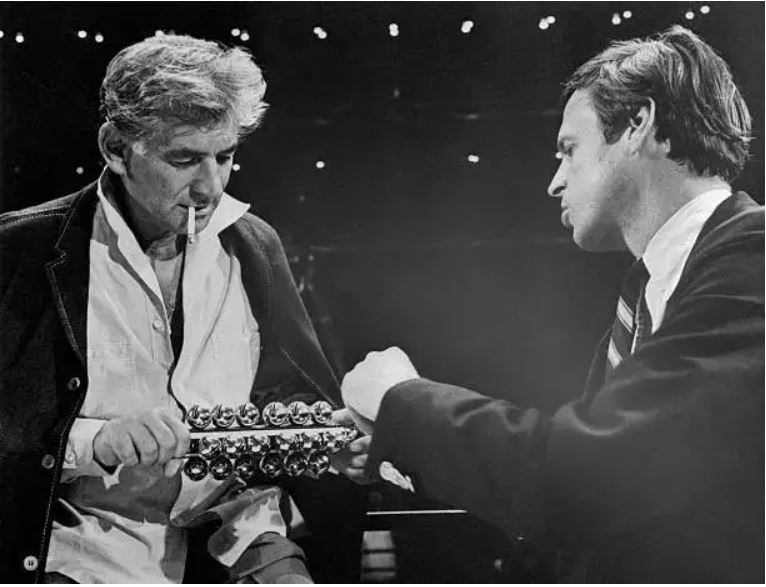
    Bernstein talks Beethoven at the piano with Maximilian Schell – and ever-present cigarette

    “Rhapsody in Blue” from the keyboard, with the fearless Stanley Drucker on clarinet

    Bernstein conducts “Prelude, Fugue and Riffs” on “Omnibus” in 1955

    Bernstein and Aaron Copland create demo record of “Fancy Free” for Jerome Robbins. Stick around for commentary at the end, with self-incriminating interjection by Copland!

    Bernstein’s sensational eleventh-hour debut with the New York Philharmonic, at 25, in 1943

    Bernstein’s European conducting debut, with the Czech Philharmonic in 1946

    An entire playlist of Bernstein rarities!

    Conducting Shostakovich in Tokyo

    Conducting Haydn – with his face

    Lauren Bacall sings “The Saga of Lenny,” lyrics by Stephen Sondheim (with apologies to Kurt Weill), for Bernstein’s 70th birthday celebration

    Bernstein’s death reported on ABC News in 1990

    Bernstein conducts his recently-composed “Candide Overture” on a televised Young People’s Concert in 1960

    Bernstein conducts Mahler’s “Resurrection Symphony” as a memorial tribute, broadcast live, two days after the assassination of President Kennedy in 1963

    https://www.youtube.com/watch?v=qruHjywjE_g

    Bernstein on the future of music, from one of his Harvard lectures. The answer is yes!

    Bernstein celebrates the fall of the Berlin Wall with a multinational ensemble and Beethoven’s 9th

  • Lukas Foss A Centennial Remembrance

    Lukas Foss A Centennial Remembrance

    Today would have been the 100th birthday of Lukas Foss.

    Foss was a multi-talented musician, who received considerable recognition in his lifetime, certainly, but I wonder if was as much as he deserves. Part of the problem is pinning him down. As a composer, it was always difficult to categorize him, as he drew from so many different styles. With Foss, you never knew what you were going to get. Serialism? Aleatory? Populism? Polystylism?

    He was born Lukas Fuchs in Berlin in 1922. A piano prodigy, he began studies at the age of 6. In 1933, his family moved to Paris, where he also studied composition and flute. He arrived in Philadelphia in 1937. By then, the family had changed its name, and Foss entered the Curtis Institute of Music. At Curtis, he studied piano with Isabelle Vengerova, composition with Rosario Scalero, and conducting with Fritz Reiner.

    Leonard Bernstein, a classmate, described him as an “authentic genius.” Bernstein would conduct first performances of several of Foss’ works. In return, Foss would conduct the premiere of Bernstein’s “West Side Story Symphonic Dances.” He also appeared as piano soloist in two recordings of Bernstein’s Symphony No. 2, “The Age of Anxiety,” both with Bernstein conducting.

    In addition, he was one of four esteemed American composer-pianists on Stravinsky’s recording of “Les noces.” (The others were Aaron Copland, Samuel Barber, and Roger Sessions.)

    Foss pursued further studies in conducting with Serge Koussevitzky, during summers at the Berkshire Music Center (Tanglewood), and composition with Paul Hindemith. He became an American citizen in 1942.

    In 1953, he replaced Arnold Schoenberg as composition professor at UCLA. Later, in 1991, he taught at Boston University. He served as music director of the Buffalo Philharmonic (1963-70) and the Brooklyn Philharmonic (1971-88) and as conductor of the Milwaukee Symphony (1981-86).

    As a young man, he was frequently categorized as one of the “Boston School” of composers. Other notable members included Bernstein, Irving Fine, Arthur Berger, Harold Shapero, Ingolf Dahl, and Louise Talma.

    I met him once at a reception at the Academy of Music in Philadelphia, back in the 1980s, following a concert with the Curtis Symphony Orchestra, a student band, but one of a very high caliber. A significant number of seats in U.S. orchestras, including a disproportionate number of principal chairs, are occupied by Curtis graduates. Nearly half of the Philadelphia Orchestra is made up of Curtis alumni.

    Foss hadn’t been Curtis’ first choice for this particular occasion. Bernstein was originally scheduled to appear, but this was toward the end of Bernstein’s life, and he was canceling concerts like crazy. The original program was to consist of Ives’ “Decoration Day,” Tchaikovsky’s “Francesca da Rimini,” and Sibelius’ Symphony No. 1. Sadly, when Foss took over, the Sibelius was swapped out for Brahms.

    Nevertheless, it was great to have a chance to talk with him. Foss was living history, not least as friend and frequent collaborator of Bernstein, and a significant composer in his own right. Even so, in our few minutes of conversation, he impressed me as modest and low-key. Maybe it was because he had just been conducting for two hours.

    I was a little awed at first and reluctant to approach him. But somebody urged me to go ahead, that he would really appreciate it. And so it proved. He had been lingering in a corner, looking a little aimless and nursing a glass of water. He seemed especially pleased that I knew his Bach record.

    I first discovered Foss all the way back in the infancy of my record collecting, from a Turnabout LP on which he appeared as soloist and conductor of the Jerusalem Symphony Orchestra. The repertoire consisted of Bach’s Keyboard Concertos Nos. 1 & 5. Foss played them on a modern piano. To my knowledge, this has never been reissued on CD, but in my early teens, it sounded pretty good. It was probably among my first five or ten classical LPs.

    Years later, I met his son at the opening of the reconstituted Charles Ives Studio at the American Academy of Arts and Letters in New York City. By then, Foss had already been gone for five years. He died in 2009 at the age of 86.

    On October 3, JoAnn Falletta, music director of the Buffalo Philharmonic Orchestra – Foss’ former group – will honor him with a centenary concert at Carnegie Hall. The program is set to include some of his most attractive music.

    https://www.carnegiehall.org/Calendar/2022/10/03/Lukas-Foss-Centennial-Celebration-0700PM

    Happy birthday, Lukas Foss!


    “Three American Pieces”

    “Renaissance Concerto”

    Bernstein conducts the premiere of Foss’ “Phorion,” including an interview with the composer. The concert is introduced by Milton Cross. The interview begins around the 13-minute mark.

    Foss plays Bach in 1961 (not the same performance as on my LP)

    Stravinsky’s “Les noces,” with Foss, Copland, Barber, and Sessions on pianos

    An early recording of Bernstein’s “The Age of Anxiety”

    In conversation with Bruce Duffie

    http://www.bruceduffie.com/foss.html

    Check out some additional nifty Foss photos in the comments section!

  • Nielsen’s Symphony 3: From Philly Summer

    Nielsen’s Symphony 3: From Philly Summer

    When I first heard Carl Nielsen’s Symphony No. 3, I was sweating it out in a one-room efficiency in West Philadelphia that I shared with two of my classmates, while making up a math course I had flubbed at Temple University.

    It was the summer of ’85, there was no air conditioning, and I studied and slept in a netted hammock suspended from two bicycle hooks I had screwed into the door frames to prevent being surprised by mice. There was always movement in the lone trash bag that sat exposed on the linoleum in the corner of the kitchenette, and to prove a point once I lobbed a sneaker into it, from the safety of my resting place, so that the rodents poured out of it and scurried around the apartment, sending one of my roommates, the one whose name was on the lease, shrieking into his bunk. He had a job canvasing for a political organization, so he was gone all day and would stagger back every night after last-call to sketch with intensity under a bright, exposed lightbulb that shone down in my face. Somewhere along the way, he brought home a turtle, which he kept in the bathtub and fed raw hamburger, until I couldn’t take its imprisonment any longer and finally released it into Fairmount Park.

    The other roommate had the good sense to get a girlfriend, so he was never there. His contribution was a makeshift bunk bed hastily assembled from planks he had plucked from the garbage. The top bunk was usually vacant, due to his absence, and the bottom bunk was where my politically-motivated, alcohol-fueled, musky, mulchy-footed friend slept between me and the sole window fan.

    Occasionally, I’d glimpse a cockroach making its way down one of the ropes of my hammock, and I’d start rocking about, trying to dislodge it. More than once, one of the bike hooks let go. The roaches were everywhere. There were even roaches in the freezer.

    It was under these circumstances, one boxed-in, sweltering afternoon, that I first experienced Carl Nielsen’s Symphony No. 3, subtitled “Sinfonia espansiva.” It was broadcast on WFLN, Philadelphia’s classical music station for nearly 50 years (sadly, now defunct). Nielsen’s aspirational music opened up horizons for me and offered glimpses of larger things.

    The recording was conducted by Leonard Bernstein. For those of you who aren’t familiar with him, Carl Nielsen is Denmark’s most celebrated composer. Yet, internationally, his music has struggled to take root in the shadow of that other great bard of the North, Jean Sibelius. This is a shame, since, far from being a Sibelius knock-off, Nielsen forged his own, immediately-recognizable style. Bernstein believed Nielsen’s rightful place was as Sibelius’ equal.

    “I think many people are in for pleasant surprises as they get to know Nielsen,” he said at a centennial celebration of the composer’s birth, “his rough charm, his swing, his drive, his rhythmic surprises, his strange power of harmonic and tonal relationships – and especially his constant unpredictability – all these are irresistible. I feel confident that Nielsen’s time has come.”

    Hey, he was right about Mahler. But that was in 1965, and Lenny’s prophetic lightning failed to strike twice. Fifty-seven years on, with many more recordings and performances to choose from, Nielsen’s music remains, stubbornly, an acquired taste, if a rewarding one. There really is nothing else quite like it – the puckish wit, the ambiguities, the quirky juxtaposition of seemingly disparate melodies, harmonies, and key signatures, all very often shot through with a sense of hope and optimism that rises above the chaos.

    I only lived in that hell hole for about a month, one summer session, thankfully, just long enough to make-up my credits, and then it was off to the greenery of my hometown to detox. But I was in the process of selling my soul for a piece of parchment, a degree, so in the fall it was back to Philadelphia.

    After the purchase of my first CD-player, in order to feed my habit, I took a part-time job as a clerk at Sam Goody, a record shop then located at 11th and Chestnut Streets, which at the time had the most extensive classical music section in the city. (This was before the arrival of Tower Records.) It was there that I acquired Neeme Järvi’s Prokofiev cycle, Bernard Haitink’s Shostakovich cycle, Adrian Boult’s Vaughan Williams cycle, and my first recording of Nielsen’s Symphony No. 3. Essentially, I signed my paycheck back over to the company in exchange for CDs. I remember my frustration that so much of the good stuff was still only on LP.

    The Nielsen recording was not the classic Leonard Bernstein performance I had heard on the radio – which had yet to be transferred to compact disc – but a newer, digital recording with Myung-Whun Chung and the Gothenburg Symphony Orchestra, on the BIS label. And I have to say, giving all credit to Bernstein for his advocacy of Nielsen’s music, I believe Chung’s recording outshines his in every way. To this day, I find it to be one of the most satisfying Nielsen recordings. It must have been within my first ten CD purchases. I remember when I had so few, I could keep them all in a shoebox. Now I’ve got a library of a good 10,000. You might say it has gone “espansiva.”

    What exactly did Nielsen mean by that choice of subtitle? Robert Simpson wrote that the use of “espansiva” suggests an “outward growth of the mind’s scope.” There is certainly a sensation of expanding horizons about the piece, which includes a pastoral slow movement complete with wordless solos for soprano and baritone. According to Nielsen, the symphony concludes with “a hymn to work and the healthy activity of living.” All I know is that it fills me with optimism and happiness.

    A tip of the blond brush cut to Carl Nielsen on his birthday. Perhaps his time will come. For me, it arrived in a very different climate from that of Copenhagen, in tropical West Philadelphia, in the summer 1985.


    Leonard Bernstein conducts the Royal Danish Orchestra on its own turf

    Myung-Whun Chung and the Gothenburg Symphony

    “Espansiva: A Portrait of Carl Nielsen”

  • Carl Nielsen’s Symphony No. 5: A Century of Optimism

    Carl Nielsen’s Symphony No. 5: A Century of Optimism

    I can’t claim to know how to solve the world’s problems, but more Carl Nielsen would be a good start.

    Nielsen was, of course, Denmark’s most celebrated composer. He experienced a lot of change in his lifetime (1865-1931), in a world of accelerating anxiety. There is plenty of struggle in his symphonies, to be sure. But to my ears, for the most part, they reflect a spirit of optimism and nobility, and they retain the power to inspire.

    Nielsen’s Symphony No. 5 was first performed in Copenhagen on this day 100 years ago. The work is built on an unusual structure, organized into two movements, as opposed to the customary four. We don’t know what inspired the composer to write his Fifth Symphony, but it’s a good guess that it is a reaction to the War to End All Wars.

    Already by four minutes in, an implacable snare drum appears, and the movement becomes a struggle of contrasts between martial and transcendent impulses. At the climax of the first movement, the composer instructs the drummer to improvise “as if at all cost he wants to stop the progress of the orchestra.” In this sense, the symphony acts almost as a second “Inextinguishable” (the subtitle of Nielsen’s Symphony No. 4, with its dueling timpani), with open wounds, but yearning for the attainment of nobler things.

    Nielsen claimed he was not conscious of the influence of recent world events in the writing of his symphony, but he conceded that “not one of us is the same as we were before the war.”

    A performance in Sweden in 1924 caused a commotion, when the audience rebelled against the cacophonous “modernism” of the first movement. There was a mass exodus from the concert hall, as about a quarter of those in attendance left. Those who remained attempted to hiss the orchestra to silence. It’s too bad they were insensible to the overarching grandeur and hard-won optimism of the piece.

    The symphony received its premiere the same week as the first performance of a very different work influenced by the war, Ralph Vaughan Williams’ “A Pastoral Symphony.” I’ll write more about that on Wednesday.

    In the meantime, here’s a classic performance of Nielsen’s Symphony No. 5, with Leonard Bernstein and the New York Philharmonic:

    Funny how the passage of the years modifies one’s perspective. At the time this recording was made, the symphony was only 40 years-old!

  • Stravinsky’s White House Dinner & JFK Tribute

    Stravinsky’s White House Dinner & JFK Tribute

    On this date 60 years ago, Igor Stravinsky went to dinner at the White House. You’ll find an amusing account of the evening here:

    https://www.whitehousehistory.org/igor-stravinsky-at-the-white-house

    “Despite such criticism – which was entirely typical of Stravinsky’s unfiltered personality – he clearly remembered the visit with fondness and gratitude. In January, 1964 he commemorated John F. Kennedy – who had been assassinated on November 22, 1963 – by composing ‘Elegy for J.F.K.,’ a vocal piece with words by W.H. Auden. ‘I felt that the events of November were being too quickly forgotten,’ the composer told The New York Times, ‘and I wished to protest.’”

    Leonard Bernstein was also in attendance at the dinner. Bernstein’s “Fanfare for JFK” was heard for the first time on the eve of Kennedy’s inauguration, also on this date, though one year earlier. It’s only 40 seconds long, so if you blink, you’ll miss it.

    In 1978, Bernstein gave the opening speech at the first Kennedy Center Honors, at which the honorees included Marian Anderson, Richard Rodgers, George Balanchine, Fred Astaire, and Arthur Rubinstein:

    I’ll spare you the entirety of Bernstein’s “Mass,” commissioned by Jacqueline Kennedy for the opening of the Kennedy Center in 1971, but here’s the piece’s hit tune, “A Simple Song”

    Where are our Bernsteins and Stravinskys – or for that matter our Marian Andersons, Richard Rodgerses, George Balanchines, Fred Astaires, and Arthur Rubinsteins – and provided they can be identified, why are they not honored at the White House, or even on television?

Tag Cloud

Aaron Copland (92) Beethoven (95) Composer (114) Film Music (123) Film Score (143) Film Scores (255) Halloween (94) John Williams (187) KWAX (229) Leonard Bernstein (101) Marlboro Music Festival (125) Movie Music (138) Opera (202) Philadelphia Orchestra (89) Picture Perfect (174) Princeton Symphony Orchestra (106) Radio (87) Ralph Vaughan Williams (85) Ross Amico (244) Roy's Tie-Dye Sci-Fi Corner (290) The Classical Network (101) The Lost Chord (268) Vaughan Williams (103) WPRB (396) WWFM (881)

DON’T MISS A BEAT

Receive a weekly digest every Sunday at noon by signing up here


RECENT POSTS