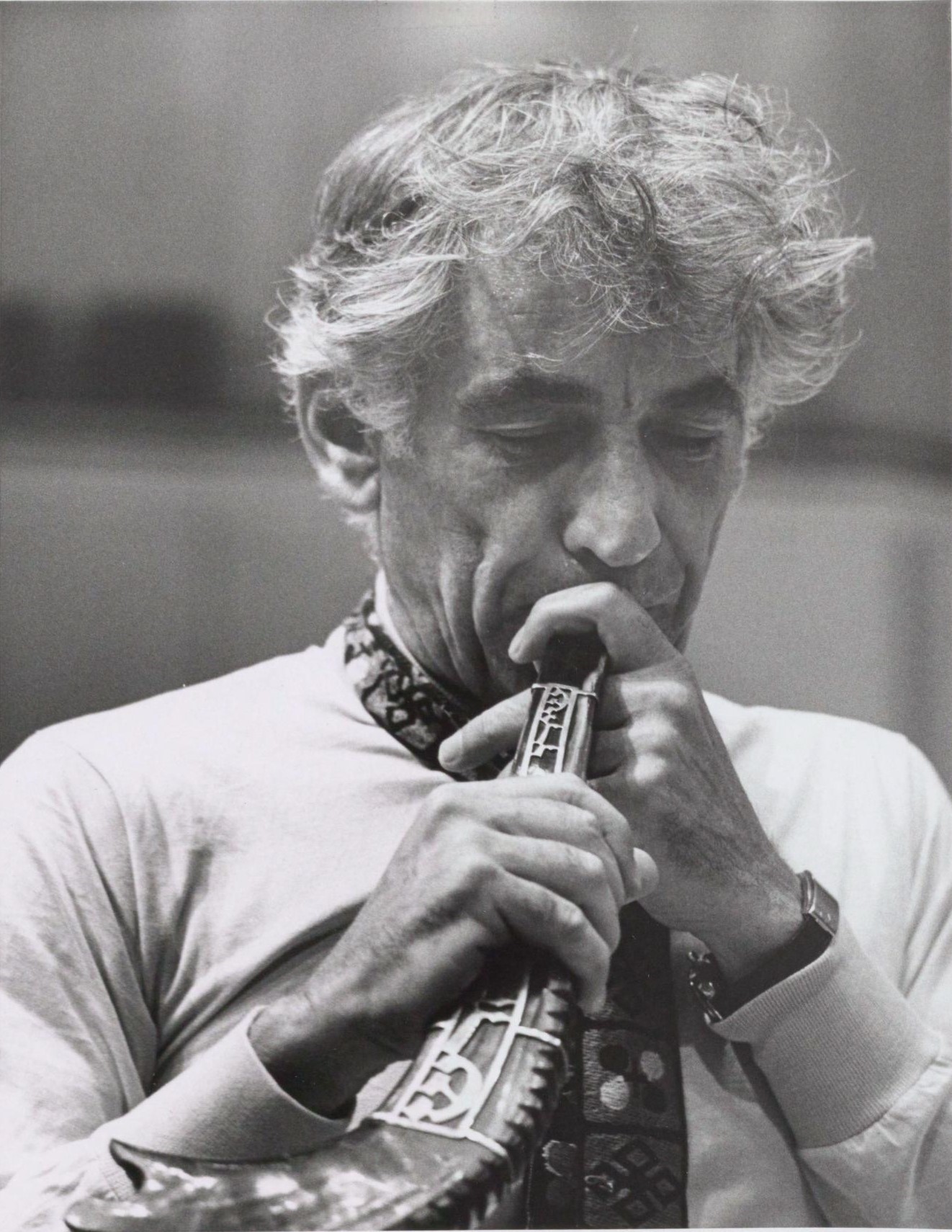
The other day, for Rosh Hashanah, I posted a photo of Leonard Bernstein playing the shofar at a rehearsal for his “Mass” at the Kennedy Center in 1971. A lot of Bernstein’s concert music grapples with a crisis of faith in the modern world, so it’s hardly surprising that, in composing, he would often recall and incorporate into his mature works reminiscences of the synagogue and the traditions of his youth and apply them in addressing more universal humanistic concerns.
The shofar, typically fashioned from a ram’s horn, is especially significant during the Jewish High Holy Days, ten days of awe and repentance, as it is sounded on Rosh Hashanah to welcome the new year and again to conclude Yom Kippur services, marking the end of a day of fasting and prayer.
More broadly, anyone with a passing familiarity with the Judeo-Christian tradition, even if merely through the viewing of Hollywood biblical epics, likely has had some exposure to the instrument. Generally speaking, whenever you see “trumpet” or “horn” mentioned in an English translation of the Bible, what’s meant is the shofar. The instrument is often associated with the voice of God, the end of the world, or the raising of the dead. Its clarion blast accompanies celebratory or cataclysmic events. Its presence is noted to enhance a sensation of awe in the face of the sublime.
The opening of Bernstein’s “West Side Story” evokes the call of the shofar – which makes sense when you consider that the show was originally conceived as “East Side Story,” with the clashing factions Jews and Irish Catholics in Lower East Side Manhattan. To bring it more in line with contemporary urban gang warfare of the 1950s, the setting was moved uptown to San Juan Hill (Lincoln Square), and the rival gang membership reimagined as white American and Puerto Rican immigrant.
Less obvious is the reason Bernstein emulates the shofar in “Candide!”
Bernstein was far from the only one to recognize the shofar’s expressive potential. The ram’s horn has been embraced by many composers, whether employing the actual instrument or suggesting it, as Bernstein did, in their orchestrations.
Not surprisingly, some seized upon the shofar when treating biblical subjects. Sir Edward Elgar, a Roman Catholic, employs one in his oratorio “The Apostles” – though the part is usually taken by a flugelhorn.
Sir William Walton’s cantata “Belshazzar’s Feast” opens with a suggestion of the shofar on the trombones.
In his Requiem, Hector Berlioz, an atheist, conceived of four spatially separated brass bands to convey the effect of blaring shofars at the end of the world.
“The Gates of Justice,” David Brubeck’s plea for racial harmony, includes a part for shofar. However, in performance, the part is often taken by a French horn.
Of course, Elmer Bernstein employed the shofar in his film score for “The Ten Commandments.” John Williams paid homage when he gave Bernstein’s shofar calls to the Ewoks in “Return of the Jedi.”
Jerry Goldsmith included the instrument in his music for “Planet of the Apes” and “Alien.”
Another film composer, Franz Waxman, emulates the shofar in his oratorio “Joshua,” during the siege of Jericho.
Then there’s a whole genre of shofar concerto, explored by a number of contemporary composers, among them Ofer Ben-Amots, Miguel Kertsman, and Meira Warshauer.
Composers Herman Berlinski, Alvin Curran, and Matthew H. Fields have used the shofar, or suggested the shofar, in their works for their own expressive ends.
Yes, yes, shofar so good. The instrument’s range may be comparatively limited, but it more than makes up for the fact through its powerful associations.