Spring is a time of rebirth – a renaissance, if you will – so I thought it might be fun, this week “Sweetness and Light,” to round out Early Music Month with an hour of Renaissance dances. Most of these will be reimagined by 20th century composers – though with a couple of notable exceptions – and in the case of Ralph Vaughan Williams, we’ll hear a wholly original work employing early instruments. (When’s the last time you heard RVW’s “Suite for Pipes?”)
It will be venison and peacock for breakfast. Put your hands up for a program of courtly and rustic dances on “Sweetness and Light,” this Saturday morning at 11:00 EDT/8:00 PDT, exclusively on KWAX, the radio station of the University of Oregon!
On my way to the Lehigh Valley to hear the Allentown Symphony Orchestra & Chorus perform Ralph Vaughan Williams’ “Dona nobis pacem.” Peace out. And don’t forget to turn your clocks tonight!
Soprano Deanna Breiwick practicing with an audience of one
With the hustle and bustle of the holidays for the most part behind us and temperatures plummeting, January is a great time of year for armchair travel.
This week on “Picture Perfect,” cozy in, but get a world view, as we drift beyond our shores for an hour of wintry scenes from world cinema, with entries from England, Finland, the Soviet Union, and Japan.
Akira Kurosawa’s “Dersu Uzala” (1975) is one of the best of his later films, although it seems to have faded into the shadows of “Kagemusha” and “Ran.” The plot centers on an early 20th century friendship between a Russian explorer and an East Asian trapper and hunter, who acts as his guide. This would be the last of Kurosawa’s works to be recognized with an Academy Award for Best Foreign Language Film. The music is by Isaac Schwartz.
Snow again is in abundance in Finland’s “The White Reindeer” (1952). Set in Lapland, it tells the tale of a lonely herder’s wife, who visits a local shaman and is transformed into a shapeshifting, vampiric hind. The film was honored at the Cannes Film Festival with a special award for Best Fairy Tale Film, and at the Golden Globes as Best Foreign Film. Einar Englund wrote the music.
Sergei Prokofiev’s concert suite from “Lieutenant Kijé” (1934) is very well known, but for some reason the film is not. In fact, it has been widely circulated in program notes that the film was never actually completed, which is false. It has not been available for purchase in the U.S. for as long as I can remember, but you can watch it here:
Why The Criterion Collection has never gotten around to this one, I don’t know, but I’m sure there must be an explanation. The famous sleigh-ride, the “Troika,” begins just before the 45-minute mark. Note that the baritone on the soundtrack is none other than the composer himself, who thought the original singer employed for the purpose too refined.
Finally, we head to the South Pole with Robert Falcon Scott, for “Scott of the Antarctic” (1948). England’s Ealing Studios is probably best recognized for its classic comedies of the 1950s, many of them starring Alec Guinness. There’s not much funny about this harrowing true story, with John Mills as Scott and the most celebrated film score by Ralph Vaughan Williams. Vaughan Williams’ music perfectly reflects the sublime, austere beauty of an impenetrable wilderness. Material from the score was later reworked and incorporated into his Symphony No. 7, the “Sinfonia Antartica” (using the Italian spelling.)
Don’t forget your gloves and a hat! It’s a small world of cold this week, on “Picture Perfect,” music for the movies, now in syndication on KWAX, the radio station of the University of Oregon!
Clip and save the start times for all three of my recorded shows:
PICTURE PERFECT, the movie music show – Friday at 8:00 PM EST/5:00 PM PST
SWEETNESS AND LIGHT, the light music program – ALL NEW! – Saturday at 11:00 AM EST/8:00 AM PST
THE LOST CHORD, unusual and neglected rep – Saturday at 7:00 PM EST/4:00 PM PST
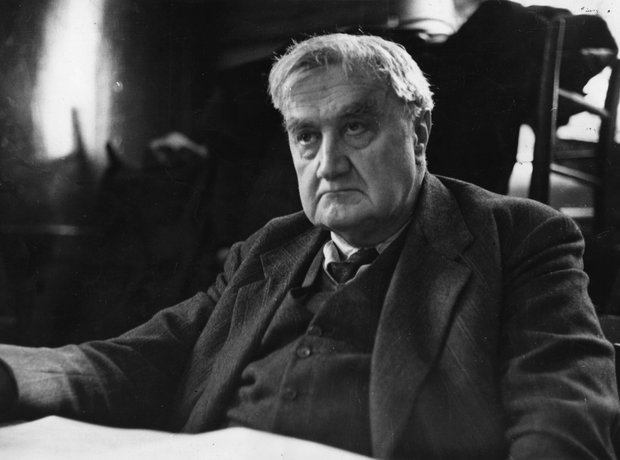
Ralph Vaughan Williams was born on this date in 1872. Since he happens to be one of my favorite composers, I couldn’t be more delighted that the anniversary happens to coincide with one my radio shows. I hope you’ll join me this morning on “Sweetness and Light” for what I guarantee will be a lovingly-curated Vaughan Williams miscellany.
This will not be the usual collection of greatest hits (although we’ll enjoy one or two of those, as well). Among the rarer works will be the “Bucolic Suite” of 1900, when the composer was still feeling his way toward his mature style; also the “Stratford Suite,” made up of incidental music RVW provided for a number of the Shakespeare plays during the brief period he was music director at Stratford-on-Avon (1912-13). If you’re a Vaughan Williams fanatic, I’m sure you’ll recognize some of the melodies, derived from early music and folk song, many of which the composer employed in other, better-known works. The “Stratford Suite” appears on a new release, “Royal Throne of Kings,” chock-full of Vaughan Williams’ uncollected Shakespeare music, on the Albion Records label, the recording branch of the Ralph Vaughan Williams Society.
Some of the music will be dreamy and luminous and some of it will be boisterous and earthy. You’re always safe with Uncle “Rafe.”
Pour yourself a cuppa and join me for “Sweetness and Light,” this Saturday morning at 11:00 EDT/8:00 PDT, exclusively on KWAX, the radio station of the University of Oregon!