Being such a huge Sibelius fan, I remember being positively charmed on my discovery of the music of Douglas Lilburn. Lilburn is probably New Zealand’s most celebrated composer.
Lilburn studied journalism and music at Canterbury University College, then part of the University of New Zealand, before embarking for London’s Royal College of Music. There he was tutored by Ralph Vaughan Williams. The two remained good friends, with Lilburn sending his former teacher gifts of New Zealand honey.
Lilburn made his mark at home not only as a composer, but as a conductor and a noted teacher. For decades, he was associated with Victoria University in Wellington, beginning in 1947.
Astonishingly, for one whose own music was so rooted in tradition, Lilburn founded the first electronic music studio in Australasia. This followed visits to electronic facilities at Darmstadt and the University of Toronto.
Actually, his comparatively thorny Third Symphony signaled something of a turning point. Soon after its completion, in 1961, he shifted his attention exclusively to electronics, a field in which he spent the remainder of his career. Many of his works in the medium evoke the New Zealand landscape and the natural sounds he loved so well.
Lilburn died in 2001. He was 85 years old. He has been described as “the elder statesman” and “grandfather” of New Zealand music.
Happy birthday to this eminent antipodean!
“A Song of Islands” (1946)
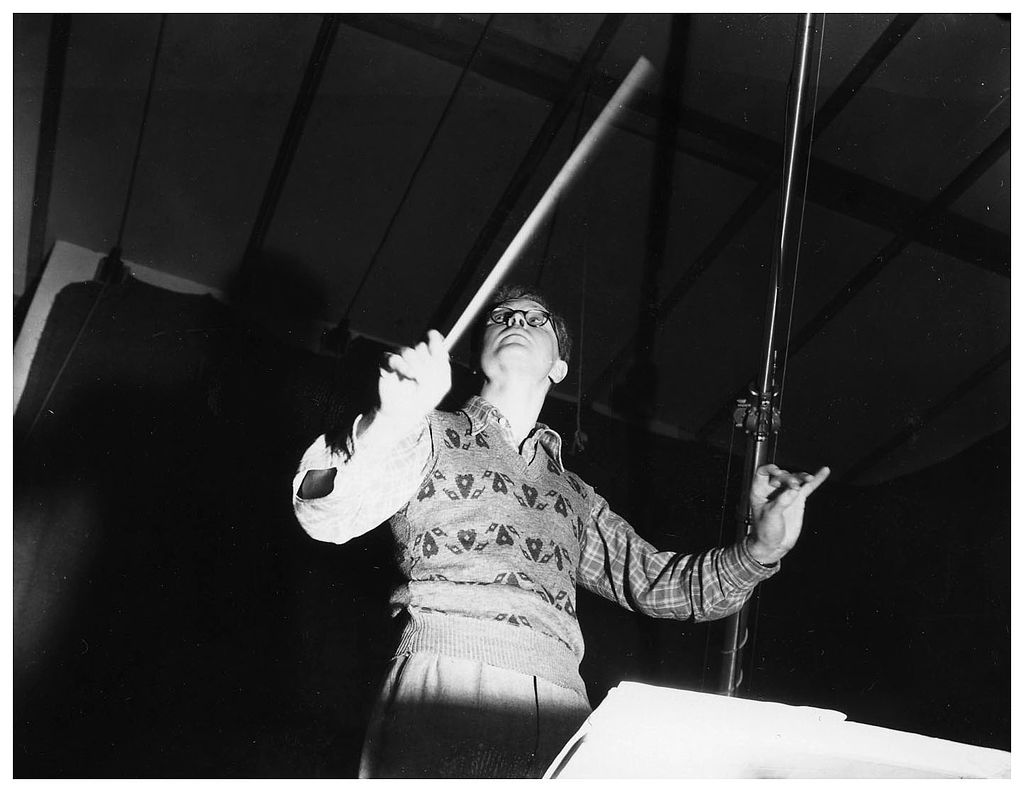
The composer in the electronic music studio he founded
On the birthday of Ralph Vaughan Williams, a party favor:
A link to Ken Russell’s quasi-documentary, “Vaughan Williams: A Symphonic Portrait” (1983) – aptly named, since the hour is structured around the composer’s nine symphonies, with a few welcome digressions to accommodate reflections on the “Tallis Fantasia,” “The Lark Ascending,” and the Oboe Concerto.
The film is surprisingly reverential by Russell standards – this, after all, is the guy who directed “Tommy” and “Lisztomania” – though it is not without its moments of impishness. Russell himself appears prominently, as does his crew, who are made part of the supporting cast, as they are shown shooting on various locations with the composer’s widow, Ursula. The style is part documentary, part deconstruction, with touches straight out of French New Wave, as when Russell calls in a script supervisor to sit down with Ursula to go over her “lines,” when she leaves something out of one her personal reminiscences! There are a number of instances of filmmaker and subjects breaking the fourth wall.
There is also a recurring bit with Russell and his daughter, Molly, clearly engaged and asking questions, as he flips through photographs in a book about Vaughan Williams. By the end, cumulatively, I found this surprisingly moving.
A number Vaughan Williams associates and champions also appear: David Willcocks, Vernon Handley, and Evelyn Barbirolli – widow of the conductor John Barbirolli (Glorious John, as Ralph called him), for whom RVW composed his Oboe Concerto – composer and Vaughan Williams pupil Elizabeth Maconchy, and violinist Iona Brown, arguably the foremost interpreter in her day of “The Lark Ascending.”
I’m afraid you’ll have to ignore the Swedish subtitles. The only other option I could find is dubbed into German!
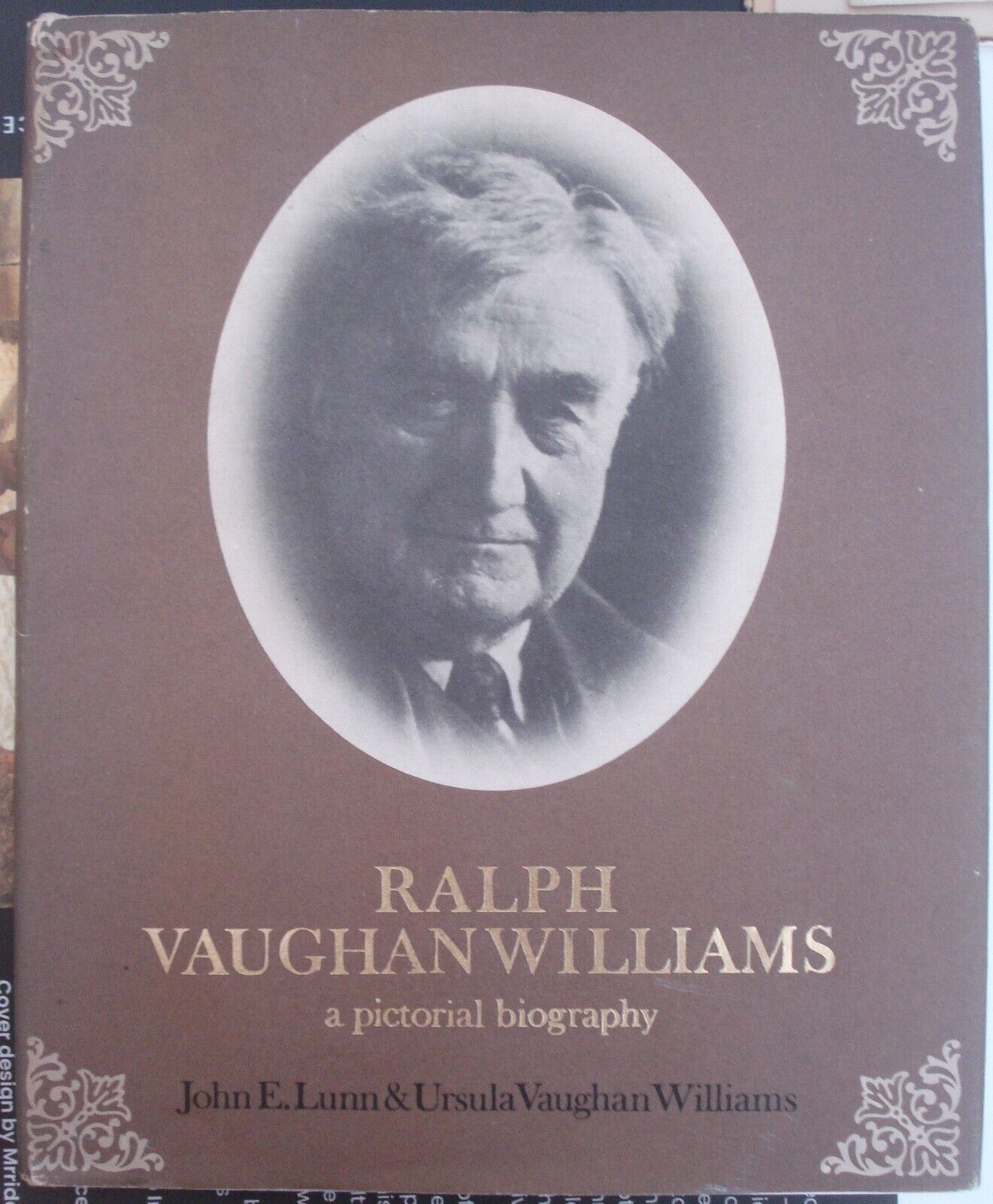
I figured out that the book the Russells are reading is “Ralph Vaughan Williams: A Pictorial Biography,” a volume I had somehow overlooked. Since viewing the film, I was able to track down a copy, signed by Ursula and her co-author, John E. Lunn. This will now reside in my library alongside Jerrold Northrop Moore’s “Vaughan Williams: A Life in Photographs.”
Enjoy the film, and happy birthday, Ralph Vaughan Williams!
On the birthday of Ralph Vaughan Williams, another party favor:
Musicologist Diana McVeagh, as near as I can calculate, was just weeks shy of her own 97th birthday, when she shared these recollections about her experiences with Gerald Finzi, Herbert Howells, Ursula Vaughan Williams, and “Uncle Ralph” himself, with wonderful side-stories about Sir Edward Elgar and Sir Charles Villiers Stanford, among others. Enjoy these priceless eyewitness accounts. They’re guaranteed to elicit a few chuckles. McVeagh is the author of several books, two of which I ordered immediately after listening to her anecdotes. “Elgar the Musicmaker” turned up inscribed by the author (to a previous owner). Thank you to Byron Adams, who conducted the interview, via video communication, during this summer’s Bard Music Festival.
Thanks, New Jersey Festival Orchestra and conductor David Wroe, for a glorious performance of Ralph Vaughan Williams’ Symphony No. 5, presented last night in the acoustically-impressive St. Helen’s Church in Westfield, NJ. You did RVW proud!
It was also my great pleasure to meet Facebook friend Jim Barclay Jr., who, like me, traveled a little over an hour to get there. RVW devotees unite!
Two further area performances of this symphony coming up – astonishing as, to my knowledge, it has not been performed in the Philadelphia area since André Previn led the Curtis Orchestra in 1995.
On November 4 at 7:30 p.m., the Southeastern Pennsylvania Symphony Orchestra will perform the Fifth at Calvary Baptist Church, 1380 S. Valley Forge Road, in Lansdale, PA – again, for me about an hour’s drive. Also on the program will be Elgar’s “Enigma Variations.” Two of my favorite pieces in English music! Allan R. Scott will conduct.
The Main Line Symphony Orchestra will perform the Fifth on November 17 at 8 p.m., also about an hour away, at Valley Forge Middle School in Wayne, PA. The latter concert is especially attractive in that the Symphony No. 2 by Vaughan Williams pupil Ruth Gipps will also be performed. Ernest Bloch’s “Schelomo” will feature as soloist Philadelphia Orchestra cellist Yumi Kendall. The conductor will be Don Liuzzi, also of the Philadelphia Orchestra.
Prior to yesterday, I only ever heard the Fifth in concert twice! (The other time was with Leon Botstein conducting at a Bard Music Festival devoted to Sibelius in 2011.)
As always, I ask everyone to keep me apprised of Vaughan Williams performances on the East Coast. To hear the Fifth Symphony live, as it was played last night, can be transformative. It’s a hard heart indeed that can resist its third movement Romanza, but the whole thing is a wonder.
PHOTO: Vaughan Williams conducting the Fifth Symphony at Royal Albert Hall
It’s interesting that Gustav Holst and Ralph Vaughan Williams were born only three weeks apart, albeit separated by two years. Uncle Ralph’s birthday looms on October 12 – but for today, we celebrate Holst!
“Gustav” may be a strange name for one of England’s greatest composers. Even stranger, he was actually christened Gustavus. Also, there was a “von” in his name – Gustavus Theodore von Holst. Holst’s father was of Swedish, Latvian, and German descent. His great-grandfather had also been a composer, who taught harp at the Imperial Russian Court in St. Petersburg. Continuing in the family trade, his grandfather set up shop in England. In doing so, he added the “von,” thinking it lent a little gravitas and might help to drum up business. Sensibly, Gustav dropped the prefix with the outbreak of war with Germany in 1914.
Like Vaughan Williams, Holst was born in Gloucestershire. Both were students at the Royal College of Music, who studied with Sir Charles Villiers Stanford. Significantly, they were also linked by a common destiny, spearheading a movement to establish a distinctly “English” national sound in music. They accomplished this by getting their hands dirty, tying on their boots and striking out for the fields and fens, to collect songs of the countryside, already endangered by encroaching industrialization. In some of their best original music, both composers assimilate English folk inflections into their respective styles.
Holst himself was an exacting teacher, who took his duties very seriously. However, in common with the best of his profession, he never imposed his will on his students, but rather shepherded them in finding their own solutions. Holst served as director of music at St. Paul’s Girls’ School, Hammersmith, and at Morley College.
Of course his masterpiece would be “The Planets,” composed between 1914 and 1916. Hard to believe, in a world of composers schooled on the piano, that Holst’s principal instrument was the trombone! I recall listening to this music for the first time in my teens and thinking “Jupiter,” in particular, positively exuded “England.” Its roistering, galumphing, perhaps even Falstaffian antics give way to a stately, processional theme, later adapted into the patriotic hymn “I Vow to Thee, My Country.” But with the passage of time, and longer familiarity, “The Planets’” English identity, detectable in every note, has become increasingly evident.
Even so, Holst was never of a provincial mindset. On the contrary, he was a much more adventurous – and frequently modernist – composer than he is frequently given credit for having been. His literary inspirations were far-ranging, from Thomas Hardy to Walt Whitman to Sanskrit. His music is often less emotive than Vaughan Williams’. I’ve always detected more of an objective detachment in his works. Remarked Vaughan Williams, “He was not afraid of being obvious when the occasion demanded, nor did he hesitate to be remote when remoteness expressed his purpose.”
The two were one another’s most constructive critics. When Holst died, comparatively young, at the age of 59, Vaughan Williams felt his friend’s passing keenly. Aside from the personal loss, from a professional and artist standpoint, suddenly he was bereft of his most valued confidante and advisor.
Holst’s legacy can be detected best in those composers who reacted against Vaughan Williams and the pastoral school. His economy and restraint appealed to the generation of Walton, Britten, and Tippett. Also – and I never see this remarked upon – I detect his spirit often in the film and concert music of Bernard Herrmann. (Herrmann was a great anglophile, who championed Holst.) There is a certain aloofness, perhaps even a chill, in the work of both artists, but also great sensitivity.
Happy birthday, Gustav Holst (1874-1934)! You may be regarded by some as a one-hit wonder, but it is an assessment made in ignorance. May the inertia of your greatest success carry listeners far beyond “The Planets.”
The composer’s most famous music, “Mars, the Bringer of War” (1914)
“Jupiter, the Bringer of Jollity” (1914)
“Beni Mora” (1910)
Vaughan Williams’ setting of “Seventeen Come Sunday” from his “English Folk Song Suite” (1923)
Listen for the tune in Holst’s “Somerset Rhapsody” (1906), about three minutes in
“Choral Hymns from the Rig Veda” (1911), anticipating Britten?
First Choral Symphony (1923-24); RVW expressed only “cold admiration” for it
12 Welsh Folk Songs (1930-31): “My sweetheart’s like Venus”
Finally, a collaborative work, “Pan’s Anniversary,” a masque written by Ben Jonson, circa 1620, revived in 1905 for a production at Stratford-upon-Avon. Vaughan Williams composed most of the incidental music, with Holst stepping up to arrange some dance tunes under considerable time pressure. The piece was released for the first time on Albion Records, the recording branch of the Ralph Vaughan Williams Society, with some colorful bonuses.
You can sample the entire album, including an arrangement of the “Fantasia on a Theme by Thomas Tallis” for voices and strong octet, here:
The Albion catalogue sports much unusual and intriguing RVW fare, often in world premiere recordings. You’ll find some great gift ideas for the musical anglophile who “has everything.”