Ralph Vaughan Williams died 65 years ago today. Here’s the world premiere recording of his Symphony No. 9 of 1956-57. Critics of the day were largely dismissive of the work, finding it enigmatic, and puzzled by the composer’s decision to include among his orchestration three saxophones and a flügelhorn. Horrors!
In recent decades, it seems the very characteristics that confounded the gatekeepers – the symphony’s visionary, violent, elusive, and ambiguous nature – are some of the very qualities for which it is now praised. This is not the kind of valedictory anyone was expecting from the octogenarian so famous for the “Fantasia on a Theme by Thomas Tallis” and “The Lark Ascending.”
RVW had been scheduled to attend the recording session, which, in the event, took place only hours after his passing, on August 26, 1958. The performance is prefaced by a brief, spoken introduction by his great champion, the conductor Sir Adrian Boult.
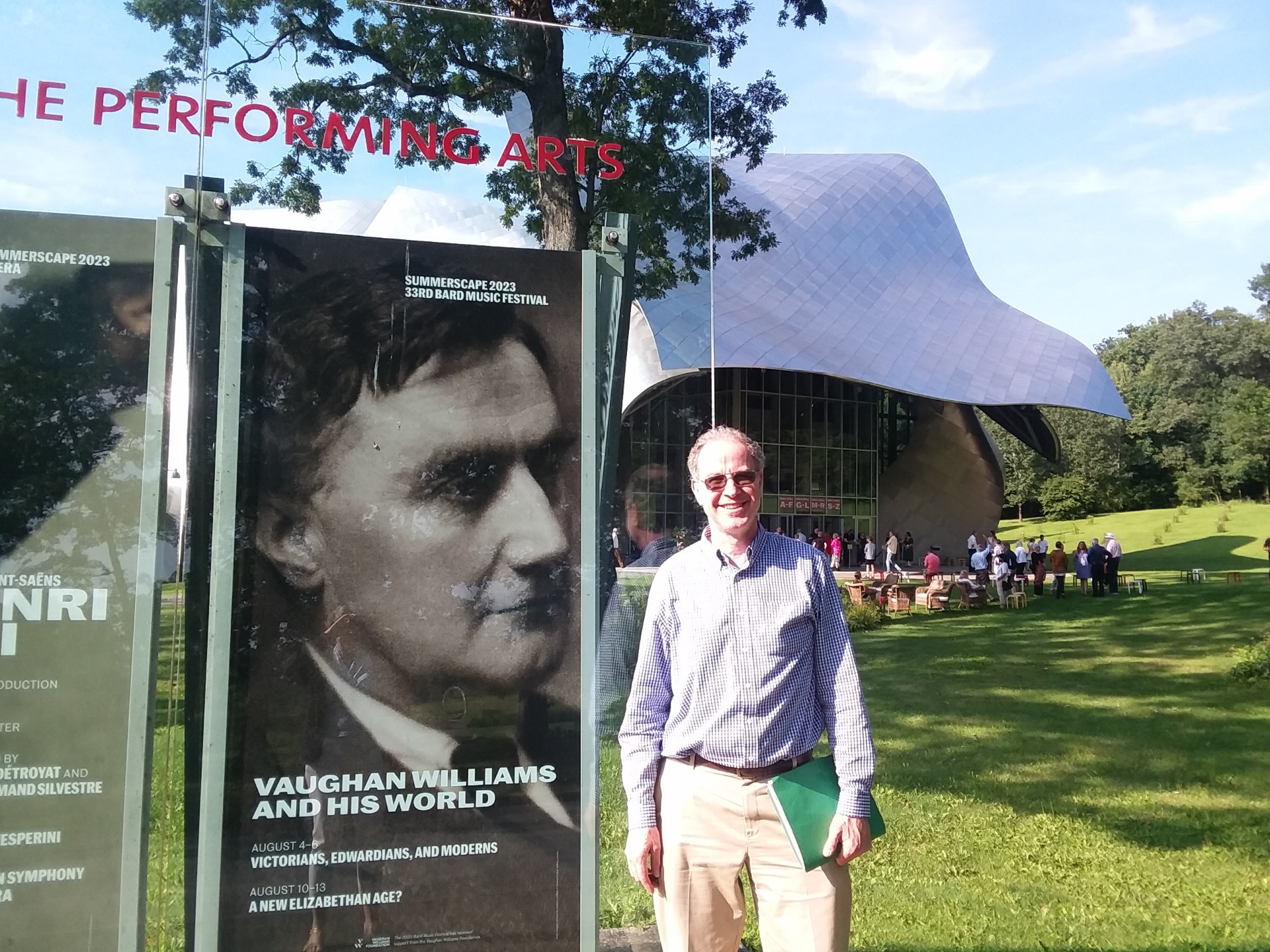
One of the pleasures of attending the Bard Music Festival – which focuses on a primary composer and his or her world – is the chance to listen to music by dozens of ancillary figures that in one way or another further illuminate the year’s subject. This makes for some felicitous discoveries. One of these, in this year devoted to Ralph Vaughan Williams, was surely the Piano Sonata No. 1 by Michael Tippett.
I went through a Tippett phase, back in the late ‘80s, early ‘90s, when I first discovered his Concerto for Double String Orchestra, his oratorio “A Child of Our Time,” the “Suite in D (for the Birthday of Prince Charles),” and the opera “The Midsummer Marriage,” which I was lucky to see in a revival at New York City Opera. But then I kind of cooled on him, still liking the pieces I liked, of course, but not going out of my way to revisit the thornier, more perplexing works of his later development. There are exceptions, of course. I’ve always been partial to his Symphony No. 4, for instance, which the composer compares to a birth-to-death cycle, complete with intermittent “breathing” effects. And of course, I have recordings of his piano sonatas, which, if I ever listened to them at all, have sat dormant on the shelf. In the case of No. 1, no longer!
The sonata was composed in 1939, it turns out not long after the Concerto for Double String Orchestra. You would never know it from the music, but at the time the composer was going through quite a lot of turbulence. He’d recently weathered a particularly messy break-up. Tippett was homosexual, so even under the best of circumstances, there would have been a degree of stress at a time when same-sex relationships were viewed as criminal offenses. But the break-up was acrimonious and threw the composer into turmoil. Furthermore, Europe was full to bursting with political and military tension. Tippett always leaned far to the left, which placed him in further jeopardy with the authorities, especially when he not only refused to fight, but to participate in the war effort in any way.
Vaughan Williams always did much to assist and support younger composers, not only as a teacher but as a colleague, even if he didn’t particularly care for the kind of music they happened to be writing. Tippett was one such composer. I don’t believe it ever came up during any of Bard’s panels or pre-concert talks, but Vaughan Williams, as one of the country’s most venerated composers, volunteered himself as a character witness during Tippett’s trial as a conscientious objector.
Tippett admitted to, as a young man, having despised Vaughan Williams and all that he stood for. But probably in part because of the elder composer’s unusual kindness, he came to realize “there was an essential goodness about the man.”
Later, after Vaughan Williams’ death, Tippett began to perceive that it was Vaughan Williams more than anyone else “who had made us free.” After two hundred years of German cultural domination following the death of Henry Purcell, when the most popular composers in England were Handel, Haydn, and Mendelssohn, Elgar brought new hope; but it could be argued, and to Tippett’s way of thinking, it was Vaughan Williams who allowed English composers to be comfortable in their own skins. He had bequeathed to all who followed the freedom to be “English.”
Tippett talks about Vaughan Williams here:
The first movement of Tippett’s sonata is cast in the form of a theme and variations; the second is based on a Scottish folksong, “Ca’ the yowes” (which Tippett also employs in the Concerto for Double String Orchestra); the third movement scherzo, in sonata form, unusually bears the greatest weight (I hear flashes of Beethoven); only to have that weight lifted in the fourth movement by a cakewalk. Tippett was always interested in Black music, with jazz, blues, boogie-woogie, and spirituals frequent influences on his work.
Tippett’s sonata was performed at Bard by Orion Weiss. Here’s a recording with Phyllis Sellick, who introduced the piece, from the 1940s.
And Daniel Harding and the London Symphony Orchestra with the lovely Concerto for Double String Orchestra:
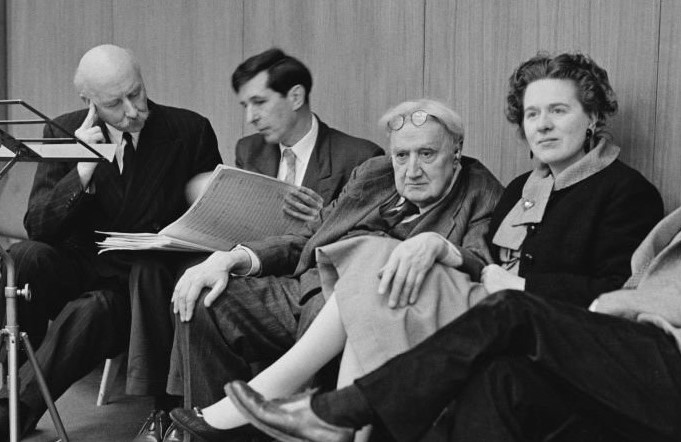
PHOTO (left to right): Sir Adrian Boult, Michael Tippett, Ralph Vaughan Williams, and Ursula Vaughan Williams in 1958. Tippett would be knighted in 1966. Decades earlier, Vaughan Williams declined a knighthood. In 1935, he was awarded the Order of Merit by King George V.
Here’s some of the merch from this year’s Bard Music Festival. Of course, I already own most of the CDs. A particularly nice showing for those on Albion Records, the recording branch of the Ralph Vaughan Williams Society. Attractive design for the festival t-shirt, with a lark ascending, naturally, against a background of sky blue. I’m not a t-shirt guy, but I picked one up for the archive. Reading Eric Saylor’s Vaughan Williams book now. Saylor is one of this year’s resident scholars.
Of this past weekend’s concerts, Saturday night was the clear champion, with The Orchestra Now (TŌN) performing “Job, A Masque for Dancing” (with projections of the Blake illustrations), the Concerto for Two Pianos (with Danny Driver and Piers Lane the soloists), and the Symphony No. 4. Co-artistic director Leon Botstein conducted. “Job,” in particular, was sublime. Orchestras in the United States should hang their heads in shame for not programming this music.
Friday evening too had its rewards. I never much cared for Vaughan Williams’ “Concerto Accademico” on record, but hearing it played in person, with Grace Park the violinist, made me a convert. The “Serenade to Music” was luminously transcendent. The vocal soloists were all excellent, but soprano Brandie Sutton took it to the next level. What a presence, and what a voice!
It was also an inspired idea to open the festival with a communal singing of Vaughan Williams’ hymn “Down Ampney” (“Come Down, O Love Divine”), as one of the composer’s great achievements was his revitalization of the “The English Hymnal.” The man truly left his imprint on every musical facet of his time.
The Saturday morning panel, “Composer and Nation,” was also very special, with Saylor, Botstein, and Princeton University’s Deborah Nord participating. The discussion was moderated by Richard Aldous. The Bard Music Festival rewards on many levels, paying dividends on however much one decides to invest in it. If you’re there to take in some concerts of largely underexposed music, there’s plenty to enjoy. But if you want to dig a little deeper, the panels and pre-concert talks can be both absorbing and rewarding, and Saturday morning’s was among the best I’ve attended.
The daytime chamber concerts brought many pleasures, including exemplary performances of Samuel Coleridge-Taylor’s Clarinet Quintet (with clarinetist Todd Palmer) and Herbert Howells’ Piano Quartet (with pianist Danny Driver). Nicholas Phan was on hand yesterday afternoon to sing Vaughan Williams’ “On Wenlock Edge” (with pianist Piers Lane). All three works featured members of the Ariel Quartet, surely the hardest-working chamber ensemble at this year’s festival.
Next weekend’s concerts are primed to be a series of “Holy Grails” for fans of the composer. Featured highlights will include a concert of English string classics, RVW’s Symphony No. 8 and “Sinfonia Antartica” [sic], and the Falstaff opera “Sir John in Love.” Of course, there will be plenty of chamber music during the day. This year, there will also be a couple of supplementary concerts held at the Church of the Messiah in Rhinebeck on Thursday evening and Friday afternoon (including a performance of the Mass in G minor).
“Vaughan Williams and His World” continues at Bard College, in Annandale-on-Hudson, NY, through August 13. You’ll find the complete schedule at the link.
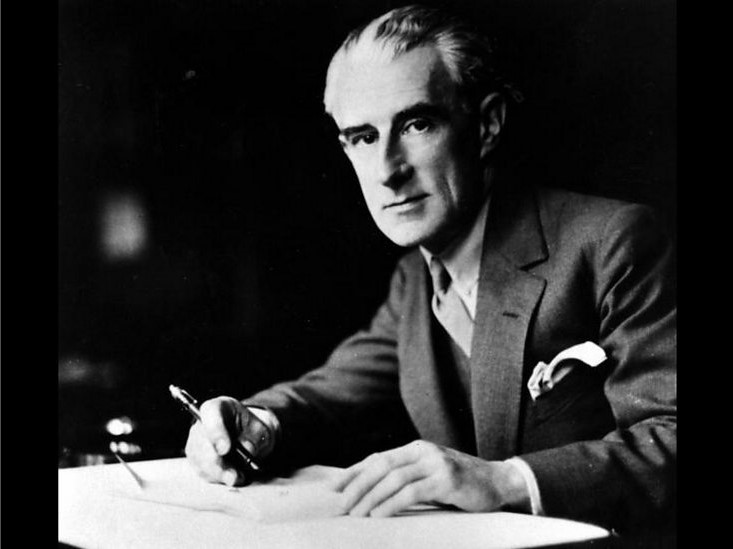
Maurice Ravel was one of the greatest of French composers. Reluctantly, he also became the teacher of one of England’s.
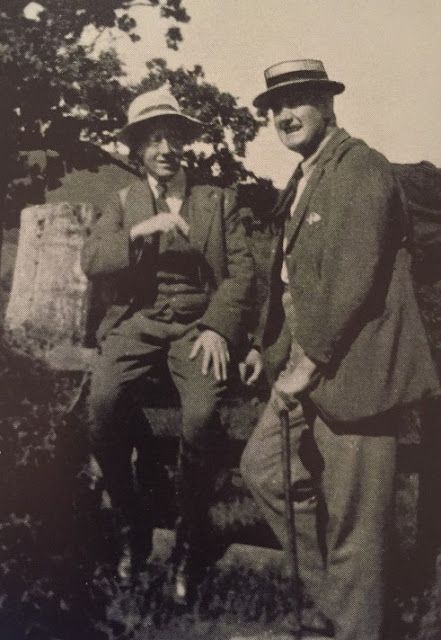
Ralph Vaughan Williams studied in Paris with Ravel for three months in 1907-08. Ravel betrayed some hesitancy at first. He took few pupils, but this untidy bear of an Englishman was not about to take no for an answer. Despite his earthy disposition (his response to Ravel’s assignment to write a minuet in the manner of Mozart was met with an unprintable response), Vaughan Williams quickly earned his teacher’s admiration and soon his friendship. Ravel later remarked of Vaughan Williams, “He is my only pupil who does not write my music.” That is to say, RVW remained his own man.
For his part, Vaughan Williams credited Ravel with having helped him to overcome the heavy Teutonic influence on his earlier training. Ravel had the effect of lightening the textures in Vaughan Williams’ music and sharpening its focus. RVW, already in his mid-30s and three years older than his teacher, learned his lessons well (at least the ones he considered valid), assimilated what he found useful, and applied it to the achievement of his own objectives. It could be said that Ravel’s greatest gift to his English pupil was the courage to be himself.
Ravel organized the first French performance of Vaughan Williams’ “On Wenlock Edge” in Paris in 1912. RVW later recollected that it was one of the worst things he’d ever heard. But he was thankful for Ravel’s advocacy in a country that rarely showed much interest in English music. Ravel also visited Vaughan Williams in London and quite enjoyed steak and kidney pudding with stout at Waterloo Station.
The two friends continued to correspond through World War I, during which both served as, among other things, ambulance drivers. Vaughan Williams had some experience with the “big guns,” which contributed to his gradual deafness, and Ravel was rejected from the air force for being too short. Ravel wrote RVW after the war and urged him to return to Paris. “I would be happy to see you after so many terrible years,” he confessed.
Pictured are some of Ravel’s letters to his friend. Unfortunately, to my knowledge, Vaughan Williams’ letters to Ravel have not survived.
Remembering Ravel’s influence on one of my favorite composers –happy birthday, Maurice Ravel!