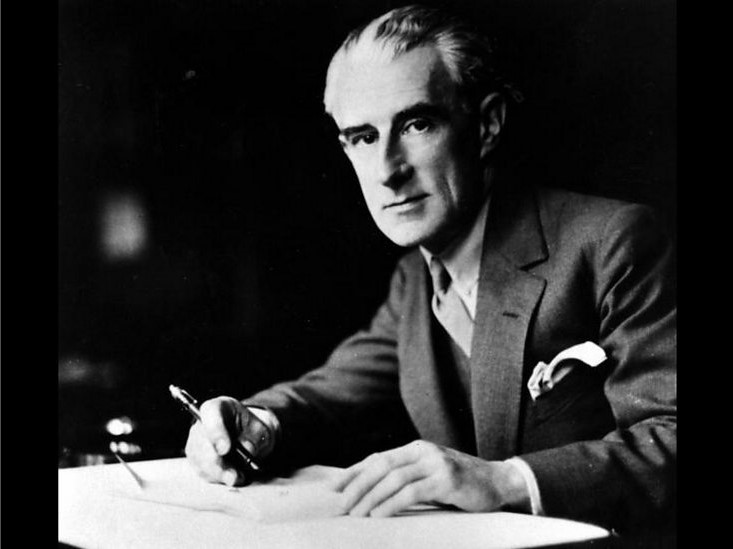
Maurice Ravel was one of the greatest of French composers. Reluctantly, he also became the teacher of one of England’s.
Ralph Vaughan Williams studied in Paris with Ravel for three months in 1907-08. Ravel betrayed some hesitancy at first. He took few pupils, but this untidy bear of an Englishman was not about to take no for an answer. Despite his earthy disposition (his response to Ravel’s assignment to write a minuet in the manner of Mozart was met with an unprintable response), Vaughan Williams quickly earned his teacher’s admiration and soon his friendship. Ravel later remarked of Vaughan Williams, “He is my only pupil who does not write my music.” That is to say, RVW remained his own man.
For his part, Vaughan Williams credited Ravel with having helped him to overcome the heavy Teutonic influence on his earlier training. Ravel had the effect of lightening the textures in Vaughan Williams’ music and sharpening its focus. RVW, already in his mid-30s and three years older than his teacher, learned his lessons well (at least the ones he considered valid), assimilated what he found useful, and applied it to the achievement of his own objectives. It could be said that Ravel’s greatest gift to his English pupil was the courage to be himself.
Ravel organized the first French performance of Vaughan Williams’ “On Wenlock Edge” in Paris in 1912. RVW later recollected that it was one of the worst things he’d ever heard. But he was thankful for Ravel’s advocacy in a country that rarely showed much interest in English music. Ravel also visited Vaughan Williams in London and quite enjoyed steak and kidney pudding with stout at Waterloo Station.
The two friends continued to correspond through World War I, during which both served as, among other things, ambulance drivers. Vaughan Williams had some experience with the “big guns,” which contributed to his gradual deafness, and Ravel was rejected from the air force for being too short. Ravel wrote RVW after the war and urged him to return to Paris. “I would be happy to see you after so many terrible years,” he confessed.
Pictured are some of Ravel’s letters to his friend. Unfortunately, to my knowledge, Vaughan Williams’ letters to Ravel have not survived.
Remembering Ravel’s influence on one of my favorite composers –happy birthday, Maurice Ravel!
Leave a Reply