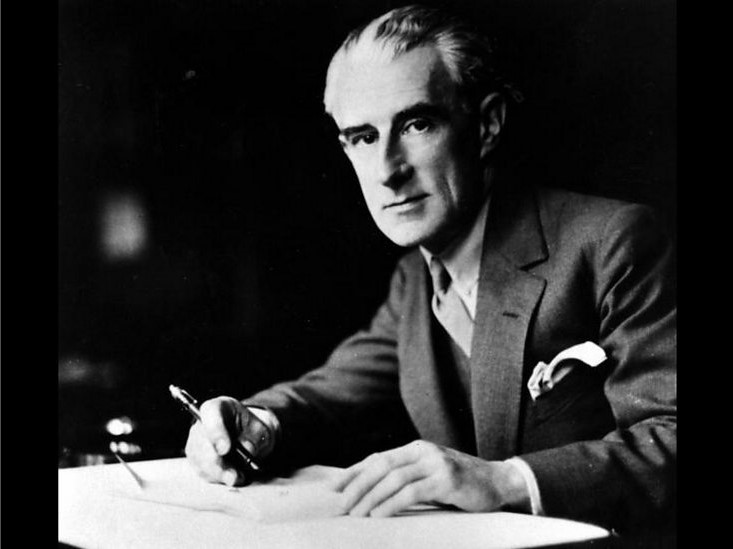
Tag: Maurice Ravel

  • French Halloween Music the Lost Chord

    French Halloween Music the Lost Chord

    On the whole the French don’t really celebrate Halloween (too American), but if you find one who does, don’t say “trick or treat.” Rather, demand “Des bonbons ou un sort!” – candy or a spell.

    While France might not be down with the whole Halloween thing, many of the country’s great artists, writers, and composers could totally conjure a Halloween vibe. Think Odilon Redon’s “The Smiling Spider,” Charles Baudelaire’s “Les Fleurs du mal,” or Camille Saint-Saëns’ “Danse macabre.”

    This week on “The Lost Chord,” we’ll have three pieces of French music totally suitable for the season.

    Maurice Ravel’s “Gaspard de la Nuit” (“Gaspard of the Night”) – musical responses to the weird and sinister poetry of Aloysius Bertrand – is a suite of creepy impressions of (1) a flirtatious water spirit, (2) a hanged man at sunset against the backdrop of a tolling bell, and (3) a vampiric dwarf named Scarbo. Gina Bachauer will be the pianist, and Sir John Gielgud will preface each of the movements with recitations of the Bertrand poems.

    Claude Debussy was enthralled by the writings of Edgar Allan Poe, which he knew through Baudelaire’s translations. At the time of his death, he left incomplete sketches for two operas after Poe stories – “The Fall of the House of Usher” and “The Devil in the Belfry.” We’ll hear fragments of the former, conducted by Georges Prêtre.

    Finally, we’ll listen to the third of the “Etudes in Minor Keys,” subtitled “Scherzo Diabolico,” by Charles-Valentin Alkan. Alkan, a sometimes neighbor of Chopin and Georges Sand, shared a home with his illegitimate son, two apes, and a hundred cockatoos. Franz Liszt is alleged to have commented, “Alkan had the finest technique I had ever known, but preferred the life of a recluse.”

    Best known is the story surrounding the circumstances of his death: while reaching for a copy of the Talmud, situated on a high shelf of a heavy bookcase, the case let go and crushed Alkan beneath it. It’s been suggested that the composer actually collapsed while in the kitchen – but when the legend becomes fact, print the legend. We’ll hear his etude in a recording by the late Michael Ponti.

    I hope you’ll join me for “Jacques o’ Lanterns” – lurid music by French composers for Halloween on “The Lost Chord,” now in syndication on KWAX, the radio station of the University of Oregon!


    Clip and save the start times for all three of my recorded shows:

    PICTURE PERFECT, the movie music show – Friday at 8:00 PM EDT/5:00 PM PDT

    SWEETNESS AND LIGHT, the light music program – Saturday at 11:00 AM EDT/8:00 AM PDT

    THE LOST CHORD, unusual and neglected rep – Saturday at 7:00 PM EDT/4:00 PM PDT

    Stream them, wherever you are, at the link!
    https://kwax.uoregon.edu/

  • Ravel A Life Book Review Breezy & Entertaining

    Ravel A Life Book Review Breezy & Entertaining

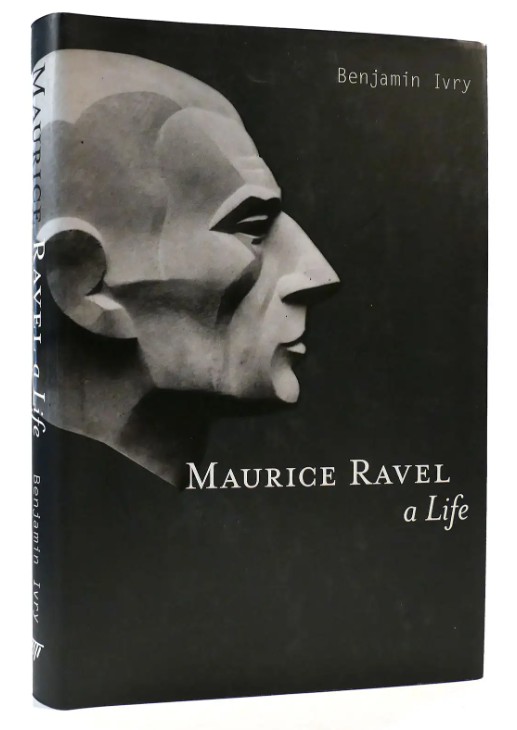
    Last week, I finished reading the first of my recent acquisitions from this year’s Bryn Mawr-Wellesley Book Sale. You may recall the photos I posted of a veritable music book motherlode. As I was about to head out for a train to New York, I was looking for something to keep me entertained for the commute. It being the composer’s sesquicentennial, I reached for “Maurice Ravel: A Life,” by Benjamin Ivry.

    I’ll start off by saying, it’s a breezy read. It’s not an academic bio, although of course the more you know about the era and the artists who peopled it, the more you’ll get out of it. Also, the writer doesn’t get bogged down in musical analysis. He writes about each piece, even the songs, but the minor works yield only a few lines. The major works are mostly tied in to related anecdotes.

    The book is a bit lackadaisically edited. There is at least one sentence that includes a repeated word, in which one of the uses was clearly meant to be deleted. Sometimes, when a person is introduced, it is as if he or she is being mentioned for the first time, when he or she has already appeared in another episode earlier in the book. Frankly, this isn’t necessarily a bad thing. If you’re like me, by the time you get to the bottom of a newspaper article, you’re always looking back to the earlier paragraphs to try to straighten out who’s who. That will never happen in “Ravel: A Life.”

    At the start, I was wondering if I would have to make allowances in reading a book by a writer who isn’t conversant with musical terminology or syntax, as there are several “tells” in the early pages that make it seem as if it’s written by a dilettante. Not that there’s anything wrong with that. Dilettantes can still write well and entertain and offer helpful personal insights. But I wasn’t very far in before I wondered if that too wasn’t the result of a heavy editorial hand, because there’s nothing glaring in that regard for the rest of the book. It’s as if all the editorial effort went into the opening pages and then the interloper got bored, fired, or called to another project. If that is indeed the case, I can certainly relate, having had plenty of articles marred by interventionist editors with little understanding of whatever it is I’m writing about.

    There are really only two other criticisms I could level, and they’re not really criticisms. One is the author’s fascination – fixation really – on who’s gay. If I remember correctly one of the objectives in writing the book was getting to the bottom of Ravel’s elusive sexuality; but if that sounds off-putting to you, don’t let it be, because it’s the merest leitmotif that recurs unobtrusively at certain points in the narrative. But it is amusing to find certain artists being introduced as “the gay writer” or “the gay composer” at times when it has no bearing on the anecdote in question.

    More to the point, in his determination to solve the Ravel “mystery,” the author is always hoping to convince us through circumstantial evidence. Ravel was a meticulous dresser. He was an artist who hung out in artistic circles that included a lot of artistic gay people. He liked cats and was unusually close to his mother. So surely he must be… (it’s at this point, I guess, that we’re supposed to clap our hands over our mouths in feigned shock).

    Granted, I suppose there is some value if anyone can prove conclusively what Ravel’s sexual preferences were (the accepted narrative has been that he was asexual), but only to the extent that it casts illumination on the man and perhaps the artist. Whether or not it informs the creation of his music or how we receive it is open to debate.

    My other “criticism” is that nothing is footnoted, so at times it’s unclear from what source the author is drawing his information. Relatedly, whenever he tends toward speculation, especially in terms of psychological insight, I leave it to you whether or not you should take it with a grain of salt.

    None of this should be interpreted as that I am trashing the book and that I think it is of no value. I found it very entertaining and a few times I actually laughed out loud. But I’m one of those sick fellows who tends to find inappropriate behavior hilarious. Political correctness was not a thing in the 1920s, and artists can be so bitchy. And I will never forget the image of Ravel getting into an indoor sponge fight with a friend’s child, leaving splotches of water all over the walls.

    There’s plenty here for anyone interested to learn more about the composer, and I think the author is successful in supplying enough material that you can really get a sense of his personality.

    Ivry is a poet who has also written biographies of Arthur Rimbaud and Francis Poulenc. “Maurice Ravel: A Life” is brisk and enjoyable. At 229 pages (38 of them devoted to bibliography and index), it’s a book I could knock out comfortably in four days. Not the last word on the composer, by any means, but worthwhile for both the novice and the specialist.

    At any rate, it was published in 2000, so anything I have to say on the matter can only help, rather than hinder, sales!

    Here’s a link to my post about the Bryn Mawr book sale, complete with mouthwatering photos:

  • Pierre Boulez Provocations in Sound

    Pierre Boulez Provocations in Sound

    Think of Pierre Boulez as a corrective.

    Whether or not you are crazy about Boulez as a composer or a conductor, he certainly had a knack for casting music in a fresh light. No romantic indulgence or fuzzy thinking to be found in his interpretations of Debussy and Ravel. Instead, a kind of neoclassical elegance prevails.

    A similar sense of discipline informs his recordings of the Mahler symphonies (of all things). He transforms what under Leonard Bernstein, for instance, became the ne plus ultra of Romantic excess, into presentiments of the Modern Age – which to some extent actually makes sense. After all, didn’t Mahler himself once declare, “My time will come!”

    As concerns his own music, he actually thought Arnold Schoenberg didn’t take his 12-tone experiments far enough. Boulez was a radical who out-radicaled the radicals. He redrew the boundaries of integral serialism, controlled chance, and electronic music. An aggressive push to the avant-garde earned him a reputation as an enfant terrible.

    Ironically, by the time Boulez died on January 5, 2016, at the age of 90, his brand of dogma had long come to seem old-fashioned, as pluralism and a new acceptance of tonality have come to dominate the contemporary music scene.

    And now, here we are, already poised to mark the centenary of his birth on March 26…

    This week on “The Lost Chord,” we’ll remember Boulez with two of his recordings for voice and somewhat intimate ensembles, imaginatively employed.

    We’ll begin with his keystone composition, “Le Marteau sans maître” (“The Hammer without a Master”), composed between 1953 and 1957. The piece consists of three cycles, instrumental and vocal, after poems by René Char – one surreal and fantastical; another somber and existentialist; and a third romantic and utopian. The individual movements of the cycles are shuffled and integrated. The titles of the poems: “The Furious Craftsman,” “Stately Building and Presentiments,” and “Hangmen of Solitude.”

    There is a further fascination to be found in the work’s instrumentation, which includes a colorful assortment of percussion, and the use of the instruments, which suggests Southeast Asian and African influences.

    The piece was lauded by Igor Stravinsky as “the only significant work of this new age,” and by György Ligeti as “the chief work of the 1950s.” Furthermore, it is surprisingly listenable, with a kind of hypnotic allure.

    We’ll round out the hour with Maurice Ravel’s evocations of a distant land, his “Chansons madécasses” (“Madegascan Songs”), of 1925/1926, on texts of Evariste-Desiréa de Parny.

    Again, there are three of them: “Nahandove,” the name of the narrator’s beloved, the arrival of whom he anticipates on a sticky, languorous night; “Aoua!,” a violent outcry against white imperialism; and “Il est doux” (“How pleasant to lie”), a portrait of a lazy day, passed beneath a palm tree, waiting for the cool of night.

    If anything, Ravel’s songs are even more sparsely scored than Boulez’s, for voice, flute, cello, and piano. Yet the composer manages to convey a certain lushness, or at any rate sensuousness, that boils over into violence as the music skirts atonality.

    I thought it an ideal complement to “Le Marteau sans maître,” with Boulez conducting, of course.

    If there’s one thing Boulez did well it was to force everyone to think – about music, about progress and about the reasons we value the things we hold sacred.

    He once proclaimed, “A civilization that conserves is one that will decay!” Even so, we are very lucky to have his recordings, and music is the healthier for his provocations.

    I hope you’ll join me for “Modern Romance” – Pierre Boulez in poetry and song – on “The Lost Chord,” now in syndication on KWAX, the radio station of the University of Oregon!


    Clip and save the start times for all three of my recorded shows:

    PICTURE PERFECT, the movie music show – Friday at 8:00 PM EDT/5:00 PM PDT

    SWEETNESS AND LIGHT, the light music program – Saturday at 11:00 AM EDT/8:00 AM PDT

    THE LOST CHORD, unusual and neglected rep – Saturday at 7:00 PM EDT/4:00 PM PDT

    Stream them, wherever you are, at the link!

    https://kwax.uoregon.edu/


    PHOTO: The Hammer has found a Master

  • Maurice Ravel: A 150th Birthday Celebration

    Maurice Ravel: A 150th Birthday Celebration

    He was a natty dresser, a reckless driver, a lover of cats, mechanical toys, and American jazz. Most of all, he was an exquisite composer. Frequently pigeonholed as an Impressionist, he could certainly evoke mood and atmosphere in his music, but he also expressed himself with the transparency and precision of a classicist. I’ve posted a lot about Maurice Ravel over the years. On the 150th anniversary of his birth, here are links to just a few of my past observations. If you’re interested, I hope you’re able to access everything.

    Merci, Maurice Ravel!


    Ravel’s love of toys

    https://www.facebook.com/photo/?fbid=559132580920703&set=a.279006378933326

    Ravel and cats (there are multiple images, so you’ll have to click “view post” at the upper right after following the link)

    https://www.facebook.com/photo/?fbid=2064327513734528&set=pcb.2064339847066628

    Ravel and Gershwin (and, by extension, jazz)

    https://www.facebook.com/photo/?fbid=1265378057714588&set=a.883855802533484

    Ravel and Vaughan Williams (again, there are multiple images, so you’ll have to click “view post” at the upper right after following the link)

    https://www.facebook.com/photo/?fbid=1057531578499238&set=pcb.1057534635165599

    Ravel and war

    https://www.facebook.com/photo?fbid=784646281702664&set=a.279006378933326

    Ravel’s “Bolero” (multiple images, so you’ll have to click “view post” at the upper right after following the link)

    https://www.facebook.com/photo?fbid=1253515038900890&set=pcb.1253593182226409

    Ravel delays possible

    https://www.facebook.com/photo?fbid=1176348285865793&set=a.279006378933326

  • Ravel’s Unexpected English Pupil

    Ravel’s Unexpected English Pupil

    Maurice Ravel was one of the greatest of French composers. Reluctantly, he also became the teacher of one of England’s.

    Ralph Vaughan Williams studied in Paris with Ravel for three months in 1907-08. Ravel betrayed some hesitancy at first. He took few pupils, but this untidy bear of an Englishman was not about to take no for an answer. Despite his earthy disposition (his response to Ravel’s assignment to write a minuet in the manner of Mozart was met with an unprintable response), Vaughan Williams quickly earned his teacher’s admiration and soon his friendship. Ravel later remarked of Vaughan Williams, “He is my only pupil who does not write my music.” That is to say, RVW remained his own man.

    For his part, Vaughan Williams credited Ravel with having helped him to overcome the heavy Teutonic influence on his earlier training. Ravel had the effect of lightening the textures in Vaughan Williams’ music and sharpening its focus. RVW, already in his mid-30s and three years older than his teacher, learned his lessons well (at least the ones he considered valid), assimilated what he found useful, and applied it to the achievement of his own objectives. It could be said that Ravel’s greatest gift to his English pupil was the courage to be himself.

    Ravel organized the first French performance of Vaughan Williams’ “On Wenlock Edge” in Paris in 1912. RVW later recollected that it was one of the worst things he’d ever heard. But he was thankful for Ravel’s advocacy in a country that rarely showed much interest in English music. Ravel also visited Vaughan Williams in London and quite enjoyed steak and kidney pudding with stout at Waterloo Station.

    The two friends continued to correspond through World War I, during which both served as, among other things, ambulance drivers. Vaughan Williams had some experience with the “big guns,” which contributed to his gradual deafness, and Ravel was rejected from the air force for being too short. Ravel wrote RVW after the war and urged him to return to Paris. “I would be happy to see you after so many terrible years,” he confessed.

    Pictured are some of Ravel’s letters to his friend. Unfortunately, to my knowledge, Vaughan Williams’ letters to Ravel have not survived.

    Remembering Ravel’s influence on one of my favorite composers –happy birthday, Maurice Ravel!

Tag Cloud

Aaron Copland (92) Beethoven (95) Composer (114) Film Music (120) Film Score (143) Film Scores (255) Halloween (94) John Williams (185) KWAX (229) Leonard Bernstein (100) Marlboro Music Festival (125) Movie Music (135) Opera (198) Philadelphia Orchestra (88) Picture Perfect (174) Princeton Symphony Orchestra (106) Radio (87) Ralph Vaughan Williams (85) Ross Amico (244) Roy's Tie-Dye Sci-Fi Corner (290) The Classical Network (101) The Lost Chord (268) Vaughan Williams (103) WPRB (396) WWFM (881)

DON’T MISS A BEAT

Receive a weekly digest every Sunday at noon by signing up here


RECENT POSTS