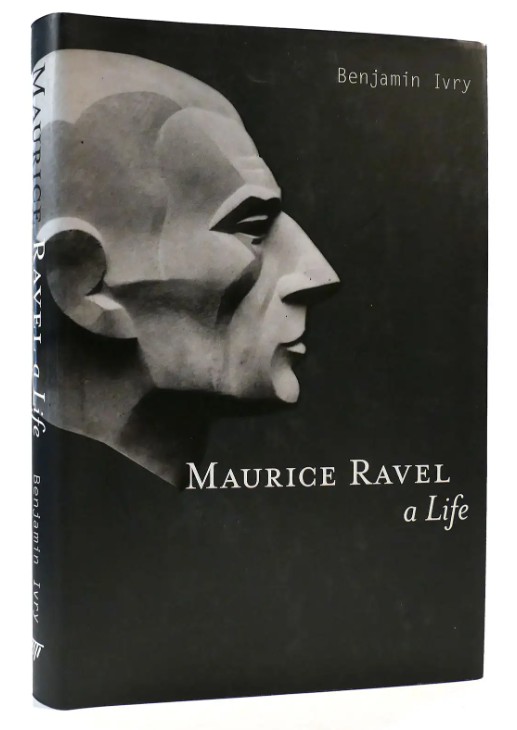
Last week, I finished reading the first of my recent acquisitions from this year’s Bryn Mawr-Wellesley Book Sale. You may recall the photos I posted of a veritable music book motherlode. As I was about to head out for a train to New York, I was looking for something to keep me entertained for the commute. It being the composer’s sesquicentennial, I reached for “Maurice Ravel: A Life,” by Benjamin Ivry.
I’ll start off by saying, it’s a breezy read. It’s not an academic bio, although of course the more you know about the era and the artists who peopled it, the more you’ll get out of it. Also, the writer doesn’t get bogged down in musical analysis. He writes about each piece, even the songs, but the minor works yield only a few lines. The major works are mostly tied in to related anecdotes.
The book is a bit lackadaisically edited. There is at least one sentence that includes a repeated word, in which one of the uses was clearly meant to be deleted. Sometimes, when a person is introduced, it is as if he or she is being mentioned for the first time, when he or she has already appeared in another episode earlier in the book. Frankly, this isn’t necessarily a bad thing. If you’re like me, by the time you get to the bottom of a newspaper article, you’re always looking back to the earlier paragraphs to try to straighten out who’s who. That will never happen in “Ravel: A Life.”
At the start, I was wondering if I would have to make allowances in reading a book by a writer who isn’t conversant with musical terminology or syntax, as there are several “tells” in the early pages that make it seem as if it’s written by a dilettante. Not that there’s anything wrong with that. Dilettantes can still write well and entertain and offer helpful personal insights. But I wasn’t very far in before I wondered if that too wasn’t the result of a heavy editorial hand, because there’s nothing glaring in that regard for the rest of the book. It’s as if all the editorial effort went into the opening pages and then the interloper got bored, fired, or called to another project. If that is indeed the case, I can certainly relate, having had plenty of articles marred by interventionist editors with little understanding of whatever it is I’m writing about.
There are really only two other criticisms I could level, and they’re not really criticisms. One is the author’s fascination – fixation really – on who’s gay. If I remember correctly one of the objectives in writing the book was getting to the bottom of Ravel’s elusive sexuality; but if that sounds off-putting to you, don’t let it be, because it’s the merest leitmotif that recurs unobtrusively at certain points in the narrative. But it is amusing to find certain artists being introduced as “the gay writer” or “the gay composer” at times when it has no bearing on the anecdote in question.
More to the point, in his determination to solve the Ravel “mystery,” the author is always hoping to convince us through circumstantial evidence. Ravel was a meticulous dresser. He was an artist who hung out in artistic circles that included a lot of artistic gay people. He liked cats and was unusually close to his mother. So surely he must be… (it’s at this point, I guess, that we’re supposed to clap our hands over our mouths in feigned shock).
Granted, I suppose there is some value if anyone can prove conclusively what Ravel’s sexual preferences were (the accepted narrative has been that he was asexual), but only to the extent that it casts illumination on the man and perhaps the artist. Whether or not it informs the creation of his music or how we receive it is open to debate.
My other “criticism” is that nothing is footnoted, so at times it’s unclear from what source the author is drawing his information. Relatedly, whenever he tends toward speculation, especially in terms of psychological insight, I leave it to you whether or not you should take it with a grain of salt.
None of this should be interpreted as that I am trashing the book and that I think it is of no value. I found it very entertaining and a few times I actually laughed out loud. But I’m one of those sick fellows who tends to find inappropriate behavior hilarious. Political correctness was not a thing in the 1920s, and artists can be so bitchy. And I will never forget the image of Ravel getting into an indoor sponge fight with a friend’s child, leaving splotches of water all over the walls.
There’s plenty here for anyone interested to learn more about the composer, and I think the author is successful in supplying enough material that you can really get a sense of his personality.
Ivry is a poet who has also written biographies of Arthur Rimbaud and Francis Poulenc. “Maurice Ravel: A Life” is brisk and enjoyable. At 229 pages (38 of them devoted to bibliography and index), it’s a book I could knock out comfortably in four days. Not the last word on the composer, by any means, but worthwhile for both the novice and the specialist.
At any rate, it was published in 2000, so anything I have to say on the matter can only help, rather than hinder, sales!
Here’s a link to my post about the Bryn Mawr book sale, complete with mouthwatering photos:
Leave a Reply