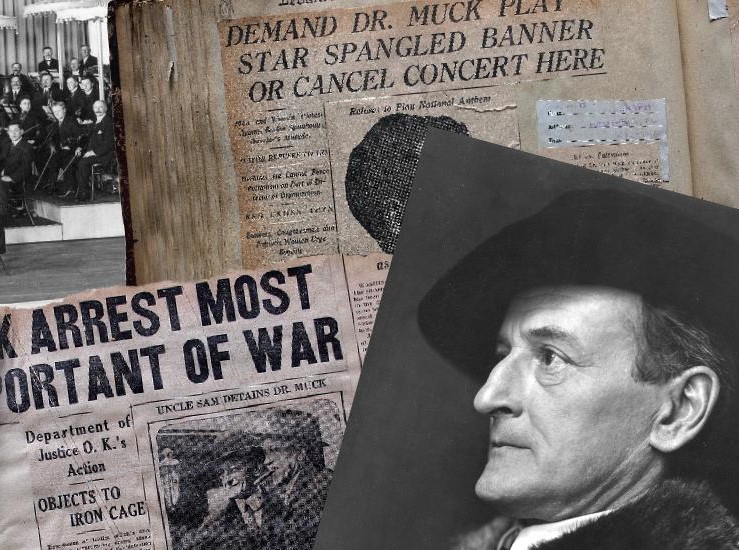
In the last few months, any illusions that we’ve progressed as a nation and as a people have evaporated. Take the case of Karl Muck, who was arrested as an enemy alien on this date, all the way back in 1918.
Muck served as music director of the Boston Symphony Orchestra during the first two decades of the 20th century. He, more than any other, was responsible for establishing the orchestra as a world-class ensemble.
By happenstance, the conductor was born in Darmstadt, but his family had lived in Switzerland since 1867. Muck himself held Swiss citizenship since 1880. Nevertheless, during World War I, he was hounded by jingoistic factions of Boston society, a press that fomented anti-German sentiment, and overzealous federal agents who weren’t about to let him off the hook (despite the fact that he had earlier been cleared of any wrongdoing by the FBI).
Tensions mounted after Muck allegedly refused to conduct the “Star-Spangled Banner” at the request of some women’s associations before a concert. The truth is, the request had never been communicated to the conductor by BSO founder Henry Lee Higginson, who personally declined a last-minute change in the program. When Muck found out about it, he was mortified and made sure to include the anthem on subsequent concerts.
Unfortunately, the damage had already been done. Muck was arrested without a warrant and ended his American years in an internment camp in Georgia, set up for those suspected of being dangerous alien enemies of the United States. 29 other Boston musicians were also targeted, fired and imprisoned, because of their German or Austrian origins. Muck and his associates were among the lucky ones. In some areas of the country, suspects were actually lynched in the streets.
Muck’s house and bank account were seized by the U.S. government. In 1928, nine years after his delayed release and deportation, he received a partial return of his assets.
Ironically, before any of his troubles, Muck had actually offered to resign his post after war had been declared, concerned about the BSO’s image and his personal safety, given the rise of anti-German sentiment. It was Higginson who allayed his fears.
Later, in 1933, Muck would face another political test. As chief conductor of the Hamburg Philharmonic since 1922, he actually did resign, in 1933, having become increasingly uncomfortable with Nazi ideology.
Despite his treatment in the U.S., Muck looked back on his years in Boston as among the happiest and most fruitful of his career. Obviously, he meant from an artistic standpoint.
Needless to say, his experiences here are eerily resonant in a way they would not have been only a few months ago. We should be looking back with wisdom, and a touch of revulsion, on a less-enlightened time when legal rights and due process were suspended in order to preserve an illusion of national security. As is all too often the case, the true enemies of the people were those who pushed “The Star-Spangled Banner” at the expense of facts and basic human decency.
Leave a Reply