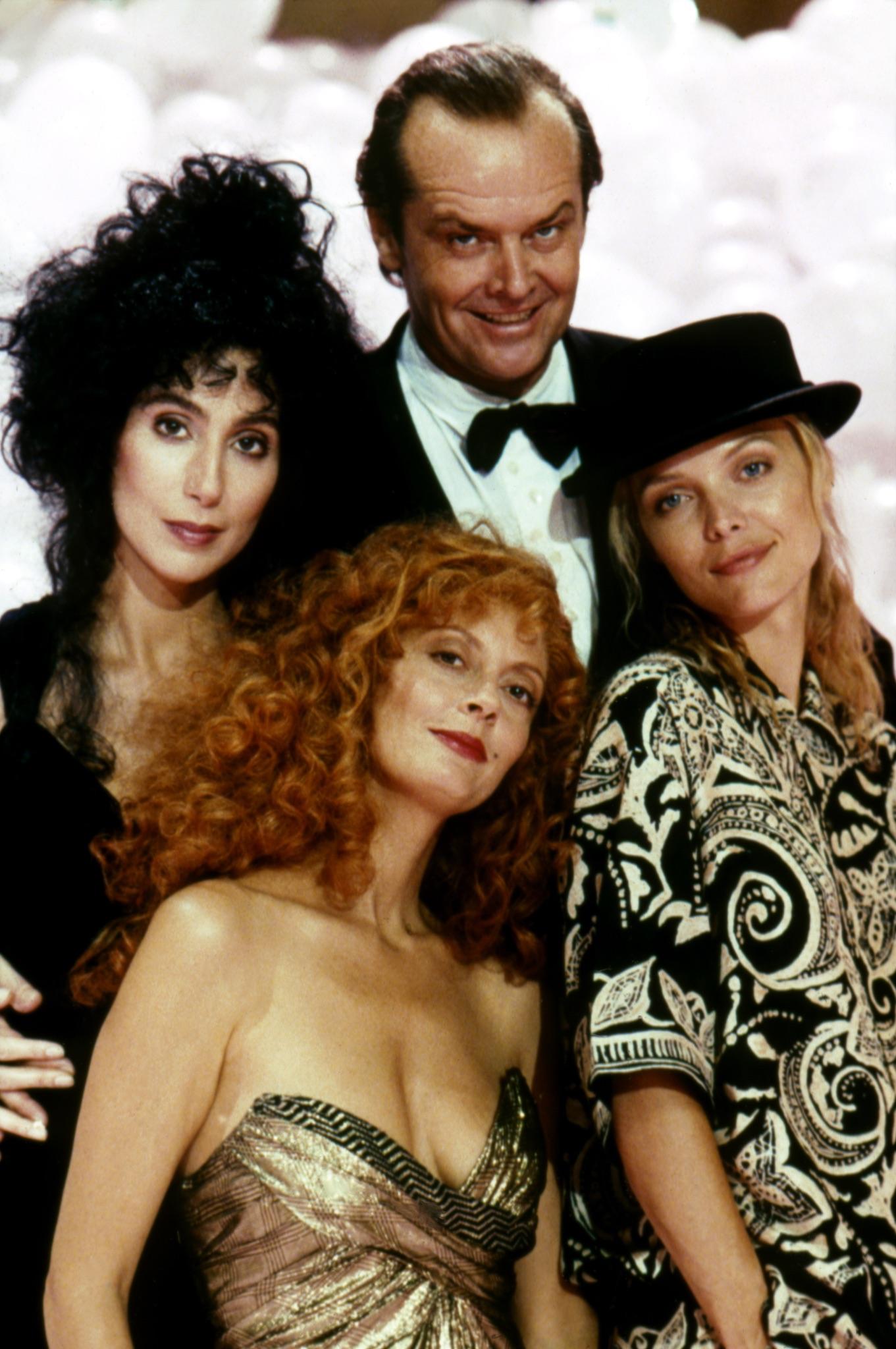
Weak “Witches of Eastwick” Yields Entertaining Tennis Music

Weak “Witches of Eastwick” Yields Entertaining Tennis Music

by 

in ,
20 responses

I just rewatched “The Witches of Eastwick” the other week, I think for the first time since it was theaters in 1987 – nearly 40 years ago! It’s a pretty bad movie, which I recognized even at the time. The metaphors landed better in John Updike’s novel, which I read when it first came to paperback, but to be honest, I wasn’t all that crazy about the book either.

First of all, so much money was thrown at the movie. And who’s idea was it to make it into such a broad comedy? The tone is all wrong, and none of the leads have any chemistry with one another, not with Jack Nicholson, not with anyone else. It’s a pretty depressing, resoundingly hollow movie, with Jack giving yet another one of his mad, oh so tiresome post-“Shining,” scenery-chewing performances. Moreover, the whole thing just devolves into a special effects extravaganza. Updike must have been vomiting harder than Veronica Cartwright.

On the plus side, this was the first time I noticed Richard Jenkins was in it. He’s gone on to much better things. But Nicholson, Cher, Susan Sarandon, Michelle Pfeiffer, George Miller (director of “The Road Warrior” and “Babe”), and John Williams! What was the price tag for this thing? I guess it was a modest success, making three times its budget – peanuts by today’s standards. And yes, the movie comes to life for maybe a minute or two during a diabolical rehearsal of Dvořák’s Cello Concerto, but as a whole the film is Halloween entertainment for very undiscerning viewers. I’d rather rewatch “Phantasm.”

That said, Williams does what he can with it, and I have to admit the theme is an instant earworm. I found this clip in which he has fun with the music he composed for a telekinetic tennis match between the film’s four principals. In spirit, there’s a little Prokofiev in there, maybe a little Ravel, but all in all, it makes you lament that Williams wasn’t a concert composer in the early decades of the 20th century.

It’s also a rare opportunity to see what an accomplished pianist Williams is. In his youth, he entertained ambitions to be a concert pianist, but he also adored jazz. His talents as an improviser, arranger, and crackerjack sight-reader made him a perfect fit for the movies.

As an encore, Seiji Ozawa conducts “E.T.”


Williams squanders an indelible tune


Comments

20 responses to “Weak “Witches of Eastwick” Yields Entertaining Tennis Music”

  1. Anonymous

    I was working at the movie theater in the 25th St. shopping center when this came out… let’s just say, I’m glad I didn’t have to pay to see it….🙄

    1. Classic Ross Amico

      Lesley Siedt I think I actually saw it at that theater. I hope you didn’t have to sweep up my popcorn. 🍿 🤭

  2. Anonymous

    Women!!! Was it a mistake?!??? Or did He do it to us on purpose?!!??

    1. Classic Ross Amico

      Jon Haag Can you make it crazier, Jack? No… CRAZIER!

  3. Anonymous

    Another of your brilliant pieces. Such a pleasure to read.

    1. Classic Ross Amico

      Daron Hagen Wow, thank you, Daron. I was actually a little self-conscious about it, because I had just tossed it off, and to me it felt weak. Thanks for the confidence-booster!

  4. Anonymous

    Screenwriter Michael Christofer, also wrote that godawful adaptation of Bonfire of the Vanities. The start of dePalma’s career downward spiral.

    1. Classic Ross Amico

      Brennan Morsette Ouch! From what I understand, there was also a lot of meddling by the suits. And likely some ill-feeling among the cast and crew. Cher took the role intended for Sarandon (Sarandon didn’t find out until she showed up for the first day of shooting); and at some point, I’m not sure if it was before or after, Cher was pressured to leave because she wasn’t attractive enough (in Nicholson’s and Miller’s opinion). Miller actually quit twice. Nicholson finally had to talk him down and take him under his wing and teach him how to handle the producers. But yeah, the unbelievably stupid last 20-minutes of the film was the result of studio interference. Not that anything would have saved the movie. It required a much more incisive, satirical touch, cleverly handled and delivered with a modicum of subtlety. And maybe not so many stars. Certainly they weren’t going to get any of that from Nicholson. When you hire a greasepaint devil, you’re going to get a hambone performance. But at some point, Bill Murray was attached to the project (to play Nicholson’s role!). From that point, it was probably never going to be any better.

      1. Anonymous

        Classic Ross Amico when are you and Roy covering it?

      2. Classic Ross Amico

        Brennan Morsette We’re not, if I can help it! I’m interested to learn that Michael Cristofer was not only a Pulitzer Prize recipient (for his drama “The Shadow Box,” which was also awarded a Tony for best play), but he was born in Trenton and grew up virtually in my back yard, in Hamilton, NJ, only minutes from here and even closer to my former place of employment. So he’s got some talent, even if some of his screenplays were made into bad movies. I notice that he’s also an actor and director.

      3. Anonymous

        Classic Ross Amico I wish Miller had made another Mad Max with Nicholson in it and Williams doing the music. That would have been interesting.

      4. Classic Ross Amico

        Brennan Morsette LOL! Are you yanking my chain?

      5. Anonymous

        Classic Ross Amico I would have preferred Mad Max yes. I don’t know why Miller wanted to make Witches. I guess he didn’t lol

        I agree with your assessment of Updike’s book, but they weren’t going to follow it either so what was the point?
        His book, if I remember correctly, was more of a statement on the 60’s and its permissiveness. The witches were not feminist heroes. If fact, I think they killed a rival for Van Horne’s affections at the end. It’s been a while since I read it.

      6. Classic Ross Amico

        Brennan Morsette Yeah, there’s been some debate as to whether or not the book was intended to be ironic. I remember Updike often got blowback from some feminists and critics because of how he wrote his female characters in general. I can’t really speak to that, because I never read the “Rabbit” books, or any of his other stuff, for that matter, beyond a short story, “A&P,” which was frequently anthologized. Even in that, the first-person narrator ogles a nubile teenager, but he was a grocery bagger, and I think he was supposed to be in high school himself, so it kind of suited the character. In the case of “Witches,” which still stirred some controversy, some of the literary folk defended it, saying Updike was making a point. Also, just because you write a character a certain way doesn’t mean you condone his or her behavior. That’s been an issue with some readers probably for as long as there’s been fiction. Anyway, all the tedious ’60/’70s small town sexual nonsense in books of that era always put me off “adult” fiction. Too many of them were just so sordid and depressing. Lord knows, there was plenty of objectification of female characters in sci-fi, fantasy, adventure, and detective novels, but those all had the resonance of a comic book. And if I felt bad reading literature, it was usually because somebody turned into a cockroach or got stabbed and tossed into a lake.

      7. Anonymous

        Classic Ross Amico oddly enough, “A&P” is also, for me, the only other thing I read by him. I liked that. I was never interested in the Rabbit books. They seem to have fallen out of favor now too.

      8. Classic Ross Amico

        Brennan Morsette Yeah, it’s crazy. A lot of the literary figures of that era, you really don’t hear all that much about them anymore. Are people reading Saul Bellow? Bernard Malamud? But that often happens after artists die. Quite naturally, they’re not creating any more work! With luck, there’s a revival of interest somewhere down the road. If not, oh well. There are still folks who read Booth Tarkington, Sinclair Lewis, John O’Hara. Not many, granted, but they haven’t completely been forgotten. And then you get guys like us, who plumb around the popular fiction of the 1890s. 😄

      9. Anonymous

        Classic Ross Amico yep. Gore Vidal, Norman Mailer, Truman Capote, Joseph Heller. I remember when Ray Bradbury and Theodore Sturgeon were big names in the sf community. Now most don’t even know who they are.
        I was reading Earthly Powers by Anthony Burgess recently. He was someone who took his craft seriously but he is almost completely forgotten now except for Clockwork Orange. His other novels are mostly out of print.

      10. Classic Ross Amico

        Brennan Morsette It’s terrifying to think that anyone interested in sci-fi doesn’t know Ray Bradbury. But it wouldn’t surprise me, even though I wouldn’t even have considered it had you not pointed it out. I had a number of Burgess’ novels, but I think I might have sold them all off. The only one I read is “A Clockwork Orange,” but I was always curious about his other works, because I knew he was very much interested in music, and in fact was a composer himself. I have his two volumes of autobiography, one of them signed. I picked it up that way off of a remainder table! Capote is a terrific writer, and Heller’s “Catch-22” is a book everybody read. I can’t say that I’ve read any Vidal or Mailer, but they were both celebrities. Capote too. It was nice to live in world where people were celebrated for more than movies and pop music.

    2. Anonymous

      Classic Ross Amico Burgess was very much interested in music, and some of his pieces are on yt if you are so inclined.
      He also wrote a novel about Mozart, and one of the main characters in Earthly Powers was a composer of librettos (a lot on that subject).
      The more distance I am away from Earthly Powers, the more I think it’s one of his better books (although I have only read ten) and one of my favorites this year. It’s a very long book and not for everyone but there is also a lot to chew on, philosophically speaking.

      1. Classic Ross Amico

        Brennan Morsette Also, his “Napoleon Symphony” hews to the structure of Beethoven’s “Eroica” (which Beethoven had originally dedicated to Napoleon). When Kubrick wanted to do a Napoleon film, Burgess suggested the conceit of structuring it in this way, and Kubrick asked him to write a novel that could be fashioned into a screenplay. Of course, the movie never came to be. It could have been a good one.

        I just checked my personal library, and the Burgess books I still have in my possession are, beside the two volumes of autobiography I mentioned and a paperback somewhere of “A Clockwork Orange,” are “M/F,” which I should probably get rid of, I don’t know why it’s still there, “The Devil’s Mode,” short stories, a few of them related to music, and “This Man and Music,” of which, for some reason, I have two copies.

        I had “Earthly Powers” at some point, or maybe it was just in my bookshop, and probably a few others. I just figured I had so many other things I wanted to read. If the urge took me, I’d look for it again later. Of course, the prices on the hardbacks have since gone up.

        I also have a couple of CDs of Burgess’ music, some orchestral works released on Naxos and a guitar disc put out by Harmonia Mundi. None of it appeals to me as much as this “Petite Symphonie.”

        https://www.youtube.com/watch?v=kyppJLHNxtA&t

Leave a Reply

Tag Cloud

Aaron Copland (94) Beethoven (95) Composer (114) Film Music (153) Film Score (143) Film Scores (255) Halloween (107) John Williams (198) KWAX (233) Leonard Bernstein (105) Marlboro Music Festival (125) Movie Music (168) Mozart (92) Opera (222) Philadelphia Orchestra (91) Picture Perfect (174) Princeton Symphony Orchestra (110) Radio (90) Ross Amico (244) Roy's Tie-Dye Sci-Fi Corner (290) The Classical Network (101) The Lost Chord (269) Vaughan Williams (107) WPRB (397) WWFM (881)

DON’T MISS A BEAT

Receive a weekly digest every Sunday at noon by signing up here


RECENT POSTS