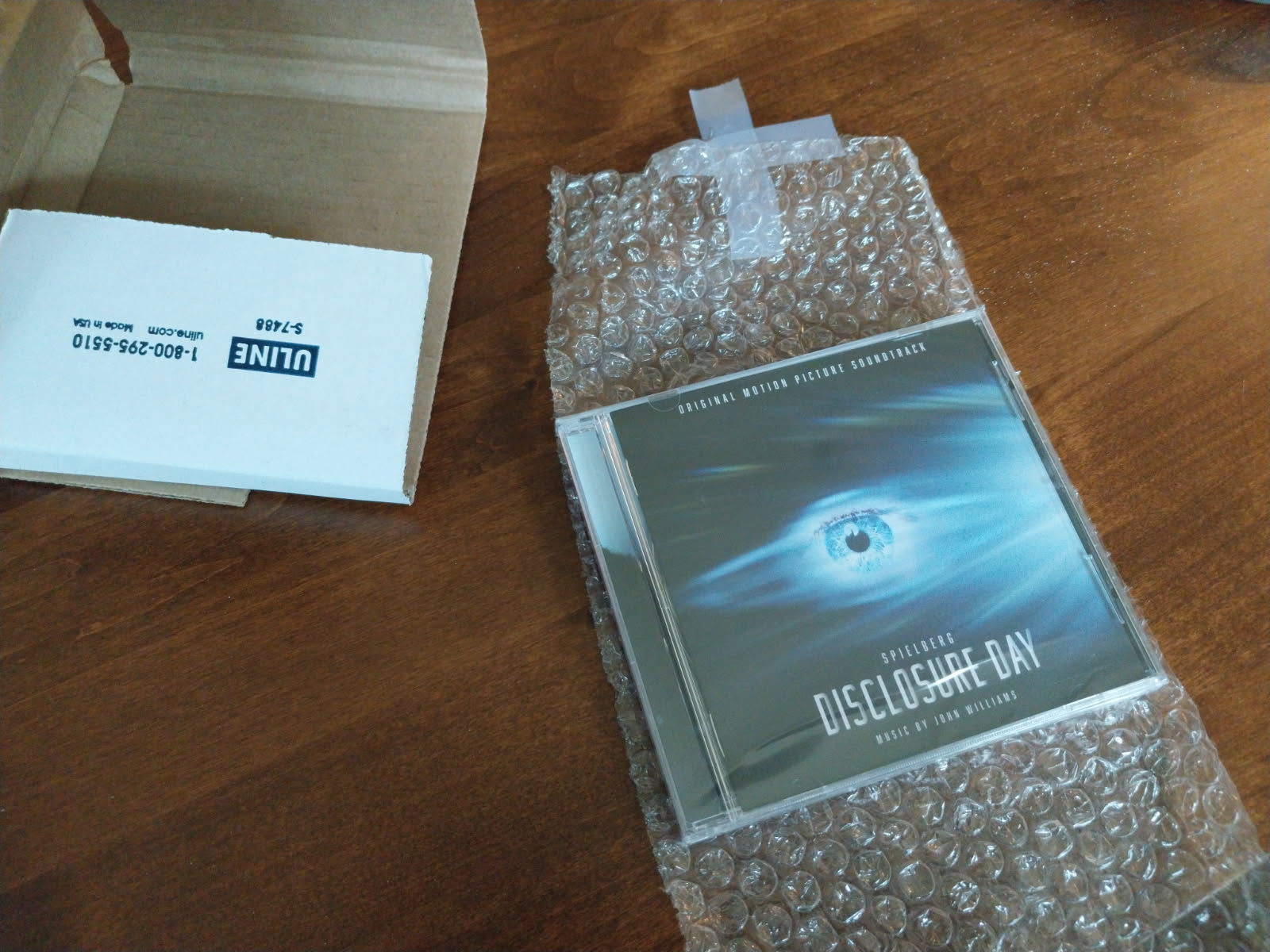
This finally arrived in the mail last week. Does anyone who’s seen the movie even remember it at this point? The quality of the film aside, I am always thankful for more John Williams, especially when he’s not squandering his talent on the diminishing returns of “Star Wars” or Indiana Jones.
What’s remarkable, Williams having written and recorded this at the ages of 93 and 94, is how good it is. This is not one of his scores in “heroic blockbuster” mode. The car chase cue is one of the least remarkable tracks on the album. The train scene everyone raves about, for some reason (it makes no sense), is presented in the film without music. Rather, it is the emotional moments and the moments of wonder (in the music, if not the film) that resonate and remind one of what the movie is so sorely lacking.
The film opened on June 12. I ordered the CD from Waxwork Records on June 18. The soundtrack was shipped exactly one month later. This should not be construed as a slam against Waxwork. It’s just the way things are now, and I can’t see how it helps sales. If the product is not available for purchase by your average, moderately-interested person on the street, either immediately in a brick-and-mortar shop or for two-day delivery from an online retailer, how can you expect more than a few thousand sales, mostly to hardcore John Williams fans and die-hard film score collectors? I guarantee Williams’ name alone would generate many times that amount, if only they would make it easier for people to buy it. As it is, it’s not even available on Amazon, save as a digital download.
Quality-wise, I have no qualms. This is a polished product of the sort that used to be put out by the major labels. The sound is immediate, without seeming to be right in your face; the choral contributions and electronic elements blend well with the acoustic instruments. I must say, the bass is quite striking, to a degree I haven’t really noticed in previous orchestral soundtrack releases – although I confess my consumption of newer movie music has diminished, most of my purchases tending toward music of decades past. Considerably past, in terms of most of the classical stuff. If you want to really feel the lower registers – the cellos, double basses, and percussion – “Disclosure Day” has a unique, appealing sound. More important is the content, and there’s plenty here, in terms of emotion and lyricism, for me to enjoy.
Alas, physical media are not the priority they once were. I miss the days of just being able to walk into a record store and buy a soundtrack when it arrived a week or two before a film’s release. Now, if you want the CD, you have to do your research, find out who is distributing it, and jump through the hoops of preorder and postal delivery. The digital downloads for “Disclosure Day” weren’t even available until the day of the film’s release. I really don’t understand this strategy. A successful soundtrack album has always been one more tool with which to sell a film. How many repeat viewings has Williams’ music inspired? But all that is peanuts, I suppose, in a world in which a movie has to make $300 million in order to turn a profit.
When I called Waxwork to request a few tracks to air on one of my radio shows in advance of the official soundtrack release, I was told it wouldn’t be possible; there would be a rights issues, and I would have to contact Universal directly. Everything has become such a corporate labyrinth over the past decades, it’s like trying to infiltrate the Illuminati to get permission from a studio. Don’t even get me started on Disney. At least at Waxwork someone actually answered the phone, and he was normal and pleasant, competent and human and real, the way people used to be. The prospect of having to deal with Universal was not appealing. In the end, I decided to wait the extra week and just air some tracks from the digital download. So yeah, I bought the soundtrack twice.
All this jealously-guarded secrecy surrounding every aspect of the film, and the final trailer basically gives away the entire movie…
My summation is spoiler-free: I can describe my viewing experience as one of anger, at the start, softening, by the end, to disappointment. At least Emily Blunt and John Williams were good, though I have to admit, in the scenes where Spielberg tries to be more contemporary and dystopian, the score does seem a bit out of place. As I say, Williams does emotion and wonder very well. Watching “Disclosure Day” was a reminder of how much those two qualities are lacking in movies today. Even Spielberg movies, apparently.
I can’t believe I am living in a world where you can’t get a CD of a John Williams soundtrack. The guy who broke all records for soundtrack sales and singlehandedly revived the orchestral film score with such verve that it carried into the 21st century. His appeal transcends the collectors’ market, or at least it did. But since everyone’s awareness about anything, beyond what they are fed on social media, seems to have diminished, you have to be 50 years old to remember a better world.
Disney has to be the biggest group of idiots, judging from its handling of Williams’ last soundtrack, for “Indiana Jones and the Dial of Destiny” – a far less interesting score, save for the delectable “Helen’s Theme,” which is pure golden age, though evidently not appreciated by everyone. As has been the case with the current score, clearly different people expect different things from John Williams. If it doesn’t possess “Jurassic Park” bombast, they’re incapable of recognizing or remembering a theme, apparently. At its best, the music for “Disclosure Day” is gorgeous. I’ve already commented on how the opening track, “Listen,” taps into the spiritual world of Vaughan Williams’ “Tallis Fantasia.” Already, right there, I am sold.
Others have pointed out a kinship between one of the tracks and Williams’ music for Spielberg’s “A.I.,” which, by the way, is easily my most-hated Spielberg film. And while I’m at it, he really missed the boat on creating a prescient sci-fi classic about honest-to-goodness, now-in-the-headlines, anxiety-provoking A.I.! While “Disclosure Day” doesn’t make me violently angry the way “A.I.” did, both movies make me question why I ever liked Spielberg to begin with. But then I remember “Jaws,” “Raiders,” “CE3K,” “E.T.,” and a few others.
“Disclosure Day” is no “Close Encounters,” for as much as it wants to be, and it is certainly no “E.T.” Say what you want about Spielberg’s remake of “War of the Worlds,” at least it was coherent. In 2 ½ hours, “Disclosure Day” has plenty of time to tell its story. But the ideas the screenplay seems to think are the most profound don’t cut very deep, at least in the way they are handled, and plot holes so glaring a ten-year-old child would recognize them are brushed off with a single line of dialogue, if that.
Despite some nice visual touches and some potentially interesting, sadly underdeveloped ideas, there’s more talk than show in what is, after all, a visual medium, and one this director has always exploited better than just about everyone else.
“Disclosure Day” often doesn’t make sense, and I couldn’t understand what any of the critics saw in it, until I realized we have very few actual critics who understand movies anymore, or even basic storytelling. The film proves that, if Spielberg wants to speak to the heart, if he wants empathy and wants us to “listen,” then John Williams is indispensable.
This soundtrack gives me a lot of pleasure, and moves me in a way the movie most definitely did not.
Category: Album Reviews
-
Full Disclosure About “Disclosure Day”
-

In a York Bowen State of Mind
As a nutty musical Anglophile, I have to say I’ve never been able to get my head around the music of York Bowen. Lord knows, I’ve tried. Every year as a radio host, I’d pull something from the station library on his birthday anniversary and give it a whirl. But he was not someone whose music I sprang for whenever looking for a piece to fill out a program.
Bowen lived from 1884 to 1961. His contemporaries included Frank Bridge, John Ireland, Cyril Scott, John Foulds, Arnold Bax, George Dyson, Lord Berners, George Butterworth, Rebecca Clarke, and Eric Coates.
Allegedly, he enjoyed considerable success in his lifetime as a pianist and composer, and his career unquestionably contained some notable achievements. Bowen was the soloist in the first recording of Beethoven’s Piano Concerto No. 4. He played the premiere of William Walton’s Sinfonia Concertante for Orchestra and Piano. He published his own editions of the piano works of Mozart and Chopin. His own music was championed by such artists as Fritz Kreisler, Efrem Zimbalist, Lionel Tertis, and Adrian Boult (naturally).
Kaikhosru Shapurji Sorabji, who got to the point that he didn’t want his works performed by anyone (to the point that he enacted a 36-year ban), dedicated his to Twenty-Four Preludes, Op. 102, to him. Camille Saint-Saëns went so far as to praise him as “the finest of English composers.”
Who am I to disagree? But alas, I do.
Bowen’s music, while Romantic in influence and disposition, is not to my ear especially “English,” in the sense that, say, Vaughan Williams or Walton are English. Also, I just don’t find him all that interesting.
Or at least I didn’t. But maybe I just wasn’t listening closely enough.
I have the great good fortune to live near Princeton Record Exchange, with its vast store of secondhand merchandise always deeply discounted. It is not unusual for me to walk out of there with a shopping bag full of classical music treasures priced at a dollar or two or maybe three. The trouble is, I buy so much that, with a collection of over 10,000 recordings, it’s not unusual for me to duplicate. I used to take them back and swap them out, but for a dollar, it got to the point where I figured why bother? Instead, every December I just divvy up the dupes and send them out in bulk as gifts to receptive friends.
This year, one of these was a Chandos recording from 2011 of York Bowen’s Symphonies Nos. 1 & 2, with Sir Andrew Davis conducting the BBC Philharmonic, which, when I went to unpack my treasures following one of these PREX expeditions, I discovered I already own, but obviously never listened to it. In driving around last week I decided to take it with me as companion on my travels. The Symphony No. 1 did nothing to change my opinion of Bowen. It’s innocuous music, though hardly indelible, a student work, written when the composer was 18 years-old. At times, it seems to be on the verge of blossoming into a light music wallow, along the lines of somebody like Roger Quilter, but sadly it never quite gets there.

Version 1.0.0 The Symphony No. 2 (1909-11), however, is another matter entirely, and may at last have made me a convert. The work is compelling, with a degree of drama and forward momentum, it has some good tunes, and it’s strikingly orchestrated. It’s also interesting to note how Tchaikovsky might have been filtered through an English sensibility. It doesn’t sound exactly like its prototype – at times it’s like a hybrid of Tchaikovsky and Bowen’s classmate Arnold Bax – but you can pretty much lay a transparency of a Tchaikovsky symphony over it and the influence is unmistakable. The scherzo reminds me of Mendelssohn (an enormous influence in the U.K. in the 19th century) and even a little bit of Korngold. It’s sparked my interest to go back and listen to all those other Bowen works I’ve dismissed, to see if maybe I’d just been having a bad day, or at the very least, if there’s an ember in there somewhere that in my growing disinterest I might have overlooked.
This is an often-unacknowledged aspect, I think, of one’s mania for classical music. It’s a genre that, in some respects, is a celebration of the past, as the repertoire, accumulated over centuries, is enormous. Yet because it’s so vast, one discovers new things all the time. So even if the music itself has been around for quite a while, there is the stimulation of novelty. Of course, one can also listen to the greatest works again and again, and in different performances that reveal further wonders within the familiar.
Even if we’re to ignore the fact that there are new “classical” works being written all the time, in this kind of aural museum, there is always growth. Of course, the experience is not unique to this particular art form. We see or hear things differently, depending on where we are in our individual lives – our maturity, our life circumstances, our moods, our stresses, the time of day, the weather, what we’ve eaten for lunch. Sometimes, for whatever reason that has nothing at all to do with the music itself, it just doesn’t hit us right.
Who knows, maybe this has been the case for me with York Bowen.
I typed up these thoughts last week, but it was so late in the day, I figured it would get lost on Facebook, so I set it aside, planning to post it in the morning. Then I forgot all about it, until Rocky Lamanna played a York Bowen piano concerto yesterday afternoon on KWAX. (Thanks, Rocky!) How many half-baked posts linger forgotten among my Word documents, I wonder?
In the meantime, you know what? I got to enjoying Bowen’s Symphony No. 1 too. It’s nowhere on the same scale or level of flamboyance as its successor, but the work does have its charms. Its geniality is infectious, and revisiting it by way of the Second Symphony, it’s obvious that Bowen’s affection for Tchaikovsky was there all along. I particularly like the last movement, which also picks up a trick or two from Schumann. On the Chandos album, the work receives its world premiere recording.
Is it life-altering, world-shattering music? No, but it is pleasurable to listen to. I’m glad I made the effort to really let it in. Sometimes you have to live with music for a while, through all moods and extraneous conditions, to truly get to know it.
See what you make of Bowen’s Symphony No. 2.
Tag Cloud
Aaron Copland (94) Beethoven (95) Composer (114) Film Music (148) Film Score (143) Film Scores (255) Halloween (97) John Williams (196) KWAX (232) Leonard Bernstein (105) Marlboro Music Festival (125) Movie Music (163) Mozart (91) Opera (215) Philadelphia Orchestra (90) Picture Perfect (174) Princeton Symphony Orchestra (110) Radio (90) Ross Amico (244) Roy's Tie-Dye Sci-Fi Corner (290) The Classical Network (101) The Lost Chord (269) Vaughan Williams (107) WPRB (397) WWFM (881)