Tag: A Clockwork Orange

  • Roy’s Tie-Dye Sci-Fi Corner Anniversary

    When I got home, I had to get my sound files for “Picture Perfect” and “The Lost Chord” in to KWAX for the next few weeks (they’re on the West Coast and therefore three hours behind), but now that I’m cooking dinner, I can finally take a few minutes to acknowledge my convivial lunch today with Roy! It’s all about the food, people…

    Yes, indeed, it’s my third anniversary as cohost of @[100063986017424:2048:Roy’s Tie-Dye Sci-Fi Corner], the pandemic antidote that reunited two old friends after an intermission of, I think, 34 years. Thank you, Roy, for inviting me on your show. I guess I’m one of those nightmare guests who never knows when to leave.

    Here we are this afternoon, a couple of high-end tie-dye models, taking in lungs full of carcinogenic smoke from burning Canada, so you don’t have to. Sending condolences and best wishes to our friends north of the border (including the four-legged ones). Who would have thought we’d all live to see the kind of dystopia we used to encounter only in bad 1970s science fiction movies. All that’s missing is Jan Michael Vincent and some giant scorpions.

    Thanks to all of you who have tuned in week after week for the past few years. I’ve really enjoyed getting to know a lot of you through your witty and insightful commentary.

    If you haven’t tuned in, what are you waiting for? Oh. I guess we’re not on this week. But we’ll be back on June 16 at 7:30 PM EDT! If you really can’t wait, listen to what we have to say about “A Clockwork Orange,” at the link:

    https://www.facebook.com/watch/live/?ref=watch_permalink&v=634665158576124

    Or visit some of our other past shows, all archived on the “Roy’s Tie-Dye Sci-Fi Corner” Facebook page:

    https://www.facebook.com/roystiedyescificorner

    Here’s to a live-long-and-prosperous fourth year! Nanu nanu!

  • A Clockwork Orange Anniversary

    A Clockwork Orange Anniversary

    Our govoreeting about Stanley Kubrick’s “A Clockwork Orange” (1971) purred away real horrorshow last night, with angel trumpets and devil trombones, and some dobby clips from past episodes to celebrate my third anniversary on Roy’s Tie-Dye Sci-Fi Corner. It was gorgeousness and gorgeousity made flesh. The very thing for leering and smacking over eggiwegs and lomticks of toast, my brothers. Viddy well!

  • Picture Perfect vs. Sci-Fi Airing Conflict

    Picture Perfect vs. Sci-Fi Airing Conflict

    And all at once, I find I am competing against myself…

    Since my shows were dropped from WWFM The Classical Network, after a combined run of 23 years, the only way to enjoy their broadcast is in syndication. As things stand, the most reliable source for “Picture Perfect” and “The Lost Chord” is now KWAX, the radio station of the University of Oregon.

    Unfortunately, that means that “Picture Perfect” now streams directly opposite “Roy’s Tie-Dye Sci-Fi Corner!” Holy Agamemnon!

    But I’m working on it. Now that the sound files are in my possession, and I’ve got the equipment so that I can finally think about recording some fresh episodes, I’ll be pushing for the shows’ distribution to other markets, so that hopefully soon they will be available to listen to at a variety times.

    For tonight, you’ve got a difficult decision to make, between a recorded hour of music from films set during the Restoration, on “Picture Perfect,” and a livestream discussion of Stanley Kubrick’s “A Clockwork Orange,” on “Roy’s Tie-Dye Sci-Fi Corner.”

    Interestingly, there is some overlap, as both employ references to the music of Henry Purcell (“The Fairy Queen,” on the one hand, and “Music for the Funeral of Queen Mary,” on the other).

    That said, this week on “Picture Perfect,” beauty patches are back! It’s an hour of lace and licentiousness, with music from movies set during the reign of Charles II.

    “Restoration” (1995) features quite the cast, with a pre-“Iron Man” Robert Downey, Jr. as a young doctor torn between duty and debauchery. He succumbs to the latter at the court of Charles, played by Sam Neill, before finding redemption as he battles the Great Plague and braves the Fire of London. The film also stars David Thewlis, Polly Walker, Meg Ryan, Ian McKellen, and Hugh Grant. The main title of James Newtown Howard’s score takes its impetus from Purcell’s “The Fairy Queen.” And indeed, there are baroque inflections throughout.

    George Sanders plays Charles in “The King’s Thief” (1955). Edmund Purdom is a highwayman who pilfers an incriminating book from David Niven. An aristocratic schemer, Niven will stop at nothing to get it back. The swashbuckling score is by Miklós Rózsa.

    I don’t recall Charles making an appearance in “The Draughtsman’s Contract” (1982), Peter Greenaway’s saucy, though strangely aloof, Restoration opus. However, there is plenty of licentiousness and an abundance of outlandish wigs. And, it being a Greenaway film, it is certainly strange in more ways than one. Michael Nyman’s score puts a minimalist spin on baroque sources. (Purcell is listed in the film’s credits as “musical consultant.”) For the theme, Nyman whips “The Fairy Queen” into a kind of musical egg cream, complete with 1950s-style rock and roll saxophones.

    Finally, “Forever Amber” (1947) is based on a then-scandalous novel by Kathleen Winsor, about an ambitious young woman’s rise through the bedchambers of the Royal Court. The film was directed by Otto Preminger. Linda Darnell is Amber. Once again, George Sanders plays Charles, eight years before reprising the role for “The King’s Thief.” Cornel Wilde, Richard Greene, and Jessica Tandy are also in the cast. Philadelphia-born composer David Raksin, he of “Laura” fame, plays fast and loose with music of the era.

    Bwoo-hoo-hoo-hoo! It’s so naughty! Everyone, giggle into your handkerchiefs and wear ribbons on your shoes. We’ll be powdering our faces and going heavy on the rouge, on “Picture Perfect,” music for the movies, now in syndication on KWAX.

    “Picture Perfect” and “The Lost Chord” can now be streamed at the following times at the link below. Keep in mind that KWAX is on the West Coast, so there’s a three-hour time difference (conversions are included in parentheses) – actually rather convenient for those of us located in the vicinity of their erstwhile home at WWFM.

    PICTURE PERFECT – Fridays on KWAX at 5:00 PACIFIC TIME (8:00 PM EDT)

    THE LOST CHORD – Saturdays on KWAX at 4:00 PACIFIC TIME (7:00 PM EDT)

    https://kwax.uoregon.edu/

    The ”Clockwork Orange” livestream can be seen here, on Roy’s Tie-Dye Sci-Fi Corner, tonight at 7:30 EDT:

    https://www.facebook.com/roystiedyescificorner

  • A Clockwork Orange: Funny or Frightening?

    A Clockwork Orange: Funny or Frightening?

    With my lifelong love of classical music – and subversive sense of humor – one might well wonder why it’s taken us so long to get around to discussing “A Clockwork Orange” (1971). Stanley Kubrick’s controversial adaptation of Anthony Burgess’ novel presents an intelligent young sociopath who gets up to all sorts of hooliganism while worshipping Beethoven. We’ll talk about it this week on “Roy’s Tie-Dye Sci-Fi Corner.”

    Oscar Wilde wrote, “There is no such thing as a moral or an immoral book. Books are well written or badly written. That is all.”

    One could just as easily apply Wilde’s maxim to Kubrick’s film. Both film and book portray acts of “ultra violence” that, by all rights, should be both horrific and repellent, and yet Kubrick presents the material in such a way that the story comes across, basically, as a black comedy. And there’s the rub.

    The film is actually quite funny, in a twisted sort of way, with deliberately outrageous costumes and set design, grotesque cinematography, and exaggerated performances. Electronically-altered Beethoven and hyperkinetic Rossini grace the equally over-the-top soundtrack. And then there’s Gene Kelly.

    We’re like Alex and his droogs, exceeding all speed-limits, on a nocturnal joyride in a stolen supercar. When all at once we’re brought up short by the content of a particular scene that we know should be horrifying, suddenly we’re conscious of the inappropriateness of the rigored smile on our lips. That’s when the movie becomes truly disturbing.

    Kubrick subjects us to an inversion of Alex’s rehabilitation therapy, in which we find a peculiar enjoyment in violence, but then the therapy is reversed, so that we realize how monstrous we’ve allowed our sympathies to become. It’s a great trick, Kubrick turning a cold lens on the viewer. It’s the most subversive element in a film that seems to embrace subversion.

    The peel of “A Clockwork Orange” turns out to be a multilayered one. There are all sorts of interesting questions raised about free will, government, science, correctional institutions, violence and objectification, and yes, morality. Watching “A Clockwork Orange” is like being stretched around inside a taffy puller. Yet somehow, it’s also very, very funny. To some.

    Over the years, I’ve come to realize there are those who are not equipped to take the journey: basically those who see no humor in it at all. These fall into two categories: those who find the characters’ behavior too difficult to watch; and those who glorify and emulate it. It’s a movie that inspired copycat crimes, and which became a popular defense among attorneys arguing for lighter sentences for their juvenile clients. Kubrick himself had it pulled from distribution in the U.K., where he made his home, after receiving multiple death threats. The film is especially attractive to young people, which is why you still see so many Little Alexes strolling around college campuses at Halloween.

    Should we blame the movie for celebrating violence? Or is, in fact, “A Clockwork Orange” neither moral nor immoral? It’s a film that plays with our perceptions by forcing us to acknowledge some nauseating truths – holding our eyes open, as it does Alex’s – even as we laugh at some very inappropriate jokes.

    For the politically correct, I’m guessing, it’s a film that has aged very badly; but for students of human nature, it’s all too up-to-date.

    Just one man’s analysis. There’s plenty of food for thought, as we mark my third anniversary as neither a moral nor an immoral co-host on Roy’s Tie-Dye Sci-Fi Corner. Orange you eager to be in the comments section? We’ll be there like “Clockwork,” as we livestream on Facebook, YouTube, etc., this Friday evening at 7:30 EDT.

    https://www.facebook.com/roystiedyescificorner

    Viddy well, little brothers!


    Did you know that Anthony Burgess himself was a composer? In fact, he considered himself as much a composer as a writer. You can check out his “Petite Symphonie pour Strasbourg” here:

    A rediscovered Cello Sonata, appropriate Memorial Day, it turns out, since the slow movement bears the dedication “For the Dead 1939-45.”

    Burgess works for piano

  • Burgess Symphony Kubrick Chelsea Drug Store

    Burgess Symphony Kubrick Chelsea Drug Store

    Neat discovery du jour: a neoclassical symphony by Anthony Burgess, author of “A Clockwork Orange”:

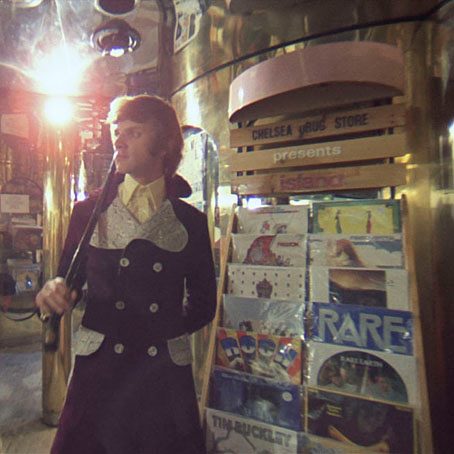
    Some monomaniac has managed to identify most of the prominently-displayed albums at the Chelsea Drug Store, the record shop seen in the Kubrick film!

    Alex in the Chelsea Drug Store


    PHOTO: Kubrick’s vision of Burgess’ dystopia, where street punks worship Beethoven, and record shops thrive

    (O time machine, where art thou?)

Tag Cloud

Aaron Copland (92) Beethoven (95) Composer (114) Film Music (120) Film Score (143) Film Scores (255) Halloween (94) John Williams (185) KWAX (229) Leonard Bernstein (100) Marlboro Music Festival (125) Movie Music (135) Opera (198) Philadelphia Orchestra (88) Picture Perfect (174) Princeton Symphony Orchestra (106) Radio (87) Ralph Vaughan Williams (85) Ross Amico (244) Roy's Tie-Dye Sci-Fi Corner (290) The Classical Network (101) The Lost Chord (268) Vaughan Williams (103) WPRB (396) WWFM (881)

DON’T MISS A BEAT

Receive a weekly digest every Sunday at noon by signing up here


RECENT POSTS