Tag: Aaron Copland

  • Thanksgiving Film Music Family Community Country

    Thanksgiving Film Music Family Community Country

    This week on “Picture Perfect,” with Thanksgiving fast approaching, we’ll have music from films about family, community and country.

    Aaron Copland’s music for “The Cummington Story” (1945) sets the tone. The short semi-documentary, made for the Office of War Information, relates the gradual acceptance of European war refugees into a cautious but fundamentally decent New England community. The score is pure Americana, with some of the material later finding its way into Copland’s Clarinet Concerto and “Down a Country Lane.”

    Thank you, amazing YouTube, for making the complete film available online!

    James Horner’s music for “Field of Dreams” (1989) is cut from the same cloth, or at any rate it is a square in the same folksy counterpane. Horner clearly wrote the music under the influence of Copland’s “Our Town.” The film itself is a male wish-fulfillment fantasy, in which a man finds redemption and a new understanding of his father in the enchanted cornfields of America’s heartland.

    “The Best Years of Our Lives” (1946) tells the tale of the three war veterans struggling to readjust to civilian life. It isn’t easy, but with the support of family and friends, there’s plenty of hope for the future. Hugo Friedhofer wrote the Academy Award-winning score. The orchestrations were by Copland protégé (and composer of “The Big Country”) Jerome Moross.

    Finally, Daniel Day-Lewis elevated Steven Spielberg’s “Lincoln” (2012) to greatness with one of the most amazing performances ever captured on film. Day-Lewis’ gentle but shrewd Man of Destiny would go to any lengths to hold the country together. John Williams tapped into America’s proud musical heritage, clearly influenced by Copland and Ives, to create a score of stirring nobility.

    I hope you’ll join me for these musical reflections of family, community and country this week, on “Picture Perfect.” You can listen to it this Friday evening at 6, with a repeat Saturday morning at 6, or you can catch it later as a webcast at http://www.wwfm.org.

  • Nietzsche, Music, and the Joy of Raking Leaves

    Nietzsche, Music, and the Joy of Raking Leaves

    “Without music, life would be a mistake.”

    Thus spake Friedrich Nietzsche (1844-1900), philosopher and sometimes Wagnerite, whose birthday it is today. Did you know Nietzsche was also a composer? Here’s one of his works for violin and piano, written at the age of 19:

    Actually, this time of year, with the leaf-blowers blasting full-tilt, I am always reminded of Nietzsche’s forerunner, Arthur Schopenhauer, who inveighed against the carriage drivers of his day mindlessly cracking their whips for the sake of filling up the silence with noise.

    Here’s his complete screed on the subject:

    http://www.schopenhauervereinigung.com/articles/arthur-schopenhauer-on-noise/

    Bring back the rake is what I say!

    Raking allows one to be in the moment and part of nature. We’re losing too many of the quiet rituals that permit us to become absorbed in a natural rhythm. The state of “peace and pensiveness” Schopenhauer craved is more rarified than ever, alas (says Ross, as he types on Facebook).

    When you walk the dog this afternoon, leave your smartphone on the kitchen counter. Close your laptop and observe what’s going on outside. But above all, put your leaf-blower on Craigslist and pick up a rake!

    PHOTO: If it was good enough for Aaron Copland, it’s good enough for me

  • Copland Beats the Heatwave

    Copland Beats the Heatwave

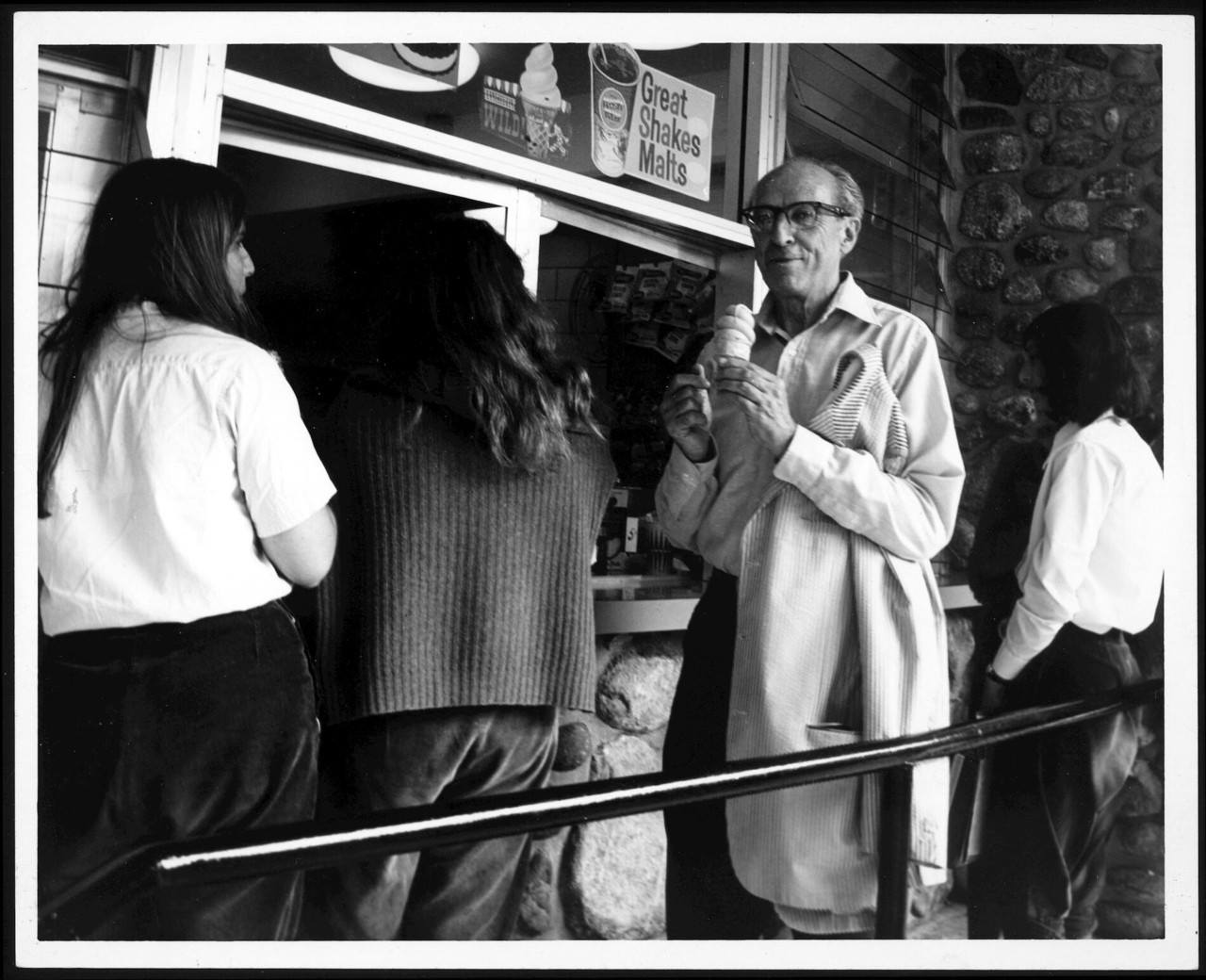
    We’re entering our third day of an early summer heat wave here on the East Coast. (You’d think it would have at least had the courtesy to wait for summer.)

    How did America’s greatest composer keep cool? Following on the heels of yesterday’s free-spirited photo of Igor Stravinsky, here’s a candid shot of Aaron Copland enjoying an ice cream cone.

  • Aaron Copland’s Hollywood Battles & Brilliance

    Aaron Copland’s Hollywood Battles & Brilliance

    If you want to work in Hollywood, you’ve got to expect once in a while somebody’s going to mess with your things – even if you’re a Pulitzer Prize winner, lauded as the “Dean of American composers.”

    Aaron Copland was not very happy when his music for “The Heiress” was chopped to ribbons, dialed down and rescored without his approval.

    William Wyler (“Wuthering Heights,” “Friendly Persuasion,” “The Big Country,” “Ben-Hur”) was a brilliant director, but he had a tin ear. His films consistently sported the best scores of their era, and yet he mostly underappreciated, if not outright disliked them.

    “The Heiress” was made fresh off Wyler’s runaway success with “The Best Years of Our Lives.” The film, based on Henry James’ “Washington Square,” was nominated for eight Academy Awards, winning four, including Oscars for Olivia De Havilland and for Copland’s score, which is so strong it manages to maintain its integrity despite all of the studio tinkering.

    Wyler insisted Copland work the song “Plaisir d’Amour” into the fabric of his music, which he artfully did in three cues. But that wasn’t good enough. Without his knowledge, the main title was replaced with a garish arrangement of “Plaisir,” which was also looped in for some of the love music. André Previn, in 1949 already one of Hollywood’s bright young talents, likened the return of Copland’s original thoughts following the interpolations to “suddenly finding a diamond in a can of Heinz beans.”

    When Copland’s contribution was recognized by the Academy, it was the only instance up to that time of a score being honored after being shorn of its main title, the part of a score that generally makes the biggest impression. Copland never bothered to collect his award. “The Heiress” would be the last time he would work in Hollywood.

    He did compose one more film score, however, for the 1961 independent film, “Something Wild,” which contains some of his most insistently non-commercial music. Occasionally brutal and often thrilling, its character is worlds away from the pastoral tranquility of “Appalachian Spring.” It’s a brilliant piece of work, yet it did not receive a commercial release until 2003.

    This week on “Picture Perfect,” we’ll sample music from “The Heiress” and “Something Wild,” as well as from the controversial pro-Soviet film “The North Star,” and even a little bit from the 1939 World’s Fair documentary “The City.”

    Join me for the film music of Aaron Copland, this Friday evening at 6 ET, or catch the show later as a webcast, at http://www.wwfm.org.

Tag Cloud

Aaron Copland (94) Beethoven (95) Composer (114) Film Music (148) Film Score (143) Film Scores (255) Halloween (97) John Williams (196) KWAX (232) Leonard Bernstein (105) Marlboro Music Festival (125) Movie Music (163) Mozart (91) Opera (215) Philadelphia Orchestra (90) Picture Perfect (174) Princeton Symphony Orchestra (110) Radio (90) Ross Amico (244) Roy's Tie-Dye Sci-Fi Corner (290) The Classical Network (101) The Lost Chord (269) Vaughan Williams (107) WPRB (397) WWFM (881)

DON’T MISS A BEAT

Receive a weekly digest every Sunday at noon by signing up here


RECENT POSTS