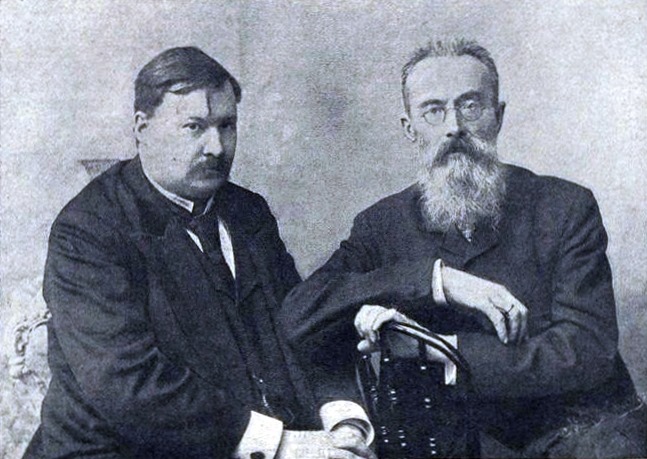
I’m not afraid to say it: I am a great admirer of the music of Alexander Glazunov! A phenomenal talent, a child prodigy, a noted teacher, and one-time director of the Petrograd (a.k.a. St. Petersburg) Conservatory, he’s frequently underrated as a composer, though he wrote a lot of attractive music.
His Violin Concerto is still heard from time to time. We should hear the symphonies more often. (A few years ago, I was surprised to discover I actually own four cycles!) He’s written some lovely suites and tone poems. Occasionally we’ll hear “The Seasons,” especially in autumn.
This week on “Sweetness and Light,” I’ll devote the hour to another of his delectable ballets, “Raymonda.”
Enjoy this luscious music of Alexander Glazunov in a very fine recording by the Scottish National Orchestra conducted by Neeme Järvi.
Brew the coffee strong, because it’s going to be a sugary breakfast on “Sweetness and Light,” this Saturday morning at 11:00 EDT/8:00 PDT, exclusively on KWAX, the radio station of the University of Oregon!
Okay, I admit it, I have a sweet tooth. And perhaps, at a time when I have no intention of getting a haircut, much less going to the dentist, that predilection could cost me. But damn it, here it is, dental health to the dogs: I do like the music of Alexander Glazunov!
Glazunov is one of those composers I’ve always felt a little sheepish about liking. I remember sitting at a listening bar at a record shop in Philadelphia and asking to preview a recording of Glazunov ballet music. “I know I’m not supposed to like this stuff,” I offered, apologetically.
Admittedly, at the time, other than the Violin Concerto, I didn’t really know a lot of great recordings of his music. I found the Marco Polo releases that I had heard, with the Hong Kong Philharmonic, to be underwhelming, and these prejudiced me against the composer for years. But Neeme Järvi’s performances on Chandos were revelatory. Then of course I eventually got my hands on the Melodiya issues with Gennady Rozhdestvensky and Evgeny Svetlanov. I know it’s going to make somebody cry to read this, but I currently have in my collection four complete cycles of Glazunov’s symphonies. Not even I know how that happened.
Okay, so he isn’t Beethoven. Who is? But at his best, his music is well-crafted, attractive (to me, anyway), and marked by an abundance of memorable melodies that would make any honest composer jealous.
As a person, he was not without his faults. He had a real problem with alcohol, which may have contributed to his disastrous performance as conductor at the premiere of Rachmaninoff’s First Symphony, a real train-wreck that elicited a savage review from Cesar Cui and plunged the younger composer into creative paralysis.
But Glazunov was also generous, almost to a fault. As director of the Petrograd Conservatory, he was in a position to pull strings so that a young Dmitri Shostakovich didn’t have to deal with preparatory theory and instead could plunge right into the business of composition.
Also, after the death of Alexander Borodin, Glazunov stepped up (with Rimsky-Korsakov) to help complete Borodin’s unfinished masterpiece, the opera “Prince Igor.” Legend has it that he wrote out the overture from memory, having heard Borodin play through it a couple of times on the piano.
So maybe you don’t want this guy on the podium during a performance of your music, but put him on a piano bench with a bottle of vodka, and you’re in good hands.
Glazunov’s own music can be full of serene lyricism, generously melodic, and, yes, often quite beautiful.
Happy birthday, Alexander Glazunov! You won’t catch me going to a custard stand during COVID, but surely this is the next best thing.
On today’s Noontime Concert on The Classical Network, join me for a cool and colorful recital by cellist Timotheos Petrin and pianist Chelsea Wang.
Petrin and Wang will perform sonatas by Valentini, Debussy and Prokofiev, with Gregory Piatigorsky’s arrangement of Stravinsky’s “Suite Italienne” tossed into the mix. Violinist Maria Ioudenitch will make a guest appearance in the world premiere of “Three Consolations” for piano trio, by Estonian-Canadian composer Riho Esko Maimets. The program was presented in February at the Philadelphia’s American Philosophical Society, under the auspices of Astral Artists.
Then, following the concert broadcast, with temperatures spiking into the mid-90s, we’re off to Russia, where in St. Petersburg the high today is 58. Find refreshment in one of the underplayed symphonies of Alexander Glazunov. It will be lightly dressed by a tangy vinaigrette à la Dmitri Shostakovich. We’ll top it off with a work formulated by Mikhail Glinka while rowing across Lake Maggiore in uncharacteristically raw weather. He was in Italy, on doctor’s orders, for his health.
Raise high your glasses, from 12 to 4 p.m. EDT. The vodka will be served chilled, on WWFM – The Classical Network and wwfm.org.
Dmitri? DMITRI! Pull yourself together. Don’t look so miserable.
This week on “Music from Marlboro,” we’ll be featuring your Piano Trio No. 2 in E minor. Sure, it’s dedicated to Ivan Sollertinsky, a close friend of yours who died an untimely death, and it was given its premiere in Leningrad in 1944, not the cheeriest place in the months following a years-long siege that killed probably a million and a half people, maybe two, created subhuman conditions, and instilled unfathomable desperation in the populace.
This is the piece that lent your String Quartet No. 8 its inexorable, klezmer-influenced “danse macabre.” After all, among Sollertinsky’s many other talents and enthusiasms – as a musicologist, a critic, a linguist, a professor, and the artistic director of the Leningrad Philharmonic – he was an ardent enthusiast of the music of Gustav Mahler. Sollertinsky had been evacuated during the siege. Unfortunately, he died suddenly of a heart attack in Siberia at the age of 41.
With Sollertinsky’s death, the barricades of misery were shattered, and you mourned as only you could. It’s not exactly uplifting music, but boy does it make an impression.
We’ll hear it performed at the 2011 Marlboro Music Festival by pianist Bruno Canino, violinist Ying Fu, and cellist Matthew Zalkind.
Then Alexander Glazunov – representative of an earlier generation, oblivious, and perhaps not entirely sober – will clear the air with his String Quintet in A major. Glazunov knew you well, did he not? As director of the Petrograd Conservatory, he saw to it that you were allowed to bypass preparatory theoretical courses and enter directly into the conservatory’s composition program.
What a nice guy! Too bad you were lukewarm on his music. But you did have kind things to say about the man, and even opined that his scherzos weren’t too bad.
Glazunov’s quintet is full of serene lyricism, generously melodic and quite beautiful. Then again, Glazunov never had to worry about Nazis and probably never had to eat anyone to survive. We’ll hear it performed at Marlboro in 1982, with violinists Sylvie Gazeau and Ernestine Schor, violist Toby Hoffman, and one-and-future cellists of the Guarneri Quartet, David Soyer and Peter Wiley.
That’s a dazed piano trio, with a glaze of Glazunov, on the next “Music from Marlboro,” this Wednesday evening at 6:00 EDT, on WWFM – The Classical Network and wwfm.org.
RAINY DAY ACTIVITY: Post your most miserable photo of Shostakovich in the comments section below.
Marlboro School of Music and Festival: Official Page
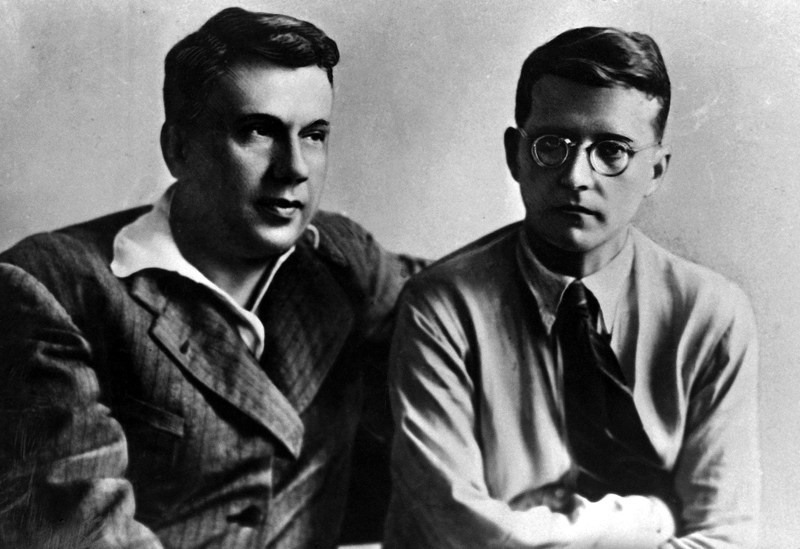
PHOTOS: Sollertinsky (upper left) and the many moods of Shostakovich
Today is the birthday of Alexander Glazunov (1865-1936), a prodigious musician whose talent unfortunately was all too often compromised by drink. It was Glazunov the conductor who, under the influence, derailed the first performance of Rachmaninoff’s Symphony No. 1.
On a more positive note, he accomplished minor miracles in the completion of Alexander Borodin’s magnum opus, the opera “Prince Igor.” The oft-told story is that Glazunov jotted the overture down from memory, having heard Borodin play through it once at the piano. By Glazunov’s own admission, the feat wasn’t quite as impressive as all that – he had found a few fragmentary sketches Borodin left behind and simply allowed his imagination to vault off of those, honoring Borodin’s intended structure. Still, it was Glazunov who did the heavy lifting, and if not for him and Rimsky-Korsakov, “Prince Igor” would have never become the icon of Russian music that it has.
Earlier in the hour, we heard the overture in Glazunov’s completion and orchestration of the work. We also had a chance to listen to music by Glazunov’s star pupil, Dmitri Shostakovich – his Concertino for 2 Pianos, written for performance by Shostakovich and his son. Right now we’re enjoying Glazunov’s lovely and languid Symphony No. 4, in a recording with Gennadi Rozhdestvensky conducting.
In the 5:00 hour, we’ll be celebrating the birthday of American composer Douglas Moore (1893-1969) with selections from his opera, “The Ballad of Baby Doe,” with Beverly Sills in the title role, and his delightful suite, “The Pageant of P.T. Barnum” in a classic recording conducted by Howard Hanson.
The 6:00 hour will be all-Brazilian, including a piece for string orchestra by Clarice Assad, the daughter of guitarist Sergio Assad, as we continue to play off of the Olympic Games in Rio de Janeiro.
Our trajectory takes us from Russia to Brazil today, until 7:00 EDT, on WWFM – The Classical Network and at wwfm.org.