Tag: An American in Paris

  • Gershwin & Schoenberg An Unlikely Friendship

    Gershwin & Schoenberg An Unlikely Friendship

    Who’d a thunk the High Priest of Dodecaphonic Music would be such an admirer of popular success George Gershwin? You know, the guy that gave us “Swanee,” “I Got Rhythm,” and “Embraceable You,” and also “Rhapsody in Blue,” “An American in Paris,” and “Porgy and Bess.” And that furthermore the admiration would be reciprocated?

    In this Arnold Schoenberg sesquicentennial year (he was born on September 13, 1874), we mark Gershwin’s birthday anniversary (born on this date in 1898) with a glimpse into classical music’s most unlikely mutual admiration society.

    Gershwin and Schoenberg were tennis partners, both very serious about the game; they were painters (although Schoenberg abandoned the art to devote himself to music); and of course Gershwin hoped to study with Schoenberg, arguably the most influential avant-garde master of the 20th century.

    Sadly, just months after Gershwin painted Schoenberg’s portrait, he died of a brain tumor at the age of 38. The next day, Schoenberg eulogized his friend for broadcast over the radio.

    Interestingly, Gershwin’s friend and champion, the pianist Oscar Levant, did study composition with Schoenberg. Schoenberg was sufficiently impressed that he offered Levant a job as his assistant, but Levant turned him down, feeling he wasn’t worthy. Levant is still considered one of Gershwin’s foremost interpreters. Of course, he also appeared in the film version of “An American in Paris” with Gene Kelly.

    George and Arnie were like the Frog and Toad of Beverly Hills. Remembering the multifaceted George Gershwin on his birthday.


    Gershwin the painter

    https://smtd.umich.edu/ami/gershwin/?p=870

    Schoenberg paintings and drawings

    https://www.schoenberg.at/index.php/en/schoenberg-2/bildnerischeswerk

    Home movies of Schoenberg, filmed by Gershwin, set to a recording of Schoenberg’s String Quartet No. 4 that Gershwin sponsored. The nattily turned-out Gershwin can be seen with pipe and five o’clock shadow, winding the camera. Also, Schoenberg eulogizes Gershwin. All in three minutes!

    More Gershwin home movies, including images of Schoenberg, courtesy of the Library of Congress.

    Levant in “An American in Paris.” He’s the whole show in Gershwin’s Concerto in F.


    PHOTO: Gershwin paints Schoenberg

  • Vintage Gershwin on the Lost Chord

    Vintage Gershwin on the Lost Chord

    This week on “The Lost Chord,” it’s very clear our love (for Gershwin) is here to stay!

    We’ll get a jump on the Fourth of July celebrations with an hour of vintage recordings of music by one of our most versatile composers.

    George Gershwin occupied a unique place in American music, rising from Tin Pan Alley scrapper to Broadway royalty. From there, he conquered the concert hall and even the opera house, with his blend of popular song, jazz, blues, spirituals and European classical forms.

    Like Franz Schubert a hundred years before, Gershwin managed to churn out an astonishing amount of music over a comparatively brief span. His songs, in particular, have been of enduring interest. His gift of lyricism and invention defied early critics as he bestrode the worlds of popular and classical music like an American colossus.

    Sadly, at the peak of his success, he died of a brain tumor at the age of 38.

    We’ll sample Gershwin’s artistry in recordings of the era, including several songs performed by Al Jolson, Fred Astaire, and Ella Logan. (So many excellent recordings to choose from!)

    We’ll also hear the world premiere recording of “An American in Paris” – performed by the Victor Symphony Orchestra (really members of the Philadelphia Orchestra), with the composer himself on the celesta – and the Concerto in F, performed as part of a memorial concert at the Hollywood Bowl, with the composer’s friend, Oscar Levant, as soloist.

    Three of these recordings date from 1937, the year of the composer’s death. All are from his era. I hope you’ll join me for “Vintage Gershwin,” this week on “The Lost Chord,” now in syndication on KWAX, the radio station of the University of Oregon!


    Clip and save the start times for all three of my recorded shows:

    PICTURE PERFECT, the movie music show – Friday at 8:00 PM EDT/5:00 PM PDT

    SWEETNESS AND LIGHT, the light music program – ALL NEW! – Saturday at 11:00 AM EDT/8:00 AM PDT

    THE LOST CHORD, unusual and neglected rep – Saturday at 7:00 PM EDT/4:00 PM PDT

    Stream them, wherever you are, at the link!

    https://kwax.uoregon.edu/


    PHOTO: (left to right) Astaire with George and Ira Gershwin

  • Ravel Gershwin and Jazz Influences

    Ravel Gershwin and Jazz Influences

    On days when I’ve got a lot of work to do, I’ll often post something short or simply cut and paste, with a few tweaks, from the Classic Ross Amico archive. If it happens to be the birthday of a major composer – in this case, Maurice Ravel, born on this date in 1875 – I try to take a fresh perspective, if I can, since I tend to write about the subject every year. I thought this year, I might write about Ravel’s experiences in the United States with George Gershwin and, by extension, jazz. But of course the subject is an involved one. And really, I don’t know how I could handle it any better than it has been by the writer at the link. Enjoy the musical examples below, and happy birthday, Maurice Ravel!

    https://cso.org/experience/article/7984/fascinatin-rhythm-when-ravel-met-gershwin


    Ravel, Piano Concerto in G, 1929-31 (Leonard Bernstein in concert)

    Gershwin, Concerto in F, 1925

    Ravel, “Blues” from Violin Sonata No. 2, 1923-27 (completed before his trip to the States)

    Gershwin, “An American Paris,” 1928 (Bernstein in concert)

    https://www.youtube.com/watch?v=9HI62_udgEI


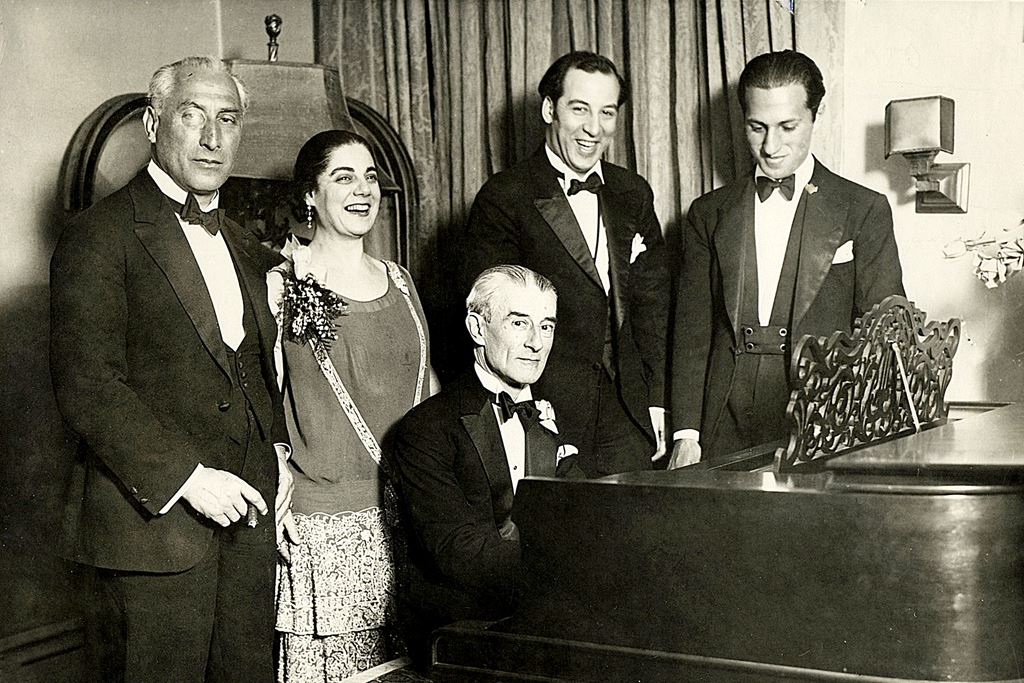
    PHOTO: Ravel (seated), in New York the day after his 53rd birthday, in 1928, with (left to right) conductor Oskar Fried, mezzo-soprano Éva Gauthier, composer-conductor Manoah Leide-Tedesco, and George Gershwin

  • Gershwin & Berlioz in Princeton

    Gershwin & Berlioz in Princeton

    Gershwin and Berlioz are “in” this weekend at the Princeton Symphony Orchestra. The orchestra will present “An American IN Paris” and “Harold IN Italy,” IN Richardson Auditorium IN Alexander Hall, this Saturday evening at 8:00 and Sunday afternoon at 4:00.

    By merest coincidence, “Harold in Italy” received its first U.S. performance on this date, 160 years ago. In 1863, it was presented in New York by the Theodore Thomas Orchestra, sharing a program with Mozart’s overture to “The Magic Flute” and Beethoven’s Symphony No. 5, interspersed with some shorter musical interludes.

    Berlioz’s symphony is unusual for, among other things, its prominent role for an instrumental soloist – a flourish usually reserved for the concerto. The work was written for Niccolò Paganini, the legendary violinist who was hoping for a showcase for his new Stradivarius viola.

    Unfortunately, when Paganini received the score, his face dropped, as the composer was evidently more interested in Harold’s meditations – admittedly punched up by some colorful musical evocations, of a religious pilgrimage, a mountaineer’s serenade, and a brigands’ orgy – than in the virtuosic flights Paganini had envisioned. In the event, the world premiere took place in Paris in 1834, with Chrétien Urhan as the soloist.

    Though Paganini never played the piece, he did come to appreciate its genius. When he finally heard the work performed in 1838, he ascended the stage, dropped to his knees, and before a cheering crowd, kissed Berlioz’s hand. Perhaps even more gratifying for the composer, Paganini later sent him a bank draft for 20,000 francs.

    As Berlioz stated in his “Memoirs,” “My intention was to write a series of orchestral scenes, in which the solo viola would be involved as a more or less active participant while retaining its own character. By placing it among the poetic memories formed from my wanderings in the Abruzzi, I wanted to make the viola a kind of melancholy dreamer in the manner of Byron’s Childe-Harold.”

    Although “Harold” is probably the composer’s second most-popular symphony, after the weird and wonderful “Symphonie fantastique,” concert performances are comparatively rare, due to a scarcity of star violists – that is to say, violists who are able to sustain a career as soloists. If the work is done, it’s generally with an orchestra principal in the spotlight. In fact, I believe the last time I heard the piece in person was over 30 years ago, with Joseph de Pasquale and the Philadelphia Orchestra. That’s not to say it hasn’t been played, but rather in my decades of concertgoing, it’s the last time I personally encountered it. Indeed, De Pasquale was the orchestra’s principal violist, but he had quite an association with the piece, having performed it in Boston, where he had also been principal, with Charles Munch, and recorded it in Philadelphia with Eugene Ormandy.

    Princeton’s soloist will be De Pasquale’s successor, Roberto Diaz, who was Philadelphia’s principal violist for ten years. In 2006, he left to become director of the Curtis Institute of Music.

    The weekend’s concerts will also include Julia Perry’s “Study for Orchestra.” Perry, a graduate of Princeton’s Westminster Choir College in 1948, continued her studies with Luigi Dallapiccola at the Berkshire Music Center at Tanglewood, at the Juilliard School in New York, and with Nadia Boulanger in Paris. With the recent push to reevaluate neglected music by minority composers, Perry’s “Study” has become a focus of renewed interest, with a number of performances popping up on orchestra schedules this season and next.

    The other American on the program requires little introduction. “An American in Paris” even became the subject of an Academy Award winning movie, starring Gene Kelly, with the show-stopping climax a 17-minute ballet inspired by Gershwin’s by turns eager, melancholy, and exuberant score.

    It’s an American IN Paris and Harold IN Italy IN Princeton, with one of Westm-IN-ster’s own, IN concert this Saturday and Sunday with the Princeton Symphony Orchestra. Rossen Milanov will conduct. For tickets and information, visit princetonsymphony.org.


    Berlioz, stylin’, in 1832 (portrait attributed to Emile Signol)

  • Gershwin’s Genius: July 4th on The Lost Chord

    Gershwin’s Genius: July 4th on The Lost Chord

    Happy Independence Day! This Sunday night on “The Lost Chord,” cap your Fourth of July celebrations with an hour of vintage recordings of the music of George Gershwin.

    Gershwin occupied a unique place in American music, rising from Tin Pan Alley scrapper to Broadway royalty. From there, he conquered the concert hall and even the opera house, with his blend of popular song, jazz, blues, spirituals and European classical forms.

    Like Franz Schubert a hundred years before, Gershwin managed to churn out an astonishing amount of music over a comparatively brief span. His songs, in particular, have been of enduring interest. His gift of lyricism and invention defied early critics as he bestrode the worlds of popular and classical music like an American colossus.

    Sadly, at the peak of his success, he died of a brain tumor at the age of 38.

    We’ll sample Gershwin’s artistry in recordings of the era, including several songs performed by Al Jolson, Fred Astaire and Ella Logan. (So many excellent recordings to choose from!)

    We’ll also hear the world premiere recording of “An American in Paris” – performed by the Victor Symphony Orchestra (really members of the Philadelphia Orchestra), with the composer himself on the celesta – and the Concerto in F, performed as part of a memorial concert at the Hollywood Bowl, with the composer’s friend, Oscar Levant, as soloist.

    Three of these recordings date from 1937, the year of the composer’s death. All are from his era. I hope you’ll join me for “Vintage Gershwin,” this Sunday night at 10:00 EDT, on WWFM – The Classical Network and wwfm.org.


    PHOTO: (left to right) Astaire with George and Ira Gershwin

Tag Cloud

Aaron Copland (92) Beethoven (95) Composer (114) Film Music (120) Film Score (143) Film Scores (255) Halloween (94) John Williams (185) KWAX (229) Leonard Bernstein (100) Marlboro Music Festival (125) Movie Music (135) Opera (198) Philadelphia Orchestra (88) Picture Perfect (174) Princeton Symphony Orchestra (106) Radio (87) Ralph Vaughan Williams (85) Ross Amico (244) Roy's Tie-Dye Sci-Fi Corner (290) The Classical Network (101) The Lost Chord (268) Vaughan Williams (103) WPRB (396) WWFM (881)

DON’T MISS A BEAT

Receive a weekly digest every Sunday at noon by signing up here


RECENT POSTS