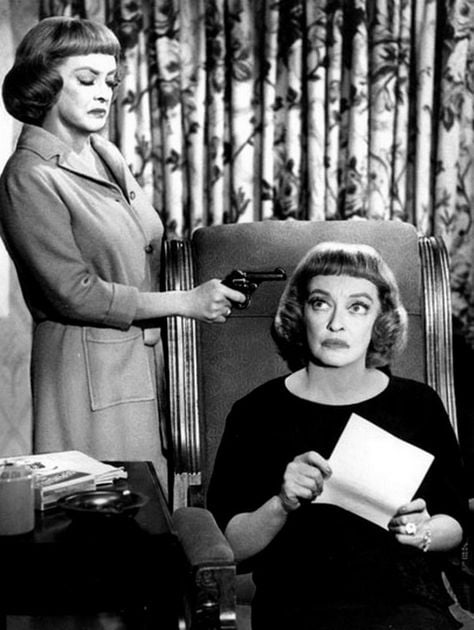
This week on “Picture Perfect,” we’re seeing double.
James Stewart plays Scottie Ferguson, a traumatized police detective who becomes obsessed with the woman he loves – and loses – in Alfred Hitchcock’s “Vertigo” (1958). Kim Novak portrays both the enigmatic beauty and her spitting image, who Ferguson, rather creepily, attempts to mold. Bernard Herrmann wrote the hypnotic score.
Krzysztof Kieślowski’s “La double vie de Véronique”/“The Double Life of Véronique” (1991) depicts parallel characters living in Poland and France who are mysteriously linked, both of them played by Irène Jacob. The performance(s) earned Jacob an award for Best Actress at the Cannes Film Festival. The music, which plays a significant role in the actual plot, is by Zbigniew Preisner.
For the second time in her career, Bette Davis gets a chance to play an evil twin in “Dead Ringer” (1964). The first was in the 1946 good twin-bad twin melodrama, “A Stolen Life.” When asked what the difference was between the two performances, Davis quipped, “About 20 years.” “Dead Ringer” was directed by her longtime friend and “Now, Voyager” co-star Paul Henreid. The music is by André Previn, whose score employs a stock-in-trade sinister harpsichord, yet when he comes to write the love theme, he manages to whip up one hell of a tribute to Erich Wolfgang Korngold.
Korngold scored a number of Davis’ films in the 1940s, though he is principally remembered for his work on the swashbucklers of Errol Flynn. To capitalize on Flynn’s star-making performance in “Captain Blood,” Warner Brothers produced a big screen adaptation of Mark Twain’s Tudor switcheroo, “The Prince and the Pauper” (1937). Flynn steals the show as Miles Hendon, the devil-may-care guardian of Prince Edward and Tom Canty, Edward’s mirror image, played by real-life twins Bobby and Billy Mauch. If you’re a Korngold fan, or an enthusiast of violin concertos, you may recognize some of the music. Korngold recycled the theme for use in the last movement of his Violin Concerto, championed by Heifetz and others.
Double your pleasure with an hour of doppelgangers, twins, and dual identities, on “Picture Perfect,” music for the movies, now in syndication on KWAX Classical Oregon!
——–
Clip and save the start times for all three of my recorded shows:
PICTURE PERFECT, the movie music show – Friday at 8:00 PM EST/5:00 PM PST
SWEETNESS AND LIGHT, the light music program – Saturday at 11:00 AM EST/8:00 AM PST
THE LOST CHORD, unusual and neglected rep – Saturday at 7:00 PM EST/4:00 PM PST
Stream them, wherever you are, at the link!
https://kwax.uoregon.edu
Tag: André Previn
-

Previn, Carol, and a General’s Musical Mishap
Last week, when writing my memorial to Norman Carol – longtime concertmaster of the Philadelphia Orchestra, who died on April 28 – I recollected reading an anecdote André Previn shared in his book “No Minor Chords” (Doubleday, 1991), an amusing memoir, largely about Previn’s experiences in Hollywood, where seemingly no one in charge knew anything about music (hence the mocking title, taken from a memo handed down by producer Irving Thalberg, “No music in an MGM film is to contain a minor chord”).
Previn was hired by Metro-Goldwyn-Mayer in 1946 while still in high school. MGM was “looking for somebody who was talented, fast, and cheap and, because I was a kid, I was all three,” he mused. He worked as a session musician, arranger, and composer, cutting his teeth supplying cues for Lassie movies. He would go on to write music for 50 films, was nominated for 11 Academy Awards, and won four. In 1960, he received three nominations in a single year! But Previn never took the movie biz too seriously and eventually he left it all behind to pursue a career in classical music.
He was drafted into the military during the Korean War, and beginning in 1951, while stationed with the Sixth Army Band in San Francisco, he began conducting lessons with Pierre Monteux, then music director of the San Francisco Symphony. The particular passage I was thinking of is about the time he and Carol served together at the Presidio. I’ve been wanting to look it up, so this morning I finally took the book down from the shelf, and of course there’s no index. Thankfully, it’s a lean and entertaining 148 pages, so it didn’t take long for me to find what I was looking for.
Sobering to think that both these gentlemen are gone now.
Beginning on page 47:
I made friends with Norman Carol, another musician stationed at the Presidio. He was even then a most remarkable violinist. Shortly after his discharge from the army he became concertmaster of the Philadelphia Orchestra, a distinguished position he has now held for thirty-odd years. But back in 1951, neither one of us could have laid claim to the adjective “distinguished” by the wildest stretch of the imagination. Whenever it was possible, we would commandeer a piano and play sonatas for our own pleasure, and I remember quite a few evenings at officers’ clubs, trying to make some Viennese bonbons audible over the hubbub.
Norman and I were summoned to appear at the office of the reigning two-star general one day. We absolutely could not figure out why. Our small transgressions of the rules were definitely not worthy of generals, and neither of us could come up with a reason to receive a medal. So we shined our boots, pressed our wrinkled ties, and polished our belt buckles, hoping that our smart appearance might lessen whatever blow was to be aimed at us. The general was feeling chatty. “I’m told you two can play the fiddle and the piano pretty good,” he said. “Well, in two weeks’ time there’s going to be a huge meeting of heads of state here in Frisco; Truman is coming, and so are the Russians, the English, the French, and everybody else. After the meetings are over, there’s gonna be a big blowout at the Palace Hotel, and I want you to play for a half hour or so. Understood?”
We nodded rapidly. Yes, we understood. We thank the general, sir. We’ll do our best, sir, yes indeed. We saluted and backed away from the desk, treading on each other’s feet and bumping into a map case. When we got to the door, the general said rather sharply, “Oh, there’s one thing I forgot. You mustn’t play anything recognizably national. Nothing American or Russian or French or English. Understood?”
We looked at one another. Obviously this request was both loony and impossible to fulfill. My misplaced compulsion for jokes surfaced. “If the general agrees,” I said winningly, “we could play a long Swiss medley.”
Not a blink, not a smile was forthcoming. That’ll be fine. See to it,” and the general turned away from us. Silently we went outside. Once we were on the street, Norman turned on me. “You moron,” he started, “you asshole, what are we going to do now? A Swiss medley, you jerk! Name me some Swiss composers except Bloch and Frank Martin! We’ll be court-martialed!”
I calmed him down. “Nobody’ll be listening, Norman,” I said with confidence, “and if by chance anyone does listen, what makes you think they’ll recognize the music? As it turned out, I was right. The ballroom of the Palace Hotel was live with bunting and flags, the guests were representative of the world’s power, and they were not interested in the two GIs on a small corner platform, assaying Brahms, Debussy, and Prokofiev. We ate a lot of very good food, drank a glass or two of wine, and ogled the great and powerful. Our general passed, retinue in tow. This was one night when he was outranked, but he was very scary to us. He gave us the briefest of glances and smiled a smile which never reached his eyes.
“Well done, boys,” he said. “Carry on.”
My post about Norman Carol here:
https://www.facebook.com/photo/?fbid=1297416914510702&set=a.883855802533484
-

Ernő Dohnányi A Forgotten Hungarian Genius
While Béla Bartók is respected as the foremost Hungarian composer of the 20th century, Ernő Dohnányi, until recently, has been subject to neglect, at least in proportion to his significance. Sure, Bartók and his friend, Zoltán Kodály, were at the forefront of the whole nationalist movement, traipsing around the countryside in order to document authentic folk traditions before they were swallowed up forever by industrialization. But as director of the Budapest Academy of Music and music director of the Budapest Philharmonic Orchestra, Dohnányi would exert as much influence over his country’s musical development as that of his folk music-mad friends and contemporaries
Unfortunately, he would become the target of character assassination campaigns after World War II, in which he was painted as a Nazi sympathizer. Dohnányi was investigated and cleared several times by the U.S. Military Government, and in fact has been defended as a forgotten hero of Holocaust resistance, since it was through his administrations that countless Jewish musicians survived. Also, between the wars, he went to bat for Kodály, a leftist, by refusing to fire him from the Budapest Academy. As a result, Dohnányi too lost his position, albeit temporarily. Nevertheless, he continued to be eyed with suspicion, and his slandered reputation never fully recovered.
Equally fatal is the fact that much of his music bears a more cosmopolitan stamp than that of the Hungarian composers of his era that are now so celebrated. His composition teacher, the German-born Hans von Koessler (known in Hungary as János Koessler), was a cousin of Max Reger. Of course, Koessler also taught Bartók and Kodály. But Dohnányi was perfectly happy nestled in the world of Brahms. For his international career, he assumed the name Ernst von Dohnanyi.
I’ve always been partial to Sir Malcolm Sargent’s recording of Dohnanyi’s gorgeous Serenade in F sharp minor, with the London Symphony Orchestra. Unfortunately, the sound file doesn’t seem to be posted anywhere. For as much as I appreciate the existence of this CD, the performance is a comparatively weak substitute – in my humble opinion, of course:
In the meantime, nice to have discovered this live performance of Dohnanyi’s best-known piece, the “Variations on a Nursery Tune,” with André Previn conducting. The soloist is the Brazilian pianist Cristina Ortiz, cute as a button. The piece has its share of “inside” musical jokes, but the best one must be the agonizingly portentous build-up to the pianist’s first entrance – here complete with a stroll through the cemetery, beneath the chilly gaze of an ominous medieval castle!
Furthermore, the entire orchestra appears to be dressed as Captain Kirk.
Happy birthday, Ernő Dohnányi. Energize!
PHOTO: Dohnányi (left), boldly taking the train with Bartók
-

William Walton: Star Wars Inspiration
Today is the 120th anniversary of the birth of Sir William Walton. Walton is perhaps best remembered for his coronation marches and film scores, but he also wrote operas, symphonies, concertos, chamber music, and choral works.
Sadly, these days, we don’t seem to encounter these much in concert anymore, at least in the U.S., which is a great pity, since Walton was an impeccable craftsman and his music often quite inspirational.
Be that as it may, his influence has been felt by just about anyone who’s ever gone to the movies since 1977. That’s the year John Williams married Walton’s heroic sound to George Lucas’ vision of a long time ago, in a galaxy far, far away.
Walton’s concert music may have fallen out of fashion, but Williams would have never become the household name he has without having assimilated his marches, harmonies, and orchestrations. When André Previn first heard Williams conduct his music to “Star Wars,” he could hardly contain his glee, exclaiming, “Why, it’s Willie Walton!”
Hear for yourself…
“Star Wars” throne room – from the one-minute mark, pure Walton:
What Walton cooked up for the Queen in 1953 – there’s a proto-“Star Wars” moment about two minutes in, but do listen to the whole thing:
This is what he composed for her dad in 1937:
For Olivier’s film of “Richard III”
“Belshazzar’s Feast”: “Praise Ye!”
“Belshazzar’s Feast”: “Alleluia”
In 1966, Previn himself laid down what is considered the benchmark recording of Walton’s Symphony No. 1. It’s possible he managed to surpass it with this explosive performance with the London Symphony Orchestra in 1970:
Happy birthday, Sir William Walton!
PHOTO: Walton (right) with Previn, his champion
-
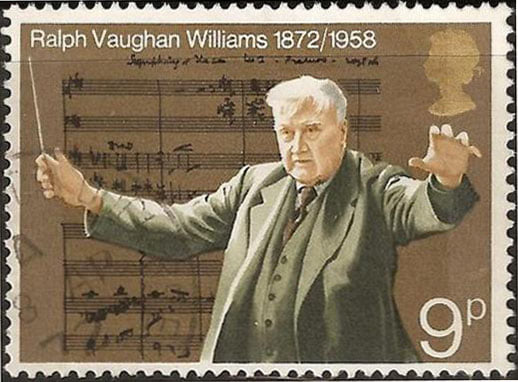
Vaughan Williams 150th Anniversary Celebration
2022 marks the 150th anniversary of the birth of Ralph Vaughan Williams (on October 12, 1872). Following up on yesterday’s post about the composer’s connections to the Day Lewis family, here’s some additional RVW material to brighten the weekend of any musical Anglophile.
I transcribed the text of C. Day Lewis’ encomium, on the occasion of RVW’s 85th birthday, from this first-rate radio documentary, which also includes abundant commentary by Vaughan Williams himself, his wife Ursula, Sir Adrian Boult, Sir John Barbirolli, and others. I highly recommend it.
Then enjoy two concert performances of Vaughan Williams symphonies led by two of his most notable American interpreters. André Previn conducts the Houston Symphony at Carnegie Hall in the Symphony No. 4, from 1969, and Leonard Slatkin conducts the Chicago Symphony in the Symphony No. 5, from 1988. Both conductors went on to record acclaimed cycles of Vaughan Williams’ symphonies.
You don’t have to purchase the recordings at the link. Just click on any of the arrows and allow them to play through. The tracks will play continuously, from one into another.
These works – which couldn’t be more different – should be in the repertoire of every American orchestra. Sadly, it looks as if we’re in for another year of “Tallis Fantasias,” if that. If anyone happens to hear of a Vaughan Williams symphony being performed live on the East Coast, PLEASE let me know!
Tag Cloud
Aaron Copland (93) Beethoven (95) Composer (114) Film Music (144) Film Score (143) Film Scores (255) Halloween (94) John Williams (195) KWAX (229) Leonard Bernstein (104) Marlboro Music Festival (125) Movie Music (159) Mozart (90) Opera (212) Philadelphia Orchestra (89) Picture Perfect (174) Princeton Symphony Orchestra (109) Radio (88) Ross Amico (244) Roy's Tie-Dye Sci-Fi Corner (290) The Classical Network (101) The Lost Chord (269) Vaughan Williams (105) WPRB (397) WWFM (881)