Tag: Antal Doráti

  • Liszt’s Christus: A Christmas Oratorio You Need to Hear

    Liszt’s Christus: A Christmas Oratorio You Need to Hear

    I try to make it a point to listen to Franz Liszt’s oratorio, “Christus,” every year, whether I need it or not.

    It helps that I love Liszt, of course. Not all of his music – anyone as prolific as he was had to turn out a clunker now and then – but he was such a noble, well-intentioned guy. I’ve been a hardcore admirer ever since I read Alan Walker’s biography, now probably 23 years ago. The years, they do fly by! And having heard so many performances of his Piano Sonata certainly hasn’t hurt.

    Liszt was one of the most original musical thinkers of the 19th century. In fact, I’d go as far as to say that, after Beethoven, he was possibly the most influential musician of the 1800s. There was likely no composer who didn’t at some point make a decision to follow or to react against him.

    He was, admittedly, hit-and-miss. Liszt wrote a lot of astonishingly wonderful music, but also a fair amount that might charitably be described as slightly embarrassing. Arguably, he was more successful as a philosopher and an innovator than he was as a consistent executor of his ideas. Richard Wagner (who became Liszt’s son-in-law), to name only one, would have been a very different composer without Liszt. And we all know how influential Wagner was.

    Liszt’s flamboyance was legendary, but his reputation in that regard stemmed mostly from the overwhelming sensations he conjured in recital, and his audiences’ hysterical responses to them. He could also be introverted, thoughtful, and pious. He was so pious, in fact, that at a point he wound up taking minor orders and living in a cell in Rome, where he was known as the Abbé Liszt. His sacred works were not mere posturing.

    The magnificent “Christus” is an oratorio in three parts – spanning some three hours in length – that is really part oratorio, part loose collection of symphonic poems. Part I, the Christmas portion, contains two purely orchestral movements, which together comprise about half an hour. The concluding “March of the Three Holy Kings” is a corker. It’s also interesting in that one of the movement’s main themes is nearly identical to Wagner’s motif for Wotan. Which came first? Both “Christus” and “Das Rheingold” were written at just about the same time.

    I know it’s an extraordinarily busy time of year, but do yourself a favor: send your regrets to the office holiday party, seclude yourself in a quiet place with no distractions (a sofa, with the Christmas lights on, would do nicely), and marvel at this ambitious, romantic music.

    I own three recordings of the piece, and this one, conducted by Antal Dorati, is far and away the most satisfying.

    If you find you just can’t get enough, there’s also Liszt’s “Christmas Tree Suite.” Liszt dedicated the work to his granddaughter, Daniela von Bülow. Some of the early movements are reflections on familiar carols (including “Adeste Fideles,” in yet another evocation of the Three Holy Kings), but as the suite progresses, Liszt just kind of dreamily wanders off into the future the way only Liszt can. The suite was first performed on Christmas Day, 1881. All the movement titles are listed below the video at the link.

    What else is there to say, but Merry Liszt-mas!


    Liszt takes the cloth (left); Jesus gets frankincense and myrrh
  • Hungarian Night Music & Bela Lugosi

    Hungarian Night Music & Bela Lugosi

    “Children of the night – what beautiful music they make!” So says Hungarian superstar Bela Lugosi in his signature role of Dracula. The observation (spoken in response to the howling of wolves) might equally be applied, under less chilling circumstances, to three of Lugosi’s composer-compatriots, whose nocturnal meditations we’ll enjoy this Sunday night on “The Lost Chord.”

    Miklós Rózsa, himself a figure with cinematic associations, wrote nearly 100 film scores and won three Academy Awards – for “Spellbound” (1945), “A Double Life” (1947), and “Ben-Hur” (1959). He was also an active concert composer, writing concertos for Jascha Heifetz, Leonard Pennario, Gregor Piatigorsky, and Pinchas Zukerman.

    In the summer of 1962, Rózsa composed “Hungarian Nocturne” on a commission from Edward B. Benjamin, a New Orleans millionaire with a fondness for quiet music. However, in order to maintain interest, the composer realized, there was no way he could remain quiet for the entire span of the piece. So the nocturne eventually builds to a climax before returning to the serene mood of its opening. His patron wasn’t entirely pleased, though he did draw enjoyment from the quieter parts. The piece was an attempt by the composer to recapture the rare beauty of nights on his estate in rural Hungary.

    Though Antal Doráti would ultimately become world famous as a conductor, he studied composition at the Franz Liszt Academy under Zoltán Kodály and Leó Weiner. He also studied piano with Béla Bartók. A fine Bartok interpreter, Doráti would later conduct the world premiere of his teacher’s Viola Concerto.

    Doráti’s own music has always been regarded as something of a sidelight. His “Night Music,” from 1970, is a collection of evocative miniatures for flute and orchestra. We’ll hear it performed by Alison Young, now a host for Minnesota Public Radio.

    Unlike Rózsa and Doráti, who were both natives of Budapest, Zoltán Kodály was born in a small town in Southern Hungary. He claimed that his first exposure to folk music was through the singing of servant girls in his own home. He went on to become one of the most important figures in Hungarian musical life, as composer, ethnomusicologist, and educator.

    Kodály will be represented by his orchestral idyll, “Summer Evening,” music originally composed in 1906, then revised in 1929, to fulfill a commission from Arturo Toscanini. Kodály himself will conduct, on a gorgeous recording with the Budapest Philharmonic.

    That’s “Children of the Night” – Hungarian composers take wing – this Sunday night at 10:00 EDT, on WWFM – The Classical Network and wwfm.org.


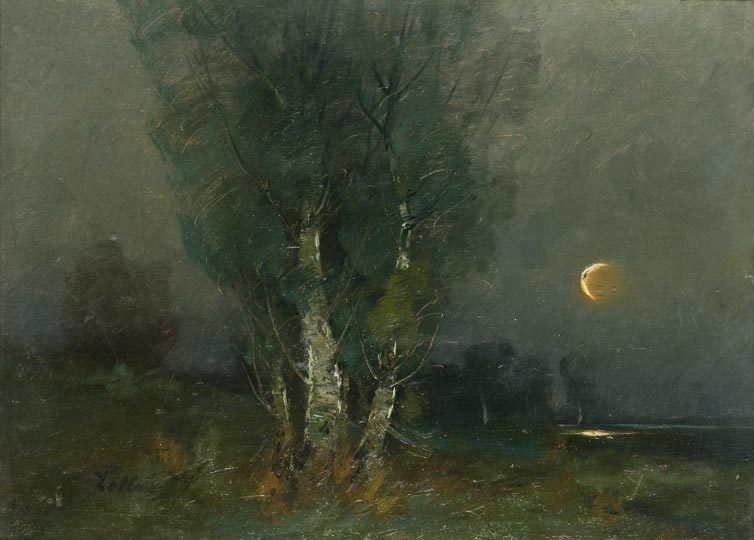
    IMAGE: “New Moon,” by Mihály Zeller

  • Hungarian Night Music Bela Lugosi’s Requiem

    Hungarian Night Music Bela Lugosi’s Requiem

    “Children of the night – what beautiful music they make!” So says Hungarian superstar Bela Lugosi in his signature role of Dracula. The observation (spoken in response to the howling of wolves) might equally be applied, under less chilling circumstances, to three of Lugosi’s composer-compatriots, whose nocturnal meditations we’ll enjoy this Sunday night on “The Lost Chord.”

    Miklós Rózsa, himself a figure with cinematic associations, wrote nearly 100 film scores and won three Academy Awards – for “Spellbound” (1945), “A Double Life” (1947), and “Ben-Hur” (1959). He was also an active concert composer, writing concertos for Jascha Heifetz, Leonard Pennario, Gregor Piatigorsky, and Pinchas Zukerman.

    In the summer of 1962, Rózsa composed “Hungarian Nocturne” on a commission from Edward B. Benjamin, a New Orleans millionaire with a fondness for quiet music. However, in order to maintain interest, the composer realized, there was no way he could remain quiet for the entire span of the piece. So the nocturne eventually builds to a climax before returning to the serene mood of its opening. His patron wasn’t entirely pleased, though he did draw enjoyment from the quieter parts. The piece was an attempt by the composer to recapture the rare beauty of nights on his estate in rural Hungary.

    Though Antal Doráti would ultimately become world famous as a conductor, he studied composition at the Franz Liszt Academy under Zoltán Kodály and Leó Weiner. He also studied piano with Béla Bartók. A fine Bartok interpreter, Doráti would later conduct the world premiere of his teacher’s Viola Concerto.

    Doráti’s own music has always been regarded as something of a sidelight. His “Night Music,” from 1970, is a collection of evocative miniatures for flute and orchestra. We’ll hear it performed by Alison Young, now the host of American Public Media’s “SymphonyCast.”

    Unlike Rózsa and Doráti, who were both natives of Budapest, Zoltán Kodály was born in a small town in Southern Hungary. He claimed that his first exposure to folk music was through the singing of servant girls in his own home. He went on to become one of the most important figures in Hungarian musical life, as composer, ethnomusicologist, and educator.

    Kodály will be represented by his orchestral idyll, “Summer Evening,” music originally composed in 1906, then revised in 1929, to fulfill a commission from Arturo Toscanini. Kodály himself will conduct, on a gorgeous recording with the Budapest Philharmonic.

    That’s “Children of the Night” – Hungarian composers take wing – this Sunday night at 10:00 EDT, on WWFM – The Classical Network and wwfm.org.


    IMAGE: “New Moon,” by Mihály Zeller

Tag Cloud

Aaron Copland (93) Beethoven (95) Composer (114) Film Music (127) Film Score (143) Film Scores (255) Halloween (94) John Williams (190) KWAX (229) Leonard Bernstein (102) Marlboro Music Festival (125) Movie Music (142) Mozart (87) Opera (205) Philadelphia Orchestra (89) Picture Perfect (174) Princeton Symphony Orchestra (107) Radio (88) Ross Amico (244) Roy's Tie-Dye Sci-Fi Corner (290) The Classical Network (101) The Lost Chord (268) Vaughan Williams (103) WPRB (396) WWFM (881)

DON’T MISS A BEAT

Receive a weekly digest every Sunday at noon by signing up here


RECENT POSTS