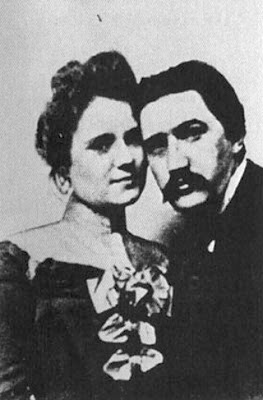
Tag: Antonin Dvorak

  • Antonin Dvořák:  Two Degrees of Separation

    Antonin Dvořák: Two Degrees of Separation

    I once shook the hand of Antonin Dvořák’s grandson. No, really! It was in 2014, at a reception for an exhibit of the manuscript of his grandfather’s “New World” Symphony – the first time the document had been back in the United States since the composer took it with him to Europe when he returned home in 1895.

    Dvořák, arguably the most famous Bohemian (now Czech) composer, arrived in New York in 1892 to take up the directorship of the National Conservatory of Music. As an outsider, he was amazed at the unique musical impulses he detected all around him that seemed to go unnoticed by aspiring American composers, who were busy emulating European models.

    In particular, Dvořák was fascinated by the Negro spiritual (as it was then identified), thanks in no small part to Harry T. Burleigh, a Black student at the conservatory, who he overheard singing in a corridor adjacent to his office. The exposure to this music struck Dvorak with the force of an epiphany.

    Thereafter, Burleigh was a regular guest at the Dvořák home. He frequently sang for the composer and worked as his copyist beginning in 1893.

    Reflecting on his own debt to the folk idioms of his native land in the development of a Czech national sound, Dvořák was eager to share his impressions with American composers, and to encourage them to embrace this unique and neglected resource.

    “I am now satisfied that the future music of this country must be founded upon what are called Negro melodies,” he wrote. “This must be the real foundation of any serious and original school of composition to be developed in the United States. When I first came here last year I was impressed with this idea and it has developed into a settled conviction. These beautiful and varied themes are the product of the soil. They are American.”

    This was quite the pronouncement for 1893.

    Spirituals, of course, became an important part of the “New World” Symphony’s DNA. Since Dvořák’s masterwork was intended, in part, as instructional, leading American composers by example to a distinctly national sound, the significance of Burleigh’s influence is inescapable.

    Burleigh also served as a double-bassist and timpanist in the school’s orchestra, which Dvořák conducted.

    Another one of Dvořák’s students, William Arms Fisher, put words to the melody of the famous slow movement of the “New World” to create a kind of ersatz spiritual, “Goin’ Home.”

    The “New World” manuscript was displayed at the Czech Center New York, where guests gathered following a performance of the symphony at Carnegie Hall – where the work was introduced in 1893 – on this occasion, by the Czech Philharmonic conducted by Jiři Bělohlávek. I had a chance to meet Bělohlávek briefly, although I got the impression that his conversational English was not very good. I had the privilege to hear him conduct a few times, though, including Dvořák’s “Rusalka” with Renée Fleming at the Met. I think it was in 2009.

    On the occasion of the “New World” display, I wandered into another room, a quieter, more intimate space, where suddenly I was introduced to Dvořák’s grandson, who, if he spoke any English at all, he didn’t let on. But he shook hands firmly and with great mirth. And I’ll be darned if he wasn’t the spitting image of his grandfather and namesake. That was some uncanny valley experience!

    Sadly, both Bělohlávek and Antonin Dvořák III died, within days of one another, in 2017.

    On Dvořák’s birthday I remember them both, and of course the music of Antonin himself, which I have enjoyed so very much over the years, with great appreciation.

    Happy birthday, sir!

    ———-

    Bělohlávek conducts a selection from the “New World” in Prague


    The famous Largo (second movement)


    “Goin’ Home”


    Harry T. Burleigh’s arrangement


    More about Burleigh

    https://www.youtube.com/watch?v=YbbB4suz2co


    Interview with Antonin Dvořák III (you may have to translate from Czech)

    https://www.casopisharmonie.cz/rozhovory/antonin-dvorak-iii-buh-laska-vlast-rodina/

    Classic, if brisk, recording of the “New World” (complete), conducted by Paul Paray


  • Healing by Nature with Josef Suk on “The Lost Chord”

    Healing by Nature with Josef Suk on “The Lost Chord”

    Josef Suk’s 30th year was a tragic one, marked by the deaths of both his young wife, Otilie, and her father, his former teacher, Antonín Dvořák. Not surprisingly, a sense of morbidity colors much of his mature output. The double-loss directly inspired Suk’s “Asrael Symphony,” named for the Angel of Death.

    This week on “The Lost Chord,” we’ll take a look at “A Summer’s Tale,” the next step in Suk’s emotional rehabilitation. The work is a five-movement symphonic poem, the second of a four-part cycle that contemplates death and the meaning of life. More affirmative than the grim “Asrael,” which is full of pain, loss, and grief, “A Summer’s Tale” explores the healing powers of nature, in a score that at times reflects the epic romanticism of Gustav Mahler and at others the impressionism of Claude Debussy. It was composed over the course of just six weeks in the summer of 1907. Further tinkering took place over the next year-and-a-half. The work received its premiere in January of 1909.

    Suk later described the theme of the piece as “finding a soothing balm in nature.” I hope you’ll join me as we clear a path to “Healing by Nature” – Josef Suk’s “A Summer’s Tale” – on “The Lost Chord,” now in syndication on KWAX Classical Oregon!

    ———-

    Clip and save the start times for all three of my recorded shows:

    PICTURE PERFECT, the movie music show – Friday at 8:00 PM EDT/5:00 PM PDT

    SWEETNESS AND LIGHT, the light music program – Saturday at 11:00 AM EDT/8:00 AM PDT

    THE LOST CHORD, unusual and neglected rep – Saturday at 7:00 PM EDT/4:00 PM PDT

    Stream them, wherever you are, at the link!

    https://kwax.uoregon.edu/

Tag Cloud

Aaron Copland (93) Beethoven (95) Composer (114) Film Music (143) Film Score (143) Film Scores (255) Halloween (94) John Williams (195) KWAX (229) Leonard Bernstein (104) Marlboro Music Festival (125) Movie Music (158) Mozart (90) Opera (212) Philadelphia Orchestra (89) Picture Perfect (174) Princeton Symphony Orchestra (109) Radio (88) Ross Amico (244) Roy's Tie-Dye Sci-Fi Corner (290) The Classical Network (101) The Lost Chord (269) Vaughan Williams (105) WPRB (397) WWFM (881)

DON’T MISS A BEAT

Receive a weekly digest every Sunday at noon by signing up here


RECENT POSTS