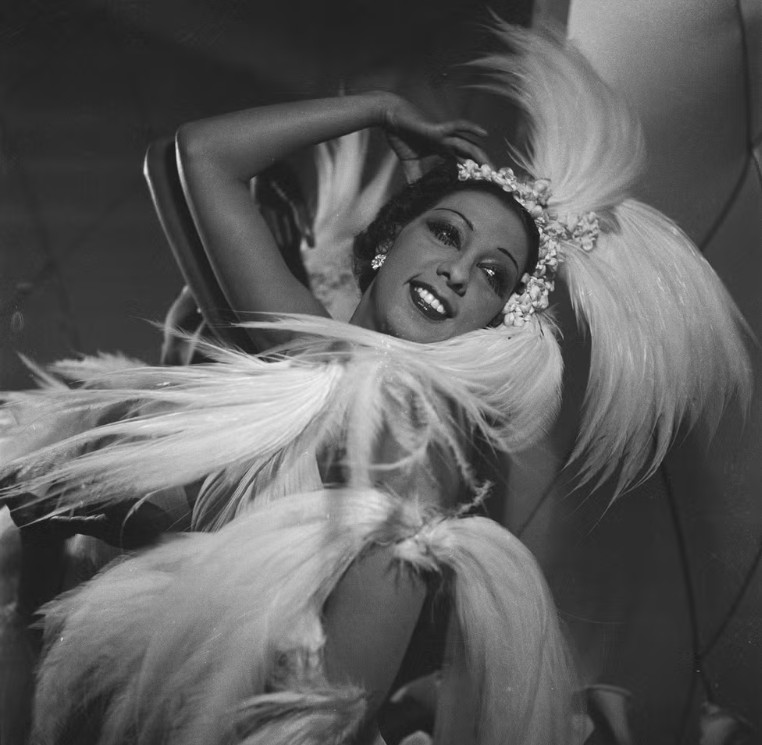
One selection I regret not including in this morning’s “April in Paris” playlist on “Sweetness and Light” is Josephine Baker’s “J’ai deux amours” (“I have two loves, my country and Paris”). Baker died 50 years ago today. Learn more about her remarkable life at the link, which includes access to an hour-long documentary.
This Saturday morning on “Sweetness and Light,” it’s April in Paris.
We’ll hear April-and-Paris themed songs by Charles Trenet (“En avril, à Paris”) Georges Bizet (“Chanson d’avril”) and, of course, Vernon Duke (“April in Paris”), alongside a symphony for wind instruments by Charles Gounod (first performed in Paris in April 1885), a love song by Erik Satie, a suite (“Paris”) by British light music master Haydn Wood, and a work by Darius Milhaud as good as spring itself.
It will be an hour of cafés and croissants, blossoms and bisous, on “Sweetness and Light,” this Saturday morning at 11:00 EDT/8:00 PST, exclusively on KWAX, the radio station of the University of Oregon!
This afternoon, it’s our last chance for April in Paris. Join me today on The Classical Network for an international salute to the City of Lights.
It’s also the birthday of John Jacob Niles, so get ready for some settings of Appalachian mountain songs. It will be a refreshing mix of foreign and domestic from 4 to 6 p.m. EDT.
Then stay tuned for “Picture Perfect,” beginning at 6, for music from movies inspired by comic adventurers – that is, heroes from the funny pages. I’ll be elaborating on that in just a bit.
For now, enjoy the weather and enjoy the music. It’s baguettes and banjos all around on WWFM – The Classical Network and wwfm.org.
It’s April in Paris (and everywhere else for that matter).
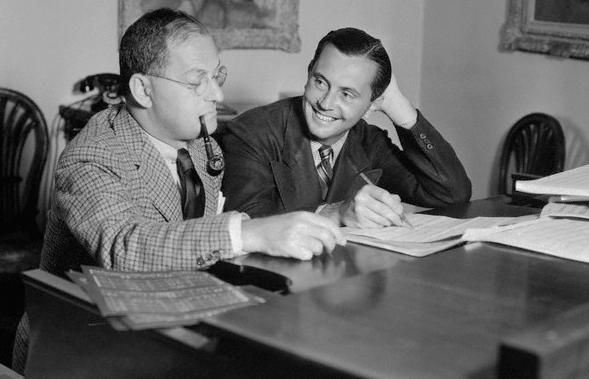
Vernon Duke was born Vladimir Dukelsky in what is now Belarus in 1903. In Kiev, he studied composition under Reinhold Gliere. He left the USSR in 1920, traveling to New York, where he was befriended by George Gershwin. In fact, it was Gershwin who suggested the name change. (Gershwin himself was born Jacob Gershowitz.)
For a time, he ping-ponged back and forth to Europe, where he fulfilled a commission by Serge Diaghilev (for the ballet “Zephyr and Flora”). The work impressed Sergei Prokofiev, and the two became fast friends. Dukelsky’s Symphony No. 1 was given its premiere in Paris, under Serge Koussevitzky, on the same program as excerpts from Prokofiev’s “The Fiery Angel.”
Around the same time, Duke began contributing material to musical comedies in London. This laid the groundwork for a return to New York in 1929. There, he continued to composed “serious” works, while insinuating himself into the Broadway scene. A number of his songs – “April in Paris,” “Autumn in New York,” “Taking a Chance on Love,” “I Can’t Get Started” – have since become standards.
When Gershwin died in 1937, Duke stepped in to complete his unfinished score for “The Goldwyn Follies,” for which he contributed a couple of ballets (choreographed by George Balanchine) and the song, “Spring Again.” His greatest success came in 1940, with the Broadway show, “Cabin in the Sky.”
A number of his concert works have been recorded in recent years. While bouncing around YouTube this morning, I came across this rare concert broadcast of his Symphony No. 3:
Here’s a fine, digital recording by Metropolitan Opera cellist Samuel Magill of Dukelsky’s Cello Concerto: