Tag: Bach

  • Bach, Schweitzer, Růžičková: Music for the Soul

    Bach, Schweitzer, Růžičková: Music for the Soul

    If there is any doubt that Bach is good for the soul, one need look no further than two spiritual titans whose birthdays we’ll celebrate today.

    Albert Schweitzer (1875-1965) is widely remembered for his humanitarian efforts. A lifelong scholar, a missionary, and a physician who brought medical assistance to the people of Gabon, he was awarded the Nobel Prize in 1952.

    A frail child, Schweitzer took to the organ as soon as he was tall enough to reach the pedals. His love of music paralleled his development as a philosopher and a theologian. In fact, no less an authority than Charles-Marie Widor was stunned by Schweitzer’s insights into Bach’s organ works, which were informed in part by a Lutheran background he shared with the composer. Schweitzer wrote extensively on Bach, in French, German, and English. In addition, he gave numerous organ recitals in Europe to finance his hospital in Africa.

    A reverence for life was central to Schweitzer’s philosophy. While he continued his humanitarian work in Lambaréné throughout World War II, Zuzana Růžičková (1927-2017) weathered the incomprehensible in several Nazi concentration camps.

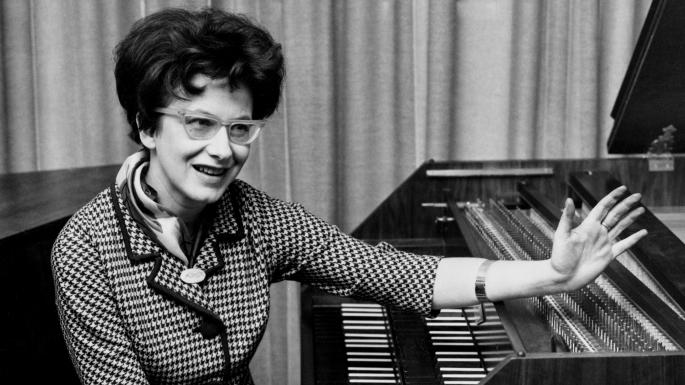
    Růžičková survived internment at Terezin, Auschwitz, and Bergen-Belsen. Of the latter, in particular, she recalled, “If ever there was Hell, this was the lowest part of Hell.” Following the war, she stood up for years against political and anti-Semitic persecution under Czechoslovakia’s communist rule. She survived Stalin and lived through the Velvet Revolution, maintaining her integrity and gaining recognition as “first lady of the harpsichord.” Růžičková became the first harpsichordist to record all of Bach’s keyboard music.

    Unlike Schweitzer, Růžičková was not particularly religious, but her spirit was large and her will indomitable. Her love of music was with her always, even in the camps. (At Terezin, she transcribed some of Bach’s music to take with her to Auschwitz.) Both she and Schweitzer were acutely aware of human suffering on a scale that most of us are lucky never to have encountered. Yet they also recognized a greater good. Perhaps it’s no coincidence that they both lived to be 90.

    I hope you’ll join me today as we sample their artistry, among my featured offerings from 4 to 7 p.m. EST, on WWFM – The Classical Network and wwfm.org.

  • Bach & Mendelssohn from Marlboro Festival

    Bach & Mendelssohn from Marlboro Festival

    On this week’s “Music from Marlboro,” we get a good start on 2019, with music by Felix Mendelssohn, bounding out of the gate at 16 years-old with one of the most astonishing works in the repertoire.

    Mendelssohn’s Octet for Strings in E-flat is the piece that established him as music’s foremost preternatural genius. Hear a 1960 performance from the legendary Marlboro Music Festival, featuring violinists Jaime Laredo, Alexander Schneider, Arnold Steinhardt and John Dalley, violists Michael Tree and Samuel Rhodes, and cellists Leslie Parnas and David Soyer.

    Holy smokes! In case you didn’t notice, the performers include the entire Guarneri String Quartet – which didn’t formally come together as a group until four years later, at Marlboro – and then some.

    Of course, Mendelssohn was also the most important figure in the revival of the music of Johann Sebastian Bach, at the age of 20 spearheading the first performance since Bach’s death of the “St. Matthew Passion.”

    Equally important to Bach’s rehabilitation was Pablo Casals, who rediscovered Bach’s cello suites in a Catalan bookshop at the age of 13. Casals championed the pieces for the remainder of his days. Thanks to him, what had previously been regarded as dimly-recollected etudes are now standard repertoire.

    Casals was affiliated with the Marlboro Music Festival from 1960 to 1973, the last 13 years of his life. We’ll hear Casals conduct Marlboro musicians in Bach’s Bradenburg Concerto No. 5. Flutist Ornulf Gulbransen, violinist Alexander Schneider, and pianist Rudolf Serkin are standouts in this 1964 recording. Serkin, of course, was the Marlboro Music School and Festival’s founding artistic director.

    Begin the new year with inspirational performances of music by Bach and Mendelssohn – a surefire balm for the back-to-work blues – on the next “Music from Marlboro,” this Wednesday evening at 6:00 EST, on WWFM – The Classical Network and wwfm.org.

    Marlboro School of Music and Festival: Official Page


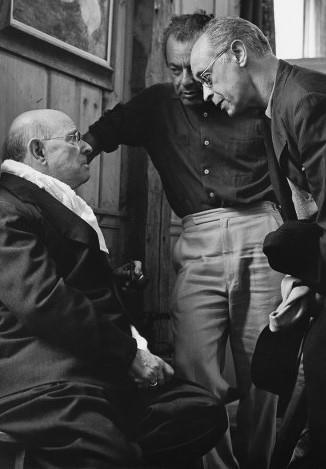
    PHOTO: Pablo Casals, Alexander Schneider, and Rudolf Serkin will feature prominently on this week’s “Music from Marlboro.”

  • Chelm’s Wise Fools Meet Bach on WWFM

    Chelm’s Wise Fools Meet Bach on WWFM

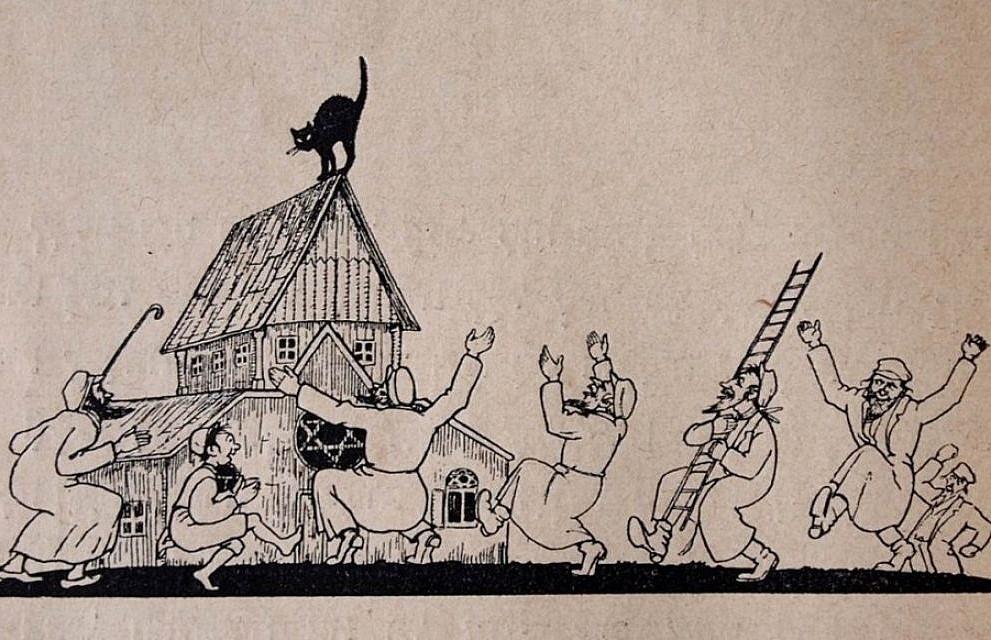
    In Jewish lore, the wise men of the Polish city of Chelm may be very wise indeed, but they sure do lack common sense. For example, when carrying logs down a mountain to build their dwellings, they encounter someone who suggests it might be easier simply to roll them down. They recognize this as a very good idea – so they carry the logs back up the mountain and proceed to roll them down.

    This kind of playful irony informs the tales of Isaac Bashevis Singer, Aaron Zeitlin, and Sholem Aleichem. More to our purposes, the folkloric antics inspired composer Matthew H. Fields when he came to write his “Sages of Chelm.” The work falls into three movements: “Khutzpah,” “Tsores,” and “Simchas.” We’ll enjoy the piece on this last day of Hanukkah, beginning at 3:00 EST.

    In the meantime, here’s a link to a round-up of favorite Chelm stories:

    https://www.myjewishlearning.com/article/the-sages-of-chelm/

    I’ll actually be in a little earlier than usual today, to host “Bach at One.” The Choir of Trinity Wall Street and Trinity Baroque Orchestra will present the Cantata BWV 8 “Liebster Gott, wenn Werd ich sterben” (“Dearest God, when will I die?”), under the direction of Julian Wachner. Then we’ll get a taste of “Pipes at One,” with Kent Tritle on the organ of Trinity’s St. Paul’s Chapel. Featured composers will include Dietrich Buxtehude, Nicolas de Grigny, Louis Marchand, Jean Langlais, Felix Mendelssohn, and of course Bach. As the titles of the programs suggest, these concerts will be broadcast back-to-back (Bach-to-Bach?), beginning at 1:00 EST.

    Then, following “Sages of Chelm,” it will be business as usual at 4:00 EST, as I offer a skillful juxtaposition of birthday anniversaries and commuter entertainment, with some intimations of Christmas folded into the mix.

    The “ch” in “Chelm” is pronounced like the “ch” in “Bach.” It’s not just the cold weather that will have me clearing my throat during this musical marathon run, from 1 to 7 p.m. EST, on WWFM – The Classical Network and wwfm.org.


    The People of Chelm and the Cat:

    https://www.yiddishbookcenter.org/collections/oral-histories/excerpts/woh-ex-0002054/people-chelm-and-cat

  • Bach & Beyond with The Dryden Ensemble

    Bach & Beyond with The Dryden Ensemble

    Ah! Few things are as warming in the middle of a school day as a “Bach’s lunch” – especially when it has been packaged so lovingly.

    Join me for today’s Noontime Concert on The Classical Network, when we’ll present “Bach & Beyond,” with The Dryden Ensemble. On the menu will be music by George Philipp Telemann, Johann Gottlieb Janitsch, Johann Christian Bach, and Johann Sebastian Bach himself. The only thing missing will be a note from Mom.

    The Dryden Ensemble’s Bach Cantata Fest will be presented on two concerts this weekend: on Saturday, October 20, at 7:30 p.m., at Trinity Episcopal Church, 6587 Upper York Road, in Solebury, PA; and on Sunday, October 21, at 3 p.m., at Miller Chapel, on the campus of Princeton Theological Seminary.

    The program will include the Cantatas 87 and 154, with selected Bach arias performed by mezzo-soprano Kristen Dubenion-Smith, tenor Jason McStoots, and baritone William Sharp.

    The Dryden Ensemble is made up of artistic director Jane McKinley and Julie Brye, oboes; Vita Wallace and Dongmyung Ahn, violins; Andrea Andros, viola; Rebecca Humphrey, cello; Motomi Igarashi, double bass; Daniel Swenberg, theorbo, and Webb Wiggins, chamber organ, all performing on period instruments.

    The ensemble will continue its celebration of Bach on November 10 at 3 p.m. with a Bach organ recital performed by Jacob Street at Miller Chapel on the Princeton Theological Seminary campus. On January 19 & 20 the group will present “Queen Christina Goes to Rome,” a theatrical program featuring two acclaimed actors. The season will conclude on April 6 & 7 with Musica Stravagante and glorious music for oboe and strings by Albinoni, Vivaldi, Biber, Bach, and others. Tickets and information are available at drydensensemble.org.

    Following today’s broadcast concert, stick around for the Symphony in B flat by Alexander Zemlinsky, a work written very much under the influence of Brahms and Dvořák. Zemlinsky’s style would evolve. Some of his mature works undoubtedly achieve greater distinction, but there’s something to be said for great tunes and abundant charm. He also happened to be the teacher of Arnold Schoenberg and Vienna’s great musical prodigy of the day, Erich Wolfgang Korngold.

    Korngold, of course, went on to become one of the great film composers. He applied the same romantic opulence that made his operas so successful to his work for the silver screen. His Piano Trio in D major, Op. 1, written at the age of 13, reveals him to be already in command of the distinctive musical language that would serve him so well.

    Schoenberg too wound up in Hollywood. He may have been the godfather of dodecaphonic music, but his neoclassical Suite for String Orchestra in G, his first piece composed in the New World, could almost be described as a charmer. This work “in the olden style” is wholly tonal and betrays the composer’s love of the music of Johann Sebastian Bach.

    I hope you’ll join me for Bach and beyond today. The lunch box doubles as a music box, from 12 to 4 p.m. EDT, on WWFM – The Classical Network and wwfm.org.

  • Bach Month Donation Drive at The Classical Network

    Bach Month Donation Drive at The Classical Network

    March is Bach Month at The Classical Network. Every March we reach out to you, our listeners, asking you to come forward and donate in whatever amount is comfortable for you. Once we reach 500 donations, we stop the solicitations and celebrate with just Bach’s music, in honor of Bach’s birthday on March 21. Of course, this year, Old Man Winter threw a wrench in the works by blanketing the East Coast with snow in the fourth nor’easter in three weeks. Thanks, Old Man!

    Because of the setback, we lost momentum on the special day, and we are still racing to catch up. As of this writing, the membership thermometer stands at 341 – only 159 contributions to go! Can you help us wrap up this campaign by the weekend? There’s $15,000 on the line, courtesy of the Bach Pot, challenge money put up by some of our most dedicated listeners. You can do your part by heading over to wwfm.org and clicking on the “donate now” button beneath the thermometer at the right side of the page. Or by calling us at 1-888-232-1212.

    Your contribution is like nitrous oxide to the engine of Johann Sebastian’s Heavy Chevy. Help propel us to a successful finish, so that we can fill the air waves once again with uninterrupted, glorious music and kick back in unalloyed enjoyment. As always, thank you for your ongoing support of WWFM – The Classical Network. We couldn’t do it without you!

Tag Cloud

Aaron Copland (92) Beethoven (95) Composer (114) Film Music (120) Film Score (143) Film Scores (255) Halloween (94) John Williams (185) KWAX (229) Leonard Bernstein (100) Marlboro Music Festival (125) Movie Music (135) Opera (198) Philadelphia Orchestra (88) Picture Perfect (174) Princeton Symphony Orchestra (106) Radio (87) Ralph Vaughan Williams (85) Ross Amico (244) Roy's Tie-Dye Sci-Fi Corner (290) The Classical Network (101) The Lost Chord (268) Vaughan Williams (103) WPRB (396) WWFM (881)

DON’T MISS A BEAT

Receive a weekly digest every Sunday at noon by signing up here


RECENT POSTS