Tag: Bard SummerScape

  • Smetana’s “Dalibor” US Debut at Bard SummerScape

    Smetana’s “Dalibor” US Debut at Bard SummerScape

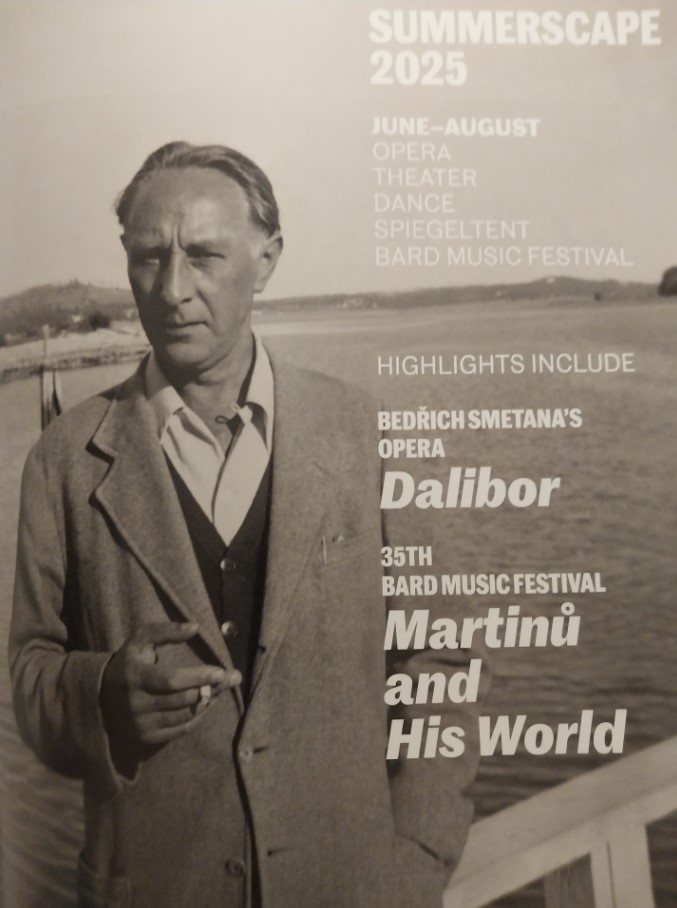
    As something of a preamble to this year’s Bard Music Festival, devoted to the Czech master Bohuslav Martinů (“Martinů and His World,” to be presented at Bard College over two weekends, August 8-10 and 14-17), this year’s Bard SummerFest, now in progress, will offer the U.S. stage debut of Bedřich Smetana’s 1868 opera “Dalibor” in four performances, beginning this weekend at Bard College’s Fisher Center for the Performing Arts, July 25 at 6:30 p.m., July 27 at 2 p.m., July 30 at 2 p.m., and August 1 at 4 p.m.

    If it sounds enticing, but you can’t make it, the July 30 matinee will be available for livestreaming, in real-time, with an encore broadcast on August 2 at 5 p.m. There’s more information at the “Dalibor” link below.

    Smetana is regarded as the father of Czech national music, his immediately identifiable sound an inspiration to Dvořák and those who followed.

    His best-known opera, by far, is “The Bartered Bride,” with its rousing overture and rustic dances. Also, I’ll wager you can’t listen to classical radio for a week without encountering “The Moldau,” the second of the collection of symphonic poems that comprise the composer’s epic patriotic tableau “Ma Vlast” (“My Country”).

    “Dalibor” is very far from “The Bartered Bride.” It’s a drama, for one thing, full of Teutonic iconography: medieval castles, minnesingers, and resourceful damsels. There’s some “Lohengrin” in it, and some “Fidelio.” (The heroine disguises herself as boy in order spring the man she loves from imprisonment.) Having attended performances of Richard Strauss’ “Guntram” and Wagner’s “Tristan und Isolde” in recent weeks, you’d think I’d have had enough of this sort of thing, but no!

    At any rate, Smetana’s music, despite the scenic trappings, is unmistakably Czech to its core. Hey, the Czech lands have their castles too. “Dalibor” was tepidly received at its premiere, but it gained traction following the composer’s death and its significance is now deemed to be considerable among Smetana’s countrymen. Although programmed in Europe, in its early years performed throughout the Austro-Hungarian Empire, by Gustav Mahler, among others, it has yet to make it to these shores.

    It was Bard president and festival artistic co-director Leon Botstein who oversaw the presentation of “Guntram” at Carnegie Hall in June, with the American Symphony Orchestra. Conductor and orchestra will also take part in these performances of “Dalibor.” On top of everything else, Botstein has been music director of the ASO since 1992.

    The production was to have been headlined by the Czech tenor Ladislav Elgr and Polish soprano Izabela Matula, but due to visa issues, some talented Americans have stepped up to address the challenges of learning what must be for them new roles in an uncommon language. Slavic opera is much less frequently encountered here than Italian, German, and French.

    But don’t for a moment think that you’ll be getting shortchanged. I was at the performance of “Guntram” at Carnegie, featuring tenor John Matthew Myers, and I can attest that anyone who attends “Dalibor” will be in for a real treat. This guy has a clarion voice, with a warm, radiant tone, guaranteed to fill the entire house. Soprano Cadie J. Bryan is unfamiliar to me, but she has received praise for her radiance and vocal luster. I’m very much looking forward to hearing her as Mlada. Glancing through the rest of the cast, I also recognize bass-baritone Alfred Walker, another Botstein favorite (among other things, he sang the title role in Bard’s production of Saint-Saens’ “Henri VIII”). He’ll return as King Vladislav.

    The stage director is Jean-Romain Vespirini (also the director of “Henri VIII”). There are two endings to the work, both of them tragic. Which one will be used?

    Botstein and Bard are all about resurrecting unusual and neglected repertoire. Other rarely-encountered operas revived at Bard include Ernest Chausson’s “Le roi Arthus,” Dvořák’s “Dmitrij,” Korngold’s “Das Wunder der Heliane,” Meyerbeer’s “La prophète,” Anton Rubinstein’s “Demon,” and Ethel Smyth’s “The Wreckers,” among many others.

    For anyone in search of a little respite from Puccini, Verdi, Wagner, Mozart, and the four or five others who dominate the world’s opera houses, Bard’s offerings are like manna in a desert of seemingly endless repetition.


    Smetana’s “Dalibor” at Bard SummerScape

    https://fishercenter.bard.edu/events/dalibor/

    Bard Music Festival, “Martinu and His World”

    Bard Music Festival

    Some of the past Bard operas are available for streaming here

    SummerScape Opera in HD

    Fisher Center at Bard

  • Martinů Festival at Bard: A Sleeping Giant Awakens

    Martinů Festival at Bard: A Sleeping Giant Awakens

    The sleeping giant of Czech music gets his own festival!

    Why is Bohuslav Martinů not better known? It’s one of the questions, I’m sure, that will be explored at the 35th annual Bard Music Festival, “Martinů and His World,” to be held largely on the campus of Bard College in Annandale-on-Hudson, NY, August 8-17.

    Over two weekends, conductor and Bard president Leon Botstein will oversee orchestral, orchestral/choral, and opera performances, at the helm of the American Symphony Orchestra and presumably Bard’s own The Orchestra Now (TŌN). Evening concerts will take place at the Sosnoff Theater, the state-of-art concert hall housed in the Frank Gehry-designed Fisher Center for the Performing Arts.

    Daylight concerts and panels will be held across campus in the more intimate surroundings of the 300-seat Olin Hall. Performers will include superb musicians and ensembles from the faculty of the Bard Conservatory, guests, and visiting artists with long relationships with the festival.

    Part of the Martinů problem is surely that he was so prolific, it’s difficult to summarize his significance by ferreting out the important works. For the uninitiated, getting one’s head around the composer’s output can be disorienting and overwhelming. Yet Martinů’s music is immediately appealing, generally easily digestible, and often a great deal of fun.

    Some of the works have a strong Czech national flavor, revealing a spiritual descent from the line of Dvořák and Smetana; others are evidently modernist, full of churning flywheels and motor rhythms, characteristic of a mechanized age; others still flirt with popular styles, especially jazz. He’s a unique mash-up of Bohemian, French, and American influences. His “modernism,” such as it is, is seldom at the expense of broadening passages of great lyrical beauty.

    I’m happy to see a few of my favorites represented: the Nonet, the Cello Sonata No. 3, the Flute Sonata, and the jazz sextet “La revue de cuisine.” Among the larger works will be the Symphonies Nos. 2 & 6, “The Epic of Gilgamesh,” and a semi-staged performance of his opera “Julietta.”

    This being Bard, there will be plenty of fascinating rarities by other hands, including a string quartet by Martinů student (and mistress) Vítězslava Kaprálová and a piano concertino I didn’t even know existed by his friend and champion Rudolf Firkušný.

    Also featured will be works by Iva Bittová, Aaron Copland, David Diamond, Antonín Dvořák, Petr Eben, Karel Husa, Leoš Janáček, Jaroslav Ježek, Arthur Honegger, Kryštof Mařatka, Jan Novák, Maurice Ravel, Jaroslav Řídký, Erwin Schulhoff, Josef Suk, Alexandre Tansman, Joan Tower, and Frank Zappa.

    For more information about “Martinů and His World,” visit

    https://fishercenter.bard.edu/whats-on/programs/bard-music-festival/?utm_source=wordfly&utm_medium=email&utm_campaign=2025-02-11SU25Announcement&utm_content=version_A

    The festival is the crown jewel in the diadem of Bard SummerScape, Bard’s annual celebration of the arts, which will take place July 27- August 17. Fans of Czech music will also eagerly anticipate a fully-stage production of Bedřich Smetana’s “Dalibor,” that will precede the Martinů festival, July 25-Aug 3.

    https://fishercenter.bard.edu/whats-on/programs/summerscape/

    Some of the events, including one of the performances of “Dalibor” will be available for livestreaming.

    The sleeping giant stirs. Set your alarms for Martinů!

    Fisher Center at Bard

  • Bard SummerScape: Henry VIII Opera

    Bard SummerScape: Henry VIII Opera

    Bard SummerScape once again makes history, with the first major U.S. production of Camille Saint-Saëns’ grand opera “Henry VIII.”

    A seven-week arts festival consisting of opera, dance, theater, film, music, and cabaret, Bard SummerScape is held every year on the idyllic campus of Bard College in Annandale-on-Hudson, NY.

    In common with all of Bard’s operas, “Henry VIII” is rarely staged. In fact, you’re unlikely to encounter any of Saint-Saëns’ operas other than, of course, “Samson and Delilah.” I was lucky enough to hear this one, also at Bard, in a concert performance during a festival devoted specifically to Saint-Saëns in 2012.

    This year’s fully-staged production, held at the Sosnoff Theater in the Frank Gehry-designed Fisher Center for the Performing Arts, opened on Friday. Remaining performances will take place at the following times:

    TODAY AT 2 PM
    JULY 26 AT 2 PM
    JULY 28 AT 4 PM
    JULY 30 AT 2 PM

    Livestreams will also be made available on July 26 AT 2 PM and July 29 AT 5 PM.

    Eleven of Bard’s past operas – again, many of them U.S. premieres – are now available for streaming, free, and can be accessed on YouTube through the festival’s archive at the link below.

    2022 – Richard Strauss, “Die Schweigsame Frau” (“The Silent Woman”)

    2021 – Ernest Chausson, “Le roi Arthus” (“King Arthur”)

    2019 – Erich Wolfgang Korngold, “Das Wunder der Heliane” (“The Miracle of Helen”)

    2018 – Anton Rubinstein, “Demon”

    2017 – Antonin Dvořák, “Dmitrij”

    2016 – Pietro Mascagni, “Iris”

    2015 – Ethel Smyth, “The Wreckers”

    2014 – Carl Maria von Weber, “Euryanthe”

    2013 – Sergei Taneyev, “Oresteia”

    2012 – Emmanuel Chabrier, “Le roi malgré lui” (“The King in Spite of Himself”)

    2011 – Richard Strauss, “Die Liebe der Danae” (“The Love of Danae”)

    https://fishercenter.bard.edu/explore-learn/summerscape-opera/?utm_source=wordfly&utm_medium=email&utm_campaign=2023-07-21-OperaOpeningNight&utm_content=version_A

    Arguably, the crown jewel of Bard SummerScape is the Bard Music Festival (August 4-13), two weeks devoted to a specific composer and his or her world – their contemporaries, those they were influenced by, and those they influenced. This year (its 33rd) the focus is on none other than Ralph Vaughan Williams.

    Highlights will include performances of “Job, A Masque for Dancing,” the “Sinfonia Antartica” [sic], the Symphonies Nos. 4 & 8, the Concerto for Two Pianos, the Concerto Accademico for violin and orchestra, “Flos Campi” for viola, chorus and orchestra, and a concert performance of the Falstaff opera “Sir John in Love,” alongside old favorites like “The Lark Ascending,” the “Fantasia on a Theme by Thomas Tallis,” “Five Variants of Dives and Lazarus,” and the “Serenade to Music.”

    With the composer largely neglected in the United States during his sesquicentennial year, all I can say is… it’s about bloomin’ time!

    Of course, there will be works by many other composers, as well, though all of the music will be connected in one way or another with RVW.

    The Bard Music Festival is an intensive regimen of concerts, panels, and pre-concert talks. One basically gets out of it whatever one puts into it. If total immersion is what you desire, there’s no place like Bard for a scholarly crash course. But if you prefer to cherry-pick, and just go and casually experience some worthwhile, often rarely-heard music, you can do that, too. One thing’s for certain: the lavish program book will keep you busy for days after the festival’s end. There is also always a tie-in book of scholarly essays and many recordings available for purchase.

    For more information on Bard SummerScape and the Bard Music Festival, visit here:

    https://fishercenter.bard.edu/whats-on/programs/summerscape/

    If you’re an opera lover and you’ve got a lazy Sunday afternoon or evening ahead, consider streaming one of the operas today!

    Fisher Center at Bard


    PHOTO: Still from Bard’s “Henry VIII”

  • Arthurian Art The Lost Chord’s Musical Knights

    Arthurian Art The Lost Chord’s Musical Knights

    King Lot, Lancelot, Camelot – that’s a lot of “lots.”

    This Sunday night on “The Lost Chord,” we put the “art” in “Arthur” with musical treatments of the Arthurian legends by two peripatetic American Romantics,

    We’ll hear “Excalibur,” a symphonic poem after Arthur’s enchanted sword, by Louis Coerne (pronounced “Kern”). Coerne was born in Newark, NJ, in 1870. As was the custom at the time, he studied abroad, in France and Germany, then closer to home with John Knowles Paine. In Munich, he pursued organ and composition studies with Josef Rheinberger.

    After that, it was back and forth to Germany, between church and conducting appointments in the United States, and then the assumption of a series of academic posts throughout the American Northeast and Midwest. Despite all the worn shoe leather, in his 52 years he managed to produce 500 works.

    The remainder of the hour will be devoted to the Straussian tone poem “Le Roi Arthur,” a work in three movements, by George Templeton Strong, son of the famous Civil War diarist, born in 1856. Strong Jr. studied at the Leipzig Conservatory, where Joachim Raff was among his teachers. For a time, he played viola in the Gewandhaus Orchestra. He rubbed shoulders with Liszt and Wagner, then was lured back to the United States by the offer of a teaching position (by former European transplant Edward MacDowell) at the New England Conservatory.

    However, in part because the work didn’t agree with him, and in part because of health issues, Strong soon took off for Switzerland, where he settled on the banks of Lake Geneva. There, he dedicated the remainder of his life to painting watercolors and composing. Even after musical fashion had changed, he continued to play an active role in Geneva’s musical life.

    I hope you’ll join me for “Kinetic Yankees in King Arthur’s Court.” Break a lance for Arthur, this Sunday night at 10:00 EDT, on WWFM – The Classical Network and wwfm.org.


    BONUS! Wholly by coincidence, this year’s opera at Bard Summerscape is Ernest Chausson’s rarely-staged “Le Roi Arthus.” I can’t speak for the production, not having seen it, but Bard generally does a fine job with anything they put their musical minds to. You can make it a full Arthurian evening by enjoying the livestream tonight at 6:30 pm. The running time of the opera is 3 ½ hours, so it should end just in time for the start of “The Lost Chord.”

    https://fishercenter.bard.edu/events/king-arthur/

  • Strauss’ “Love of Danae” Rare Opera Online

    Strauss’ “Love of Danae” Rare Opera Online

    On Richard Strauss’ birthday, enjoy this production of the rarely-heard opera “Die Liebe der Danae” (“The Love of Danae”), a comedy after Hugo von Hofmannsthal (libretto by Joseph Gregor), steeped in Greek mythology.

    The powerful god Jupiter and the lowly donkey driver Midas compete for the love of the beautiful Danae. According to the promotional material, “The story is a Mozartean blend of comedy, romance, and drama on the themes of transformation and the acceptance of life’s changes, all brilliantly illuminated by Strauss’s orchestral mastery.” The production is a collaboration of stage director Kevin Newbury and architect Rafael Viñoly.

    True to the mission of Bard SummerScape, this is the first time the opera has ever been staged in New York. The performance took place at Bard College in 2011. The American Symphony Orchestra is conducted by Leon Botstein:

    Some background and a brief synopsis of the opera:

    https://en.wikipedia.org/wiki/Die_Liebe_der_Danae

    Unfortunately, because of the COVID-19 pandemic, this year’s Bard Music Festival, which was to have focused on Nadia Boulanger and her world, has been postponed until the summer of 2021.

    You’ll find more information at the website of Fisher Center at Bard, https://fishercenter.bard.edu/summerscape/.

Tag Cloud

Aaron Copland (92) Beethoven (95) Composer (114) Film Music (120) Film Score (143) Film Scores (255) Halloween (94) John Williams (185) KWAX (229) Leonard Bernstein (100) Marlboro Music Festival (125) Movie Music (135) Opera (198) Philadelphia Orchestra (88) Picture Perfect (174) Princeton Symphony Orchestra (106) Radio (87) Ralph Vaughan Williams (85) Ross Amico (244) Roy's Tie-Dye Sci-Fi Corner (290) The Classical Network (101) The Lost Chord (268) Vaughan Williams (103) WPRB (396) WWFM (881)

DON’T MISS A BEAT

Receive a weekly digest every Sunday at noon by signing up here


RECENT POSTS