150 years ago today: the beginning of the end. Or should it be the end of the beginning? The first complete Ring Cycle concludes with the premiere of “Götterdämmerung” – “Twilight of the Gods” – at the inaugural Bayreuth Festival in 1876.
Tag: Bayreuth Festival
-
Vintage Wagner on “The Lost Chord”
I’ve been celebrating the sesquicentennial of the “Ring” on my radio shows this weekend. The four installments of Wagner’s famed operatic tetralogy were performed on quasi-consecutive days for the first time in the newly-constructed Festspielhaus at the inaugural Bayreuth Festival on August 13-17, 1876.
I’ll conclude my three-part homage on “The Lost Chord,” with an hour of vintage recordings, two of them “Ring”-related and the other captured on the premises at Bayreuth.
American baritone Lawrence Tibbett never actually sang the role of Wotan on stage, in the context of a “Ring” cycle. However, he did record “Wotan’s Farewell and Magic Fire Music,” magnificently, in 1934, with the Philadelphia Orchestra and Leopold Stokowski.
Karl Muck was a casualty of anti-German sentiment during his time as music director of the Boston Symphony Orchestra, which, unfortunately, happened to coincide with the First World War. Be that as it may, he was held in the highest regard by fellow musicians and thought by many to be one of Wagner’s finest interpreters. We’ll hear a fascinating 1927 recording of the Transformation Music and the beginning of the Grail Scene from Act I of “Parsifal,” made at the Festspielhaus in Bayreuth.
The recording employs the original bells designed by Wagner, which would be melted down by the Nazis for ammunition during the Second World War. So this will be a rare opportunity to experience the “Parsifal” Wagner actually knew. Muck was principal conductor of the Bayreuth Festival since 1903. He conducted “Parsifal” at Bayreuth 14 times between 1901 and 1930.
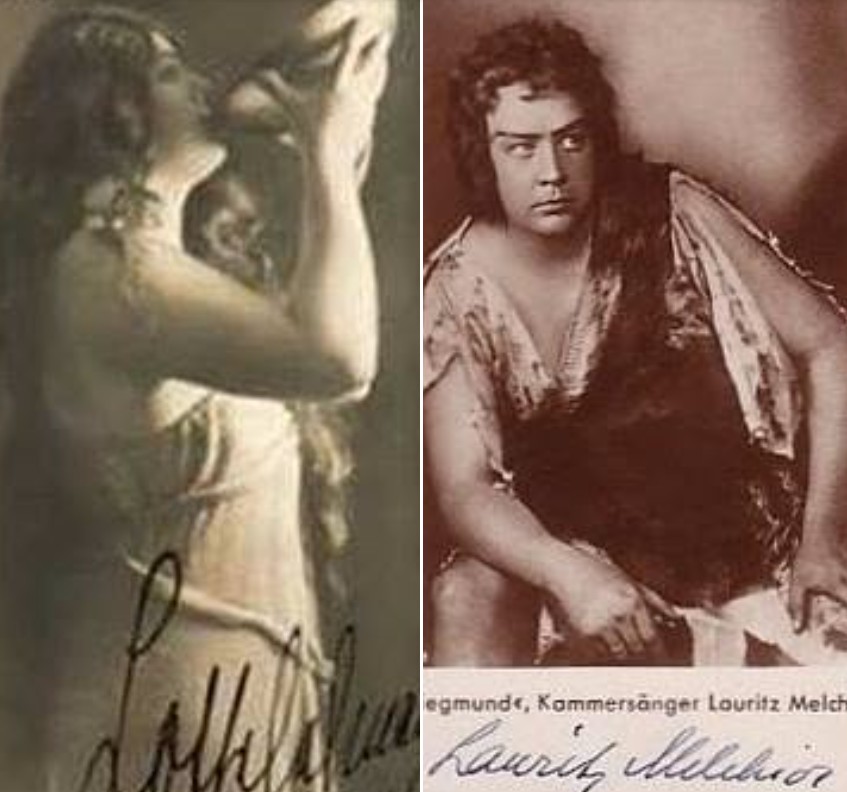
Finally, we’ll return to “Die Walküre” to wrap things up on a buoyant note with Siegmund and Sieglinde’s love music from Act I, which concludes with the lovers fleeing together into the welcoming spring. Nine months later, Sieglinde gives birth to Siegfried, the saga’s hero-without-fear. Lotte Lehmann strikes sparks with legendary Danish heldentenor Lauritz Melchoir in a 1935 recording with Bruno Walter and the Vienna Philharmonic.
The power of these performances remains undiminished by the passage of time. I hope you’ll join me for another Wagner power hour on “Vintage Wagner,” on “The Lost Chord,” now in syndication on KWAX Classical Oregon!
——-
Clip and save the start times for all three of my recorded shows:
PICTURE PERFECT, the movie music show – Friday at 8:00 PM EDT/5:00 PM PDT
SWEETNESS AND LIGHT, the light music program – Saturday at 11:00 AM EDT/8:00 AM PDT
THE LOST CHORD, unusual and neglected rep – Saturday at 7:00 PM EDT/4:00 PM PDT
Stream them, wherever you are, at the link!
https://kwax.uoregon.edu
——-
PHOTOS: Lotte Lehmann as Sieglinde and Lauritz Melchior as Siegmund -
Frolicking with Light Music Master Richard Wagner on “Sweetness and Light”
The four installments of Wagner’s Ring Cycle were performed together for the first time in the brand-spanking-new Festspielhaus at the inaugural Bayreuth Festival on August 13-17, 1876. This week on “Sweetness and Light,” to mark the 150th anniversary of Wagner’s magnum opus, we’ll have music tying in, in one way or another, with opera’s most successful “miniseries.” An unlikelier source for a light music program would be more difficult to imagine!
I may lack the muscle to hoist Donner’s hammer, but I will employ the cunning of Loge to dissipate the Wagnerian gloom with virtuosic piano transcriptions of “Ride of the Valkyries” (by Carl Tausig) and “Magic Fire Music” (by Louis Brassin), Wagner’s “Siegfried Idyll” (arguably the sweetest thing he ever wrote), humorist Anna Russell’s classic routine “The Ring of the Nibelungs (An Analysis),” and a cheeky work for piano four-hands by Gabriel Fauré & André Messager, in which they render somber motifs from the “Ring” as a quadrille!
They say it can’t be done! You’ll be left agog at the evidence of your own ears when you join me for an hour of Wagnerian “light” music, in celebration of 150 years of the “Ring,” on “Sweetness and Light,” this Saturday morning at 8:00 EDT/11:00 PDT, exclusively on KWAX Classical Oregon!
Stream it, wherever you are, at the link:
https://kwax.uoregon.edu/ -
Wagner Out the Wazoo on “Picture Perfect,” “Sweetness and Light,” and “The Lost Chord”
In 1876, the four operas – or music dramas (the composer’s preferred term) – of Wagner’s “Ring Cycle” were performed together for the first time, from August 13 through August 17, at the inaugural Bayreuth Festival, in the Festspielhaus (a theater of the composer’s design) in Bayreuth, Germany. The Bayreuth Festival has continued as a mecca for Wagnerites down to the present day.
To mark the 150th anniversary of the “Ring,” all three of my radio shows this weekend will tie in, in one way or another, with this most grandiose and influential undertaking.
First, today on “Picture Perfect,” we’ll have music from four films in which Erich Wolfgang Korngold served as ghostwriter for onscreen composers, providing a ballet for Errol Flynn’s in “Escape Me Never” (1946), a tone poem for Charles Boyer in “The Constant Nymph” (1943), and a cello concerto for Claude Rains in “Deception” (1946). More to the point, Korngold actually appears onscreen – hastily made-up when the actor hired for the purpose didn’t show – to play conductor Hans Richter in the Wagner biopic “Magic Fire,” for which he adapted selections from, yes, the Ring Cycle.
Then tomorrow morning, on “Sweetness and Light,” it will be the unlikeliest “light music” program, as we listen to piano transcriptions by Carl Tausig and Louis Brassin, the “Siegfried Idyll” (probably the sweetest thing Wagner ever wrote), humorist Anna Russell’s classic routine “The Ring of the Nibelungs (An Analysis),” and a cheeky work for piano four-hands by Gabriel Fauré & André Messager, in which they distill somber motifs from the cycle into a frivolous ballroom dance.
Finally, tomorrow afternoon/evening (depending on where you are), it will be an hour of historic recordings of “Die Walküre” – the second of the “Ring” operas (er, music dramas) – by Lawrence Tibbett, with Leopold Stokowski and the Philadelphia Orchestra, in 1934, and Lotte Lehmann and Lauritz Melchior, with Bruno Walter and the Vienna Philharmonic, in 1935. Also, we’ll hear Karl Muck conducting selections from Wagner’s “Parsifal” at the actual Festspielhaus, in 1927. The recording will feature actual bells of Wagner’s design, which were later melted down for munitions by the Nazis.
Hojotoho! Get out your party hats (helmets with horns and wings, of course), as we celebrate the 150th anniversary of the “Ring” this weekend, on KWAX Classical Oregon!
Stream the shows, wherever you are, at the times below:
PICTURE PERFECT, the movie music show – Friday at 8:00 PM EDT/5:00 PM PDT
SWEETNESS AND LIGHT, the light music program – Saturday at 11:00 AM EDT/8:00 AM PDT
THE LOST CHORD, unusual and neglected rep – Saturday at 7:00 PM EDT/4:00 PM PDT
Here’s the link!
https://kwax.uoregon.edu -
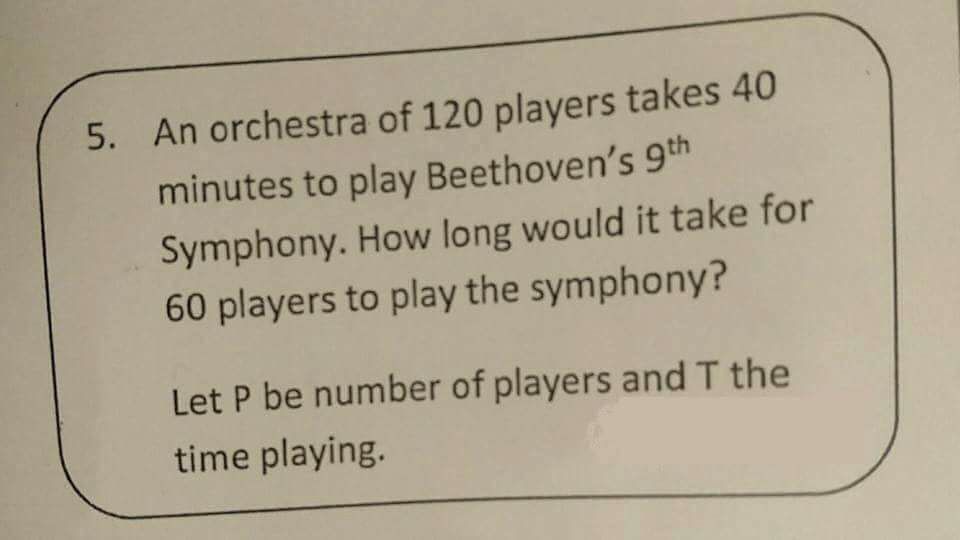
Beethoven’s 9th CD Length Surprise
Careful! It’s a trick question, and not for the reason you might think. In 1980, the compact disc was actually standardized at 74 minutes to accommodate the length of Beethoven’s 9th Symphony – specifically using Wilhelm Furtwängler’s 1951 Bayreuth Festival performance as a template. No orchestra in the world would be able to get through it in 40 minutes – not even conducted by Charles Munch, as in this astonishing recording:
Yet one more way, albeit it unintended on the part of the composer, in which Beethoven caused the world to hear music differently.
Hey, teacher! Leave them kids alone!
Tag Cloud
Aaron Copland (93) Beethoven (95) Composer (114) Film Music (144) Film Score (143) Film Scores (255) Halloween (94) John Williams (195) KWAX (229) Leonard Bernstein (104) Marlboro Music Festival (125) Movie Music (159) Mozart (90) Opera (212) Philadelphia Orchestra (89) Picture Perfect (174) Princeton Symphony Orchestra (109) Radio (88) Ross Amico (244) Roy's Tie-Dye Sci-Fi Corner (290) The Classical Network (101) The Lost Chord (269) Vaughan Williams (105) WPRB (397) WWFM (881)