Tag: BBC

  • Remembering the BBC’s “My Music”

    Remembering the BBC’s “My Music”

    Scrolling through the musical birthdays today, I notice the name of Ian Wallace. Does anyone else remember “My Music?”

    “My Music” was a ridiculously entertaining BBC game show, I suppose (what else to call it?) that pit two teams of two panelists each against one another for a half-hour of musical trivia, song, and droll digression. I don’t think anyone ever really cared who won, least of all the contestants, who returned week after week anyway.

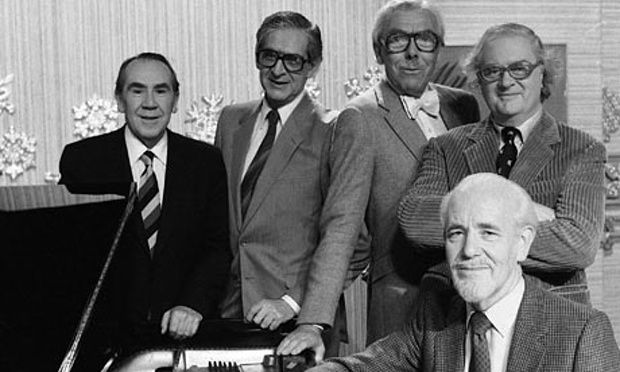
    Ian Wallace (1919-2009), a bass-baritone, broadcaster, and entertainer, appeared regularly, alongside comedy writers Denis Norden (1922-2018) and Frank Muir (1920-1998). At the point I was listening they were usually joined by broadcaster and music critic John Amis (1922-2013). Other contestants over the years included singers David Franklin and Owen Brannigan. The show was hosted for its entire run by Steve Race (1921-2009). Wallace and Race appeared in all 502 episodes. Race, also a pianist, accompanied each of the contestants in zany novelty songs and music hall numbers. The non-singers had no voices at all, but that only lent to the fun.

    Even though the show ran from 1967 to 1993 (with rebroadcasts continuing until 2011), the production always had something of an early ‘70s vibe, kind of like if Dick Cavett had hosted a revival of “Name That Tune” produced by Chuck Barris. There was also a TV show that ran from 1977 to 1983. Even without seeing these guys, I just knew they were wearing very wide lapels.

    I listened to it for years on our radio station, which carried it from the BBC World Service, by way of the WFMT Fine Arts Network, when it aired on Saturday evenings. At the start, I would listen for the pure enjoyment of it – I always admire the breadth and width of experience of seasoned music-lovers, and these guys had clearly been around and seen and heard it all – whether it be classical, jazz, popular, or music hall.

    Week after week, I’d listen and try to play along, and every once in a while I’d know an answer, but any one of these guys could have mopped the floor with me. Little did I realize I was like one of those bumbling apprentices in a kung fu movie, subject to repeated failure and humiliation, only to realize at the climactic showdown that, through observation and the wise tutelage of a sly master, I had inadvertently been attaining mastery myself! Seemingly all at once, the day came when I could actually answer most of the questions. Then, of course, the distributors finally pulled the plug.

    Of course, no matter how much of the trivia I knew, there is no way I would ever acquire the same kind of experience these gentlemen did, all of them having lived through the Great Depression and World War II. All of them had seen and heard so much. And, of course, they were all outstanding raconteurs.

    I confess I’m just using Wallace’s birthday as an excuse to write about this, as earlier this summer I came across some television broadcasts of the program on YouTube, and I’d been biding my time to post about it.

    I admit that not every 30 year-old would find “My Music” entertaining, but I was always a little unusual. This would have been the era during which I had to rise at 3 or 4:00 in order to turn on the transmitter before my morning air shifts. If I heard the start of “Distant Mirror” at 10 p.m., I knew I was up too late! Since I always lived in student-heavy neighborhoods and apartment buildings, parties would often rage well into the night. I had very little sleep on weekends for 19 years. Perhaps this aged me sufficiently so that I was on the same wavelength as “My Music!”

    I do miss these guys. Accumulated knowledge like theirs, much of it time-specific, is irreplaceable. As each generation passes, we lose so much. And their like will not come again.


    “My Music” television broadcast – with smaller lapels and less garish colors than I would have ever imagined!

    PHOTO (left to right): Ian Wallace, Denis Norden, Frank Muir, and John Amis; at the piano, Steve Race

  • BBC Cuts: A Crisis of Arts & Culture Funding

    BBC Cuts: A Crisis of Arts & Culture Funding

    It’s been a bad week for the British Broadcasting Corporation, which celebrated its 100th anniversary in grand, self-congratulatory fashion, beating its drum and trumpeting its accomplishments, with PR pennons hoisted high all through 2022. In the meantime, it has been doing its underhanded best in recent years to build its gallows high, dumbing down its programming, chasing the lowest common denominator, and instituting cuts across the board.

    Most flabbergasting was the recent announcement that it would disband the BBC Singers, the only full-time professional choir in the UK and one of the most respected ensembles of its kind. The outrage with which this decision was met, from musicians, listening public, and politicians alike, miraculously has caused the BBC (the organization, not the choir) to issue a reprieve, if not a mea culpa.

    Press releases issued by the organization have been disingenuous, ladling on the upbeat spin in an attempt to convince that all its boneheaded decisions are in the name of creating a more robust musical environment with greater educational opportunities. But this kind of talk fools no one. People aren’t buying it, and rightly so.

    In truth, the BBC has strayed so far from its founding principles to inform, educate, and entertain at this point that it will never be what it once was. Kind of like American PBS or any of our classical music stations. There’s very little integrity left in arts and educational media anywhere, it seems, which, like everything else, at the end of the day, is all about the $$$.

    Even now, the jobs of one-fifth of all musicians in BBC-managed orchestras remain on the chopping block. “Tough decisions” can be blamed on funding, of course. Even so, as is too often the case, most of those entrusted with steering the organization have no classical music background.

    The BBC Singers, founded in 1924, has worked with many of the great conductors and composers of the past century, has given notable premieres, and has recorded prolifically. A stay of execution for the ensemble is a battle won, but the war continues. The issue will be revisited in the coming years.

    The latest BBC annual report states that, within the last financial year, £25m was spent on orchestras and performing groups. If I’m not mistaken, that’s about $30.5m US. The average annual salary of a football player in the UK is £3m, more than $3.5m US. So the yearly budget of one of BBC’s live performance groups is less than the combined salaries of eight of England’s star football players. That’s infuriating.

    Aside from the hope and enrichment the arts bring to our existence in an increasingly bleak and unstable world, they also bring hope and enrichment to local economies, as people who attend performances and exhibitions tend to spend money. They eat out, they shop, they make it a day.

    Yet the income generated is frequently overlooked in favor of the flashier, often-televised gladiatorial thrills of sport. The roaring crowds may pack the stadiums, but those stadiums are self-sufficient organisms, largely segregated from area businesses. Revenue from sporting goods and broadcast are not doing the hometown all that much good.

    BBC orchestras, on the other hand, enrich the community on multiple levels, without the rioting and vomit in the streets.

    My love of English music is well known. I salute the BBC for its past efforts that have cultivated such a proud history and a rich literature. But really, I have very little faith in its current management.

    As cellist Julian Lloyd Webber (brother of composer Andrew) stated in an article that appeared this week in Radio Times, “The dereliction of its core principles has happened stealthily, over many years and with a lack of transparency that has eroded trust both inside and outside the organisation.”

    Be that as it may, let us enjoy the current victory. To conclude on a positive note: Vivat the BBC Singers!


    The BBC reports on the BBC

    https://www.bbc.com/news/entertainment-arts-65063238
Tag Cloud

Aaron Copland (92) Beethoven (95) Composer (114) Film Music (120) Film Score (143) Film Scores (255) Halloween (94) John Williams (185) KWAX (229) Leonard Bernstein (100) Marlboro Music Festival (125) Movie Music (135) Opera (198) Philadelphia Orchestra (88) Picture Perfect (174) Princeton Symphony Orchestra (106) Radio (87) Ralph Vaughan Williams (85) Ross Amico (244) Roy's Tie-Dye Sci-Fi Corner (290) The Classical Network (101) The Lost Chord (268) Vaughan Williams (103) WPRB (396) WWFM (881)

DON’T MISS A BEAT

Receive a weekly digest every Sunday at noon by signing up here


RECENT POSTS