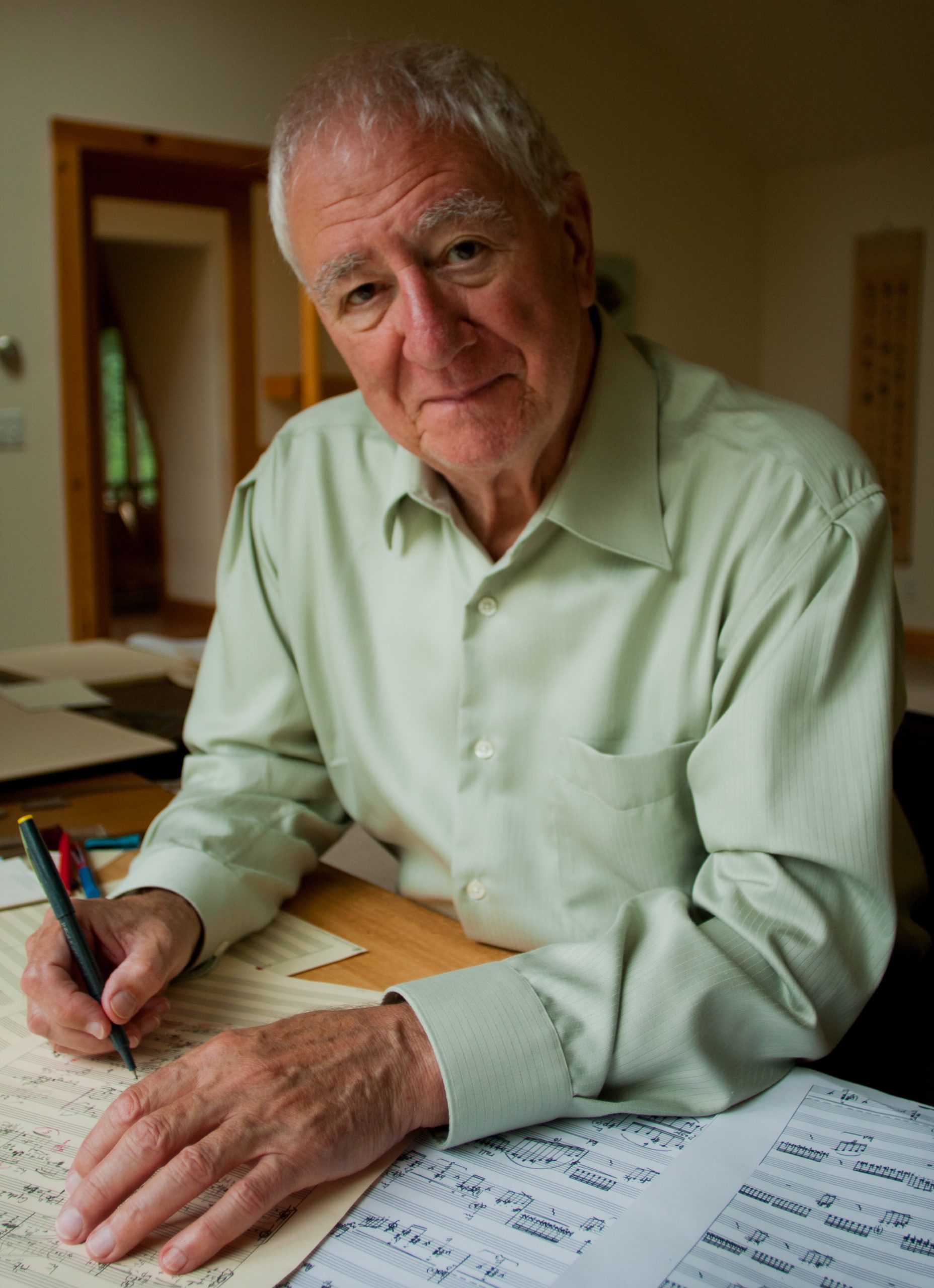
My friend Mather Pfeiffenberger tipped me off last week that composer Bernard Rands died. I received the news with some amazement, as I could have sworn he’d been gone for some time. But Rands lived to a venerable age, passing on March 4, two days after his 92nd birthday.
He was a regular presence at Philadelphia Orchestra concerts during Riccardo Muti’s music directorship in the 1980s and ‘90s. He served as the orchestra’s composer-in-residence from 1989 to 1995. If I remember correctly, as part of his job description, he offered advice on new music and exercised enormous influence over Muti’s contemporary programming. I can’t say I took to very many of the works that were performed, but I was young then. I might appreciate them more now.
EDIT: I did NOT remember correctly. It was Richard Wernick who advised Muti. I wrote about Wernick when he died last April. (Please note, it was A.I. that generated the headline.)
https://rossamico.com/2025/04/28/richard-wernick-pulitzer-winner-almost-hit-me/
Born in Sheffield, England, Rands studied with Pierre Boulez and Bruno Maderna in Darmstadt and Luigi Dallapiccola and Luciano Berio in Milan. This certainly gave him a grounding in contemporary and avant-garde techniques – unquestionably he was well-versed in the multifarious musical idioms of the day, at least the more abstract ones – but I never detected anything that would frighten the horses in his own works.
Among his residencies in the United States was a stint at Princeton University. He emigrated to the U.S. in 1975 and became an American citizen in 1983. He also held teaching posts at the University of California, San Diego, Juilliard, Yale, Boston University, and from 1988 to 2005, Harvard University.
He was married to the composer Augusta Read Thomas. I actually had dinner with them once in Philadelphia, I believe in connection with an Orchestra 2001 concert in 2007. We were not the only guests, and if we talked at all it couldn’t have been about anything of substance, because I can’t remember anything about it.
Rands was an influential figure, no doubt, as an advisor and teacher. He composed around 100 works, which were widely performed, and many of them were recorded. I was a frequent enough attendee of Philadelphia Orchestra concerts back in the day that I was present at the performances that were documented on this New World Records release, including “Canti dell’Eclissi” conducted by Gerard Schwarz, who as I recall was an eleventh-hour substitution for Muti, who was down with the flu. “Canti” was the recipient of the Pulitzer Prize for Music in 1984.
I can’t say it was my favorite of his works.
I thought “Le Tambourin Suite No. 1” was more my speed, but it’s not hitting me right this morning. It would go down a lot easier if it sounded more like “Le tombeau de Couperin.”
In reviews, his music was often compared to that of Ravel and Debussy. This “Aubade,” the second of three movements that make up his English Horn Concerto, seems like something I could live with.
Rands always seemed like a nice guy. I wish I liked his music better.
R.I.P.
———
Rands on listening to new music
“Adieu”