Tag: Bluebeard

  • Paul Dukas Beyond The Sorcerer’s Apprentice

    Paul Dukas Beyond The Sorcerer’s Apprentice

    When we hear of Paul Dukas, we generally think of one thing: “The Sorcerer’s Apprentice.” And when we think of “The Sorcerer’s Apprentice,” we think of Mickey Mouse.

    Dukas was an intensely self-critical artist, who wound up destroying most of his own works. Eventually he gave up composition altogether. Rather, like Shakespeare’s Prospero, he broke his staff and drowned his book to become a respected teacher of music, taking up posts at the Paris Conservatory and the École Normale de Musique. Among his students were Carlos Chávez, Maurice Duruflé, Olivier Messiaen, Manuel Ponce and Joaquin Rodrigo.

    Would that this creator of such vivid, brilliantly orchestrated works had left us more. But since all anyone knows is “The Sorcerer’s Apprentice,” I suppose it hardly matters.

    Here’s a suite from his rarely-heard opera, “Ariane et Barbe-Bleue,” after the Bluebeard story. Bluebeard, of course, is the fairy tale uxoricide whose castle rooms reveal increasingly horrible secrets. But since Dukas’ libretto was taken from a play by Maurice Maeterlinck – whose “Pelléas et Mélisande” Debussy was only just in the process of finishing up – there is less blood, and more layers of airy ambiguity. In fact, Maeterlinck essentially turns the tale on its head, making Ariane a pluckily resourceful, would-be liberator.

    Arturo Toscanini conducts the NBC Symphony and Princeton’s own Westminster Choir:

    “O mes clairs diamants” (“O my clear diamonds”):

    Those expecting a darker, more disturbing, psychologically twisted account of the fairy story should stick with Bartók’s Bluebeard.

    Zut alors! Look what I found! Silent film master Georges Méliès’ adaptation of Bluebeard:

    Mommy! Where’s Mickey Mouse???

    Why, right here…

    https://video.disney.com/watch/sorcerer-s-apprentice-fantasia-4ea9ebc01a74ea59a5867853?fbclid=IwY2xjawFpAr9leHRuA2FlbQIxMAABHeVVIl9i0OU2jnjVQDWmlIzZw3us7GOQXrkZHFUXsy2_FHP5lMx8ppbWRA_aem_r9KNCmIfsrEvoZXsUnCTAg

    Happy birthday, Paul Dukas (1865-1935)!


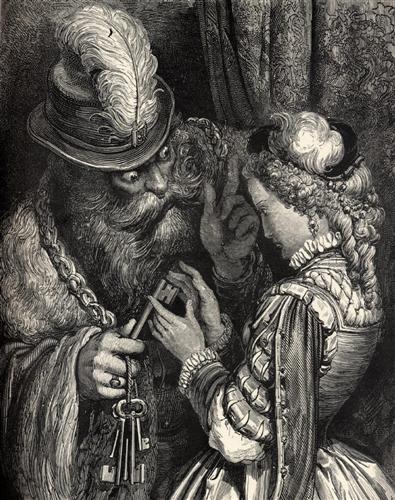
    PICTURED: The key to a dysfunctional marriage; and Mickey Mouse, axe-murderer
  • Bluebeard’s Enduring Myth & Bartók’s Castle

    Bluebeard’s Enduring Myth & Bartók’s Castle

    Like any myth worth its salt, the disturbing fairy story of Duke Bluebeard embeds itself in the recesses of the unconscious, only to color and confirm subterranean anxieties or perceived truths about the wider world.

    The best-known version of the story is the one by Charles Perrault, set down in the 17th century. Perrault’s popular retellings of Little Red Riding Hood, Cinderella, The Sleeping Beauty, and Puss in Boots served to codify these timeless folk tales for the modern age.

    Bluebeard as an archetype informs the characterizations of so many of the tortured antiheroes of the Gothic novel – the mysterious and brooding nobleman who lives in a dank castle of many chambers that surely contain their share of skeletons, be they literal or figurative.

    Sometimes Bluebeard really is the menace of Perrault, the volatile madman who lives in a house full of corpses. At others (as in “Jane Eyre”), he is a tragic hero who harbors a guilty secret that cuts him off from all happiness, love, and normalcy. Only gradually do the heavy doors grind open on rusty hinges to reveal their truths. The chambers are like the dark corners of his psyche, vulnerabilities he holds close, to the point of near-destruction or even beyond. Only understanding and acceptance have the power to alter his world.

    That said, sometimes Bluebeard really is a murderous creep who’s all about control and over-the-top cruelty.

    And what about his bride, named Judith in Béla Bartók’s opera, “Bluebeard’s Castle?” Is her curiosity a liberating force or a destructive one? The parable of fatal curiosity extends back through the Biblical stories of Lot’s wife and Eve and the Classical myths of Pandora, Eurydice, and Psyche.

    The tale positively drips with allegory. If there is anything that is clear about the Bluebeard story, it’s that it would take two very special people to make this unusual relationship work. There’s no way any outside observer would ever, ever, EVER understand.

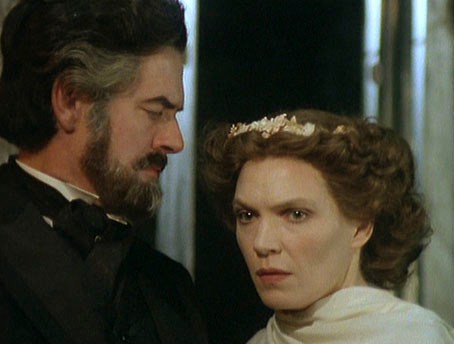
    On Béla Bartók’s birthday, I stumbled across this 1988 film of “Duke Bluebeard’s Castle.” It’s not sung in the original Hungarian. English-speaking viewers may find that a plus; anyone else, I think, will find compensation in its atmosphere and insight.

    In whatever language, the music is still terrific. Happy birthday, Béla Bartók!

  • Paul Dukas Beyond The Sorcerer’s Apprentice

    Paul Dukas Beyond The Sorcerer’s Apprentice

    Welcome to another 31 DAYS OF HALLOWEEN… and Paul Dukas’ birthday.

    When we think of Dukas, we generally think of one thing: “The Sorcerer’s Apprentice.” And when we think of “The Sorcerer’s Apprentice,” we think of Mickey Mouse.

    Dukas was an intensely self-critical artist, who wound up destroying most of his own works. Eventually he gave up composition altogether. Rather, like Shakespeare’s Prospero, he broke his staff and drowned his book to become a respected teacher of music, taking up posts at the Paris Conservatory and the École Normale de Musique. Among his students were Carlos Chávez, Maurice Duruflé, Olivier Messiaen, Manuel Ponce and Joaquin Rodrigo.

    Would that this creator of such vivid, brilliantly orchestrated works had left us more. But since all anyone knows is “The Sorcerer’s Apprentice,” I suppose it hardly matters.

    Here’s a suite from his rarely-heard opera, “Ariane et Barbe-Bleue,” after the Bluebeard story. Bluebeard, of course, is the fairy tale uxoricide whose castle rooms reveal increasingly horrible secrets. But since Dukas’ libretto was taken from a play by Maurice Maeterlinck – whose “Pelléas et Mélisande” Debussy was only just in the process of finishing up – there is less blood, and more layers of airy ambiguity. In fact, Maeterlinck essentially turns the tale on its head, making Ariane a pluckily resourceful, would-be liberator.

    Arturo Toscanini conducts the NBC Symphony and Princeton’s own Westminster Choir:

    “O mes clairs diamants” (“O my clear diamonds”):

    Those expecting a darker, more disturbing, psychologically twisted account of the fairy story should stick with Bartók’s Bluebeard.

    Zut alors! Look what I found! Silent film master Georges Méliès’ adaptation of Bluebeard:

    Mommy! Where’s Mickey Mouse???

    Why, right here, Billy…

    https://video.disney.com/watch/sorcerer-s-apprentice-fantasia-4ea9ebc01a74ea59a5867853

    Happy birthday, Paul Dukas (1865-1935)!


    PICTURED: The key to a dysfunctional marriage

  • The Dark Allure of Bluebeard’s Tale

    The Dark Allure of Bluebeard’s Tale

    Do you know the tale of Bluebeard?

    Hot on the heels of yesterday’s “Picture Perfect” featuring Gothic romances, my mind is full of this disturbing fairy story, which, like any myth worth its salt, embeds itself in the recesses of the unconscious, only to color and confirm certain anxieties or perceived truths about the wider world.

    The best known version of the story is the one by Charles Perrault, set down in the 17th century. Perrault’s popular retellings of Little Red Riding Hood, Cinderella, The Sleeping Beauty, and Puss in Boots served to codify these timeless folk tales for the modern age.

    Bluebeard as an archetype informs the characterizations of so many of the tortured antiheroes of the Gothic novel – the mysterious and brooding nobleman who lives in a dank castle of many chambers that surely contain their share of skeletons, be they literal or figurative.

    Sometimes Bluebeard really is the menace of Perrault, the volatile madman who lives in a house full of corpses. At others (as in “Jane Eyre”), he is a tragic hero who harbors a guilty secret that cuts him off from all happiness, love, and normalcy. Only gradually do the heavy doors grind open on rusty hinges to reveal their truths. The chambers are like the dark corners of his psyche, vulnerabilities he holds close, to the point of near-destruction and sometimes beyond. Only understanding and acceptance have the power to alter his world.

    That said, sometimes Bluebeard really is a murderous creep who’s all about control and over-the-top cruelty.

    And what about his bride, named Judith in Béla Bartók’s opera, “Bluebeard’s Castle?” Is her curiosity a liberating force or a destructive one? The parable of fatal curiosity extends back through the Biblical stories of Lot’s wife and Eve and the Classical myths of Pandora, Orpheus and Psyche.

    The tale positively drips with allegory. If there is anything that is clear about the Bluebeard story, it’s that it would take two very special people to make this unusual relationship work. There’s no way any outside observer would ever, ever, EVER understand.

    Bartók’s “Bluebeard’s Castle” will be heard worldwide as part of a double-bill – with Tchaikovsky’s “Iolanta,” a happier tale extolling the virtues of faith (in this case literally blind) – on The Metropolitan Opera’s weekly radio broadcast, which will commence today at 12:30 p.m. EST. If you’re interested, Google yourself an affiliate.


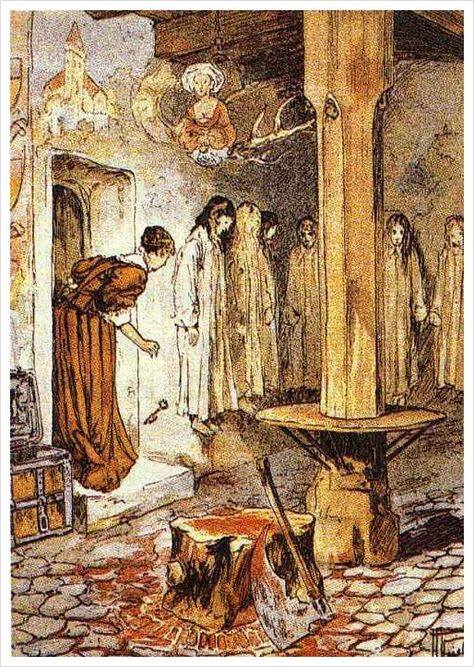
    Illustration from “Bluebeard” (1887) by Hermann Vogel

Tag Cloud

Aaron Copland (92) Beethoven (95) Composer (114) Film Music (120) Film Score (143) Film Scores (255) Halloween (94) John Williams (185) KWAX (229) Leonard Bernstein (100) Marlboro Music Festival (125) Movie Music (135) Opera (198) Philadelphia Orchestra (88) Picture Perfect (174) Princeton Symphony Orchestra (106) Radio (87) Ralph Vaughan Williams (85) Ross Amico (244) Roy's Tie-Dye Sci-Fi Corner (290) The Classical Network (101) The Lost Chord (268) Vaughan Williams (103) WPRB (396) WWFM (881)

DON’T MISS A BEAT

Receive a weekly digest every Sunday at noon by signing up here


RECENT POSTS