Tag: Bookshop

  • Remembering Edward Sargent Rare Records & Philadelphia

    Remembering Edward Sargent Rare Records & Philadelphia

    A couple of days ago, I was doing some searches in my email, as I often do, to call up old correspondence or scripts I may have saved in drafts, and somehow I came across some messages from Edward Sargent.

    Sargent was an old customer of mine from my Philadelphia bookshop days. At a point, he intuited that I would be interested in his record collection, which he was in the act of digitizing or converting to reel-to-reel or something. Maybe he knew who I was from listening to the radio. I don’t remember. In any case, it wasn’t unusual for used bookstores to have LP sections, back in the day.

    As you can imagine, I had a lot of garbage dumped on my doorstep in the night, boxes of textbooks and self-help and dog-eared paperbacks and musty records. What was salvageable I would toss out on a shelf in front of the store for a dollar. So I was about as cynical as any used bookdealer you’ve ever encountered. An interesting side-post might examine the question of whether owning a bookstore makes one cantankerous, or if cantankerous people are attracted to the trade.

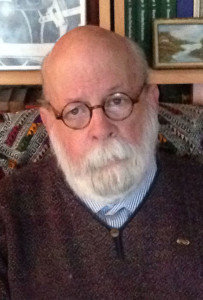
    Be that as it may, Sargent didn’t fit the profile of someone who just wanted the Hefty bags out of his garage. The man radiated quiet intelligence and discernment. I confess I was always a little intimidated by him. He spoke softly, kept his lower face wreathed in white whiskers that ran right up to and obscured the lip, and peered through coke-bottle glasses with a steady gaze that suggested he could see into your inner fool. I knew I wasn’t exactly an idiot myself, but I found him unnerving. He seemed to me the very caricature of a philosopher. I could imagine him drawing on a long-stemmed pipe while cogitating over abstractions in an isolated cottage in the woods, like something out of James Stephens’ “The Crock of Gold.”

    Perhaps I flatter myself that he somehow wound up taking a shine to me. He did maintain the utmost formality in his emails, addressing me as “Dear Ross Amico” and signing-off “Edward Sargent.” No “Warmly,” no “Regards,” not even “Best.” More likely, he found himself in the position I’m in now, having reached an age when he was starting to wonder to whom he was going to leave all this stuff. Anyone could discern from how well I curated my inventory that I at least had some awareness and refinement. Whatever the case, he proposed giving me his records. When he handed me his card, I noted “Pohjola” was part of his email address. If you know your Sibelius, then you know I’d connected with a soulmate.

    But because of his unnerving quiet or my own insecurity, or some combination of the two, we were never as friendly as we could have been. In fact, I went out of my way to avoid him. I never ignored him if he tried to contact me, but sometimes I’d hold back until I could find the courage to follow-up. I was also very busy, remember, working seven days a week, between the shop and my radio shifts. On more than one occasion I’d arrive to open the shop and find that Edward had already been there and left a handful of records behind the bars. Once, I happened across some boxes of rare classical LPs at a rummage sale being held at a church on the corner. These, of course, were further cast-offs from his collection. While everything I had gotten from him so far was free, I shelled out for these immediately and added them to my hoard.

    Eventually, after five years, I closed the shop (my second location in Philadelphia), and we lost touch. On the one hand, I really, really wanted his records; on the other, I feared to have them, as they would have just required so much storage and so much effort to collect (you try to find convenient parking in residential Philadelphia), including having to haul them up the stairs to my third-story walk up (which was more like four, because of the high-ceilinged art gallery at street level), all the while risking a hefty ticket for having to park in the bike lane with my four-ways flashing.

    In the end, I estimate I wound up with maybe half of his collection. If he hadn’t still been in the process of cataloguing and transferring audio when he first offered it to me, perhaps I would have just taken everything. It was the most amazing record collection I’d ever seen, not so much for the size as for the diversity of offerings, which stretched back decades. Highly-collectible Louisville and Mercury recordings that never made it to compact disc; 10-inch LPs pressed on colored vinyl; Melodiya releases with jackets in Cyrillic; rarely-heard Scandinavian composers; composers of the Antipodes and Latin America. I don’t even know how he accumulated it all in the era before the internet. They were not the kinds of things that would have been in the regular inventory of most record stores.

    He also slipped me a bootleg of the U.S. premiere of Hindemith’s then recently-rediscovered “Klaviermusik mit Orchester” (a performance now easily accessible on YouTube), with Leon Fleisher and the San Francisco Symphony conducted by Simon Rattle. (A few years later, I would attend the East Coast premiere.)

    I remember googling Edward once before, a few years ago, and came across an interesting article about him, written in 2013. It doesn’t surprise me that he was related to the painter John Singer Sargent. Here’s the link.

    https://www.chestnuthilllocal.com/stories/related-to-americas-premier-portrait-painter-grew-up-with-celebs-hiller-exhibits-art-in-mt,4342

    Sadly, when I did a search for him after coming across his emails the other day, I discovered he died in December 2024. The obituary didn’t read like much, but I found this more flavorful reminiscence by a friend.

    https://www.chestnuthilllocal.com/stories/edward-sargent-most-unorthodox,31239

    Rest easy, sir, and thanks for the records.


    CLOCKWISE FROM LEFT: Edward Sargent and three selections from his jaw-dropping collection: Dean Dixon conducting Howard Hanson’s Pulitzer Prize-winning Symphony No. 4; Norman Dello Joio’s “New York Profiles” on red 10” vinyl; and Philadelphia composer Paul Nordoff’s “Winter Symphony,” one of the legendary Louisville Orchestra series of world premieres, never reissued on compact disc

  • Meeting Composer John Duffy in My Bookshop

    Meeting Composer John Duffy in My Bookshop

    In 1997, I was sitting behind the desk in my bookshop in Philadelphia, when an older couple wandered in. The man was evidently careful about his movements, understandable, even under the best of circumstances, since one had to navigate a foyer with some stairs and then usually a dog when entering the space.

    After some time browsing, they approached the desk, and the man asked to see a piece of ephemera he noticed, a booklet on the composer and critic Virgil Thomson, that I had on low shelf beside me, waiting to be priced. This started a conversation, in the course of which it was revealed that he himself was a composer. When he told me his name, he seemed especially gratified that I knew who he was.

    But John Duffy’s Emmy Award-winning music for the PBS television documentary “Heritage: Civilization and the Jews” was played quite often on the local classical music station, especially around the Jewish holidays. (Duffy himself was Irish Catholic.) He and I had a lovely exchange, and when he asked me how much I wanted for the book, I told him it was on the house.

    The Duffys were in Philadelphia for the premiere of his new opera, “Black Water” (on a libretto by Princeton writer Joyce Carol Oates), at Plays and Players Theater, which was two blocks away from the shop. Perhaps in reciprocation for my generosity, he offered to comp me into the show.

    This was on a weekday. At the time, I was working the weekend mornings at WWFM in Trenton-Princeton, so it would be around 1:30 or 2:00 by the time I got back to Philadelphia and found parking on a Saturday or Sunday afternoon.

    That Saturday, I returned, and a friend of mine, who regularly sat the store in my absence, said that a kindly old gentleman had stopped by and dropped off something for me. John Duffy had gone to Tower Records and picked me up a copy of his CD “Freedom Works.” It was the only disc in stock that had selections from “Heritage.”

    With the CD he left the following note, rendered in a shaky hand:

    “Dear Ross: I wanted you to have a copy of FREEDOM WORKS. Tracks 6, 7 & 8 are based on my HERITAGE score. All best, John Duffy

    “P.S. I hope you found BLACK WATER absorbing. Thank you for the Thomson book.”

    Duffy already appeared unsteady when I met him, when he was only in his early 70s. He suffered from ill health later in life, but he held on until the 2015, reaching the ripe age of 89. He impressed me as an optimistic and gentle soul. In addition to his work as a creative artist, he went out of his way to help others in his field. He was founder and president of Meet the Composer, an organization that initiated countless programs to advance American music, from creation to performance and recordings.

    On the same CD he left, with “Three Jewish Portraits” (from “Heritage”), was his Symphony No. 1 and “A Time for Remembrance” – a “peace cantata,” as he subtitled it – commissioned in 1991 by the U.S. government to mark the 50th anniversary of the attack on Pearl Harbor that killed 2,403 Americans, wounded 1,178 others – sailors, soldiers, airmen, marines, and civilians – and precipitated the United States’ entry into World War II. After listening to the music, I promptly added it to my regular repertoire for radio broadcast on December 7.

    In his booklet notes, the composer writes that it is “Dedicated to my sister, Agnes Duffy, Ensign, U.S. Navy, Nurse, IN HER MEMORY: and in remembrance of all those who die in war: the men, women, and children killed and maimed at Pearl Harbor; my cousin, Edward Quirk, Machinist’s Mate, USS Shaw; the men entombed in the USS Arizona; those at Hiroshima, Normandy, Bergen-Belsen, and more. MAY PEACE PREVAIL IN THEIR NAMES.”

    The texts are taken from a poem by Rupert Brooke, a speech by Franklin Delano Roosevelt, an African American spiritual, and actual letters written by sailors aboard the USS Arizona. On the recording, the performance features James Earl Jones, narrator, Cynthia Clarey, mezzo-soprano, and the Milwaukee Symphony, conducted by Zdenek Macal. You can listen to it here.

    Duffy himself lied about his age when enlisting during the war. He became part of the Amphibious Scouts and Raiders, forerunners to the Navy SEALs, before deploying on the USS Hopping, a destroyer escort in the Pacific. His duties included detonating Japanese mines by shooting them from ship deck. When his ship took fire from shore batteries at Okinawa, the sailor standing next to him was killed. Duffy had to stand guard over the dead man’s body until burial at sea in the morning. That night watch determined the course of his life. “Since our time is so fleeting and unpredictable,” he later commented, “I knew I had to dedicate my life to music.”

    John Duffy on his own war experiences and his decision to become a composer:

  • Rattle, My Bookshop, and Serendipity in Philadelphia

    Rattle, My Bookshop, and Serendipity in Philadelphia

    I once owned a secondhand bookshop located a block from Philadelphia’s Rittenhouse Square. Because of the nature of the business, and its location (around the corner from the Curtis Institute of Music and three blocks from the stage door of the old Academy of Music), I met a number of notable musicians over the years and dealt with even more online.

    One day, I was out walking my dog in the park, when who should pass through but Simon Rattle. I hailed him, and though he was on his way to an orchestra rehearsal (as I knew from the time of day, the direction he was walking, and the fact that he was slated to guest conduct over the weekend), he stopped and took the time to chat. Apparently Rattle wasn’t overly concerned with punctuality. A friend of mine told me that a short while later, he saw Rattle taking a leisurely walk around the outside of the Academy, looking up at its roof.

    Rattle is fairly gregarious and, I gather, somewhat of a dog lover. So a few days later, when I knew there would be another rehearsal, I was sure to have one of his recordings on me in the park, and he was kind enough to inscribe the booklet. At the time, he commented on how we had similar hairstyles, so he appended a quick self-portrait (see photo; you may have to click on it for a better look). I think I scored brownie points for selecting Nicholas Maw’s “Odyssey,” clearly a labor of love on Rattle’s part, and certainly not the popular choice.

    Rattle had been guest conductor of the Philadelphia Orchestra already for a number of years, and I heard him lead memorable concerts of Mahler, Sibelius and Schoenberg (the monumental “Guerrelieder”). The organization at the time was hot to make him the successor of Wolfgang Sawallisch as its music director. As I recall, he had not yet received his knighthood, and he had certainly not yet been named principal conductor of the Berlin Philharmonic, arguably the most prestigious conducting position in the world. I can’t imagine that Herbert von Karajan would have walked to work, much less stopped to chat about dogs and hair (although, given Karajan’s immaculately sculpted coiff, I would have been very interested to hear his thoughts on the latter).

    Some time later, I missed out on a third chance to meet Rattle. One of the many interesting figures to wander into my shop was the youngest grandson of Jean Sibelius. I know this, because by coincidence I happened to be playing the old Kajanus recording of the Third Symphony. His grandson was astonished (although if he knew me better at the time, he would not have been, since Sibelius happens to be one of my favorite composers), and I equally so. Who knew Sibelius’ grandson was an independent filmmaker living in Philadelphia?

    When I noted that Rattle would be coming back to Philadelphia to conduct Sibelius’ Fifth Symphony, I was determined to get the composer’s grandson into the rehearsals. Why he couldn’t accomplish that on his own, I have no idea. Perhaps he lacked the self-confidence or had an inflated sense of my worth. At any rate, all it took was a phone call, and we were at the Academy watching Rattle put the piece together.

    The rehearsal ran long, and I had to get back to open my shop, so that I could be there for all the customers who wouldn’t be coming in that day. Bad choice. Sibelius’ grandson was brought backstage afterward, and not only was he introduced to Rattle, but was done so at the time that a Vanity Fair photographer was busily snapping away to have something to illustrate an article for an upcoming issue. Somewhere there exists a photograph of Rattle planting a big kiss on Sibelius’ grandson – which would be especially funny if you knew the grandson.

    Anyway, he told me about this, and of course I was disappointed to have missed out on this backstage love fest. He made it up to me a short while later by introducing me to Einojuhani Rautavaara, who was in town for the premiere of his Symphony No. 8. There is a photo of that meeting as well, but as this was in the days before cell phones and laptops, it is sitting in an envelope somewhere in my apartment with all my other old-style photos. Just as well, since, as I recall, I was grinning like a Tyrannosaurus rex.

    I hope you’ll join me for “The Lost Chord” this week, as I celebrate the 60th birthday of Sir Simon Rattle (born January 19, 1955) with an hour of his recordings. The show is called “Simon Says.” You can hear it tonight at 10 ET, with a repeat Wednesday evening at 6, or listen to it later as a webcast at http://www.wwfm.org.

    PHOTOS: Rattle at Curtis in 1997 (top); signature with self-portrait

Tag Cloud

Aaron Copland (92) Beethoven (95) Composer (114) Film Music (120) Film Score (143) Film Scores (255) Halloween (94) John Williams (185) KWAX (229) Leonard Bernstein (100) Marlboro Music Festival (125) Movie Music (135) Opera (198) Philadelphia Orchestra (88) Picture Perfect (174) Princeton Symphony Orchestra (106) Radio (87) Ralph Vaughan Williams (85) Ross Amico (244) Roy's Tie-Dye Sci-Fi Corner (290) The Classical Network (101) The Lost Chord (268) Vaughan Williams (103) WPRB (396) WWFM (881)

DON’T MISS A BEAT

Receive a weekly digest every Sunday at noon by signing up here


RECENT POSTS