Tag: British Light Music

  • Christmas Rush Last Minute Cheer

    Christmas Rush Last Minute Cheer

    Ready… set… GO!

    It’s Christmas Eve! Let the last-minute insanity begin!

    From the sound of it, Matthew Curtis’ “Christmas Rush” must be a pun – “rush” as in “hurry,” but also “rush” as in “euphoria.”

    What strikes me about this piece is that even though Curtis was born in 1959, the music clearly pays homage to the golden age of British Light Music, with composers like Eric Coates and Roger Quilter being clear influences.

    Don’t be like me – as you navigate the close aisles, frenetic parking lots, and long check-out lines, hang on to your good cheer!

  • British Light Music for Post-Holiday Relaxation

    British Light Music for Post-Holiday Relaxation

    The dishes are clean, the guests are on the road. At last, a little “me” time.

    This Sunday night on “The Lost Chord,” pour yourself something medicinal, kick back in front of the tree, and prepare to get reacquainted with the insides of your eyelids. The recovery from Christmas begins with a playlist of British Light Music classics.

    Take a load off, with vintage recordings of works by Albert Ketèlbey, Samuel Coleridge-Taylor, Sir Edward Elgar, Richard Addinsell, George Scott-Wood, Haydn Wood, Billy Mayerl, and Eric Coates.

    There’s light at the end of the tunnel. The time draws nigh for “Distant Light,” this Sunday night at 10:00 EST, on WWFM – The Classical Network and wwfm.org.

  • Clarke & Coates: A Musical Birthday in 1886

    Clarke & Coates: A Musical Birthday in 1886

    On this date in 1886, two noteworthy figures in English music were born.

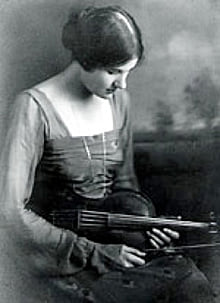
    Rebecca Clarke entered London’s Royal College of Music at a time when female students were still considered an oddity. Her teacher, Sir Charles Villiers Stanford, persuaded her to switch from violin to viola, since from that vantage she would be better able to absorb the mechanics of the orchestra. Also, thanks to musicians like Lionel Tertis, the viola was just beginning to be viewed as a viable instrument in itself.

    Clarke played in the Queen’s Hall Orchestra, under Sir Henry Wood. Then in 1916, she packed up and moved to America. Critics tended to praise her works which were listed in concert programs under male pseudonyms, while those identified as her own were often dismissed.

    The notable exception of her career was her Viola Sonata, which tied for first place in a competition sponsored by Elizabeth Sprague Coolidge with a work of Ernest Bloch. Even so, there were some who grumbled that the work couldn’t possibly have been composed by a woman, and that perhaps Bloch himself had even written it.

    Clarke married James Friskin, a founding member of the Juilliard School faculty, in 1944, and although he was supportive of her endeavors, lack of recognition and struggles with depression resulted in her ultimately giving up on composing. She died in 1979, at the age of 93. Today, her sonata is considered one of the great works written for the viola.

    Here is Rebecca Clarke’s “Morpheus”:

    By contrast, Eric Coates (1886-1957) enjoyed enormous popularity as a master of British Light Music. Ironically, Coates had taken viola lessons with Tertis at the Royal Academy of Music.

    Among his best-known works are his “London Suite,” and this one, the perfect Coates confection for a late summer’s day:

    Happy birthday, Rebecca Clarke and Eric Coates!

  • Ronald Binge British Light Music For Summer

    Ronald Binge British Light Music For Summer

    In a time when binge-watching is all the rage, how about a little Binge listening? British light music master Ronald Binge was born 110 years ago today. Here’s some carefree summer music if ever there was any.

    “Sailing By”

    “The Watermill”

    “Elizabethan Serenade”

  • Pettersson, Tomlinson: Light & Dark Music

    Pettersson, Tomlinson: Light & Dark Music

    Into every life, a little existentialism must fall. It is for this reason that God invented British Light Music.

    Today is the birthday of Allan Pettersson, a composer who never had a happy day in his life.

    Pettersson grew up in Södermalm, today a gentrified, bohemian neighborhood, but then viewed as the slum of Stockholm. And there, he more or less remained. His father was a raging alcoholic blacksmith, but his mother was pious and attentive to her children.

    Somehow, he managed to attend the conservatory of the Royal Swedish Academy of Music, where he studied violin and viola. He also took private lessons in composition on the side. Then he traveled to Paris for roughly 15 months for further studies with Rene Leibowitz, Arthur Honegger, Olivier Messiaen, and Darius Milhaud.

    In the early 1950s, he was diagnosed with rheumatoid arthritis. By the time he completed his Fifth Symphony, in 1962, his mobility had become so compromised that he was forced to dictate many of his subsequent compositions. It took him four years to write his Sixth Symphony. After completing his Ninth, he was hospitalized for nine months. He began his Tenth on his sickbed, in an apartment he seldom left. For the final decade of his life he was assigned to state living quarters, but at no point did his productivity wane. He died in 1980 at the age of 68, leaving in his wake seventeen symphonies.

    I’ve now managed to collect most of them, thanks to Princeton Record Exchange. Don’t ask me why. I guess I’m saving them to temper the happiest day of my life, should it ever occur.

    Pettersson’s symphonies are never less than ambitious, each one a saga of despair crafted by Sweden’s reigning bard of bleakness. The longest of these spans some 70 minutes. To maintain interest, the composer carefully calibrates his soundscapes, arriving at unique solutions to the question of form. The emotional range runs the entire Scandinavian gamut, from grimness to anger to violence. Don’t go into a Pettersson symphony expecting the “Pastoral Suite.”

    At the other end of the spectrum, we have Ernest Tomlinson, whose birthday is also today. Judging purely on the basis of his music, Tomlinson never had a sad day in his life. Sure, he was color-blind, but I think Pettersson would agree, color-blindness beats the hell out of rheumatoid arthritis.

    Tomlinson was a master of light music and bright arrangements. His output consists of overtures, suites, rhapsodies, and miniatures. I’d be surprised if any of them are even in a minor key.

    In 1984, Tomlinson learned that the BBC was planning to dispose of its light music archive. In response, he founded The Library of Light Orchestral Music, preserving in a barn on his property some 50,000 pieces, many of which otherwise would have been lost.

    Tomlinson died in 2015, at the age of 90.

    Which is healthier, I wonder – to lay bare the horrors of the void, in all its cruel indifference, over agonizing, epic spans, or to defy them by creating three- and four-minute miniatures of distilled happiness and purified beauty?

    A question of prophet vs. profit? You decide.


    The juxtaposition of Pettersson and Tomlinson totally puts me in mind of “Strindberg and Helium,” a series of videos from back in the days of the Wild West of the internet, when everyone still had desktop computers, with Pettersson as Strindberg (naturally) and Tomlinson as Helium.

    Each episode is around a minute long, so it’s easy to meet your daily fortification of despair.

    https://www.youtube.com/channel/UCO1tKMjYxYSJI9jLA6Jf3Mw

    Pettersson, Symphony No. 7

    Tomlinson, “The Fairy Coach”

Tag Cloud

Aaron Copland (92) Beethoven (95) Composer (114) Film Music (120) Film Score (143) Film Scores (255) Halloween (94) John Williams (185) KWAX (229) Leonard Bernstein (100) Marlboro Music Festival (125) Movie Music (135) Opera (198) Philadelphia Orchestra (88) Picture Perfect (174) Princeton Symphony Orchestra (106) Radio (87) Ralph Vaughan Williams (85) Ross Amico (244) Roy's Tie-Dye Sci-Fi Corner (290) The Classical Network (101) The Lost Chord (268) Vaughan Williams (103) WPRB (396) WWFM (881)

DON’T MISS A BEAT

Receive a weekly digest every Sunday at noon by signing up here


RECENT POSTS