Tag: César Franck

  • César Franck a Late Appreciation & Happy Birthday

    César Franck a Late Appreciation & Happy Birthday

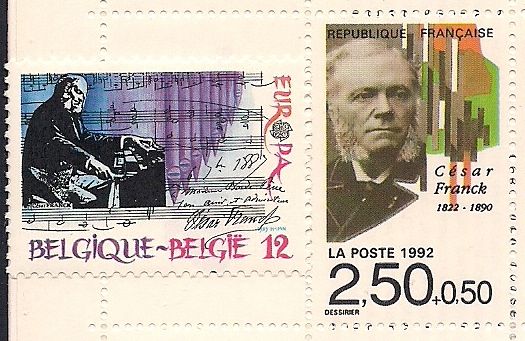
    César Franck wrote a highly-regarded symphony, which I’ve been very slow to warm to (it’s taken decades, in fact). Never liked the insipid theme of the last movement. But I’ve gotten to the point where at last I’m willing to concede its overall greatest.

    Much more congenial to me are his symphonic poems and his lovely chamber music.

    No comment on the organ works – although I once attended a “Franckathon” at St. Clement’s Church in Philadelphia, back in the 1990s, at which his complete output for the instrument was presented, with two intermissions. Just to say I did. Well, that and for the free doughnuts and coffee.

    He may very well have had the finest mutton chops in the world, I’ll grant him that.

    Happy birthday, César Franck.


    Symphony in D minor

    “Le Chasseur maudit” (“The Accursed Huntsman”)

    Piano Quintet in F minor

    Violin Sonata in A major

    “Grande pièce symphonique,” played by Marcel Dupré

    Prelude, Chorale and Fugue

    https://www.youtube.com/watch?v=wHftZ2-w4XE

    And, for the season, “Panis Angelicus”

  • Psyche & Eros Valentine’s Special

    Psyche & Eros Valentine’s Special

    This Sunday night on “The Lost Chord,” for Valentine’s Day, Cupid, draw back your bow, for two contrasting treatments of the allegorical myth of Psyche and Eros.

    Frequently interpreted as a metaphor for the elevation of the soul through love, the tale of Psyche and Eros has much in common with that of Beauty and the Beast: the prohibition against a maid glancing at her “captor,” catty stepsisters who conspire to trip her up, and the revelation of the “beast” as a kind of prince – in this case, the God of Love himself.

    In the end, the protagonists pass through travails to triumph, as true love conquers all – a nice change of pace, I think you’ll agree, from the usual classical story arc of being transformed into a stag and devoured by hounds, flying too close to the sun and being struck down by Zeus’ thunderbolt, or accidentally eating one’s own children in a meat pie.

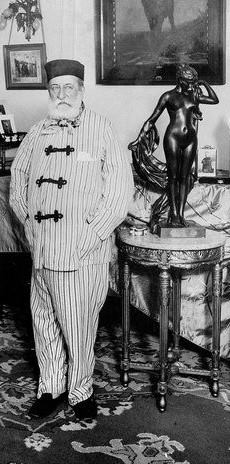
    We’ll hear music from César Franck’s “Psyché,” full of romance and ardor, and a somewhat cheekier version, “Cupid and Psyche” by Lord Berners, which sounds more suited to a ballroom or even an amusement park.

    Get Psyched for Valentine’s Day. Love is blind, then kind, on “Slings and Eros,” this Sunday night at 10:00 EST, on WWFM – The Classical Network and wwfm.org.

  • César Franck and His Belgian Disciples

    César Franck and His Belgian Disciples

    César Franck was a strangely charismatic outsider. A Belgian abroad, he was required to take French citizenship in order to teach at the Paris Conservatory. A renowned organist, his unexpected genius for composition blossomed late.

    His enduring fame rests on a handful of fairly late works. He managed to reinvigorate the French symphonic and chamber music traditions through his use of “cyclic form,” with themes throughout generated from a single motif. He also embraced the symphonic poem. In these regards he certainly bore the influence of Franz Liszt. In turn, he himself became highly influential among a generation of French and Belgian composers.

    This Sunday night on “The Lost Chord,” we’ll examine music by two Belgians who fell under his sway.

    Armand Marsick, born in 1877, trained as a violinist at the Liège Conservatory, before studying abroad in Nancy with Franck enthusiast Guy Ropartz. Then he moved to Paris, where he studied with another Franckian, Vincent d’Indy. His career led him to Athens, and then Bilbao, where he founded a conservatory and an orchestra. He returned to Liège at the age of 50, settling in to teach and direct the concert society there. He died in 1959. The bulk of Marsick’s compositional output, which consisted of some forty works, was written between the ages of 23 and 37. We’ll enjoy a symphonic poem from 1908, titled “La Source.”

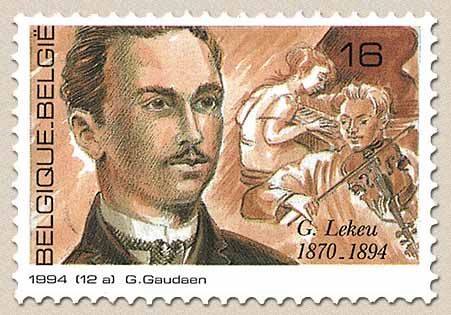
    Guillaume Lekeu was born in Verviers in 1870. He studied with Franck in Paris, then, like Marsick, with d’Indy following Franck’s death. Lekeu, unfortunately, is also remarkable for his very short life. He became ill with typhoid fever after consuming contaminated sherbet at a restaurant, and died in 1894, one day after his 24th birthday. Despite his sadly shortened existence, he managed to make important contacts and to write music of considerable promise. At the time of his death, he had already been composing for nine years, from the age of 15. In 1891 he was recipient of a second prize in the celebrated Prix de Rome competition.

    In all, Lekeu composed about 50 works. We’ll hear his Violin Sonata from 1892, written for the great Belgian virtuoso Eugene Ysaye, and his Adagio from 1891, originally composed for quartet and string orchestra. The score to the latter bears an epigraph from a poem by Georges Vanor, “The pale flowers of memory.”

    I hope you’ll join me for music by these Belgian followers of César Franck. That’s “Franckly Belgian,” this Sunday night at 10:00 EDT, on WWFM – The Classical Network and wwfm.org.

  • Saint-Saëns’ Fury Franck Holmès Music from Marlboro

    Saint-Saëns’ Fury Franck Holmès Music from Marlboro

    It’s music to get Camille Saint-Saëns’ blood boiling, on the next “Music from Marlboro.”

    Saint-Saëns was the dedicatee of the Piano Quintet in F minor by his friend, César Franck. But as he sight-read through the piano part at the work’s premiere in 1879, he became more and more agitated, angry even. At the conclusion of the piece, he rejected Franck’s attempt to shake his hand, and stormed off without acknowledging the applause.

    He wasn’t the only one. Franck’s wife also made no secret of hating it.

    Here was music of sublimated desire, and everyone knew the cause. Saint-Saëns knew, because he felt the same way about Franck’s pupil, Augusta Holmès. Franck tutored Holmès in organ and composition. No doubt he admired her musical talent, but equally there was no doubt his interest went beyond that of master-disciple. Don’t let those mutton chops fool you. A man is only flesh and blood.

    There must have been something about Holmès, the French composer of Irish descent, because she had the same effect on just about every man she crossed paths with. Saint-Saëns had proposed marriage to her multiple times, always without success. He would refer to her as a “beautiful pythoness.” Methinks his vines had tender sour grapes.

    We’ll hear a performance of Franck’s incendiary piece, featuring pianist Mitsuko Uchida, violinists Soovin Kim and David McCarroll, violist Milena Pajaro-van de Stadt, and cellist Matthew Zalkind, from the 2012 Marlboro Music Festival.

    The hour will open with a work by Claude Debussy. Debussy composed “En blanc et noir” in 1915, making it one of his later creations, contemporaneous with the Cello Sonata, the Sonata for Flute, Viola and Harp, and the Etudes for solo piano.

    It is to be remembered that Saint-Saëns, who basically lived forever, was 80 years-old by this time. He loathed the work. “We must at all costs bar the door of the Institute against a man capable of such atrocities,” he fumed. “They should be put next to the cubist pictures.”

    The first movement, an energetic waltz, is dedicated to Serge Koussevitzky; the second, a somber slow movement, to Debussy’s friend, Jacques Charlot, who was killed during the First World War; and the third, a playful scherzando, to Igor Stravinsky.

    We’ll hear it played at Marlboro in 2017 by pianists Xiaohui Yang and Cynthia Raim.

    The forbidden fruit tastes the sweetest, thanks to Saint-Saëns’ anger management issues, on the next “Music from Marlboro,” this Wednesday evening at 6:00 EDT, on WWFM – The Classical Network and wwfm.org.

    BONUS: Tune in early to hear one of Holmès’ symphonic poems in the 5:00 hour!

    Marlboro School of Music and Festival: Official Page


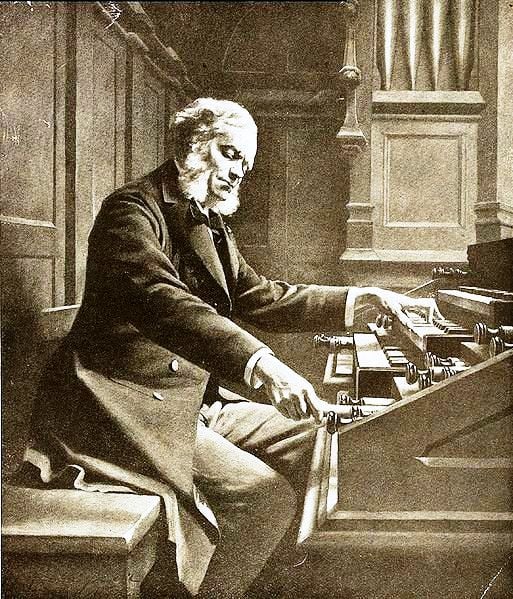
    PHOTOS (clockwise from left): Saint-Saëns, all dressed up with nowhere to go; Franck at the organ; Holmès with her je ne sais crois; Debussy, transfixed by a cigarette
  • César Franck & His Belgian Legacy

    César Franck & His Belgian Legacy

    César Franck was a strangely charismatic outsider. A Belgian abroad, he was required to take French citizenship in order to teach at the Paris Conservatory. A renowned organist, his unexpected genius for composition blossomed late.

    His enduring fame rests on a handful of fairly late works. He managed to reinvigorate the French symphonic and chamber music traditions through his use of “cyclic form,” with themes throughout generated from a single motif. He also embraced the symphonic poem. In these regards he certainly bore the influence of Franz Liszt. In turn, he himself became highly influential among a generation of French and Belgian composers.

    This Sunday night on “The Lost Chord,” we’ll examine music by two Belgians who fell under his sway.

    Armand Marsick, born in 1877, trained as a violinist at the Liège Conservatory, before studying abroad in Nancy with Franck enthusiast Guy Ropartz. Then he moved to Paris, where he studied with another Franckian, Vincent d’Indy. His career led him to Athens, and then Bilbao, where he founded a conservatory and an orchestra. He returned to Liège at the age of 50, settling in to teach and direct the concert society there. He died in 1959. The bulk of Marsick’s compositional output, which consisted of some forty works, was written between the ages of 23 and 37. We’ll enjoy a symphonic poem from 1908, titled “La Source.”

    Guillaume Lekeu was born in Verviers in 1870. He studied with Franck in Paris, then, like Marsick, with d’Indy following Franck’s death. Lekeu, unfortunately, is also remarkable for his very short life. He became ill with typhoid fever after consuming contaminated sherbet at a restaurant, and died in 1894, one day after his 24th birthday. Despite his sadly foreshortened existence, he managed to make important contacts and to write music of considerable promise. At the time of his death, he had already been composing for nine years, from the age of 15. In 1891 he was recipient of a second prize in the celebrated Prix de Rome competition.

    In all, Lekeu composed about 50 works. We’ll hear his Violin Sonata from 1892, written for the great Belgian virtuoso Eugene Ysaye, and his Adagio from 1891, originally composed for quartet and string orchestra. The score to the latter bears an epigraph from a poem by Georges Vanor, “The pale flowers of memory.”

    I hope you’ll join me for music by these Belgian followers of César Franck – “Franckly Belgian” –– this Sunday night at 10:00 EDT, on WWFM – The Classical Network and wwfm.org.

Tag Cloud

Aaron Copland (92) Beethoven (95) Composer (114) Film Music (120) Film Score (143) Film Scores (255) Halloween (94) John Williams (185) KWAX (229) Leonard Bernstein (100) Marlboro Music Festival (125) Movie Music (135) Opera (198) Philadelphia Orchestra (88) Picture Perfect (174) Princeton Symphony Orchestra (106) Radio (87) Ralph Vaughan Williams (85) Ross Amico (244) Roy's Tie-Dye Sci-Fi Corner (290) The Classical Network (101) The Lost Chord (268) Vaughan Williams (103) WPRB (396) WWFM (881)

DON’T MISS A BEAT

Receive a weekly digest every Sunday at noon by signing up here


RECENT POSTS